Category Archives: Food Safety Alert

RASFF Alerts – Salmonella – Hot Chicken Wings – Organic Almond Protein – Turkey Meat and Giblets – Turkey Hearts – Chicken Breast – Minced Meat Preparation – Doner Kebab – Sesame Seeds – Whitish Sesame Seeds – Chicken Prime Wings in Blueberry Marinade – Poultry Meat – Chicken Legs – Ground Black Pepper – Marinated Poultry Fillets

RASFF-Logo

RASFF – Salmonella (present /25g) in frozen hot chicken wings from the Netherlands in France

RASFF – Salmonella (presence /25g) in organic almond protein from Spain in Germany

RASFF – Salmonella enterica ser. Typhimurium monophasic (1 ,4, [5], 12:i:-) (presence /25g) in chilled turkey meat and giblets from France in France

RASFF – Salmonella enterica ser. Kentucky (presence /25g) in chilled turkey hearts from Poland in Lithuania

RASFF – Salmonella (presence /25g) in frozen salted chicken breasts from Brazil in the UK

RASFF – Salmonella (presence /25g) in minced meat preparation from Belgium in Belgium

RASFF – Salmonella enterica ser. Infantis (presence /25g) in chilled chicken breast fillet and chicken quarters from Poland in Lithuania

RASFF – Salmonella (presence /25g) in frozen doner kebab from the Netherlands in the Netherlands

RASFF – Salmonella (presence /25g) in sesame seeds from Sudan in Greece

RASFF – Salmonella (presence /25g) in sesame seeds from Ethiopia in Greece

RASFF – Salmonella (presence /25g) in sesame seeds from Sudan in Greece

RASFF – Salmonella (in 3 out of 5 samples /25g) in whitish sesame seeds from Sudan in Greece

RASFF – Salmonella enterica ser. Infantis (presence /25g) in chilled chicken prime wings in blueberry marinade from Lithuania in Estonia

RASFF – Salmonella enterica ser. Enteritidis (presence /25g) in chilled poultry meat from Poland in Poland

RASFF – Salmonella group C1 (presence /25g) in chilled chicken legs from Poland in Poland

RASFF – Salmonella (presence in 1 out of 5 samples /25g) in whitish sesame seeds from Sudan in Greece

RASFF – Salmonella (present /25g) in ground black pepper from Brazil in Spain

RASFF – Salmonella (presence in 1 out of 5 samples /25g) in whitish sesame seeds from Sudan in Greece

RASFF – Salmonella (presence /25g) in chilled marinated poultry fillets from Slovenia in Croatia

RASFF – Salmonella (presence /25g) in sesame seeds from Sudan in Greece

RASFF – Salmonella (presence /25g) in sesame seeds from Sudan in Greece


USA – Salmon recalled over Listeria fear

Food Poison Journal

Euphoria Fancy Food Inc of Brooklyn, NY is recalling its 7.05 oz packages of CAPITAN K salmon slightly salted pieces because they may be contaminated with Listeria monocytogenes.

No illnesses have been reported to date and connection with this problem.

RASFF Alert – Foodborne Outbreak -Listeria monocytogenes – Chilled Sausages

RASFF-Logo

RASFF – foodborne outbreak suspected to be caused by Listeria monocytogenes in chilled sausages from Germany in Germany

RASFF Alerts – Aflatoxin – Curry Powder – Peanuts – Hazlenuts – Groundnuts – Almonds – Dried Figs

RASFF-Logo

RASFF – aflatoxins (B1 = 14 µg/kg – ppb) in curry powder from Sri Lanka in the Netherlands

RASFF – aflatoxins (B1 = 5.8 µg/kg – ppb) in peanuts with shell from the United States in the UK

RASFF – aflatoxins (B1 = 129.8; Tot. = 150.4 µg/kg – ppb) in hazelnut kernels from Azerbaijan in Bulgaria

RASFF – aflatoxins (B1 > 24 µg/kg – ppb) in almonds from the United States in Spain

RASFF – aflatoxins (B1 = 32.43; Tot. = 58.86 µg/kg – ppb) in dried figs from Turkey in Germany

RASFF – aflatoxins (B1 = 22.1 µg/kg – ppb) in shelled groundnuts from the United States in Bulgaria

RASFF Alert – E.coli – Live Mussels

RASFF-Logo

RASFF – too high count of Escherichia coli (930 MPN/100g) in live mussels from France in France

RASFF Alerts – E.coli O157 – Raw Cow’s Milk Cheese Bethmale

RASFF-Logo

RASFF – shigatoxin-producing Escherichia coli and Listeria monocytogenes in raw cow’s milk cheese bethmale from France in Germany

RASFF – shigatoxin-producing Escherichia coli (O26:H1, stx+ eae+ /50g) in raw cow’s milk cheese bethmale from France in France

RASFF Alerts – Animal Feed – Moulds – Dried Beet Pulp

RASFF-Logo

RASFF – dried beet pulp from Ukraine infested with moulds in Poland

RASFF – dried beet pulp from Ukraine infested with moulds in Poland

RASFF – dried beet pulp from Ukraine infested with moulds in Poland

RASFF – dried beet pulp from Ukraine infested with moulds in Poland

RASFF – dried beet pulp from Ukraine infested with moulds in Poland

USA – Kale Chicken Caesar Pasta Sold at Fresh Market Recalled

Food Poisoning Bulletin

The Fresh Market is recalling Kale Chicken Caesar Pasta that is sold by the pound in their full service deli case, and pre-packaged in the self-service deli case for possible Listeria monocytogenes contamination. This recall was prompted by a supplier recall of one of the ingredients used in this product. The supplier is Freshway Foods. No illnesses have been reported to date in connection with this issue.

All of the products have been removed from stores and destroyed, but consumers probably purchased this product before the recall was issued and may have it in their home refrigerator or freezer.

Singapore -SFA recalls live mussels from France due to high E. coli bacteria levels

Straits Times


Live mussels from France have been taken off the shelves due to high levels of bacteria found in them.

The Singapore Food Agency (SFA) said in a statement on Wednesday (Oct 2) that the European Commission Rapid Alert System for Food and Feed has recalled Moule Bouchot “morisseau”, which are live mussels, because of a high count of Escherichia coli (E. coli) bacteria.

As the mussels were imported from France into Singapore, SFA directed the importer, Elite Fine Food, to recall the product.


Europe – Epidemiological update: Multi-country outbreak of Salmonella Enteritidis infections linked to Polish eggs

ECDC

Since the joint ECDC-EFSA rapid outbreak assessment ’Multi-country outbreak of Salmonella Enteritidis infections linked to Polish eggs’ published on 12 December 2017, 15 EU/EEA countries (Belgium, Czech Republic, Denmark, France, Hungary, Iceland, Ireland, Italy, Luxembourg, Netherlands, Norway, Poland, Slovenia, Sweden and United Kingdom) have reported 336 confirmed, 94 probable and 3 new historical-confirmed cases associated with this ongoing multi-country outbreak of Salmonella Enteritidis in the EU/EEA. In the same period, seven historical probable cases were reclassified as excluded.

Overall, 1 412 cases have been found associated with this outbreak: 532 confirmed and 166 probable cases since 1 February 2017 and 343 historical-confirmed and 367 historical-probable cases between 2012 and 31 January 2017. In addition, no dates have been reported for four outbreak-confirmed cases, so they are unclassifiable as current or historical cases (Table 1).

Table 1. Distribution of cases by case classification and country, EU/EEA, February 2012 to November 2018 (n=1 420; 4 cases missing date of onset or sampling or receipt at reference laboratory), as of 12 November 2018

Reporting country Confirmed cases Probable cases Historical-confirmed cases Probable-confirmed cases Total number of cases
Belgium 0 46 14 127 187
Croatia 0 0 4 0 4
Czech Republic 0 6 0 3 9
Denmark 16 0 6 2 24
Finland 0 0 0 1 1
France 21 0 8 0 29
Greece 0 0 0 2 2
Hungary 0 29 0 5 34
Ireland 12 0 4 4 20
Ireland 1 0 0 0 1
Italy 0 12 1 19 32
Luxembourg 4 0 5 0 9
Netherlands 8 25 90 164 287
Norway 22 18 11 32 83
Poland 25 0 0 0 25
Slovenia 0 7 3 0 10
Sweden 11 20 12 2 45
United Kingdom 412 3 185 6 606
Total 532 166 343 367 1408
              698                 710


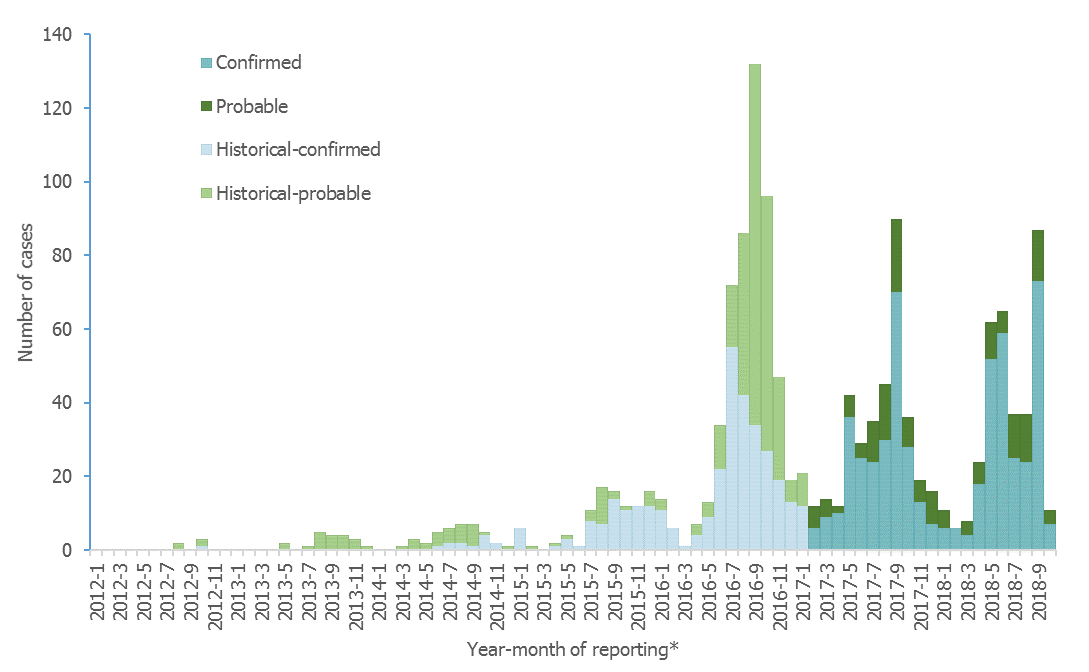
Most outbreak cases were reported during the summer months (Figure 1). Due to reporting delays, additional cases are expected to be reported with onset in recent months.

A total of 112 confirmed or historical-confirmed cases were reported with travel history in an EU country during the incubation period and therefore were likely infected there. Countries where infections likely took place were Poland (25 cases identified from 2016 to 2018), Bulgaria (22 cases from 2015 to 2018), Cyprus (14 cases in 2016 and 2018), Portugal (11 cases from 2015 to 2017) and Hungary (10 cases from 2016 to 2018). Additional travel-associated cases were also reported (<10 cases per country) with travel history to Austria, Belgium, Greece, Italy, the Netherlands, Romania, Slovenia and Spain.

Figure 1. Distribution of cases by month of onset* and case classification (n=1 412; 4 cases missing any date of report), EU/EEA, January 2012 to October 2018, as of 12 November 2018

Salmonella Enteritidis - Distribution of cases by month of onset* and case classification (n=1 412; 4 cases missing any date of report), EU/EEA, January 2012 to October 2018, as of 12 November 2018
 *: month of sampling or month of receipt by the reference laboratory if month of onset is not available.

The 2016 and 2017 European outbreak investigations identified eggs originating from Poland as the vehicle of infection in this outbreak (ECDC/EFSA rapid outbreak assessments published in March and December 2017). Outbreak-confirmed cases belong to four different WGS clusters.

Assessment

As reported in the previous ECDC/EFSA rapid outbreak assessment, in 2016 and 2017, evidence from epidemiological, microbiological, environmental and tracing investigations identified eggs originating from Poland as the vehicle of infections in this multi-strain outbreak. Control measures were implemented following these investigations. However, new outbreak cases were notified in 2017 and in 2018 with similar magnitude and temporal patterns. Based on the analysis of the travel-associated cases, it is likely that more countries where molecular typing is not performed routinely for human S. Enteritidis isolates are affected by the outbreak, including Bulgaria, Cyprus and Portugal.

Actions

ECDC monitors the occurrence of human cases associated with this threat and offers sequencing services for countries reporting probable cases of human S. Enteritidis isolates with MLVA profile 2-9-7-3-2 or 2-9-6-3-2 or
2-9-10-3-2 or 2-10-6-3-2 or 2-10-8-3-2 or 2-11-8-3-2. EU/EEA countries should consider interviewing new outbreak-confirmed cases.