
Category Archives: Food Microbiology Research

Research – Presumptive probiotic bacteria from traditionally fermented African food challenge the adhesion of enteroaggregative E. coli

Wiley Online

E.coli

Colonization of intestinal tract with the potential to exclude, displace, and inhibit enteric pathogens is principally dependent on the adhesion ability of probiotics. Therefore, probiotic efficacy is considered to be mainly determined by their adhesion ability. The current study reports the antagonistic effect of four lactic acid bacteria (LAB) on the adhesion profile of four diarrhoeagenic and one non‐diarrhoeagenic enteroaggregative Escherichia coli (EAEC). All the bacterial strains investigated adhered to the Caco‐2 cells. All the LAB tested competitively excluded, displaced, and inhibited at least three (non‐) diarrhoeagenic EAEC strains from adhesion (p < 0.05). In all, Lactobacillus plantarum, FS2 exhibited the strongest adhesion to the Caco‐2 cells, competitive exclusion (CE), displacement, and inhibition against most of the EAEC strains. Additionally, the competence to exclude, displace, and inhibit the EAEC from adhesion depended on both the pathogens and the LAB strains tested; signifying the participation of several mechanisms. Contrary to all the EAEC strains, gastro‐intestinal stress factors such as low pH (2.5) had no effect on the adhesion of the LAB. Unlike the gastro‐intestinal acidic conditions, bile salt conditioning (at pH 6.5) had no effect on the adhesion of both EAEC and LAB. In conclusion, all the LAB tested showed specific anti‐adherence effects including CE, displacement, and inhibition against the selected EAEC. The results indicate that all the LAB, particularly, the L. plantarum, FS2 had a good ability for exerting antagonistic effects against the selected EAEC for the prevention of gastrointestinal infection.

Research – Survey of New Zealand poultry consumers handling of raw poultry and food safety awareness to provide insight into risk factors for campylobacteriosis

Journal of Food Protection

CDC Campy

New Zealand (NZ) has a high rate of reported campylobacteriosis cases. Cross-contamination in home kitchens during poultry handling is considered to be the main factor in campylobacteriosis transmission. The main aim of this study was to measure NZ consumers’ food safety awareness and self-reported food safety practices associated with handling raw poultry. This study will contribute to the existing knowledge to explain the reasons behind the increase of campylobacteriosis incidents. Findings can help inform future consumer education campaigns to help reduce the incidence of campylobacteriosis in NZ. A cross-sectional survey comprised of 31 multiple-choice questions was designed, piloted, and utilized to collect information about the last time consumers purchased and prepared raw poultry at home. A street-intercept survey in public places, such as supermarkets in the Canterbury region, was used to recruit respondents for this study. A descriptive and inferential data analysis was performed, including a one-way ANOVA test used to compare the mean scored responses between the respondents among different socio-demographics. Overall, 301 valid responses were obtained. Scores, representing reported safe food safety practices ranged between 2 and 19 (maximum 21) with a mean score of 9.83 (standard deviation 3.50 with a standard error of 0.20). There was some variation of correctly answered questions by the respondents for food hygiene (25%), cross-contamination prevention (55%), temperature control and storage practices (49%), and food safety (52%). Approximately 30% of the respondents reported symptoms of a foodborne disease experience once to four times during the past 12 months. The study identified low adherence to current recommended food safety practices, including safe food storage and temperature control. The findings can be used to inform a communication campaign regarding food safety needs to be designed urgently in NZ to reduce the rate of campylobacteriosis.

WHO – DRAFT WHO GLOBAL STRATEGY FOR FOOD SAFETY 2022-2030

WHO

Introduction

Why an updated global food safety strategy?

Safe food is a primary determinant of human health. It is a basic human right to have access to safe and healthy food. In seeking to guarantee this right, governments must ensure that available food meets safety standards.

This task is not easy as the world is now more interconnected, and food systems are changing faster than ever. Foods are produced, managed, delivered and even consumed in ways that could not have been anticipated two decades ago.

These factors call for a fresh global approach to improve food safety that aims to strengthen national food safety systems while improving international and national collaboration.

While recognizing that food safety is a shared responsibility among multiple stakeholders, countries must show leadership in adopting and implementing food safety policies which ensure that each stakeholder knows–and correctly plays –their part.

However, access to sufficient, safe, and wholesome food for all remains an elusive goal. Economic disparities within and across countries, including marked differences in the strength of national food safety systems and complex dynamics that operate within food systems, have significantly slowed progress towards achieving this goal.

Research -Listeria monocytogenes Cold Shock Proteins: Small Proteins with A Huge Impact

MDPI

Listeria monocytogenes has evolved an extensive array of mechanisms for coping with stress and adapting to changing environmental conditions, ensuring its virulence phenotype expression. For this reason, L. monocytogenes has been identified as a significant food safety and public health concern. Among these adaptation systems are cold shock proteins (Csps), which facilitate rapid response to stress exposure. L. monocytogenes has three highly conserved csp genes, namely, cspAcspB, and cspD. Using a series of csp deletion mutants, it has been shown that L. monocytogenes Csps are important for biofilm formation, motility, cold, osmotic, desiccation, and oxidative stress tolerance. Moreover, they are involved in overall virulence by impacting the expression of virulence-associated phenotypes, such as hemolysis and cell invasion. It is postulated that during stress exposure, Csps function to counteract harmful effects of stress, thereby preserving cell functions, such as DNA replication, transcription and translation, ensuring survival and growth of the cell. Interestingly, it seems that Csps might suppress tolerance to some stresses as their removal resulted in increased tolerance to stresses, such as desiccation for some strains. Differences in csp roles among strains from different genetic backgrounds are apparent for desiccation tolerance and biofilm production. Additionally, hierarchical trends for the different Csps and functional redundancies were observed on their influences on stress tolerance and virulence. Overall current data suggest that Csps have a wider role in bacteria physiology than previously assumed. View Full-Text

USA – TECHNICAL REPORT:FDA REPORT ON THE OCCURRENCE OF FOODBORNE ILLNESS RISK FACTORS IN RETAIL FOOD STORE DELI DEPARTMENTS2015-2016MAY 2021

FDA

This report includes the background, design, and results of data collection on the occurrence of foodborne illness risk factors in the United States in retail food store deli departments (hereafter referred to as delis) during 2015-2016. It is a baseline report representing the first data collection period of the FDA’s current 10-year study on trends in the occurrence of foodborne illness risk factors and food safety behaviors/practices in food service facilities. Data from the 2015-2016 collection will be used as a baseline to assess trends in the occurrence of risk factors in future data collections. Of the foodborne illness risk factors investigated in this study, inadequate cooking was best controlled. The two most commonly occurring out-of-compliance risk factors were improper holding time/temperature and poor personal hygiene. Food Safety Management Systems (FSMS) were the strongest predictor of the compliance status of data items. Establishments with well-developed FSMS had significantly fewer out-of-compliance food safety behaviors/practices than did those with “less developed” food safety management systems. Neither the presence of a Certified Food Protection Manager (CFPM) nor the multiple-unit status of establishments were significant predictors of having out-of-compliance data items when all factors studied were taken into account. These findings suggest that well-developed and documented FSMS are a useful tool in reducing the occurrence of foodborne illness risk factors.

Research -Epidemiological investigation of recurrent outbreaks of haemolytic uraemic syndrome caused by Shiga toxin-producing Escherichia coli serotype O55:H7 in England, 2014–2018

Cambridge Org

Recurrent outbreaks of haemolytic uraemic syndrome (HUS) caused by Shiga toxin-producing Escherichia coli (STEC) serotype O55:H7 occurred in England between 2014 and 2018. We reviewed the epidemiological evidence to identify potential source(s) and transmission routes of the pathogen, and to assess the on-going risk to public health. Over the 5-year period, there were 43 confirmed and three probable cases of STEC O55:H7. The median age of cases was 4 years old (range 6 months to 69 years old) and over half of all cases were female (28/46, 61%). There were 36/46 (78.3%) symptomatic cases, and over half of all cases developed HUS (25/46, 54%), including two fatal cases. No common food or environmental exposures were identified, although the majority of cases lived in rural or semi-rural environments and reported contact with both wild and domestic animals. This investigation informed policy on the clinical and public health management of HUS caused by STEC other than serotype O157:H7 (non-O157 STEC) in England, including comprehensive testing of all household contacts and household pets and more widespread use of polymerase chain reaction assays for the rapid diagnosis of STEC-HUS.

Research – Ecological niche adaptation of Salmonella Typhimurium U288 is associated with altered pathogenicity and reduced zoonotic potential

Nature.com

The emergence of new bacterial pathogens is a continuing challenge for agriculture and food safety. Salmonella Typhimurium is a major cause of foodborne illness worldwide, with pigs a major zoonotic reservoir. Two phylogenetically distinct variants, U288 and ST34, emerged in UK pigs around the same time but present different risk to food safety. Here we show using genomic epidemiology that ST34 accounts for over half of all S. Typhimurium infections in people while U288 less than 2%. That the U288 clade evolved in the recent past by acquiring AMR genes, indels in the virulence plasmid pU288-1, and accumulation of loss-of-function polymorphisms in coding sequences. U288 replicates more slowly and is more sensitive to desiccation than ST34 isolates and exhibited distinct pathogenicity in the murine model of colitis and in pigs. U288 infection was more disseminated in the lymph nodes while ST34 were recovered in greater numbers in the intestinal contents. These data are consistent with the evolution of S. Typhimurium U288 adaptation to pigs that may determine their reduced zoonotic potential.

Research – How Legionella makes itself at home

Science Daily

Scientists at UT Southwestern have discovered a key protein that helps the bacteria that causes Legionnaires’ disease to set up house in the cells of humans and other hosts. The findings, published in Science, could offer insights into how other bacteria are able to survive inside cells, knowledge that could lead to new treatments for a wide variety of infections.

“Many infectious bacteria, from listeria to chlamydia to salmonella, use systems that allow them to dwell within their host’s cells,” says study leader Vincent Tagliabracci, Ph.D., assistant professor of molecular biology at UTSW and member of the Harold C. Simmons Comprehensive Cancer Center. “Better understanding the tools they use to make this happen is teaching us some interesting biochemistry and could eventually lead to new targets for therapy.”

Tagliabracci’s lab studies atypical kinases, unusual forms of enzymes that transfer chemical groups called phosphates onto proteins or lipids, changing their function. Research here and elsewhere has shown that Legionella, the genus of bacteria that cause Legionnaires’ disease, is a particularly rich source of these noncanonical kinases. According to the Centers for Disease Control and Prevention, nearly 10,000 cases of Legionnaires’ disease were reported in the U.S. in 2018, though the true incidence is believed to be higher.

After identifying a new Legionella atypical kinase named MavQ, Tagliabracci and his colleagues used a live-cell imaging technique combined with a relatively new molecular tagging method to see where MavQ is found in infected human cells, a clue to its function. Rather than residing in a specific location, the researchers were surprised to see that the protein oscillated back and forth between the endoplasmic reticulum — a network of membranes important for protein and lipid synthesis — and bubble- or tube-shaped structures within the cell.

Further research suggests that MavQ, along with a partner molecule called SidP, remodels the endoplasmic reticulum so that Legionella can steal parts of the membrane to help create and sustain the vacuole, a structure that houses the parasite inside cells and protects it from immune attack.

Tagliabracci, a Michael L. Rosenberg Scholar in Medical Research and a Cancer Prevention & Research Institute of Texas (CPRIT) Scholar, says that he suspects other bacterial pathogens may use similar mechanisms to co-opt existing host cell structures to create their own protective dwellings.

This work was funded by NIH grants DP2GM137419, R01GM113079, T32GM008203-29, F30HL143859-01, Welch Foundation grants I-1911, I-1789, CPRIT grant RP170674, and Polish National Agency for Scientific Exchange scholarship PPN/BEK/2018/1/00431.

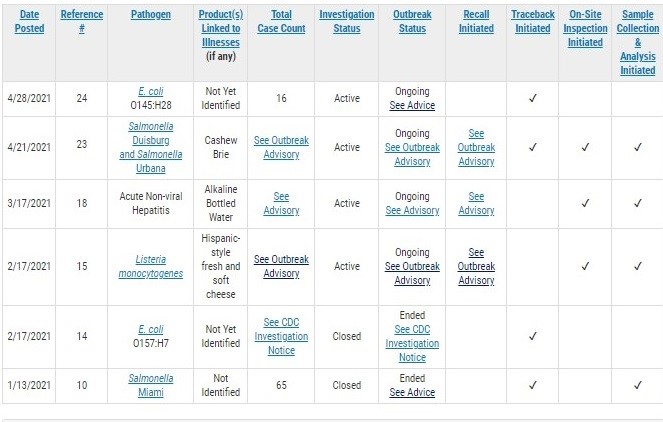
USA – FDA Core Investigation Table

FDA

0a


Research – FDA In Brief: FDA Releases Investigation Report Following 2020 Salmonella Outbreak Linked to Red Onions

FDA

“The FDA has been working with the CDC, state partners and Canadian officials to investigate the largest Salmonella Newport outbreak in over a decade, which was linked to red onions. The FDA, today, released a 2020 Salmonella Outbreak Linked to Red Onions Report that includes an overview of our investigation findings, including factors that potentially contributed to the Salmonella contamination of red onions.

“Our investigation found the outbreak to be linked to whole red onions supplied by Thomson International, Inc., with farms in Bakersfield and Holtville, California. During the investigation, the FDA identified several plausible opportunities for contamination that may have contributed to the outbreak, including potentially contaminated irrigation water, sheep grazing on adjacent land, signs of animal intrusion including scat (fecal droppings) and large flocks of birds that may spread contamination, as well as packing house cleaning and sanitizing practices.

“Eleven of the environmental subsamples tested positive for various types of Salmonella Newport; however, none matched the outbreak strain. Although a conclusive root cause could not be identified, the FDA’s leading hypothesis is that contaminated irrigation water used in a growing field in Holtville, California may have led to contamination of the onions. Considering these findings, the FDA encourages all produce growers to assess risks that may be posed by adjacent and nearby land uses, especially as it relates to the presence of livestock and the interface between farmland, rangeland, irrigation water, and other agricultural areas.

“Safeguarding the U.S. food supply and helping to ensure that our food is not contaminated at any point during its journey along the supply chain is a critical focus of the FDA’s work. Food safety is a shared responsibility that involves food producers, distributors, manufacturers, retailers, and regulators. The FDA is committed to working with these stakeholders to advance the critical work to reduce the potential for contamination events and ensure the continued safety of our food supply.”

Additional Information

  • The U.S. Food and Drug Administration is releasing a report on an investigation conducted in response to an outbreak of Salmonella Newport, which caused more than 1,600 reported illnesses in the U.S. and Canada between June and October 2020.
  • The FDA’s investigation identified Thomson International Inc. of Bakersfield, California, as the likely source of contaminated red onions. Thomson International, Inc. recalled all varieties of onions that could have come in contact with potentially contaminated red onions due to the risk of cross contamination.
  • This was the largest Salmonella outbreak in more than a decade. The FDA recommends that all produce farms assess growing operations to ensure implementation of appropriate science- and risk-based preventive measures, including applicable provisions of the FDA Food Safety Modernization Act (FSMA) Produce Safety Rule and good agricultural practices.

Related Information