Category Archives: Food Illness

UK – Listeria outbreak in English hospitals: update

Apologies for this being late but i have been on holiday 🙂

HPS

06 August 2019

Article: 53/3104

The Public Health England (PHE) team investigating cases of listeriosis linked to sandwiches and salads in NHS hospitals in England has confirmed that, since the last update on 26 June 2019, there has been another death, bringing to six the total number of deaths linked to this outbreak.

The individual who died was one of the nine previously confirmed cases. The individual is considered to have acquired listeriosis from Good Food Chain products while at Western Sussex Hospitals NHS Foundation Trust.

PHE continues to test all samples of listeria on an ongoing basis to check if they are linked to this outbreak. To date, thirty-four samples have been tested, with none linked to the outbreak.

There have been no new cases of listeriosis linked to this outbreak. Investigations are continuing and the public should be reassured that the risk continues to be low.

No cases have been reported in Scotland so far.
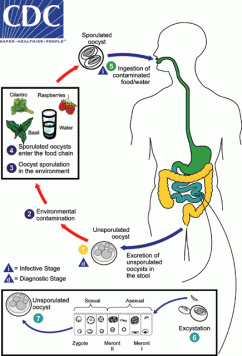
USA – Basil Cyclospora Outbreak Has Sickened 205 in 11 States

Food Poisoning Bulletin Cyclospora_LifeCycle201

The FDA has updated the basil cyclospora outbreak that has now sickened at least 205 people in 11 states. That’s an increase of 73 patients since the last update which was posted on July 25, 2019. Five people have been hospitalized because they are so sick. The basil in question is imported from Mexico by Siga Logistics de RL de CV from Morelos. That facility recalled basil on July 24, 2019.

USA -Outbreak of Listeria Infections Linked to Deli-Sliced Meats and Cheeses

Illustration with a microscope and text reading Investigation Notice

Posted April 17, 2019 at 4:30 PM ET

CDC and several states are investigating a multistate outbreak of Listeria infections linked to deli-sliced meats and cheeses. The U.S. Department of Agriculture’s Food Safety and Inspection Service and the U.S. Food and Drug Administration are monitoring the outbreak.

Latest Outbreak Information
Illustration of a megaphone.
At A Glance

Photo of deli products.

  • A total of 8 people infected with the outbreak strain of Listeria monocytogenes have been reported from 4 states.
    • All 8 people have been hospitalized, and one death has been reported from Michigan.
  • Epidemiologic and laboratory evidence indicates that meats and cheeses sliced at deli counters might be contaminated with Listeria monocytogenes and could make people sick.
  • In interviews, ill people report eating different types and brands of products, including meats and cheeses, purchased from and sliced at deli counters in many different retail locations.
  • The outbreak strain has been identified in samples taken from meat sliced at a deli and from deli counters in multiple stores.
  • A single, common supplier of deli products has not been identified.
  • CDC is not advising that consumers avoid eating products prepared at delis, or that retailers stop selling deli-sliced products.
  • Retailers should clean and sanitize deli slicersExternal frequently and other areas where deli products are prepared, stored, or served to avoid cross contamination.
  • This outbreak is a reminder that people at higher risk for severe Listeria infection should handle deli-sliced meats and cheeses carefully to prevent illness. Pregnant women and their newborns, adults age 65 and older, and people with weakened immune systems are more likely to get sick with listeriosis.

Research – Occurrence of Escherichia coli O157:H7 in Pest Flies Captured in Leafy Greens Plots Grown Near a Beef Cattle Feedlot

Journal of Food Protection

ABSTRACT

Leafy greens are leading vehicles for Escherichia coli O157:H7 foodborne illness. Pest flies can harbor this pathogen and may disseminate it to produce. We determined the occurrence of E. coli O157:H7–positive flies in leafy greens planted up to 180 m from a cattle feedlot and assessed their relative risk to transmit this pathogen to leafy greens. The primary fly groups captured on sticky traps at the feedlot and leafy greens plots included house flies (Musca domestica L.), face flies (Musca autumnalisL.), stable flies (Stomoxys calcitrans L.), flesh flies (family Sarcophagidae), and blow flies (family Calliphoridae). E. coliO157:H7 carriage rates of house, face, flesh, and blow flies were similar (P > 0.05), ranging from 22.3 to 29.0 flies per 1,000 flies. In contrast, the carriage rate of stable flies was lower at 1.1 flies per 1,000 flies (P < 0.05). Differences in carriage rates are likely due to the uses of fresh bovine feces and manure by these different pest fly groups. E. coli O157:H7 carriage rates of total flies did not differ (P > 0.05) by distance (ranging from 0 to 180 m) from the feedlot. Most fly isolates were the same predominant pulsed-field gel electrophoresis types found in feedlot surface manure and leafy greens, suggesting a possible role for flies in transmitting E. coli O157:H7 to the leafy greens. However, further research is needed to clarify this role and to determine set-back distances between cattle production facilities and produce crops that will reduce the risk for pathogen contamination by challenging mechanisms like flies.

HIGHLIGHTS
  • E. coli O157:H7 was common in flies captured in leafy greens plots near a feedlot.

  • E. coli O157:H7 carriage rates of house, face, flesh, and blow flies were similar.

  • Stable flies had lower E. coli O157:H7 carriage than the other four fly groups.

  • E. coli O157:H7 carriage of total flies was not affected by distance up to 180 m.

  • Research is needed to determine risk for leafy green contamination by pest flies.

Research – Domestic Kitchen Microbiological Contamination and Self-Reported Food Hygiene Practices of Older Adult Consumers

Journal of Food Protection

ABSTRACT

Because of increased susceptibility, older adults have an increased risk of foodborne infection, and data suggest elevated incidence; therefore, food hygiene is essential to reduce the risk. Research suggests older adults’ inadequate knowledge and negative attitudes toward food hygiene may increase implementation of unsafe food practices. Data on microbiological contamination of domestic kitchens of older adults are lacking. Therefore, this study aimed to determine microbiological contamination of domestic kitchens of older adults. Food contact surfaces and equipment (n = 1,292) in domestic kitchens (n = 100) of older adults (≥60 years) were analyzed to isolate aerobic bacteria, Enterobacteriaceae, Staphylococcus aureus, and Listeria spp.; self-reported hygiene practices were also recorded. Highest contamination levels were determined on in-use cleaning equipment (dish brushes, dishcloths, sponges) with aerobic bacteria <9.3 log CFU per item, Enterobacteriaceae <8.8 log CFU per item, and S. aureus <7.0 log CFU per item. Reported usage length of dish brushes was significantly correlated (P< 0.05) with Enterobacteriaceae contamination. Significant correlations (P < 0.05) were determined between contamination and reported cleaning frequency of refrigerators. Contamination of hand towels in single-occupant households was significantly greater (P < 0.05) than in multioccupant households. The study facilitates novel comparison between reported hygiene practices with microbial contamination, suggesting older adults fail to implement adequate and regular hygiene practices that may increase the possibility of cross-contamination in the domestic kitchen and the associated risk of foodborne illness. Data from this study have determined a need for older adults to improve food hygiene practices in the domestic kitchen.

HIGHLIGHTS
  • In-use dish brushes and dishcloths were most commonly contaminated with high counts of bacteria.

  • Correlations existed between dishcloth contamination and multiple kitchen sites.

  • Reported dish brush usage length was significantly correlated with contamination level.

  • Reported time since cleaning of refrigerators was positively correlated with contamination levels.

  • Inadequate and irregular hygiene practices may increase foodborne illness risk to older adults.

RASFF Alert – Foodborne Outbreak -Salmonella enterica ser. Enteritidis – Eggs

RASFF-Logo

RASFF – foodborne outbreak suspected to be caused by Salmonella enterica ser. Enteritidis in eggs from Poland in Austria

Ireland -Outbreak in Ireland tied to Romanian pork; other countries report illnesses

Food Safety News

Eight people are part of a Salmonella outbreak in Ireland linked to pork from Romania. Five of them were admitted to hospitals. Infected people also have been identified in other countries.

One person was sickened by Salmonella Bredeney in August 2018. The other seven people fell ill between May 4 and June 3, this year. Those stricken are six adult males and two children who are siblings. There have not been any deaths.

Pork product recall

Andromi Toba de Casa was recalled last month

In mid-July, Andromi Toba de Casa 500-gram packages with a use-by date of Aug. 4 and with the lot number 17 from Romania were recalled because of the presence of Salmonella. The chilled cooked pork preparation is sold in Polonez stores throughout Ireland.

UK – Listeria cases being investigated An investigation is underway into cases of listeria linked to sandwiches. Update Sixth person dead

Gov.uk

Latest update

The multi-agency team investigating cases of listeriosis linked to sandwiches and salads can confirm that, since the last update, there has been another death linked to this outbreak. The total number of deaths linked to this outbreak is 6.

The individual who sadly died was one of the 9 previously confirmed cases. The individual is considered to have acquired listeriosis from Good Food Chain products while at Western Sussex Hospitals NHS Foundation Trust.

Public Health England continues to test all samples of listeria on an ongoing basis to check if they are linked to this outbreak. To date, we have tested 34 samples and none are linked to the outbreak.

There have been no new cases of listeriosis linked to this outbreak. Our investigations continue and the public should be reassured that the risk continues to be low.

Denmark -WGS project helps Denmark uncover Campylobacter outbreak

Food Safety News

Fifty people are ill in Denmark from Campylobacter after eating chicken meat but authorities believe the actual number of patients may be much higher.

Statens Serum Institut (SSI), Danish Veterinary and Food Administration (Fødevarestyrelsen) and DTU Food – National Food Institute are investigating the Campylobacter jejuni outbreak.

Campylobacter is the main cause of bacterial intestinal infections in Denmark and more than 4,500 cases were registered in 2018.

The same type of Campylobacter, sequence type 122, identified in patients by whole genome sequencing has also been found in chicken meat from one slaughterhouse, named as HKScan in Vinderup, a town in Northwestern Jutland.

USA – E. coli hits South Dakota – Sisseton Area

Food Poison Journal

According to KSFY, the South Dakota Department of Health is investigating several cases of E. coli in northeastern South Dakota. The cases are in and around the Sisseton area.

Source not identified