Category Archives: Food Illness

Research – An Assessment of Listeriosis Risk Associated with a Contaminated Production Lot of Frozen Vegetables Consumed under Alternative Consumer Handling Scenarios

Journal of Food Protection

ABSTRACT

Frozen foods do not support the growth of Listeria monocytogenes (LM) and should be handled appropriately for safety. However, consumer trends regarding preparation of some frozen foods may contribute to the risk of foodborne listeriosis, specifically when cooking instructions are not followed and frozen products are instead added directly to smoothies or salads. A quantitative microbial risk assessment model FFLLoRA (Frozen Food Listeria Lot Risk Assessment) was developed to assess the lot-level listeriosis risk due to LM contamination in frozen vegetables consumed as a ready-to-eat food. The model was designed to estimate listeriosis risk per serving and the number of illnesses per production lot of frozen vegetables contaminated with LM, considering individual facility factors such as lot size, prevalence of LM contamination, and consumer handling prior to consumption. A production lot of 1 million packages with 10 servings each was assumed. When at least half of the servings were cooked prior to consumption, the median risk of invasive listeriosis per serving in both the general and susceptible population was <1.0 × 10⁻¹⁶ with the median (5th, 95th percentiles) predicted number of illnesses per lot as 0 (0, 0) and 0 (0, 1) under the exponential and Weibull-gamma dose-response functions, respectively. In scenarios in which all servings are consumed as ready-to-eat, the median predicted risk per serving was 1.8 × 10⁻¹³ and 7.8 × 10⁻¹² in the general and susceptible populations, respectively. The median (5th, 95th percentile) number of illnesses was 0 (0, 0) and 0 (0, 6) for the exponential and Weibull-Gamma models, respectively. Classification tree analysis highlighted initial concentration of LM in the lot, temperature at which the product is thawed, and whether a serving is cooked as main predictors for illness from a lot. Overall, the FFLLoRA provides frozen food manufacturers with a tool to assess LM contamination and consumer behavior when managing rare and/or minimal contamination events in frozen foods.

HIGHLIGHTS
  • A tool for frozen food manufacturers to assess listeriosis risk was developed.

  • Scenarios of low-level L. monocytogenes in frozen vegetables did not typically result in illness.

  • Listeriosis cases depended on model inputs related to consumer handling and initial concentration.

  • Scenarios of more testing increased the probability of finding a contaminated lot and reduced risk.


USA -Great American Deli Egg Salad Sandwich Recalled For Listeria monocytogenes

Food Poisoning Bulletin

Great American Deli of Ooltewah, Tennessee is recalling their Egg Salad Sandwich for possible Listeria monocytogenes contamination.  The eggs were supplied by Knott’s Fine Foods, which buys hard cooked eggs from Almark Foods. There is a Listeria monocytogenes outbreak associated with Almark Foods hard-boiled eggs, but there are no reports of illness related to the consumption of these egg salad sandwiches.

Great American Deli Egg Salad Sandwich Recalled For Listeria


USA -Outbreak Investigation of Listeria monocytogenes Linked to Hard-Boiled Eggs, December 2019

FDA

Case Counts

Total Illnesses: 7
Illnesses in 2019: 4
Hospitalizations: 4
Deaths: 1
Last illness isolation date: November 12, 2019

On December 23, 2019 Almark Foods expanded its voluntary recall to include all hard-boiled eggs manufactured at its Gainesville, Georgia facility. The initial recall included bulk hard-boiled eggs in pails and now includes product packaged for sale at retail within shelf-life, which have “Best If Used By Dates” through March 2, 2020. At this time, Almark Foods is no longer producing products from this facility.

Companies who received recalled product from Almark Foods have initiated recalls of products containing these eggs. Additional companies and products may be added as the investigation continues.

Recommendation

Consumers should not eat any of the recalled products. A full list of products sold at retail is available below.

Food processors, restaurants, and retailers should not sell or serve any of the recalled hard-boiled and peeled eggs from Almark Foods. These products were sold in bulk pails to food processors, restaurants and retailers, and in retail packaging to retailers for direct-sale to consumers. The full list of products is below.

Additionally, FDA recommends that food processors, restaurants and retailers who have received  Almark Foods bulk, fresh hard-boiled eggs, use extra vigilance in cleaning and sanitizing any surfaces that may have come in contact with these products, to reduce the risk of cross-contamination.

Background

As of December 17, 2019, a total of seven people infected with the outbreak strain of Listeria monocytogenes have been reported from five states. In interviews, ill people answered questions about the foods they ate and other exposures in the month before they became ill. Of the five people for whom information was available, four reported eating products containing eggs. Three of these people reported eating hard-boiled eggs in deli salads purchased from grocery stores and in salads eaten at restaurants. Illnesses started on dates ranging from April 10, 2017 to November 12, 2019.

Additionally, based on whole-genome sequencing, the Listeria monocytogenes found in  environmental samples collected at the firm’s processing facility during FDA inspections conducted in February 2019 and December 2019 are a genetic match to the outbreak strain. Almark Foods has been cooperating with the ongoing investigation and announced an initial voluntary recall of hard-boiled and peeled eggs in pails on December 20, 2019. On December 23, 2019 Almark Foods expanded the initial recall to include all hard-boiled eggs produced at its Gainesville, Georgia facility.

This outbreak strain was found during environmental sampling in 2017 of one other food facility. That facility is not currently handling food and ceased operation in 2018.

The investigation is ongoing and additional information will be provided as it becomes available.

USA – Investigation of Scombrotoxin Fish Poisoning Linked to Yellowfin/Ahi Tuna, Fall 2019

FDA

Case Counts

Total Illnesses: 50
Hospitalizations: 1
Deaths: 0
Last illness onset: November 24, 2019
States with Cases: DE (6), MA (2), MD (4), MN (2), NJ (2), NY (6), OH (11), PA (6), RI (3), VT (7), WV (1)

December 26, 2019

FDA has determined that recalls of yellowfin tuna supplied by Truong Phu Xanh Co., LTD have not effectively removed  potentially harmful products from the market. FDA recommends that importers, suppliers, distributors, restaurants, and retailers who purchased tuna from one of the importers listed should confirm that it was not tuna supplied by Truong Phu Xanh Co., LTD with a production date in 2019.  If it was it should be destroyed or discarded. These firms are being named to effectuate the removal of product from the market due to the reporting of additional illnesses linked to product from Truong Phu Xanh Co., LTD. The following companies imported tuna from Truong Phu Xanh Co., LTD:

  • Mical Seafood Inc. (Davie, FL)
  • Northern Fisheries LTD. (Little Compton, RI)
  • Alfa International Seafood Inc. (Medley, FL)
  • Aquabest Seafood LLC (Miami, FL)
  • Gamma Seafood Corporation (Medley, FL)
  • J. DeLuca Fish Company, Inc. (San Pedro, CA)
  •  Sym-Pac International Inc. (Corona, CA)
  • Worldwide Seafood Products LLC (Perth Amboy, NJ)

Recommendations

Yellowfin tuna from Truong Phu Xanh Co., LTD with a production date in 2019 should not be consumed because it may have the potential to cause scombrotoxin fish poisoning. Tuna from this supplier could have been sold thawed or frozen; and could have been sold as ground tuna meat, poke cubes, steaks, or loins; this product could still be within its shelf life.­­ Anyone who received tuna from this supplier should not sell, serve, or consume it and should discard it. If you purchased tuna from one of the importers listed above you should confirm that it was not tuna supplied by Truong Phu Xanh Co., LTD with a production date in 2019.

Scombrotoxin fish poisoning occurs when fish is not properly chilled or preserved and begins to spoil, resulting in increased histamine levels. Histamine cannot be destroyed by freezing or cooking.

Importers, Suppliers, and Distributors:

Importers, suppliers, and distributors should not use and should discard or destroy any yellowfin tuna imported from Truong Phu Xanh Co., LTD with a production date in 2019.

Restaurants and Retailers:

Restaurants and retailers should contact their suppliers to confirm the source of their yellowfin tuna because not all product was distributed in packaging that identifies Truong Phu Xanh Co., LTD. Yellowfin tuna imported from this company with a production date in 2019 should not be used, served, repacked, or sold; and should be discarded.

Consumers:

While restaurants and retailers should have removed yellowfin tuna with a production date in 2019 from the Vietnamese supplier Truong Phu Xanh Co., LTD, consumers should ask if the yellowfin tuna being served or sold was imported from the Vietnamese supplier Truong Phu Xanh Co., LTD and has a production date in 2019.

RASFF Alert – Foodborne Outbreak -Salmonella – Walnuts

RASFF-Logo

RASFF – foodborne outbreak suspected to be caused by Salmonella in walnuts from Austria in Germany


USA – Outbreak Investigation of Listeria monocytogenes Linked to Hard-Boiled Eggs, December 2019

FDA

Case Counts

Total Illnesses: 7
Illnesses in 2019: 4
Hospitalizations: 4
Deaths: 1
Last illness isolation date: November 12, 2019
States with Cases: FL (1), ME (1), PA (1), SC (2), TX (2)
States with Cases in 2019: TX (1), SC (2), FL (1)
Product Distribution*: Nationwide
*Distribution has been confirmed for states list, but at this time we believe the product was distributed nationwide. Updates will be provided as more information becomes available.

December 26, 2019

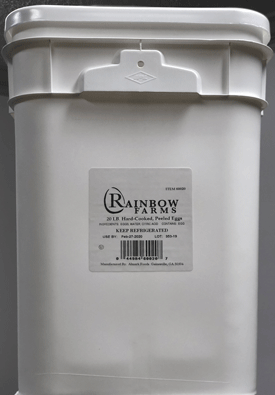
Rainbow Farms Select Hard Cooked Peeled Eggs 20 lbs container

On December 23, 2019 Almark Foods expanded its voluntary recall to include all hard-boiled eggs manufactured at its Gainesville, Georgia facility. The initial recall included bulk hard-boiled eggs in pails and now includes product packaged for sale at retail within shelf-life, which have “Best If Used By Dates” through March 2, 2020. At this time, Almark Foods is no longer producing products from this facility.

Companies who received recalled product from Almark Foods have initiated recalls of products containing these eggs. Additional companies and products may be added as the investigation continues.

Recommendation

Consumers should not eat any of the recalled products. A full list of products sold at retail is available below.

Food processors, restaurants, and retailers should not sell or serve any of the recalled hard-boiled and peeled eggs from Almark Foods. These products were sold in bulk pails to food processors, restaurants and retailers, and in retail packaging to retailers for direct-sale to consumers. The full list of products is below.

Additionally, FDA recommends that food processors, restaurants and retailers who have received  Almark Foods bulk, fresh hard-boiled eggs, use extra vigilance in cleaning and sanitizing any surfaces that may have come in contact with these products, to reduce the risk of cross-contamination.

Background

As of December 17, 2019, a total of seven people infected with the outbreak strain of Listeria monocytogenes have been reported from five states. In interviews, ill people answered questions about the foods they ate and other exposures in the month before they became ill. Of the five people for whom information was available, four reported eating products containing eggs. Three of these people reported eating hard-boiled eggs in deli salads purchased from grocery stores and in salads eaten at restaurants. Illnesses started on dates ranging from April 10, 2017 to November 12, 2019.

Additionally, based on whole-genome sequencing, the Listeria monocytogenes found in  environmental samples collected at the firm’s processing facility during FDA inspections conducted in February 2019 and December 2019 are a genetic match to the outbreak strain. Almark Foods has been cooperating with the ongoing investigation and announced an initial voluntary recall of hard-boiled and peeled eggs in pails on December 20, 2019. On December 23, 2019 Almark Foods expanded the initial recall to include all hard-boiled eggs produced at its Gainesville, Georgia facility.

This outbreak strain was found during environmental sampling in 2017 of one other food facility. That facility is not currently handling food and ceased operation in 2018.

The investigation is ongoing and additional information will be provided as it becomes available.

USA -Delaware Children Sickened in Tailor Cut Salmonella Javiana Outbreak

Food Poisoning Bulletin

Salmonellaa

Image CDC

Delaware children sickened in Tailor Cut Salmonella Javiana outbreak. The Delaware Division of Public Health has confirmed that 26 schoolchildren in Delaware are ill after eating fruit provided by Tailor Cut Produce. The sick children live in New Castle County, and attended schools served by the Red Clay Consolidated School District, Colonial School District, and the Community Education Building in downtown Wilmington. DPH was not able to confirm school information for seven of these children, except that they live in New Castle County.

Canada -Salmonella outbreak linked to raw turkey and raw chicken rises to 126

Outbreak News Today

Officials with the Public Health Agency of Canada and the various provinces report continuing to  investigate an outbreak of Salmonella infections.

Based on the investigation findings to date, exposure to raw turkey and raw chicken products has been identified as the likely source of the outbreak.

As of December 18, 2019, there have been 126 confirmed cases of Salmonella Reading illness investigated in the following provinces and territories: British Columbia (31), Alberta (44), Saskatchewan (8), Manitoba (24), Ontario (8), Quebec (2), New Brunswick (1), Prince Edward Island (1), Northwest Territories (1), and Nunavut (6). Individuals became sick between April 2017 and November 2019. Thirty-eight individuals have been hospitalized. One individual has died.

USA – Investigation of E. coli O157:H7 Outbreak Linked to Romaine from Salinas, California, November 2019

FDA

Update

December 19, 2019

FDA continues to actively investigate the cause of this outbreak. An investigation team consisting of staff from FDA, CDC, the California Department of Public Health and the California Department of Food and Agriculture are attempting to identify any factors that could have led to contamination at a common farm identified by traceback. This investigation involves assessing and sampling soil, animal droppings, compost, water, and other potential environmental sources at the ranches of this grower. The samples and information collected during the farm investigations will be analyzed.

The Wisconsin Department of Health Services recently reported that they identified the outbreak strain of E. coli O157:H7 in an unopened bag of Fresh Express brand Leafy Green Romaine collected from an ill person’s home. The source of the romaine identified in the bag was Salinas, California. It was determined that one of the growers of this product also supplied romaine linked to other E. coli outbreaks that FDA is investigating.

These outbreaks are each caused by strains that are different from each other and different from the larger outbreak. One of the additional outbreaks, in Washington state, is potentially linked to romaine lettuce. The other outbreak, with cases in the U.S. and Canada, is linked to Fresh Express Sunflower Crisp Chopped Salad Kits.

Case Counts

Total Illnesses: 138
Hospitalizations: 72
Deaths: 0
Last illness onset: December 1, 2019
States with Cases:  AZ (3), CA (4), CO (6), FL (2), IA (1), ID (3), IL (10), MD (5), MI (1), MN (5), MT (1), NE (2), NJ (9), NC (2), NM (2), OH (12), OR (1), PA (17), SC (1), SD (1), TN (1), TX (6), VA (6), WA (4), WI (33)

USA – Listeria Illnesses and a Death reported in Texas, Florida, South Carolina, Pennsylvania and Maine linked to Almark Foods Hard-Boiled Eggs

Food Poison Journal

As of December 17, 2019, a total of seven people infected with the outbreak strain of Listeria monocytogenes have been reported from five states.

Listeria specimens from ill people were collected from April 10, 2017, to November 12, 2019. Ill people range in age from less than 1 to 82 years, with a median age of 75. Seventy-one percent of ill people are male. Of six ill people with information available, four hospitalizations have been reported. One death has been reported from Texas. One illness was reported in a newborn who was infected with Listeria while the mother was pregnant, but the newborn survived.