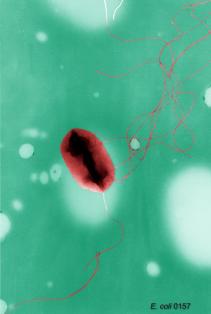
Category Archives: E.coli O157:H7

Research -Microbiological Testing Program for E. coli O157:H7 and non-O157 Shiga Toxin-Producing E. coli: Individual Positive Results for Raw Ground Beef (RGB) and RGB Components

USDA

Table 1. Raw Ground Beef Products (RGB) Analyzed for E. coli O157:H7, Current Calendar Year

Sample Source1 Collection Date Where Collected Product Status Positives this Year Samples Analyzed this Year Total Positives2 Total Samples Analyzed2
Federal RGB Verification, Beef Oct 15, 2018 MN Held 4 9,541 540 238,301
Federal RGB Verification, Beef Oct 9, 2018 NC Held 3 9,297 539 238,057
Federal RGB Verification, Beef Mar 26, 2018 OR Held 2 3,085 538 231,845
Federal RGB Verification, Beef Feb 8, 2018 CA Held 1 1,704 537 230,464

Z7_0Q0619C0JGR010IFST1G5B1055

Web Content Viewer (JSR 286)

Actions

Loading…

Microbiological Testing Program for E. coli O157:H7 and non-O157 Shiga Toxin-Producing E. coli: Individual Positive Results for Raw Ground Beef (RGB) and RGB Components

View by Year:  
2018 Positive Results
2017 Positive Results
2016 Positive Results
2015 Positive Results
2014 Positive Results
2013 Positive Results
2012 Positive Results
2011 Positive Results
2010 Positive Results
2009 Positive Results
2008 Positive Results
2007 Positive Results
2006 Positive Results
2005 Positive Results
2004 Positive Results
2003 Positive Results
2002 Positive Results
2001 Positive Results

The table below includes all positive results as of November 4, 2018.

Table 1. Raw Ground Beef Products (RGB) Analyzed for E. coli O157:H7, Current Calendar Year 

Sample Source1 Collection Date Where Collected Product Status Positives this Year Samples Analyzed this Year Total Positives2 Total Samples Analyzed2
Federal RGB Verification, Beef Oct 15, 2018 MN Held 4 9,541 540 238,301
Federal RGB Verification, Beef Oct 9, 2018 NC Held 3 9,297 539 238,057
Federal RGB Verification, Beef Mar 26, 2018 OR Held 2 3,085 538 231,845
Federal RGB Verification, Beef Feb 8, 2018 CA Held 1 1,704 537 230,464

1Sample Sources may include these types of establishments and samples:

  • Federal (verification; follow-up)
  • Retail (verification; follow-up)
  • State (verification; follow-up)
  • Import (verification; follow-up). For Import samples, the column “Where Collected” is defined as Country of Origin. <!–
  • Source may also refer to the type of product (beef, veal, or mixed), as listed on the product label.
  • –>

2Totals: “Total Positives” and “Total Samples Analyzed” are the totals since FSIS began its testing program to detect E. coli O157:H7 in raw ground beef on October 17, 1994.


The table below includes all positive results as of November 4, 2018.

Table 2. Raw Ground Beef Components (RGBC) Analyzed for Target STECs, Current Calendar Year3

Sample Source4 Collection Date Target STECs Where Collected Product Status Posi-
tives this Year
Samples Analyzed this Year5 Total Posi-
tives
Total Samples Analyzed6
Trim Verification, Beef Oct 18, 2018 O111 PA Held 19 6,594 415 59,239
Trim Verification, Beef Oct 9, 2018 O157:H7 SD Held 18 6,262 414 58,907
Trim Verification, Beef Sep 5, 2018 O157:H7 PA Held 17 5,641 413 58,286
Trim Verification, Beef Aug 14, 2018 O103 PA Held 16 5,018 412 57,663
Trim Verification, Beef Jun 6, 2018 O157:H7 MO Held 15 3,583 411 56,228
Trim Verification, Veal Jun 6, 2018 O26 PA Held 14 3,428 410 56,073
Follow-up to RGBC Positive, Beef May 30, 2018 O103 PA Held 13 3,266 409 55,911
Follow-up to RGBC Positive, Beef May 29, 2018 O103 PA Held 12 3,266 408 55,911
Trim Verification, Beef May 21, 2018 O157:H7 TX Held 11 3,147 407 55,792
Trim Verification, Beef May 16, 2018 O103 PA Held 10 2,968 406 55,613
Trim Verification, Beef May 15, 2018 O103 NY Held 9 2,968 405 55,613
Trim Verification, Beef May 9, 2018 O103 PA Held 8 2,968 404 55,613
Other RGBC Verification May 9, 2018 O157:H7 NE Held 7 2,968 403 55,613
Trim Verification, Beef Mar  19, 2018 O157:H7 NM Held 6 1,814 402 54,455
Trim Verification, Beef Mar 1, 2018 O121 ID Held 5 1,507 401 54,148
Trim Verification, Veal Feb 27, 2018 O103 WA Held 4 1,347 400 53,988
Follow-up to RGBC Positive, Beef Jan 27, 2018 O45 WI Held 3 583 400 53,225
Other RGBC Verification Jan 4, 2018 O157:H7 SD Held 2 107 399 52,749
Trim Verification, Beef Dec 28, 2017 O157:H7 WI Held 1 107 398 52,749

UK – FSA -E. coli O157 cross-contamination guidance for food business operators and local authorities

FSA

We welcome stakeholder views on the proposed amendments to our guidance document on the control of E. coli O157 and cross-contamination.

About this consultation

This consultation will be of interest to:

  • food businesses where ready-to-eat and raw foods are handled
  • local authority enforcement officers
  • trade bodies, such as The British Hospitality Association and the British Retail Consortium

Consultation subject

The subject of this consultation is guidance which assists local authorities and all types of businesses that handle both raw foods (that can be a source of pathogens including E. coli O157) and ready to eat foods. This includes best practice around hygiene, separation and safety measures to be taken to avoid cross-contamination.

Consultation purpose

Following a routine review of the E.coli O157 guidance, the guide has been moved to a new format to increase understanding and accessibility. There have been no changes to the policy, science or law.

USA – FDA issues final report on E coli in Arizona-grown romaine

CIDRAP

kswfoodworld E.coli O157

Image CDC

An environmental investigation in an Arizona romaine-growing area near Yuma that was linked to a large Escherichia coli O157:H7 outbreak earlier this year confirmed the outbreak strain in samples of irrigation canal water, which probably contaminated the lettuce.

The US Food and Drug Administration (FDA) yesterday released a report that detailed findings from federal and Arizona officials who visited the area several times over the summer. The event marked the nation’s largest E coli outbreak since 2006, with reports of 210 illnesses from 36 states. Ninety-six patients were hospitalized, 27 had hemolytic uremic syndrome (HUS), a potentially fatal kidney complication, and five people died.

FDA Commissioner Scott Gottlieb, MD, said in a statement yesterday that the agency is committed to taking steps to prevent similar outbreaks in the future and improve the safety of leafy greens. “Since the next romaine growing season for the Yuma region is underway, it’s critical for all of us to understand what happened so we can identify the changes that can prevent future outbreaks and reduce the scope of any problems that could arise,” he said.

Water contamination source still a mystery

The investigation team, led by the FDA, visited the Yuma growing area several times from June through August and collected numerous environmental samples. However, the only ones that tested positive for the outbreak strain were collected in early June from a 3.5-mile stretch of an irrigation canal near Wellton in Yuma County that delivers water to farms. The growing season had ended weeks before the probe, so no leafy greens samples could be tested.

Besides testing irrigation water, the team visited farms to look at other possible factors, including soil amendments, growing and harvesting practices, animal intrusion, adjacent land use, and employee health and hygiene practices. They also examined potential contamination sources at manufacturing and processing operations.

Despite extensive environmental sampling, only the three irrigation water samples were positive. There was a large concentrated animal feeding operation (CAFO) adjacent to the stretch of canal where water tested positive, but investigators didn’t find an obvious route for contamination, and a limited number of samples from the operation didn’t yield the outbreak strain.

The team wasn’t able to determine how the water may have contaminated the lettuce, though they said possibilities include direct application of irrigation water or use of the water to dilute chemicals applied to crops during aerial and land-based spraying. They also said they couldn’t rule out other possible contamination sources that didn’t turn up during the investigation.

Recommendations for growers and processors

Along with its investigation report, the FDA included a list of recommendations for leafy-greens producers, including assuring that agricultural water is safe for its intended use and assessing potential direct or indirect contamination risks near growing fields.

Officials also urged government and nongovernmental groups, including those in Imperial and Yuma counties, to explore other possible sources or routes of contamination. “This information is critical to developing and implementing short- and long-term remediation measures to reduce the potential for another outbreak associated with leafy greens or other fresh produce commodities,” the authors wrote.

USA- STEC E.coli Petting Zoo’s- O157

St George News

Prompted by a father whose daughter contracted E. coli and by a subsequent wave of social media claims and questions, St. George News investigated rumors that Staheli Family Farm was ground zero for an outbreak of the disease.The father, Jess Reagan, expressed his concern over the risk to the public posed by one particular strain of the Shiga toxin-producing E. coli –known as 0157:H7 – which has reportedly infected several individuals who visited petting zoos, corn mazes and farms in Utah.

Research – Investigation into an outbreak of Shiga toxin producing Escherichia coli (STEC) O157 PT 21/28 Stx2 in England, August 2017 – Raw Pet Foods

PHE

In August 2017, a cluster of 4 cases infected with genetically related strains of STEC O157 was identified. The strains possessed the stx2a toxin subtype, a toxin type known to be associated with more severe disease and the development of Haemolytic Ureamic Syndrome (HUS), a serious complication of this infection, predominantly affecting the kidneys. One case had died following development of HUS.

A multi-agency investigation was undertaken which included re-interviewing cases and the sampling and testing of implicated products. Interviews indicated that 3 of the cases had been exposed to dogs fed on a raw meat based diet), specifically, tripe. In 2 cases, the tripe has been purchased from the same supplier.

While one case was not linked to raw pet food, as cattle and sheep are the main reservoir of STEC in the UK, exposure to the same strain of STEC may have occurred through a different route. This may be indirect or direct exposure to the infected animals which entered the pet feed supply chain for example. Alternatively, the case may have been exposed to an animal fed a raw meat based diet without being aware of, or being able to recall that exposure.

Sampling and microbiological screening of raw pet food was undertaken and indicated the presence of STEC in the products. STEC was isolated from one sample of raw tripe but was different to the strain causing illness in the humans. Nevertheless, isolation of STEC did provide evidence for microbiological contamination of tripe and its pathogenic risk to human health and that it was a plausible transmission route in this outbreak. This adds to the evidence of raw pet food as a risk factor for zoonotic transmission of GI pathogens, which is already relatively widely accepted for salmonella, listeria and campylobacter.

Feeding raw meat based diet to companion animals has recently increased in popularity due to both increasing availability and beliefs that they provide health benefits to animals. Although still rare, an increase in STEC cases reporting exposure to raw meat based diet ’s was detected in 2017. There has also been an increased frequency of raw pet food incidents in 2017, suggesting an increasing trend in potential risk to humans from raw pet food. IMT concluded that the best approach to reduce the risk of infection is to improve awareness of risk and promote good hygiene practices amongst the public when handling raw pet food.


Research – Composting To Inactivate Foodborne Pathogens for Crop Soil Application: A Review

Journal of Food Protection

Compost is organic material that has been degraded into a nutrient-stabilized humus-like substance through intense microbial activity, which can provide essential plant nutrients (nitrogen, phosphorus) to aid in the growth of fruits and vegetables. Compost can be generated from animal waste feedstocks; these can contain human pathogens, which can be inactivated through the heat and microbial competition promoted during the composting process. Outbreaks of infections caused by bacterial pathogens such as Escherichia coli O157:H7, Salmonella, and Listeria monocytogenes on fruit and vegetable commodities consumed raw emphasize the importance of minimizing the risk of pathogenic contamination on produce commodities. This review article investigates factors that affect the reduction and survival of bacterial foodborne pathogens during the composting process. Interactions with indigenous microorganisms, carbon:nitrogen ratios, and temperature changes influence pathogen survival, growth, and persistence in finished compost. Understanding the mechanisms of pathogen survival during the composting process and mechanisms that reduce pathogen populations can minimize the risk of pathogen contamination in the cultivation of fruits and vegetables.

Research – Comparative persistence of Salmonella and Escherichia coli O157:H7 in loam or sandy loam soil amended with bovine or swine manure

Canadaion Journal of Microbiology

The fate of Salmonella and Escherichia coli O157:H7 in swine or dairy manure amended into sandy loam or loam soil under field conditions was studied. Soil was amended with manure inoculated with a Salmonella or E. coli O157:H7 cocktail, then transferred to 0.22 μm pore size membrane walled vials. The vials were then placed on the surface or at 15 cm depth in the test plots. Pathogen numbers, soil moisture, rainfall, and temperature were measured throughout the three trials (20–47 weeks duration) representing spring or fall application. Survival curves were characterized by having an initial rapid decline in pathogen numbers followed by a slower inactivation phase with an occasional increase in culturable cells. The CT99.9 values (time to reach a 3 log CFU reduction) varied from 2 to 120 days, with the most rapid decrease being observed on the surface of sandy loam soil. The persistence of pathogens is primarily governed by variations in moisture and temperature, although season of application along with manure and soil type also contribute. To generate more accurate predictive pathogen models, there is a need for laboratory-based trials to mirror the dynamic variation in temperature and soil moisture encountered within the natural environment.

Canada – The Farm La Granja brand Queso ranchero fresco recalled due to E. coli O157:H7

CFIA

Recall details

Ottawa, October 9, 2018 – La Granja Foods is recalling The Farm La Granja brand Queso ranchero fresco from the marketplace due to possible E. coli O157:H7 contamination. Consumers should not consume the recalled product described below.

Recalled products

Brand Name Common Name Size Code(s) on Product UPC
The Farm La Granja Queso ranchero fresco 1 lb All Best Before Dates up to and including November 15, 2018 None

Information – FDA Approves PhageGuard-E as New Food Processing Aid Against E. Coli O157

PR Newswire

WAGENINGEN, Netherlands, Sept. 18, 2018 /PRNewswire/ — FDA & USDA announced they have approved Phageguard-E as a “GRAS” (Generally Recognized as Safe) food processing aid against E.coli O157. The new product consists of natural phages against E.coli and is produced by Micreos of The Netherlands. The company confirms that industrial scale projects with US meat processing companies are set to start shortly.

Micreos, a pioneer in targeted pathogen reduction technology continues to expand its product portfolio. Today it announced that PhageGuard-E, a new surface intervention to combat E. coli O157 on food products, will now be available for the US beef industry. The findings are of particular interest to beef processors looking for natural and effective post harvest interventions, reducing E. coli O157 on beef carcasses, primals, subs and trimmings. Recent research conducted at the University of Neveda demonstrated superior results of PhageGuard-E surface spray on E. coli O157 contaminated fresh cold beef over currently used chemicals.

Research – Novel Continuous and Manual Sampling Methods for Beef Trim Microbiological Testing

Journal of Food Protection

A sampling method that represents a greater proportion of the beef trimmings in a 900-kg combo bin should improve the current pathogen sampling and detection programs used by fresh beef processors. This study compared two novel, nondestructive sampling methodologies (a continuous sampling device [CSD] and a manual sampling device [MSD]) with the current industry methodologies, the N60 Excision (the “gold standard”) and N60 Plus, for collection of trim samples. Depending on the experiment, samples were analyzed for naturally occurring Escherichia coli O157:H7 or Salmonella, inoculated surrogates, or indicator organisms in multiple plants, on multiple days, across multiple lean percentage mixtures. Experiments 1A and 1B with natural contamination found no E. coli O157:H7 but similar (P > 0.05) prevalence of Salmonella (CSD 9.2% versus N60 Excision 6.0%) and similar (P > 0.05) levels of indicator organisms for CSD compared with both N60 methodologies. In experiments 2 and 3, CSD cloth sampling had the same or higher prevalence of naturally occurring E. coli O157:H7 and E. coli O157:H7 surrogate organisms, as well as similar levels of indicator organisms compared with the N60 methodologies. In experiment 4, MSD cloth sampling detected similar (P > 0.05) prevalence of E. coli O157:H7 surrogate organisms, as well as slightly lower (P < 0.05) levels of indicator organisms compared with N60 Plus. In experiment 5, the MSD found similar (P > 0.05) prevalence of naturally occurring E. coli O157:H7 and the same or slightly higher (P < 0.05) levels of naturally occurring indicator organisms compared with N60 Plus. In experiment 6, the MSD detected the same (P > 0.05) prevalence of naturally occurring Salmonella as did N60 Excision. The results of these experiments collectively demonstrate that sampling beef trim using either the CSD or MSD provides organism recovery that is similar to or better than the N60 Excision or the N60 Plus methodologies.