Category Archives: deoxynivalenol

RASFF Alert- Mycotoxin – DON – Breadcrumbs

RASFF-Logo

RASFF – deoxynivalenol (DON) (771 µg/kg – ppb) in breadcrumbs from China in Portugal

Research -Deoxynivalenol and ochratoxin A in North Carolina grown organic wheat grains

Wiley Online

Abstract

The main safety issue of cereal grains is mycotoxin contamination. There is no published information about mycotoxin contamination of organic wheat in the United States. This study quantified the contents of deoxynivalenol (DON) and ochratoxin A (OTA), two frequently occurring mycotoxins, in organic wheat samples collected from six counties in North Carolina by enzyme‐linked immunosorbent assay (ELISA) and high‐performance liquid chromatography (HPLC). By ELISA, all samples were DON and OTA positive, and the DON contents in the flour and bran samples were 0.7–2.35 ppm and 5–8 ppm, respectively, while OTA in the flour and bran samples were 9.54–25.55 ppb and 21.67–32.55 ppb, respectively. By HPLC, the DON detected in flour and bran were 0.24–0.47 ppm and 0.35–0.83 ppm, respectively; all flour samples were OTA negative, but 5 out of 6 bran samples were OTA positive (0.48–1.28 ppb). More studies with larger sample number are needed to obtain representative results.

Practical applications

This study provides preliminary results about the DON and OTA in organic wheat grains. The results indicate that the organic wheat produced in North Carolina during 2018 season were contaminated by DON and OTA to various degrees. However, the concentrations of these two mycotoxins determined by ELISA were significantly higher than those determined by HPLC. Therefore, to avoid overestimation or underestimation, it is important for researchers and regulatory agencies to conduct multi‐lab studies to develop and standardize analytical methods and detailed procedures for accurate DON and OTA quantification. Regardless of analytical methods, all bran samples showed higher DON and OTA concentrations than flour samples. Thus, when using organic wheat bran or whole wheat as food or feed ingredients, the level of bran inclusion should be controlled to protect consumers and animals from mycotoxicosis.

RASFF Alert – Mycotoxin – DON – Wheat Bran

RASFF-Logo

RASFF – deoxynivalenol (DON) (1025.84 µg/kg – ppb) in wheat bran from Hungary in Hungary

RASFF Alert – Mycotoxin – DON – Wheat Bran

RASFF-Logo

RASFF – deoxynivalenol (DON) (1516 µg/kg – ppb) in wheat bran from Slovakia in Hungary

Research – 2017 BIOMIN Mycotoxin Survey Results

Biomin

The latest edition of the annual survey, covering 18757 agricultural commodity samples from 72 countries with over 73000 analyses, highlights the main dangers from the most important mycotoxins in primary feedstuffs and their potential risk to livestock animal production.

The survey results provide an insight on the incidence of aflatoxins (Afla), zearalenone (ZEN), deoxynivalenol (DON), T-2 toxin (T-2), fumonisins (FUM) and ochratoxin A (OTA) in the primary components used for feed which include corn (maize), wheat, barley, rice, soybean meal, corn gluten meal, dried distillers grains (DDGS) and silage, among others.

RASFF Alert – Mycotoxins – DON -Zearalone – Granola Purple Musli Mix

RASFF-Logo

RASFF-deoxynivalenol (DON) (15.28 mg/kg – ppm) and zearalenone (16.45 mg/kg – ppm) in granola purple müsli mix from Switzerland in Switzerland

RASFF Alert – Mycotoxin -DON – Deoxynivalenol – Gluten Free Oatcakes

RASFF-Logo

RASFF-deoxynivalenol (DON) (1461 µg/kg – ppb) in gluten free oatflakes from the United Kingdom in Hungary

Information – Regional Results of Global Mycotoxin Occurrence through June 2018

Biomin

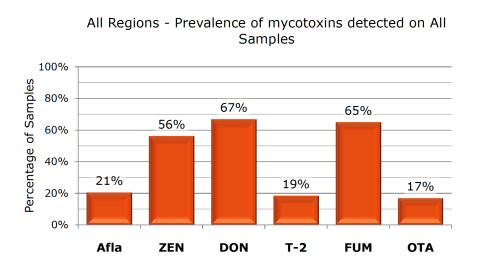
Since 2004, the BIOMIN Mycotoxin Survey Program constitutes the longest running, and most comprehensive survey of its kind. It details the incidence of the main mycotoxins occurring in agricultural commodities, which include aflatoxins (Afla), zearalenone (ZEN), deoxynivalenol (DON), T-2 toxin (T-2), fumonisins (FUM) and ochratoxin A (OTA).

The survey focuses on components that are used for feed such as corn, wheat, barley, rice, soybean meal, corn gluten meal, dried distillers grains (DDGS) and silage, among others.

From January to June 2018, the BIOMIN scientists have tested 8,310 samples, from different regions around the world.

Figure 1. Occurrence of mycotoxins worldwide through Q2 2018. Average of all samples collected by BIOMIN.

untitled.png