Category Archives: Decontamination Microbial

USA – Shigella Outbreak increases in San Diego

Food Poison Journal

Shigella - kswfoodworld

Image CDC

The County of San Diego has announced the ongoing outbreak of shigella now stands at 46 confirmed and five probable cases, with slowing cases up one from a week ago and a total of three since the 41 confirmed and seven probable cases reported in the Dec. 3 update.

The continuing investigation shows onset of illness dates between Aug. 16 and Nov. 21, 2021, with the new cases occurring between Nov.15 and Nov. 21, 2021, with symptom onset for the latest case being Nov. 27, 2021. The 51 cases in this outbreak represent 13% of the 402 total cases reported to date in San Diego County.

The County Public Health shigella website includes an epidemiological curve showing declining case numbers in recent weeks.

Research – The Application of Bacillus subtilis for Adhesion Inhibition of Pseudomonas and Preservation of Fresh Fish

MDPI

Inhibiting the growth of spoilage bacteria, such as Pseudomonas spp., is key to reducing spoilage in fish. The mucus adhesion test in vitro showed that the adhesion ability of Bacillus subtilis was positively correlated with its inhibition ability to Pseudomonas spp. In vivo experiments of tilapia showed that dietary supplementation with B. subtilis could reduce the adhesion and colonization of Pseudomonas spp. in fish intestines and flesh, as well as reduce total volatile basic nitrogen (TVB-N) production. High throughput and metabolomic analysis showed treatment with B. subtilis, especially C6, reduced the growth of Pseudomonas spp., Aeromonas spp., Fusobacterium spp., and Enterobacterium spp., as well as aromatic spoilage compounds associated with these bacteria, such as indole, 2,4-bis(1,1-dimethylethyl)-phenol, 3-methyl-1-butanol, phenol, and 1-octen-3-ol. Our work showed that B. subtilis could improve the flavor of fish by changing the intestinal flora of fish, and it shows great promise as a microecological preservative. View Full-Text

USA – CDC – Food Safety Page

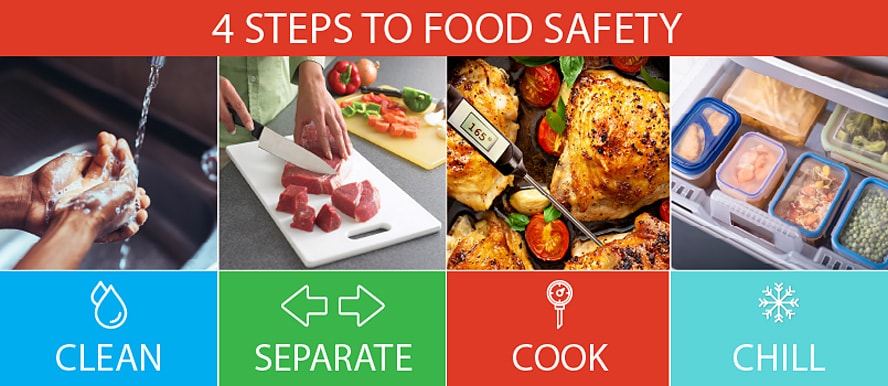
4 Steps to Food Safety - Clean, Separate, Cook and Chill

CDC

Research – Effect of Plasma-Activated Solution Treatment on Cell Biology of Staphylococcus aureus and Quality of Fresh Lettuces

MDPI

This study aimed to investigate effects of plasma-activated solution (PAS) on the cell biology of Staphylococcus aureus and qualities of fresh lettuce leaves. PAS was prepared by dielectric barrier discharge plasma and incubated with S. aureus for 10–30 min or with lettuces for 10 min. Effects on cell biology were evaluated with microscopic images, cell integrity, and chemical modification of cellular components. Effects on lettuce quality were estimated with the viable microbial counts, color, contents of vitamin C and chlorophyll, and surface integrity. PAS reduced S. aureus population by 4.95-log and resulted in increased cell membrane leakage. It also resulted in increased contents of reactive oxygen species in cells, C=O bonds in peptidoglycan, and 8-hydroxydeoxyguanosine content in cellular DNA, and reduced ratios of unsaturated/saturated fatty acids in the cell membrane. PAS treatment reduced bacterial load on fresh lettuce and had no negative effects on the quality. Data suggest that PAS can be used for the disinfection of ready-to-eat fresh vegetables. View Full-Text

Research – Differential Survival of Generic E. coli and Listeria spp. in Northeastern U.S. Soils Amended with Dairy Manure Compost, Poultry Litter Compost, and Heat-Treated Poultry Pellets and Fate in Raw Edible Radish Crops

Journal of Food Protection

Composted or heat-treated Biological Soil Amendments of Animal Origin (BSAAO) can be added to soils to provide nutrients for fresh produce. These products lower the risk of pathogen contamination of fresh produce when compared with use of untreated BSAAO; however, meteorological conditions, geographic location, and soil properties can influence the presence of pathogenic bacteria, or their indicators (e.g., generic E. coli) and allow potential for produce contamination. Replicated field plots of loamy or sandy soils were tilled and amended with dairy manure compost (DMC), poultry litter compost (PLC), or no compost (NoC) over two different field seasons, and non-composted heat-treated poultry pellets (HTPP) during the second field season. Plots were inoculated with a three-strain cocktail of rifampicin-resistant E. coli (rE.coli) at levels of 8.7 log CFU/m2. Direct plating and most probable number (MPN) methods measured the persistence of rE.coli and Listeria spp. in plots through 104 days post-inoculation. Greater survival of rE. coli was observed in PLC plots in comparison to DMC plots and NoC plots during year 1 (P < 0.05). Similar trends were observed for year 2, where rE. coli survival was also greater in HTPP amended plots (P < 0.05). Survival of rE. coli was dependent on soil type, where water potential and temperature were significant covariables. Listeria spp. were found in NoC plots, but not in plots amended with HTPP, PLC or DMC. Radish data demonstrate that PLC treatment promoted the greatest level of rE.coli translocation when compared to DMC and NoC treatments (P  < 0.05). These results are consistent with findings from studies conducted in other regions of the US and informs Northeast produce growers that composted and non-composted poultry-based BSAAO supports greater survival of rE. coli in field soils. This result has the potential to impact the food safety risk of edible produce grown in BSAAO amended soils as a result of pathogen contamination.

Research – Desiccation survival in Salmonella enterica, Escherichia coli and Enterococcus faecium related to initial cell concentration and cellular components

Journal of Food Protection

Salmonella enterica is well-known for its ability to survive and persist in low-moisture environments.  Previous studies have indicated a link between the initial cell concentration and the population of Salmonella that survive upon desiccation and subsequent storage; however, how the initial cell concentration affects survival is unknown.  This study examined the basis of this phenomena and whether it occurred in other microorganisms, specifically Shiga toxigenic Escherichia coli (STEC), and Enterococcus faecium . Salmonella, STEC, and E. faecium were grown as lawns on TSAYE and harvested using buffered peptone water (BPW). To determine recovery at different initial cell levels, cultures were diluted to 9, 7, and 5 log CFU/mL and applied to filters.  Filters were dried for 24 h, then stored for 28 d at 25°C/33% RH. During storage, cells were recovered from filters using BPW and cultivated on TSAYE.  Both Salmonella and E. coli , but not E. faecium , showed non-proportional recovery. Less viability remained with lower initial starting population after 24 h desiccation such that ≥10 log CFU/mL were recovered when 11 log CFU/mL was desiccated, but ❤ log CFU/mL were recovered when 5 log CFU/mL was desiccated. Once dried, persistence did not appear affected by initial cell concentration. When dead cells (heat-treated) were added to the diluent, recovery of Salmonella was proportional with respect to the initial cell concentration. To further examine the response on desiccation, Salmonella was diluted in BPW containing one of 11 different test cell components related to quorum sensing or known to affect desiccation resistance to assess recovery and persistence. Of the 11 additions only cell debris fractions, cell-free extract, and peptidoglycan improved recovery of Salmonella . Desiccation survival appears related to cell wall components, however, the exact mechanism affecting survival remains unknown.

Research – Legionella Occurrence beyond Cooling Towers and Premise Plumbing

MDPI

Legionella_Plate_01

Legionella is an environmental pathogen that is responsible for respiratory disease and is a common causative agent of water-related outbreaks. Due to their ability to survive in a broad range of environments, transmission of legionellosis is possible from a variety of sources. Unfortunately, a disproportionate amount of research that is devoted to studying the occurrence of Legionella in environmental reservoirs is aimed toward cooling towers and premise plumbing. As confirmed transmission of Legionella has been linked to many other sources, an over-emphasis on the most common sources may be detrimental to increasing understanding of the spread of legionellosis. This review aims to address this issue by cataloguing studies which have examined the occurrence of Legionella in less commonly investigated environments. By summarizing and discussing reports of Legionella in fresh water, ground water, saltwater, and distribution system drinking water, future environmental and public health researchers will have a resource to aid in investigating these pathogens in relevant sources. View Full-Text

USA – FDA Warning Letter – Sabra Dipping Company, LLC

FDA


WARNING LETTER
CMS #615938

December 1, 2021

Dear Mr. Bergstein:

The United States Food and Drug Administration (FDA) and Virginia Department of Agriculture and Consumer Services (VDACS) jointly inspected your ready-to-eat (RTE) hummus manufacturing facility located at 15900 Sabra Way, South Chesterfield, Virginia, from April 28, 2021 through May 6, 2021. The inspection was initiated by FDA and VDACS after FDA Investigators collected a sample of Sabra Classic Hummus from retail and subsequent testing revealed the sample contained Salmonella enterica serovar Havana Group G (hereinafter Salmonella Havana). After being notified by FDA on March 26, 2021, you initiated a Class I voluntary recall of your Sabra Classic Hummus product.

During a joint inspection of your facility, FDA and VDACS Investigators found serious violations of the Current Good Manufacturing Practice, Hazard Analysis, and Risk-Based Preventive Controls for Human Food regulation (CGMP & PC rule), Title 21, Code of Federal Regulations, Part 117 (21 CFR Part 117). At the conclusion of the inspection, the Investigators issued you an FDA Form 483, Inspectional Observations. Based on FDA’s inspectional findings, we have determined that the RTE hummus products manufactured in your facility are adulterated within the meaning of section 402(a)(4) of the Federal Food, Drug, and Cosmetic Act (the Act) [21 U.S.C. § 342(a)(4)], in that they were prepared, packed or held under insanitary conditions whereby they may have been contaminated with filth or rendered injurious to health. In addition, failure of the owner, operator, or agent in charge of a covered facility to comply with the preventive controls provisions of the CGMP & PC rule (located in subparts A, C, D, E, F, and G of part 117) is prohibited by section 301(uu) of the Act [21 U.S.C. § 331(uu)].

Additionally, the presence of Salmonella Havana in your RTE hummus products, as evidenced by the laboratory analysis of FDA’s retail sampling, causes your recalled Classic hummus products to be adulterated within the meaning of section 402(a)(1) of the Federal Food, Drug, and Cosmetic Act (the Act) [21 U.S.C. § 342(a)(1)] in that they bear or contain an added poisonous or deleterious substance which may render them injurious to health. You may find the Act and further information about the CGMP & PC rule through links in FDA’s home page at www.fda.gov.External Link Disclaimer

We received your written responses on May 27, 2021 and July 8, 2021, which describe your completed and planned corrective actions. After reviewing the inspectional findings and responses you provided, we are issuing this letter to advise you of FDA’s concerns and provide detailed information describing the findings at your facility.

Scotland – FSS launches Christmas food safety campaign

HPS

Food Standards Scotland (FSS) has launched a campaign urging families to be extra vigilant with food safety over the Christmas season, encouraging people to ensure effective safety practices are used to minimise the risk of illness.

The message is being delivered via advertising on social media, radio and on billboards in busy public places, using a series of images showing the ill effects of food poisoning, under the headline ‘Christmas isn’t so magical with food poisoning’.

FSS has also produced a Christmas food safety checklist, highlighting the best ways of reducing the risks of food poisoning.

Research – Bacillus amyloliquefaciens ALB65 Inhibits the Growth of Listeria monocytogenes on Cantaloupe Melons

ABSTRACT

Listeria monocytogenes is a foodborne pathogen that causes high rates of hospitalization and mortality in people infected. Contamination of fresh, ready to eat produce by this pathogen is especially troubling because of the ability of this bacterium to grow on produce under refrigeration temperatures. In this study, we created a library of over 8,000 plant phyllosphere-associated bacteria and screened them for the ability to inhibit the growth of L. monocytogenes in an in vitro fluorescence-based assay. One isolate, later identified as Bacillus amyloliquefaciens ALB65, was able to inhibit the fluorescence of L. monocytogenes by >30-fold in vitro. B. amyloliquefaciens ALB65 was also able to grow, persist, and reduce the growth of L. monocytogenes by >1.5 log CFU on cantaloupe melon rinds inoculated with 5 × 103 CFU at 30°C and was able to completely inhibit its growth at temperatures below 8°C. DNA sequence analysis of the B. amyloliquefaciens ALB65 genome revealed six gene clusters that are predicted to encode genes for antibiotic production; however, no plant or human virulence factors were identified. These data suggest that B. amyloliquefaciens ALB65 is an effective and safe biological control agent for the reduction of L. monocytogenes growth on intact cantaloupe melons and possibly other types of produce.
IMPORTANCE Listeria monocytogenes is estimated by the Centers for Disease Control and Prevention and the U.S. Food and Drug Administration to cause disease in approximately 1,600 to 2,500 people in the United States every year. The largest known outbreak of listeriosis in the United States was associated with intact cantaloupe melons in 2011, resulting in 147 hospitalizations and 33 deaths. In this study, we demonstrated that Bacillus amyloliquefaciens ALB65 is an effective biological control agent for the reduction of L. monocytogenes growth on intact cantaloupe melons under both pre- and postharvest conditions. Furthermore, we demonstrated that B. amyloliquefaciens ALB65 can completely inhibit the growth of L. monocytogenes during cold storage (<8°C).