Category Archives: Death

USA – Outbreak Investigation of Salmonella: Cantaloupes (November 2023)

FDA

Cantaloupe

Products and Stores Affected (Expanded and Updated on 11/27/2023)

Recalled whole cantaloupe from the following brands:

  • Whole fresh cantaloupes with a label on the cantaloupe that says “Malichita” or “Rudy”, “4050”, and “Product of Mexico/produit du Mexique”.
  • Retailers and wholesalers would have received recalled whole melons from Crown Jewels Produce in boxes labeled “Malachita/Z Farms” or from Sofia Produce doing business as TruFresh in boxes labeled “Malichita” or “Rudy”, or from Pacific Trellis in corrugated cartons with certain lot codes.

Recalled cut cantaloupe and products made from recalled whole cantaloupes:

  • ALDIExternal Link Disclaimer cantaloupe, cut cantaloupe, and pineapple spears in clamshell packaging with Best-by dates between October 27 and October 31.
  • Vinyard cantaloupe chunks and cubes, fruit mixes, melon medleys, and fruit cups containing cantaloupe. Most have a “Vinyard” label, and some have a red label with “Fresh” sold between October 30 and November 10 in Oklahoma stores.
  • Freshness Guaranteed seasonal blend, melon trio, melon mix, fruit blend, fruit bowl, seasonal fruit tray, fruit mix, and cantaloupe chunks; and RaceTrac fruit medley sold in clear square or round plastic containers at select retail stores in IN, MI, OH, KY, NC, TN, VA, IL, TX, LA (see recall announcement for lot codes and “best by” dates).

More information about recalled products and product images can be found in the recall links above.

FDA’s investigation is ongoing. Updates to this advisory will be provided as they become available.

Symptoms of Salmonella Infection

Illness usually occurs within 12 to 72 hours after eating contaminated food and usually lasts four to seven days. Symptoms include diarrhea, fever, and abdominal cramps. Children younger than five, the elderly, and people with weakened immune systems are more likely to have severe infections.

Status

Ongoing: updates to this advisory will be provided as they become available.

Recommendation

  • Consumers, restaurants, retailers, and wholesalers should not eat, sell, or serve recalled cantaloupe or recalled products containing cantaloupe.
  • Some consumers freeze cantaloupe for later use. Consumers, restaurants, and retailers should check their freezers and throw away recalled fresh or cut cantaloupe that was frozen for later use.
  • If you cannot tell if your cantaloupe is part of the recall, do not eat or use it and throw it away.
  • Retailers and wholesalers would have received recalled whole melons from Crown Jewels Produce in boxes labeled “Malachita/Z Farms” or from Sofia Produce doing business as TruFresh in boxes labeled “Malichita” or “Rudy”, or from Pacific Trellis in corrugated cartons with certain lot codes.
  • Follow FDA’s safe handling and cleaning advice and use extra vigilance in cleaning and sanitizing any surfaces and containers that may have come in contact with recalled products to reduce the risk of cross-contamination.
  • Contact your healthcare provider if you think you may have symptoms of a Salmonella infection after eating recalled cantaloupe.

Research – Foodborne botulism outbreak involving different nationalities during the Rugby World Cup: critical role of credit card data and rapid international cooperation, France, September 2023

Eurosurveillance

An unprecedented outbreak of 15 cases (including one death) of foodborne botulism occurred in Bordeaux, France, in September 2023 during the Rugby World Cup. Here we describe the national and international outbreak investigation using credit card data and control measures taken.

On 10 September 2023, the Bordeaux University Hospital reported three suspected cases of botulism to the local public health authorities [1]. All suspected cases had visited the same restaurant (Restaurant A) in Bordeaux on different dates and reported consumption of canned marinated sardines. The sardines were part of a batch made by Restaurant A on 1 September 2023 and served between 1 and 10 September. Cases were of different nationalities. In the previous days, the city had hosted two international rugby games as part of the Rugby World Cup attended by a large number of international visitors. An investigation was initiated to identify and contact persons visiting restaurant A and to contact public health agencies of countries whose citizens were affected by the outbreak.

Considering the severity of botulism and the urgency of control measures to stop the outbreak, an active search for persons who had consumed the sardines was performed by using data retrieved from credit card receipts of restaurant A.

A suspected case of botulism was defined as a person with symptoms compatible with botulism (oculomotor palsy, mydriasis, ptosis, dysphagia, nausea, vomiting, diarrhoea), living or visiting the Bordeaux area and visiting Restaurant A between 1 and 10 September 2023. A confirmed case was defined as detection of type B botulinum neurotoxins (BoNT) in stool and/or serum samples and/or detection of type B  in stools from a suspected case.

By screening meal orders and credit card receipts of Restaurant A, we identified 29 customers who had ordered canned sardines (Figure 1). Among these, 12 had already been identified as suspected cases, 14 were contacted by the French or British health authorities and were considered non-cases as they did not present any symptoms and three were symptomatic British citizens who were urgently referred to an emergency care in the United Kingdom (UK) on 13 September where they received botulinum antitoxin.

Japan – Elderly man, woman die after food poisoning sickens 33 at east Japan nursing facility – STEC E.coli

Mainichi

SHIZUOKA — Two people have died after dozens fell ill following the consumption of meals provided at a nursing facility in the Shizuoka Prefecture town of Nishiizu, the prefectural government announced on Nov. 15.

The meals in question included dishes such as “takikomi” rice, “tatsuta-age” deep-friend mackerel and stew containing “ganmodoki” tofu fritters. Of the 94 staff members and residents who ate the food, 33 aged 45 to 103 fell ill, complaining of symptoms such as diarrhea. A pathogenic O157 strain of E. coli bacteria was detected in the stools of 11 of those who fell ill.

USA – 87 Year Old Dies After Acquiring E. coli Food Poisoning From Miguel’s Cocina in San Diego, California

Food Poisoning News

According to local reports, the eldest person to fall ill in the Miguel’s Cocina Salmonella outbreak has died. This follow reports that the second eldest, an 84 year-old woman represented by Ron Simon & Associates, the national salmonella law firm that has filed all the lawsuits in this litigation so far, has finally been released from the hospital. Unfortunately, on the day of her release, her long-time husband also passed away. So far, several dozen victims have come forward, according to the Miguel’s Cocina E. Coli Lawyer Ron Simon, adding “my office is still receiving calls every day from Miguel Concina victims. We represent more than two dozen victims so far, and expect that number to grow. People who consume food at a restaurant have the right to expect that the food to be safe and wholesome. Obviously, it was not.”

Research- Three clusters of Salmonella Enteritidis ST11 infections linked to chicken meat and chicken meat products

EFSA

Abstract

From 1 January–24 October 2023, 335 laboratory-confirmed Salmonella Enteritidis ST11 cases belonging to three distinct microbiological clusters have been reported in 14 EU/EEA countries, the United Kingdom and the United States, affecting all age groups. Most interviewed cases reported consumption of chicken meat, including chicken kebabs. Nine cases in three countries were hospitalised and one case in Austria died, highlighting the potential for severe and fatal infections from this outbreak. Following the food exposure information and the national investigations in 2023, the food safety authorities in Austria, Denmark and Italy investigated 10 food products (six contaminated by Salmonella Enteritidis ST11 cluster 1 and/or cluster 2), seven final producers in Poland and one in Austria. Traceability information revealed that three Salmonella-contaminated kebabs shared a number of Polish food business operators. The trading link of the suspected kebab suggests one or more common source(s)/point(s) of contamination in Austria, Denmark, and Italy. Following the collection of genomic information, the cluster analysis revealed the presence of the outbreak strains in the food chain in multiple European countries. Most positive foods sampled in 2022–2023 with shared epidemiological data originated from Poland. Given the information collected, contaminated chicken kebab and chicken meat are the plausible vehicles of the human infections reported in these three clusters. In the absence of conclusive microbiological evidence and comprehensive traceability, the role of the identified final producers, their meat suppliers, and the possible involvement of other food business operators as sources of the infections could not be confirmed or excluded. Further investigations are needed to identify the root cause of the contamination and the source of infections, which is crucial for prompt implementation of targeted effective control and corrective measures. As the source(s) have not been identified, new cases are likely to occur in this prolonged multi-country outbreak.

South Africa – GP POLICE WARN AGAINST VIGILANTISM AFTER 4 KIDS DIE FROM ALLEGED FOOD POISONING

EWN

JOHANNESBURG – Police are urging Gauteng residents not to take the law into their own hands following the death of four children from alleged food poisoning this week.

Authorities are probing the mysterious deaths of two children aged between two and three in the West Rand.

Preliminary investigations suggest that the pair died after eating snacks bought from a nearby taxi rank.

The incident comes just a few days after the passing of two other children from Soweto – who became fatally ill after eating biscuits they allegedly bought from a spaza shop in Naledi.

France – Cases of food botulism in Bordeaux: 15 cases recorded, including 10 hospitalized and 1 death. Situation update as of September 14, 2023.

Sante Publique

As of September 14, 2023, 15 suspected cases of botulism have been identified, of which 10 are hospitalized. One person died. These people come from several countries (USA, Canada, Ireland, Great Britain, Spain, Germany, Greece). They all frequented the same restaurant-bar in Bordeaux, the Tchin Tchin Wine Bar, over the last week. The foods involved are jars of sardines in oil homemade by the restaurateur and served between September 4 and 10, 2023 in this Bordeaux restaurant. 
Type B botulism was confirmed by the National Reference Center in several of these cases and the bacteria in question was found in the suspected foods.

Investigations are continuing to find all the people who may have consumed these sardines and Public Health France is, in this context, in contact with the national public health agencies of the other countries concerned.

The health authorities, in conjunction with Public Health France and the National Reference Center (CNR) for Botulism (Institut Pasteur) recommend that people who have frequented the Bordeaux establishment Tchin Tchin Wine Bar (3 Rue Emile Duployé, 33000 Bordeaux), between Monday 4 and Sunday 10 September 2023, to consult a doctor urgently or to contact the 15th, mentioning cases of botulism, in the event of symptoms appearing after this attendance .  

The French health authorities, in collaboration with Santé publique France and the National Reference Center for Botulism (Institut Pasteur), advise anyone who attended the Tchin Tchin Wine Bar in Bordeaux (3 Rue Emile Duployé, 33000 Bordeaux) between Monday 4 and Sunday 10 September 2023 to urgently consult a doctor or contact emergency number 15, mentioning cases of botulism, if they present symptoms since attending the restaurant .

France – Emergency Serious food poisoning: 10 cases of botulism, including 8 hospitalized and 1 death, linked to visiting a restaurant in Bordeaux

Sante Publique

kswfoodworld

The health authorities, in conjunction with Public Health France and the National Reference Center for Botulism (Institut Pasteur) recommend that people who have visited the Bordeaux establishment Tchin Tchin Wine Bar (3 Rue Emile Duployé, 33000 Bordeaux) between Monday 4 and Sunday September 10, 2023 to consult a doctor urgently or to contact the 15th, mentioning cases of botulism, in the event of symptoms appearing after this attendance.

The people concerned all frequented the same restaurant-bar in Bordeaux, the Tchin Tchin Wine Bar, over the last week. The suspected foods are at this stage canned sardines in oil homemade by the restaurateur and served between September 4 and 10, 2023 in this Bordeaux restaurant. 

Botulism is a serious disease (fatal in 5 to 10% of cases) whose incubation time can range from a few hours to a few days. 
Symptoms include, to varying degrees: early digestive signs which may be fleeting (abdominal pain, nausea, vomiting and diarrhea), eye damage (failure to accommodate, blurred or double vision), dry mouth accompanied by a lack of swallowing or even speech, or neurological symptoms (wrong paths, more or less severe paralysis of the muscles). There is usually no fever.

If you have symptoms, consult a doctor urgently or contact 15, mentioning cases of botulism.

What are the possible sources of contamination?

Botulism is a serious neurological condition caused by a very potent toxin produced by the bacteria Clostridium botulinum. It develops particularly in poorly preserved foods. In France, the majority of cases of botulism correspond to food poisoning, by ingestion of the toxin produced by C. botulinum in preserved foods that have not undergone an extensive sterilization process: cured meats, cold meats or even family-made preserves. or artisanal.

It is the extremely powerful toxin that it synthesizes that is responsible for the disease.

USA – Summary of Possible Multistate Enteric (Intestinal) Disease Outbreaks in 2021

CDC

Outbreak Investigations At A Glance

Possible Multistate Outbreaks

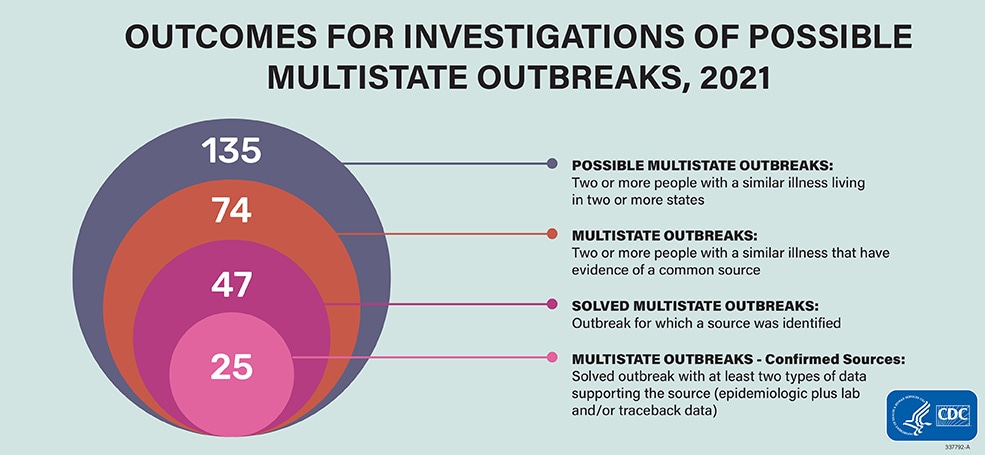
This analysis includes 135 possible multistate outbreak investigations during 2021.

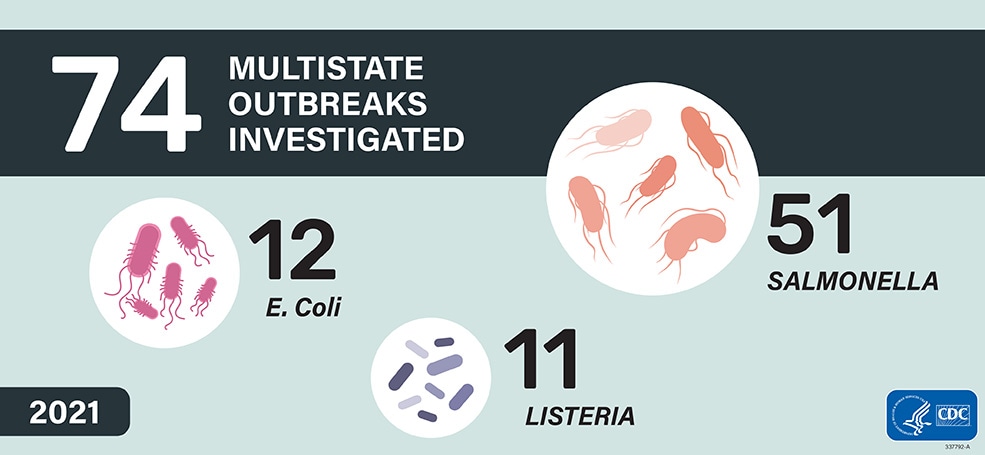
This analysis includes 135 investigations of possible multistate enteric (intestinal) outbreaks during 2021. Some possible outbreaks were excluded from this report because they were determined to be single state or because they were linked to international travel. After investigation, 74 (55%) of these were determined to be multistate outbreaks, and investigators solved 47 (64%) of these outbreaks.

Multistate Outbreaks

74 (55%) of the 135 investigations were determined to be multistate outbreaks.

The number of outbreaks increased from 2020 but was lower than the 82 investigated outbreaks in 2019. The number of outbreaks investigated in 2021 was likely lower than that in 2019 due in part to continued effects of the COVID-19 pandemic on enteric disease outbreak detection and investigation (e.g., decreased resources at local, state, and federal public health agencies, changes in healthcare-seeking behavior, and changed restaurant dining and grocery shopping patterns.) Additionally, changing diagnostic testing practices likely continued to affect enteric disease surveillance and the ability to identify possible outbreaks.

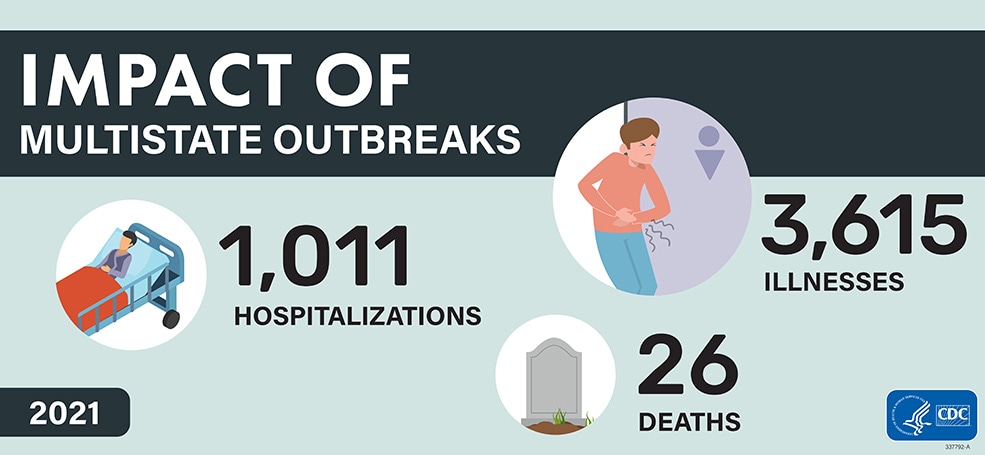
The 74 investigated multistate outbreaks resulted in 3,615 illnesses, 1,011 hospitalizations, and 26 deaths

Solved Multistate Outbreaks

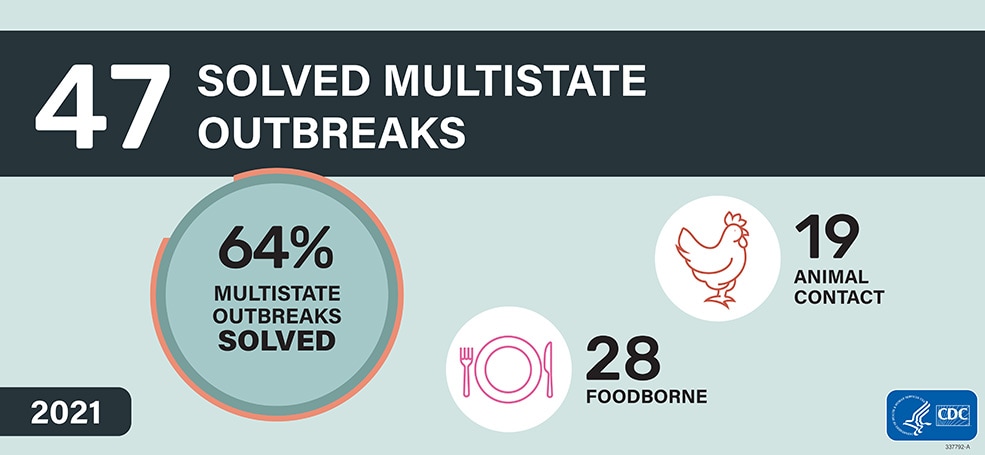
Among the 74 investigated multistate outbreaks, 47 (64%) were solved, including 25 outbreaks with confirmed sources and 22 with suspected sources.

Among the 74 multistate outbreaks, 47 (64%) were solved, meaning a confirmed or suspected source of the outbreak was identified, including 25 (53%) outbreaks with confirmed sources and 22 (47%) with suspected sources. Among the 47 solved outbreaks, 28 (60%) were linked to contaminated foods, and 19 (40%) were linked to animal contact.

Solved multistate outbreaks caused at least 2,047 illnesses. Solved multistate outbreaks linked to contaminated food caused 1,740 illnesses, 496 hospitalizations, and 15 deaths, while multistate outbreaks linked to animal contact caused 1,307 illnesses, 329 hospitalizations, and 3 deaths.

India – Food Poisoning Kills Two Passengers On Board Kota-Patna Express, Six More Critical

The News Agency

Two passengers on board the Kota-Patna Express died late on Sunday when the train stopped at Agra. According to information available, the deceased dup was part of a 90-member contingent which was headed for a pilgrimage to Mathura. Condition of five more is critical and they are undergoing treatment at the Railway Hospital in the Taj city.

Their postmortem has been done and food poisoning seems to be the cause behind the severe dehydration which led to their deaths. The actual cause of death will be known after the report comes, officials said.