Category Archives: Cryptosporidium

Research – Outbreaks Associated with Untreated Recreational Water — United States, 2000–2014

CDC

Outbreaks associated with untreated recreational water can be caused by pathogens, toxins, or chemicals in fresh water (e.g., lakes, rivers) or marine water (e.g., ocean). During 2000–2014, public health officials from 35 states and Guam voluntarily reported 140 untreated recreational water–associated outbreaks to CDC. These outbreaks resulted in at least 4,958 cases of disease and two deaths. Among the 95 outbreaks with a confirmed infectious etiology, enteric pathogens caused 80 (84%); 21 (22%) were caused by norovirus, 19 (20%) by Escherichia coli, 14 (15%) by Shigella, and 12 (13%) by Cryptosporidium. Investigations of these 95 outbreaks identified 3,125 cases; 2,704 (87%) were caused by enteric pathogens, including 1,459 (47%) by norovirus, 362 (12%) by Shigella, 314 (10%) by Cryptosporidium, and 155 (5%) by E. coli. Avian schistosomes were identified as the cause in 345 (11%) of the 3,125 cases. The two deaths were in persons affected by a single outbreak (two cases) caused by Naegleria fowleri. Public parks (50 [36%]) and beaches (45 [32%]) were the leading settings associated with the 140 outbreaks. Overall, the majority of outbreaks started during June–August (113 [81%]); 65 (58%) started in July. Swimmers and parents of young swimmers can take steps to minimize the risk for exposure to pathogens, toxins, and chemicals in untreated recreational water by heeding posted advisories closing the beach to swimming; not swimming in discolored, smelly, foamy, or scummy water; not swimming while sick with diarrhea; and limiting water entering the nose when swimming in warm freshwater.

An outbreak associated with untreated recreational water* is the occurrence of similar illnesses in two or more persons, epidemiologically linked by location and time of exposure to recreational water or to pathogens, toxins, or chemicals aerosolized or volatilized from recreational water into the surrounding air. Public health officials in the 50 states, the District of Columbia, U.S. territories, and Freely Associated States can voluntarily report recreational water–associated outbreaks to CDC. This report focuses on data on two groups of untreated recreational water–associated outbreaks: 1) those that began during 2000–2012 and were previously reported (1), and 2) those that began during 2013–2014 and were electronically reported to the Waterborne Disease and Outbreak Surveillance System (WBDOSS)§ by December 31, 2015. Data on each outbreak include case count, number of deaths, etiology, setting (e.g., park), and venue (e.g., lake/reservoir/pond) where the exposure occurred, and earliest illness onset date. Poisson regression analysis was conducted to assess the trend in the annual counts of outbreaks.

Research – Morbidity, mortality, and long-term consequences associated with diarrhoea from Cryptosporidium infection in children younger than 5 years: a meta-analyses study

The Lancet 


The protozoan Cryptosporidium is a leading cause of diarrhoea morbidity and mortality in children younger than 5 years. However, the true global burden of Cryptosporidium infection in children younger than 5 years might have been underestimated in previous quantifications because it only took account of the acute effects of diarrhoea. We aimed to demonstrate whether there is a causal relation between Cryptosporidium and childhood growth and, if so, to quantify the associated additional burden.

In 2016, Cryptosporidium infection was the fifth leading diarrhoeal aetiology in children younger than 5 years, and acute infection caused more than 48 000 deaths (95% uncertainty interval [UI] 24 600–81 900) and more than 4·2 million disability-adjusted life-years lost (95% UI 2·2 million–7·2 million). We identified seven data sources from the scientific literature and six individual-level data sources describing the relation between Cryptosporidium and childhood growth. Each episode of diarrhoea caused by Cryptosporidium infection was associated with a decrease in height-for-age Z score (0·049, 95% CI 0·014–0·080), weight-for-age Z score (0·095, 0·055–0·134), and weight-for-height Z score (0·126, 0·057–0·194). We estimated that diarrhoea from Cryptosporidium infection caused an additional 7·85 million disability-adjusted life-years (95% UI 5·42 million–10·11 million) after we accounted for its effect on growth faltering—153% more than that estimated from acute effects alone.

Interpretation

Our findings show that the substantial short-term burden of diarrhoea from Cryptosporidium infection on childhood growth and wellbeing is an underestimate of the true burden. Interventions designed to prevent and effectively treat infection in children younger than 5 years will have enormous public health and social development impacts.

Research – Cryptosporidium, Pseudomonas and Legionella responsible for most outbreaks in swimming venues including hotel swimming pools

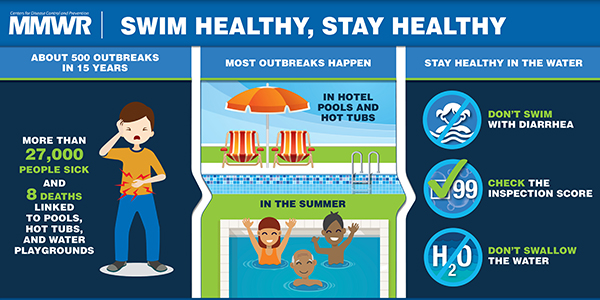
The figure is a visual abstract that details illnesses associated with recreational water and recommends how to stay healthy when swimming.

CDC-Outbreaks Associated with Treated Recreational Water — United States, 2000–2014

Outbreaks associated with exposure to treated recreational water can be caused by pathogens or chemicals in venues such as pools, hot tubs/spas, and interactive water play venues (i.e., water playgrounds). During 2000–2014, public health officials from 46 states and Puerto Rico reported 493 outbreaks associated with treated recreational water. These outbreaks resulted in at least 27,219 cases and eight deaths. Among the 363 outbreaks with a confirmed infectious etiology, 212 (58%) were caused by Cryptosporidium (which causes predominantly gastrointestinal illness), 57 (16%) by Legionella (which causes Legionnaires’ disease, a severe pneumonia, and Pontiac fever, a milder illness with flu-like symptoms), and 47 (13%) by Pseudomonas (which causes folliculitis [“hot tub rash”] and otitis externa [“swimmers’ ear”]). Investigations of the 363 outbreaks identified 24,453 cases; 21,766 (89%) were caused by Cryptosporidium, 920 (4%) by Pseudomonas, and 624 (3%) by Legionella. At least six of the eight reported deaths occurred in persons affected by outbreaks caused by Legionella. Hotels were the leading setting, associated with 157 (32%) of the 493 outbreaks. Overall, the outbreaks had a bimodal temporal distribution: 275 (56%) outbreaks started during June–August and 46 (9%) in March. Assessment of trends in the annual counts of outbreaks caused by Cryptosporidium, Legionella, or Pseudomonas indicate mixed progress in preventing transmission. Pathogens able to evade chlorine inactivation have become leading outbreak etiologies. The consequent outbreak and case counts and mortality underscore the utility of CDC’s Model Aquatic Health Code (https://www.cdc.gov/mahc) to prevent outbreaks associated with treated recreational water.

Hlavsa MC, Cikesh BL, Roberts VA, et al. Outbreaks Associated with Treated Recreational Water — United States, 2000–2014. MMWR Morb Mortal Wkly Rep 2018;67:547–551. DOI: http://dx.doi.org/10.15585/mmwr.mm6719a3

USA – Farm animals quarantined following reported illnesses at petting zoo – Cryptosporidium

Turn to 10 crypto

Animals at a Middletown farm are being quarantined after three people got sick, Rhode Island health officials announced Monday.

The Rhode Island Department of Environmental Management said one child and two adults came down with cryptosporidiosis after having contact with goats during “pet and cuddle” events at Simmons Farm on West Main Road on March 25 and 31.

“Cryptosporidiosis lives in the gut of infected humans or animals. It is spread through contact with the feces of an infected person or animal, typically when people touch their mouths with contaminated hands,” according to the Rhode Island Department of Health.

USA – Cryptosporidium cases reported in La Crosse County, Wisconsin

Outbreak News Today 


La Crosse County health officials report experiencing an increase in reported Cryptosporidiosis cases. La Crosse County has had 4 cases of cryptosporidiosis during the past 2 weeks according to Carol Drury, RS, Environmental Health Manager with the La Crosse County Health Department.

Four additional cases have been reported statewide associated with exposure from La Crosse County. The Health Department has identified that the cases have occurred among children and adults.

Public Health/Environmental Health staff are working to prevent further spread by contacting infected persons, recommending treatment and hygiene practices per guidelines from the Wisconsin Department of Health Services.

UK – Petting Farms and Crytosporidium

Westmorland Gazette 763px-Cryptosporidium_parvum_01

A CUMBRIA and north Lancashire public health chief is urging parents to be aware of potential infections that can be caught at farm attractions.

Dr Ken Lamden says everyone should practice good hand hygiene when visiting petting farms where animals can be handled.

Over the past 20 years, an average of around 80 cases of cryptosporidium infection linked to visits to petting farms have been reported to Public Health England each year. This is out of a total of around two million visits to the 1,000 plus farm attractions in the UK, with peak visitor times during school and public holidays.

Ireland – 6,000 People Affected by Cryptosporidium

The Irish Sun763px-Cryptosporidium_parvum_01

CONTAMINATED water has left 13 people with stomach  illnesses after two outbreaks of the parasitic disease crypto-sporidiosis.

Up to 6,000 people in Roscommon town and its surrounds have been affected by  the bug in the local water supply.

A “boil water notice” has been in place since April 25. The contamination can  lead to a gut infection caused by a parasite, which results in a diarrhoea-type  illness.

People living and working in the area have been advised by Roscommon County  Council and the HSE to boil all water for drinking, preparation of salads and  for use in brushing teeth.

Both bodies have set up an Incident Response Team to minimise the risk to the  public.

Sales of bottled water have shot up in the area amid concerns that the boil  water restriction could remain in place until the system gets the all-clear,  which could take several weeks.


Research – Study Pinpoints Pathogens Causing Biggest Diarrhea Burden in Kids

CIDRAP

While many pathogens cause serious diarrhea in children in developing countries, four stand out as culprits in most of the infections, a finding that could drive new prevention strategies, an international research team reported today.

The group spent 3 years in seven developing countries, collecting health information, lab samples, and outcome data on 3,439 youngsters who had moderate-to-severe diarrhea. They published their findings today in an early online release from The Lancet.

On a global scale each year, diarrheal diseases kill about 800,000 children under age 5, most of them in sub-Saharan Africa and southern Asia, according to the report.

Though interventions such as rotavirus vaccines are starting to have an impact on deaths and disease incidence, scientific data to guide other strategies to curb the diseases are scarce, especially in regions where child deaths are the highest, the group wrote.

To fill the gap, the team focused their analysis on kids under age 5 who did and didn’t have moderate-to-severe diarrhea in selected cities in Bangladesh, Gambia, India, Kenya, Mali, Mozambique, and Pakistan. The study included 13,129 matched controls.

The researchers collected clinical and epidemiologic information, took anthropometric measurements, and took fecal samples to identify pathogens. For each child they made a follow-up home visit 60 days later to assess health status, clinical outcome, and growth measures.

Four pathogens were the most common causes of diarrhea across all sites: rotavirus, Cryptosporidium, enterotoxigenic Escherichia coli (ETEC) producing heat-stable toxin (ST), and Shigella, according to the study.


UK – Cotswold Farm – Cryptosporidium

Wilts and Glous Standard763px-Cryptosporidium_parvum_01

FIVE visitors to Countryfile presenter Adam Henson’s farm in the Cotswolds and one member of staff are being treated for the intestinal infection cryptosporidium.

Public Health England (PHE) is working closely with the Health and Safety Executive, Cotswold District Council, Animal Health and Veterinary Laboratories Agency (AHVLA) and Cotswold Farm Park to investigate the outbreak at Cotswold Farm Park, Guiting Power, near Bourton-on-the-Water.

Everyone affected is recovering well at home and the farm park has put in extra measures to reduce the risk of infection to visitors over the coming bank holiday Monday.

Australia – NSW – Cryptosporidium in Swimming Pools

NSW763px-Cryptosporidium_parvum_01

NSW Health is urging people who have had diarrhoea not to swim in pools until at least two weeks after they have fully recovered following an increase in cryptosporidiosis in NSW.

There have been 484 cases of cryptosporidiosis reported to NSW Health to date this year. The highest rates of infections are in children under five,” Dr Jeremy McAnulty, Director, Health Protection, said.

This is the highest year to date figure since 2009 when there was a large outbreak with more than 1000 notified cases.

226 cases were reported in February which is a significant increase on the 5 year average of 121 cases. So far, 126 cases have been reported in March.

“Cryptosporidiosis is a diarrhoeal disease caused by a parasitic infection of the intestine. The most common symptoms include diarrhoea, stomach cramps and sometimes fever, nausea and vomiting. There is no specific treatment for the condition and symptoms may last a few weeks in some people,” Dr McAnulty said.

Among the cases, a range of possible risk factors have been reported including swimming in pools. However the outbreak has not been linked to a specific pool. In previous studies other risk factors have included contact with farm animals and drinking untreated water.