Category Archives: Campylobacter

Czech Republic – Döner classic – Campylobacter

Potravinynapranyri

Place of inspection:
Prague ( Spálená 101/37, 110 00 Prague )
ID: 09676902
Food group: Meals Hot meals

Döner classic
Category: Dangerous food
Unsatisfactory parameter:

Campylobacter spp.

The product has been found to contain the pathogenic bacterium  Campylobacter spp ., Which causes diarrheal disease. The food was evaluated as harmful to health

Quantity of product in package: pc
Producer: SRI LAK sro, Spálená 101/37, Prague 110 00
Sampling date: Aug 23, 2021
Reference number: 21-000563-CAFIA-CZ
The sample was found by an official inspection of the State Agricultural and Food Inspection Authority.

Research – Understanding and predicting food safety risks posed by wild birds

Centre For Produce Safety

Summary

Click to access SHARIAT_%20FINAL.pdf

Co-existence of fresh produce with animal agriculture has come under increased scrutiny, given multiple recent outbreaks where pathogen strains on produce have been linked to livestock. An important consideration in this co-existence is understanding how pathogens are vectored from animals and their environments to fresh produce. This proposal centers on understanding the risks posed by wild birds and how their fecal pathogen content is influenced by nearby animal agriculture. Previous studies examining wild birds have been focused in the western US, where ‘cattle is king’ in terms of animal agriculture. The southeast has a $4 billion fresh produce and nut industry and, while also having beef and dairy cattle, in this region, ‘poultry is king.’ Campylobacter and Salmonella are the top bacterial causes of foodborne illness in the US, are frequently isolated from food animals, and have been linked to outbreaks in fresh produce. This study will examine the role of poultry and cattle in influencing the pathogens deposited onto fresh produce by wild birds. Mapping and modeling technologies will be implemented to develop risk profiles resulting from links between integrated/proximal animal agriculture and wild bird feces containing viable pathogens that are deposited on produce foliage. High-resolution molecular tools will be used to generate pathogen population profiles and, alongside genomic analyses, will be used to attribute pathogen source to zoonotic reservoirs associated with animal agriculture.

Technical Abstract

There is abundant evidence that wildlife often carries potential foodborne pathogenic bacteria. Indeed, wildlife sources have been associated with several outbreaks, leading to calls to remove natural habitats from farms to discourage wildlife visits. Thus, it was surprising that a recent study found that the likelihood of produce contamination actually increased, rather than decreased, in leafy greens fields where natural habitats had been removed (31). Consistent with this, we found that wild bird feces collected from broccoli were more likely to carry Campylobacter when those fields were surrounded by intensified livestock and crop production, rather than more-natural habitats (52). Pathogens were associated with invasive starlings and house sparrows, known to frequent feedlots and other high-density livestock areas, but also with many native birds (e.g., American robins) that also are associated with pastures and cropping fields. Altogether, work to-date suggests three interacting links between wild bird-associated food safety problems: (i) intensive livestock production that provides a pathogen reservoir, (ii) heavily farmed landscapes that support large numbers of invasive birds, and (iii) simple on-farm habitats that draw livestock-associated birds to a particular field. However, thus far these links have been drawn from circumstantial, rather than direct, evidence of pathogen movement. This limits the ability of fresh produce growers to definitively assess food safety risks associated based on local and regional land-use patterns, or to manipulate on-farm habitats to mediate these risks.

Fortunately, recent advances in pathogen tracking, using fine-scale genetic differences in pathogen genomes, is providing a means to directly separate different animal agriculture, wildlife, and environmental pathogen sources. For example, Salmonella Typhimurium isolates have been attributed to different zoonotic sources based on their genome sequences (59). PI Shariat has been a leader in using next-generation sequencing approaches to assess pathogen populations, having developed CRISPR-SeroSeq as a tool to produce high-resolution population profiles of Salmonella serotypes. Here, we propose to definitively establish links between livestock/poultry pathogen reservoirs and pathogens in bird feces on produce foliage growing in the field. We will also examine how likely pathogens in bird feces are to move from deposition points to surrounding produce and plants. We propose two primary research objectives focusing on bird fecal samples collected directly from the fields of our cooperating growers: In Obj. 1 we will assess the risk posed by wild bird feces on fresh produce plants and the influence of proximal animal agriculture on pathogen presence in wild bird feces. In Obj. 2, we will determine the diversity, not just the dominant species or serotype, of Campylobacter and Salmonella in bird feces and perform fine-scale tracking and source attribution using whole genome sequencing. Both of these research objectives will be directly paired with outreach products/strategies that move our findings directly to the hands of growers, processors, and others in the industry that critically need this information. Altogether, we seek to provide produce growers with the science-based knowledge and tools to assess the risk that wild birds pose to food safety on their farms, based on farm-specific local and landscape farming practices.

Research – Investigating the Campylobacter enteritis winter peak in Germany, 2018/2019

Nature.com

Campylobacter kswfoodworld

Surveillance of notified Campylobacter enteritis in Germany revealed a recurrent annual increase of cases with disease onset several days after the Christmas and New Year holidays (“winter peak”). We suspected that handling and consumption of chicken meat during fondue and raclette grill meals on the holidays were associated with winter peak Campylobacter infections. The hypothesis was investigated in a case–control study with a case-case design where notified Campylobacter enteritis cases served as case-patients as well as control-patients, depending on their date of disease onset (case-patients: 25/12/2018 to 08/01/2019; control-patients: any other date between 30/11/2018 and 28/02/2019). The study was conducted as an online survey from 21/01/2019 to 18/03/2019. Adjusted odds ratios (aOR) were determined in single-variable logistic regression analyses adjusted for age group and sex. We analysed 182 data sets from case-patients and 260 from control-patients and found associations of Campylobacter infections after the holidays with meat fondue (aOR 2.2; 95% confidence interval (CI) 1.2–3.8) and raclette grill meals with meat (aOR 1.5; 95% CI 1.0–2.4) consumed on the holidays. The associations were stronger when chicken meat was served at these meals (fondue with chicken meat: aOR 2.7; 95% CI 1.4–5.5; raclette grill meal with chicken meat: aOR 2.3; 95% CI 1.3–4.1). The results confirmed our initial hypothesis. To prevent Campylobacter winter peak cases in the future, consumers should be made more aware of the risks of a Campylobacter infection when handling raw meat, in particular chicken, during fondue or raclette grill meals on the holidays.

Australia – Your poultry doesn’t need a bath!

Food Safety ASN

Campylobacter kswfoodworld

The Food Safety Information Council and the Australian Chicken Meat Federation today released a consumer survey that found 49% of Australian cooks were still taking a food poisoning risk by washing raw whole chicken before cooking.

Cathy Moir, Council Chair, said washing any raw poultry is very risky as it can spread bacteria to your hands, surfaces and other foods that may not be cooked. Washing is also unnecessary as cooking poultry to 75°C in the centre of a fillet or the thickest part of the thigh will kill any bacteria.

‘We are pleased that rates of washing raw whole chicken has reduced from 60% to 49% since we last asked this question in 2011. Cooks who wash raw chicken pieces with skin on has also reduced from 52% to 43% and washing skinless pieces from 41% to 40%.

‘The survey found that chicken is a popular dish with 78% of respondents cooking whole chicken, 83% cooking chicken pieces with skin on and 88% cooking skinless pieces. But the message is that washing any raw poultry, whether it is chicken, duck, goose or the Christmas turkey, is both unsafe and unnecessary.

“As we gather this Summer with multi-generations of family and friends, here are some of our key Christmas and Summer entertaining food safety tips:

  1. Wash hands: Another recent survey has found the number of times people wash their hands each day dropped 15% since last year. Don’t forget to wash your hands with soap and water before preparing and cooking food, and after handling shell eggs, seafood, raw meat and poultry, burgers and sausages. Watch how to wash your hands correctly using the Glitterbug here
  2. Clean utensils: Ensure your tools, utensils and chopping-boards are cleaned and dried thoroughly before you start preparing your food and ensure you clean them with hot soapy water after use. Use separate chopping-boards such as red for raw meat/poultry and  green for vegetables.
  3. Don’t strain your fridge: Plan ahead and don’t buy more food than you need. It’s vital that you don’t overstock your fridge and freezer, as this won’t allow the cool air to circulate freely and perishable food cannot be adequately frozen or chilled. Less food will also help to reduce food waste.
  4. Make space: Prevent overstocking by making room in your fridge for perishable foods by removing alcohol and soft drinks and put them on ice in a container or laundry sink. This also stops guests opening the fridge so often and helps to maintain the temperature at 5°C or below. Use a fridge thermometer to check the fridge temperature.
  5. Bird or bits? Think about getting a turkey breast that is simpler to cook, rather than a whole turkey. If you do need a whole turkey ask your supermarket if they sell them fresh rather than frozen. Otherwise it must be covered and defrosted in your fridge which can take several days and also increase the risk of potentially contaminating ready to eat foods stored in the fridge.
  6. Cook poultry correctly: Cook the any poultry until a meat thermometer shows it has reached 75° C in the thickest part of the thigh and cook any stuffing separately as it will slow the cooking and the inside of the bird might not be fully cooked. Probe thermometers are readily available, easy to use and help you make sure that food has reached the right temperature.
  7. Don’t go raw. Cooked egg dishes are simple and nutritious but try to avoid raw or minimally cooked egg dishes, such as raw egg mayonnaise or aioli, eggnog or fancy desserts like tiramisu, which can be a particular risk for food poisoning. A safer alternative, if you want to serve raw egg dishes, is to use pasteurised egg products.
  8. Christmas ham won’t last forever– check the storage instructions and best before or use by date before removing the ham from its plastic wrap, cover it with clean cloth soaked in water and vinegar so it doesn’t dry out, and store it in the fridge at or below 5°C. Keep the cloth moist to stop the ham drying out too much. It is important to remember that the use by date on the original packaging won’t apply after the packaging has been removed, so check the fine print and see if the ham has a suggested shelf life after opening. Reduced salt hams are now becoming popular but will not last as long as conventional hams so think how much you are going to use in the next week or so and freeze the rest for later.
  9. Phased roll-out: Don’t leave perishable chilled foods out for more than two hours. These foods include cold meats, soft cheeses like Camembert and Brie, cold poultry, cooked seafood like prawns and smoked salmon, pâtés, sushi and salads. Put out small amounts and replace them (do not top them up) from the fridge.
  10. Get it cold, quick. Refrigerate leftovers as soon as possible. If perishable foods and leftovers have been left out of the fridge for less than two hours they should be okay to refrigerate or freeze to eat later, so long as they haven’t been sitting out on a hot day. Never eat perishable food that has been unrefrigerated for more than four hours as it may not be safe and should be thrown away. Food should not be refrigerated if it has been outside in the heat for more than an hour and discarded after it has sat outside for 2 hours.
  11. Get it right hot. Always reheat leftovers to 75°C the centre of the item or the thickest part to kill any food poisoning bugs. Use a probe thermometer or the auto reheat function of your microwave (following any prompts) to help you make sure that the leftovers have been reheated safely.

‘We would like to thank our partner Tonic Media Network who will be showing our handwashing and food safety community service announcements in GP, Pharmacy and hospital waiting rooms around Australia this Summer. Also, thanks to our member First for Training, the Australian Chicken Meat Federation and Accord for their charitable donations to fund our Summer campaign.\,” Ms Mir concluded.

Media contact: Lydia Buchtmann, Food Safety Information Council, 0407 626 688 or info@foodsafety.asn.au

Survey details:

The chicken washing survey was conducted nationally by Omnipoll amongst 1219 people aged 18+ over the period 7-12 October 2021. Respondents were drawn from the online consumer panel managed by Lightspeed Research, OmniPoll’s online partner and to help reflect the overall population distribution. Results were post-weighted to Australian Bureau of Statistics (2016 Census) data on education, age, sex and area.

Research -EU One Health report: drop in reported zoonotic diseases in humans and foodborne outbreaks in 2020

EFSA

Campylobacteriosis was the most reported zoonosis in the EU in 2020, with 120,946 cases compared to more than 220,000 the previous year. It was followed by salmonellosis, which affected 52,702 people compared to 88,000 in 2019. The number of reported foodborne outbreaks also fell by 47%. These findings are based on the annual EU One Health zoonosis report, by EFSA and ECDC.

Experts acknowledged the impact of the COVID-19 pandemic in Europe in the remarkable drop in reported zoonotic diseases in humans – ranging from 7% to 53% depending on the reported disease in question – and foodborne outbreaks.

Possible factors behind the large decrease in cases include changes in health seeking behaviour, restrictions on travel and on events, the closing of restaurants, quarantine, lockdown, and other mitigation measures such as the use of masks, physical distancing and hand sanitisation.  

The next most commonly reported diseases were yersiniosis (5,668) and infections caused by Shigatoxin-producing E.coli (4,446). Listeriosis was the fifth most reported zoonosis (1,876 cases), mainly affecting people over the age of 64.

Listeriosis and West Nile virus infections were the diseases with the highest case fatality and hospitalisation rates – with most locally acquired human infections of West Nile virus reported in Greece, Spain and Italy.

The report also monitors foodborne outbreaks in the EU, events during which at least two people contract the same illness from the same contaminated food. A total of 3,086 foodborne outbreaks were reported in 2020. Salmonella remained the most frequently detected agent and caused about 23% outbreaks. The most common sources of salmonellosis outbreaks were eggs, egg products and pig meat.

The report also includes data on Mycobacterium bovis/caprae, BrucellaTrichinellaEchinococcus, Toxoplasma gondii, rabies, Q fever and tularaemia.

EFSA is publishing two interactive communication tools on foodborne outbreaks – a story map and a dashboard. The story map provides general information on foodborne outbreaks, their causative agents and implicated food vehicles. The dashboard allows people to search and query the large amount of data on foodborne outbreaks collected by EFSA from EU Member States and other reporting countries since 2015.

Information – Raw Milk

ACSA

Raw milk

milk

____________________________________________________________________________________________

  • Always boil raw milk
  • Store at 4ºC
  • Consume it within 3 days of purchasing it

TREAT RAW MILK SAFELY

The raw milk has unique virtues such as its taste, texture and smell. At the same time, it is a very direct link with good farmers, because it can only be sold by farms that meet a series of animal health and hygiene requirements in their milking facilities .

However, raw milk, due to its special composition, can contain bacteria that are harmful to health, mainly Salmonella , Campylobacter , Listeria  and Escherichia coli.

In Spain, the direct sale of raw milk to the consumer is allowed as long as the requirements established in the hygiene package regulations and the additional requirements established in Royal Decree 1086/2020 , of December 9, by which regulate and make flexible certain conditions of application of the provisions of the European Union regarding hygiene in the production and marketing of food products and activities excluded from their scope of application are regulated.

Milk-producing farms may only supply raw milk from their own farm directly to the final consumer or to retail establishments that supply directly to the final consumer if they meet the following requirements:

  • The establishment is authorized and registered in the General Registry of Food and Food Companies
  • The milk has to be sold
  • The package label indicates the expiration date not exceeding three days after milking and the following indications:
    • Raw milk without heat treatment: Consume only after boiling for at least one minute.
    • Store refrigerated between 1 and 4 ºC.
  • Retail establishments may only use raw milk as a raw material or ingredient for food processing if it is boiled or subjected to an equivalent culinary treatment.
  • However, catering establishments that serve food to vulnerable communities , such as hospitals, nursery schools, colleges or homes for the elderly, cannot use raw milk.

To drink milk safely , follow the instructions below:

2_Recipient llet Transport raw milk quickly to your home and boil it immediately , in order to destroy any bacteria it contains. Use a container with a wide base and stir while it boils. Once the boiling foam has risen, turn off the heat. Immediately, you have to cool it down and put it in the refrigerator, in the coldest place, at a temperature below 4ºC, and it is necessary to keep it covered to prevent it from becoming contaminated and acquiring odors from other foods.
3_Temperature llet If you cannot boil the milk right away, put it in the fridge at a temperature below 4ºC. But boil it as soon as possible .
4_Frozen llet You can also freeze raw milk , just like you do with other foods. Freezing, however, does not kill bacteria, so to ensure safety, remember that it is best to always boil milk before freezing . To maintain its structure and prevent it from precipitating, it must be stirred well before freezing and, even, it must be stirred several times while it freezes.
5_ Thawed llet You must defrost the milk in the refrigerator. It may happen that it has a slightly grainy texture, which is normal. Remember to keep frozen milk well covered to prevent it from absorbing strange odors.
6_Consum llet It is recommended that raw milk be consumed within 3 days of  purchase, that is, without exceeding 72 hours.

Pregnant women, children, the elderly and people with depressed immunity are more susceptible to foodborne infections, for this reason, they must take special care to strictly comply with these measures. 

Click to access Trate-la-leche-cruda-con-seguridad.pdf

UK – Morrisons Tackling Campylobacter

Morrisons

Since 2013 we have been working hard to reduce Campylobacter levels in fresh chicken. We have introduced a Campylobacter reduction plan which has shown significant improvements year on year.

Our results for the 2nd Quarter of 2021 (April to June) are as follows:

  • 0.8% of our chickens have the higher levels of contamination compared to the FSA retail target of 7% from a sample of 120 chickens tested.

Our results now for the last 26 consecutive quarters have been below the 7% FSA retail target.

The facts:

• Campylobacter is a common bacteria which causes food poisoning which can be found on fresh chicken.
• Campylobacter is destroyed if chicken is cooked thoroughly.
• As a bacteria, campylobacter can be transferred on to any surface that raw chicken contacts.
• Food Standards Agency (FSA) advice is Do Not Wash raw chicken.

Click here for a quick guide from the FSA about Campylobacter

How you can prevent it:

We understand that campylobacter can be a concern when it comes to handling fresh chicken.

However there are 4 simple steps you can take at home to minimise the risk of food poisoning:

  • Step 1 – Cover and chill raw poultry at the bottom of the fridge
  • Step 2 – Do not wash poultry
  • Step 3 – Wash hands and utensils after handling raw poultry
  • Step 4 – Ensure poultry is thoroughly cooked

What Morrisons have achieved:

  • A long term reduction of campylobacter levels from 2014 to 2021.
  • We have worked with our suppliers and implemented a Campylobacter Action Plan, which has successfully reduced campylobacter levels on fresh chicken.
  • We have established our own monitoring program; our test results show levels of campylobacter are now consistnently below the FSA 7% target (for the last 26 quarters).

image4mr2e.png

What’s next?

While the results of our reduction programme are extremely encouraging, we are not complacent and we will continue to work closely with all areas of the industry to continually find areas to improve.

UK – Co-op Tackling Campylobacter

COOP

Food safety is an absolute priority for Co-op and we are determined to tackle Campylobacter. How will we do this? By working together with our farmers and suppliers to reduce the incidence of Campylobacter. We have been keen supporters of the initiatives the FSA (Food Standards Agency) have driven to combat Campylobacter.

Industry Campaign

Co-op were one of the first retailers to sign up to be part of the Foods Standards Agency’s ‘Acting on Campylobacter Together’ (ACT) campaign. The joint aim was to rapidly introduce and share the best workable and available technologies and techniques in food production and across the supply chain.

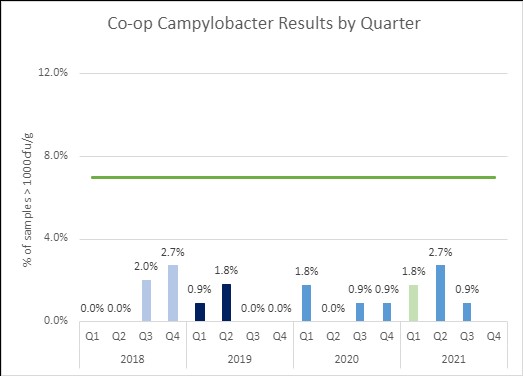
The FSA started the Campylobacter retail survey in 2014 sampling from nine retailers and publishing results showing % of chickens with incidence of Campylobacter at highest contamination levels (>1000cfu/g) . By the beginning of 2017 the overall results were showing a significant reduction in the percentage of chickens with high levels of Campylobacter from 20.3% (July 2014 – February 2015) to 7% with highest contamination levels (August – December 2016).

Heather Hancock, Chairman of the Food Standards Agency, said:

“The challenge we set of reducing the number of people who get ill from campylobacter has been achieved. In the absence of any other clear indicators, we can reasonably say that the work that we and the food industry have done from farm to fork has given us this really positive result for public health.

“This has been achieved by working with the industry to tackle this difficult problem and raising consumer awareness. We commend the efforts of the larger retailers and the major processing plants who supply them, all of which have shown significant improvement and many have achieved the target we set to reduce the highest levels of campylobacter. They have invested a lot of effort and money into interventions to tackle the problem.

Extract taken from the Campylobacter News Story 13.03.17

Our Results

From January 2017, food retailers have published our own Campylobacter test results for fresh chicken, in collaboration with the open data scheme on Campylobacter with the Food Standards Agency.

Campylobacter results Q3 2021

UK – J Sainsbury Tackling Campylobacter

Sainsburys

12 January 2021

Our customers’ health and safety is of paramount importance to us. Working closely with our suppliers and farmers, we are committed to ensuring that levels of Campylobacter on our fresh chicken are kept as low as possible

Campylobacter is commonly found on chicken and can cause food poisoning if chicken isn’t prepared and cooked properly. It’s not yet possible to eliminate it from raw chicken, but we have been working hard to reduce levels.

From farm to fork

Smiley face

With our suppliers, we’ve been busy finding ways to tackle Campylobacter at every step of the food chain. This starts on the farm by trying to stop Campylobacter from colonising flocks, introducing novel thermal treatments in the factory as well as new convenient roast in the bag packaging.

Like other raw meats, chicken still needs to be handled with care, but lower levels of Campylobacter means improved safety for our customers when they are preparing chicken at home. We were the first retailer to include food safety advice on our products.

How are we doing?

We test nearly a thousand chickens a year to check on how we are doing, and we continue to make progress. We’ve achieved a target that was set by the UK Food Standards Agency (FSA), but are committed to continue making further improvements wherever we can. To do this, we need to find new solutions through further research and trials, working closely with our suppliers.

UK – M&S Campylobacter Results Q2 – 2021

Click to access campylobacter-q2-2021.pdf