Category Archives: Bacteria

France – Product recall: 80/100 Venezuela ASC shrimps – 300g from Atelier Poissonnerie – Listeria monocytogenes

Oulah

Product recall: 80/100 Venezuela ASC shrimps - 300g from Atelier Poissonnerie

ENCOUNTERED PROBLEM

Presence of Listeria monocytogenes

PROPOSED SOLUTION

People who may have this product are asked not to consume it and to return it to the point of sale where it was purchased.

People who have consumed this product and who have a fever, isolated or accompanied by headaches, are invited to consult their doctor, notifying him of this consumption.
Pregnant women should pay special attention to these symptoms, as well as immunocompromised people and the elderly. These symptoms may suggest listeriosis, a disease that can be serious and can take up to eight weeks to incubate.

FURTHER INFORMATION

▸ Packaging
300g self-service tray

▸ Barcode
3664335051327

▸ Lot
2203220692

▸ DLC
11/27/2020

▸ Marketing period
From 11/19/2020 to 11/24/2020

▸ Identif. Veterinarian
FR 62.160.112 CE

▸ Consumer service contact
CRUSTA C is at the disposal of consumers to answer their questions at the following telephone number: 05 62 07 31 85

▸ Source
https://fd1-courses.leclercdrive.fr/magasin-089301-Aulnay-sous-Bois.aspx


Sweden – Lidl Sweden is recalling Goose Breasts, of the Culinea brand – Salmonella

Lidl

Lidl Sweden is recalling Goose Breasts from the Culinea brand, after routine analyzes it has been shown that the product may contain Salmonella.

Salmonella has been detected after a routine analysis. We would like to urge all our customers who bought the product to come back to us with the product. The relevant best-before date 2022-09-30 has been sold in all of Lidl Sweden stores. Salmonella poses no risk if you have heated the food to at least 70 degrees. 

The recall only concerns the product:

Article: Goose breast 

Pack size: 950g

Brand: Culinea

Best-before date: 2022-09-30

Other best-before dates or other Culinea products are not affected. We at Lidl Sweden apologize and take what happened seriously. Consumers who have purchased the product are welcome to return it to the place of purchase, or to the nearest Lidl store. Of course, customers get their money back, even without presenting a cash receipt.

Facts Lidl’s quality checks In addition to Lidl Sweden’s suppliers being certified with IFS (International Featured Standard), BRC (British Retail Consortium) or FSSC 22000 (Foundation Food Safety System Certification), Lidl Sweden performs regular unannounced on-site inspections at suppliers (performed by accredited institution). We go further than required by law and also test all products in external accredited laboratories to ensure that our products meet the highest quality.

Research – Updated food safety guidance gives pregnant women more certainty and choice on a wider range of foods

MPI

New research from New Zealand Food Safety provides pregnant women with more options and certainty about what they can safely eat with updated tips to avoid foodborne illness.

“We’ve looked at new foods that were not previously considered because we want pregnant women to have the most up-to-date food safety information so they can enjoy a diverse diet and stay healthy,” says Dr Claire McDonald, Manager Operational Research at New Zealand Food Safety.

“The guidance reflects the increased diversity in the New Zealand diet. The update not only provides more options, but also ensures all risky foods are captured and provides simple ways to reduce the chance of illness from food,” she said.

“It’s important pregnant women know what’s safe to they can avoid dangerous infections, such as listeriosis and toxoplasmosis, which can affect them more severely than non-pregnant women.”

Dr McDonald said the key information for women include:

  • thoroughly cooking seed sprouts (such as alfalfa or mung bean) before eating.
  • thoroughly cooking dried herbs before eating.
  • avoiding unpasteurised fruit juices and non-alcoholic cider.
  • avoiding low-acid, soft, pasteurised cheeses like Brie, Camembert, blue cheeses, ricotta, mozzarella, and feta unless they’re cooked.
  • updating guidance on some pasteurised dairy products (i.e. following manufacturer’s labelling advice and “best before” dates, etc.).
  • freshly cooked fish, mussels, oysters, crayfish, scallops, etc., should be cooked thoroughly until piping hot and eaten while hot.
  • whole melons should be washed and dried before cutting.
  • frozen berries should be cooked thoroughly before eating.
  • no restrictions on number of servings per week for gemfish, oreo dories, orange roughy, ling and smooth oreo fish species (previous advice limited the number of servings per week to minimise mercury intake).

“We know more about food safety now than we did just a few a years ago and it’s important people educate themselves and take simple steps such as washing produce and cooking certain foods properly,” Dr McDonald said.

More information on food and pregnancy

New Zealand Food Safety’s updated food safety guidance for pregnant women – YouTube

France – Product recall: Old-fashioned country pâté 1 slice of SAVEURS BRESSANES brand – Listeria monocytogenes

Oulah

Product recall: Old-fashioned country pâté 1 slice of SAVEURS BRESSANES brand

ENCOUNTERED PROBLEM

Presence of listeria

PROPOSED SOLUTION

Those in possession of this product are asked not to consume it and to return it to the point of sale where it was purchased.

People who have consumed this product and who present with a fever, isolated or accompanied by headaches, are invited to consult their doctor, notifying him of this consumption.
Pregnant women should pay special attention to these symptoms, as well as immunocompromised people and the elderly. These symptoms may suggest listeriosis, a disease that can be serious and can take up to eight weeks to incubate.

FURTHER INFORMATION

▸ Barcode
3384110003494

▸ Lot
T1911

▸ DLC
12/18/2020

▸ Health
stamp FR 38.190.001 CE

▸ Marketing
from 23/11/2020


Black tray packaging under atmosphere

▸ Consumer service contact
The company Nouvelle UTP is available to consumers to answer their questions at the following telephone number: 04.74.50.38.90

▸ Source
https://www.intermarche.com/

Germany – German authorities investigate E. coli infections involving daycare centers

Food Safety News

More than 20 E. coli infections are being investigated in a German municipality.

Four day care centers in the Lützow-Lübstorf district are affected by the outbreak of E. coli O26. Lützow-Lübstorf is in Nordwestmecklenburg, in Mecklenburg-Vorpommern, Germany.

Enterohaemorrhagic E. coli (EHEC) are often referred to as Shiga toxin-producing E. coli (STEC).

Authorities initially reported 18 patients but that had risen to 25 by the end of this past week. They warned further testing is ongoing so more cases are expected. Those sick include children and their relatives as well as a couple of day care center employees.

Italy – RAW MILK CHEESE – FORMAGGELLA – Listeria monocytogenes

Salute

Brand : CHIARELLI PIERLUIGI

Name : RAW MILK CHEESE – FORMAGGELLA

Reason for reporting : Recall due to microbiological risk

Publication date : 1 December 2020

Documentation

Documentation

France – Product recall: GUSTO Y SABOR Catalan fuets – Salmonella

Oulah

Product recall: GUSTO Y SABOR Catalan fuets

ENCOUNTERED PROBLEM

Presence of salmonella.

PROPOSED SOLUTION

Those in possession of this product are asked not to consume it and to return it to the point of sale where it was purchased for reimbursement.

Foodborne illness caused by Salmonella results in gastrointestinal disturbances, diarrhea, vomiting and abdominal pain, often accompanied by fever; these symptoms may be more severe in young children, immunocompromised individuals and the elderly. The incubation period can range from 6 to 72 hours.
People who have consumed the products mentioned below and who have these symptoms are invited to consult their doctor, notifying him of this consumption.

FURTHER INFORMATION

▸ Catalan peasant
fuet • Lot: 020373 – 0203377 – 020381
• DLC: 01/30/21

▸ Catalan peppered peasant
fuet
• Lot: 020369 • BBE: 30/01/21

▸ Catalan peasant onion
fuet • Lot: 020369 – 020384
• BBE: 01/30/21

▸ Catalan peasant fine herbs
fuet
• Lot: 020369 • BBE: 01/30/21

▸ Fuet extra red pepper
• Lot: 020384
• BBE: 30/01/21

▸ Packaging
Flow-pack sachets or without packaging

▸ Net weight
170g

▸ Sanitary
stamp ES 10.01867 / GE CE

▸ Consumer service contact
The Company “ROUSSILLON SALAISONS” is available to consumers to answer their questions at the telephone number: 04.68.52.97.80

▸ Source
https://www.supercasino.fr/

Italy – SPICY WASTED ABRUZZESE SAUSAGE – Salmonella

Salute

Brand : TAVOLA ITALIA

Name : SPICY WASTED ABRUZZESE SAUSAGE

Reason for reporting : Recall due to microbiological risk

Publication date : 2 December 2020

Documentation

Documentation

USA – Vegpro International Issues a Recall of Fresh Attitude Baby Spinach Because of Potential Salmonella Health Risk

FDA

Company Announcement

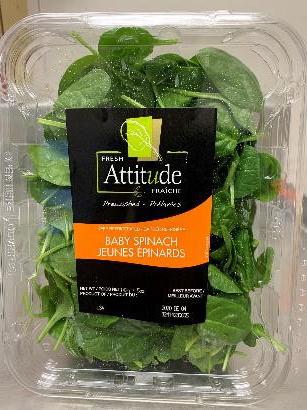
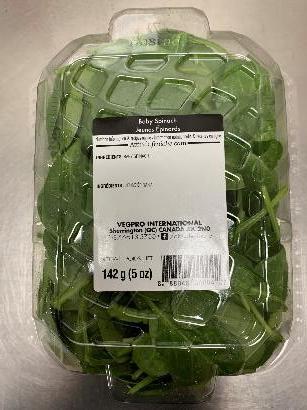
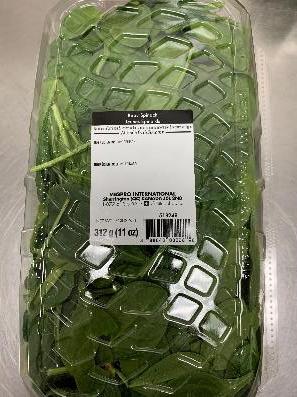
Vegpro International of Sherrington, QC CAN is recalling Fresh Attitude baby spinach (5oz and 11oz) with Best before dates of Dec 4th (for 11oz) and Dec 4th & 5th (for the 5oz), because it has the potential to be contaminated with Salmonella, an organism which can cause serious and sometimes fatal infections in young children, frail or elderly people, and others with weakened immune systems. Healthy persons infected with Salmonella often experience fever, diarrhea (which may be bloody), nausea, vomiting and abdominal pain. In rare circumstances, infection with Salmonella can result in the organism getting into the bloodstream and producing more severe illnesses such as arterial infections (i.e., infected aneurysms), endocarditis and arthritis

These products were produced in Vegpro’s Eastern Canadian plant and have been distributed ONLY in Eastern Canada and in the Northeastern United States (NY,NJ, DE, CT,MD & PA ). All other Fresh Attitude product sold in the US is produced in Belle-Glade Florida and is not linked to this recall whatsoever and therefore safe for consumption.

No illnesses have been reported to date.

The recall was initiated after it was discovered that the product was possibly contaminated with Salmonella subsequent investigation indicates that the problem may have been caused by contamination of a part of a lot of  Baby Spinach.

Veg Pro recalled due to health risk

  • BABY SPINACH. 8 X 5 OZ, Fresh Attitude, Best before 2020-12-04 & 2020-12-05
    UPC : 888048000042
    UPC case : 10888048000049
  • BABY SPINACH. 9 X 11 OZ, Fresh Attitude, Best before 2020-12-04
    UPC : 888048000288
    UPC case : 10888048000285

Consumers who have purchased these products are urged to return it to the place of purchase for a full refund. Consumers with questions may contact the company at 1-877-613-5700 or on our website at: http://vegpro.com/contact/


Company Contact Information

Consumers:
Vegpro International
 1-877-613-5700
 http://vegpro.com/contact/

Product Photos

Research – Preharvest Treatment Improves Tomato Food Safety

Technology Networks

cherry-tomato-pristine-variety

When vegetable farmers harvest crops, they often rely on postharvest washing to reduce any foodborne pathogens, but a new University of Georgia study shows promise in reducing these pathogens — as well as lowering labor costs — by applying sanitizers to produce while it is still in the fields.

Salmonella, Shiga toxin-producing E. coli and Listeria monocytogenes are major causes of foodborne diseases and of public health concern in the U.S. Tomato-associated salmonella outbreaks reported to the Centers for Disease Control and Prevention have increased in frequency and magnitude in recent years, and fresh produce accounted for 21% of E. coli outbreaks reported to the CDC over a 20-year span.

Initially researchers were going to study the use of a nonchlorine-based sanitizer made of two food additives approved by the U.S. Food and Drug Administration — levulinic acid and sodium dodecyl sulfate — as a postharvest wash solution. However, at the suggestion of a producer involved in the study — Bill Brim of Lewis Taylor Farms in Tifton, Georgia — they designed the study using the solution in a preharvest spray, said Tong Zhao, associate research scientist with the Center for Food Safety on the UGA Griffin campus.

While producers commonly use chlorine-based disinfectants — including chlorine gas, sodium hypochlorite, calcium hypochlorite and chlorine dioxide — to treat produce postharvest, the preharvest application of bactericides is not a common practice, Zhao said.