Category Archives: Algal Toxin

Guatemala – Four deaths in Guatemala linked to contaminated shellfish – Saitoxin – PSP

Food Safety News

More than 30 people have fallen sick and four have died in Guatemala after eating shellfish.

The National Commission for the Surveillance and Control of Red Tide in Guatemala has extended an alert because of the presence of saxitoxins above the limits on the coasts of Tiquisate, Escuintla, Retalhuleu and San Marcos.

Public health officials said that since the end of April, 34 people had been affected and three children and one adult had died.

Authorities urged the public not to eat bivalve mollusks such as mussels, clams and oysters.

A warning was issued earlier this month after monitoring and analysis detected high concentrations of saxitoxins above the limits.

Saxitoxin is a toxin responsible for paralytic shellfish poisoning (PSP). Harmful algal blooms are often called red tides.

RASFF – Lipophilic Toxins – Tellins

RASFF

Detection of lipophilic toxins on tellins in Italy, Spain and Switzerland

RASFF Alert – Tellins – Algal Lipophilic Toxin

RASFF

Detection of lipophilic toxins on tellins from France in Belgium, Italy, Netherlands, Spain and Switzerland

The lipophilic toxins in shellfish can be divided into four groups of toxins with different chemical structures and biological effects: OA and its derivatives, the DTXs; the pectenotoxins (PTXs); the yessotoxins (YTXs); and the azaspiracids (AZAs). These toxins can often be found in combination in shellfish.

Guatemala: Red tide alert issued, One fatality reported -Saxitoxins – PSP

Outbreak News Today

The National Commission for Surveillance and Control of the Toxic Red Tide in Guatemala, declared a red tide alert because the constant monitoring and analysis that is carried out showed high concentrations of saxitoxins above the appropriate limits.

The presence of toxic red tide was detected on the Pacific Coast, on the coast of Tiquisate, Escuintla, indicated Virginia Herzing de Stwolinsky, head of the Risk Management Unit of the Ministry of Public Health and Social Assistance (MSPAS).

For this reason, bivalve mollusks, such as mussels, clams and shells. The consumption of the aforementioned foods produces severe intoxication and could even cause death.

Saxitoxins are also known as paralytic shellfish poisons (PSPs). Most human saxitoxin toxicoses have been associated with the ingestion of marine shellfish, which accumulate saxitoxins produced by marine dinoflagellates. However, saxitoxins are also found in freshwaters, produced by cyanobacteria in the genera Anabaena, Aphanizomenon, Planktothrix, Cylindrospermopsis, Lyngbya and Scytonema

New Zealand – Public health warning for shellfish for entire Pelorus Sound area, Marlborough Sounds – PSP

MPI

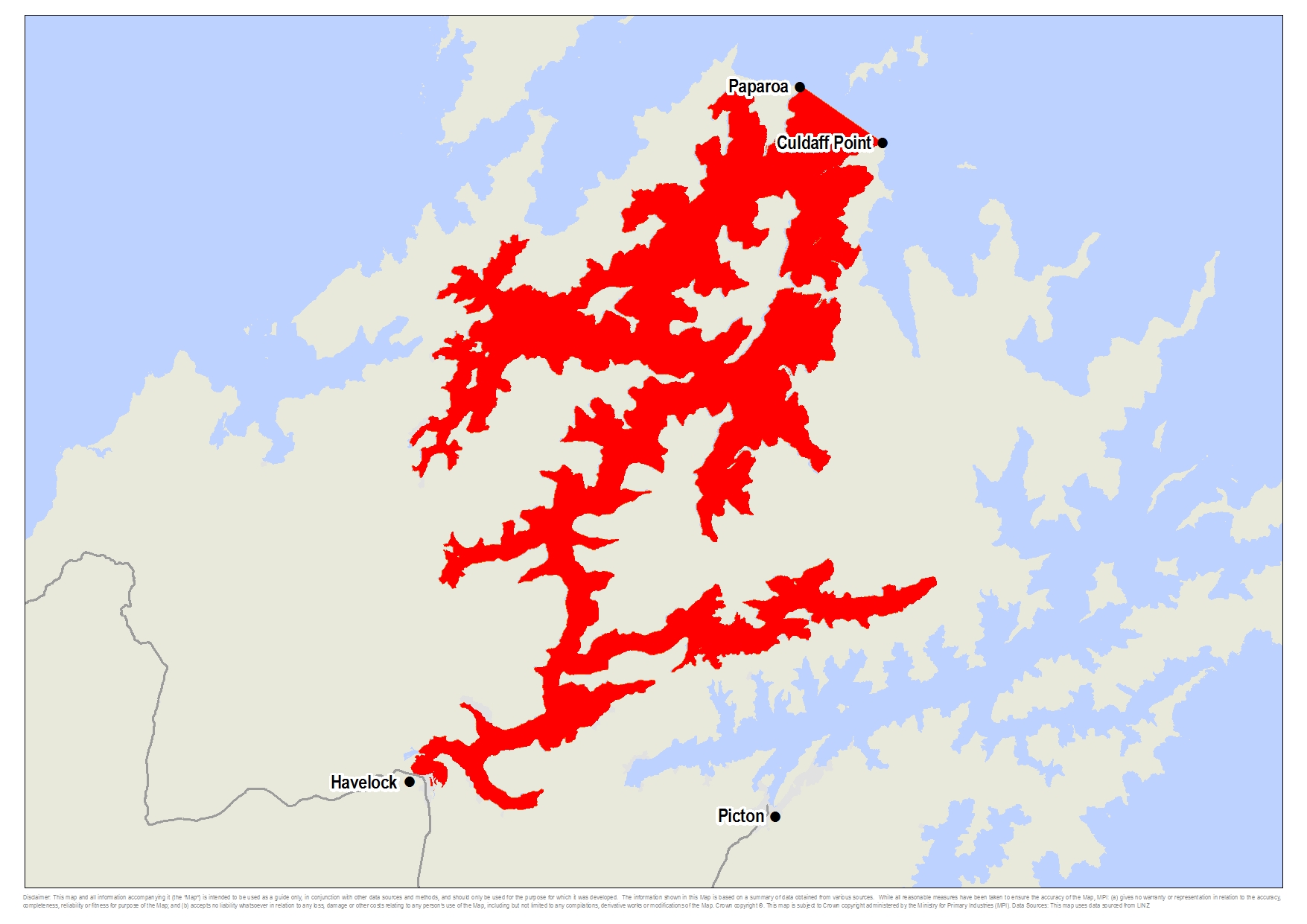
Map of the affected area to the entire Pelorus Sound area, Marlborough Sounds

The Ministry for Primary Industries (MPI) today issued an extension to the public health warning advising the public not to collect or consume shellfish harvested from Crail Bay in Marlborough Sounds. The extension now applies to the entire Pelorus Sound area including its arms to the east and west, up to a line at the entrance from Paparoa to Culdaff Point.

Routine tests on shellfish samples taken from this region have shown levels of Paralytic Shellfish Poisoning (PSP) toxins above the safe limit of 0.8 mg/kg set by MPI. Anyone eating shellfish from this area is potentially at risk of illness.

Mussels, oysters, tuatua, pipi, toheroa, cockles, scallops, catseyes, kina (sea urchin) and all other bivalve shellfish should not be eaten.

Note, cooking shellfish does not remove the toxin.

Pāua, crab and crayfish may still be eaten if the gut has been completely removed prior to cooking, as toxins accumulate in the gut. If the gut is not removed, its contents could contaminate the meat during the cooking process.

Symptoms typically appear between 10 minutes and 3 hours after ingestion and may include:

  • numbness and a tingling (prickly feeling) around the mouth, face, and extremities (hands and feet)
  • difficulty swallowing or breathing
  • dizziness
  • headache
  • nausea
  • vomiting
  • diarrhoea
  • paralysis and respiratory failure and in severe cases, death.

If anyone becomes ill after eating shellfish from an area where a public health warning has been issued, phone Healthline for advice on 0800 61 11 16, or seek medical attention immediately. You are also advised to contact your nearest public health unit and keep any leftover shellfish in case it can be tested.

Monitoring of toxin levels will continue and any changes will be communicated accordingly. Commercially harvested shellfish – sold in shops and supermarkets, or exported – is subject to strict water and flesh monitoring programmes by MPI to ensure they are safe to eat.

New Zealand – Public health warning for shellfish for all of Crail Bay, Marlborough Sounds – Paralytic Shellfish Poisoning (PSP) toxins

MPI

Map of the affected area all of Crail Bay, Marlborough Sounds

The Ministry for Primary Industries (MPI) today issued a public health warning advising the public not to collect or consume shellfish harvested from all of Crail Bay in the Marlborough Sounds.

Routine tests on shellfish samples taken from this region have shown levels of Paralytic Shellfish Poisoning (PSP) toxins above the safe limit of 0.8 mg/kg set by MPI. Anyone eating shellfish from this area is potentially at risk of illness.

Mussels, oysters, tuatua, pipi, toheroa, cockles, scallops, catseyes, kina (sea urchin) and all other bivalve shellfish should not be eaten.

Note, cooking shellfish does not remove the toxin.

Pāua, crab and crayfish may still be eaten if the gut has been completely removed prior to cooking, as toxins accumulate in the gut. If the gut is not removed, its contents could contaminate the meat during the cooking process.

Symptoms typically appear between 10 minutes and 3 hours after ingestion and may include:

  • numbness and a tingling (prickly feeling) around the mouth, face, and extremities (hands and feet)
  • difficulty swallowing or breathing
  • dizziness
  • headache
  • nausea
  • vomiting
  • diarrhoea
  • paralysis and respiratory failure and in severe cases, death.

If anyone becomes ill after eating shellfish from an area where a public health warning has been issued, phone Healthline for advice on 0800 61 11 16, or seek medical attention immediately. You are also advised to contact your nearest public health unit and keep any leftover shellfish in case it can be tested.

Monitoring of toxin levels will continue and any changes will be communicated accordingly. Commercially harvested shellfish – sold in shops and supermarkets, or exported – is subject to strict water and flesh monitoring programmes by MPI to ensure they are safe to eat.

Find out more

Read the signs in the affected area.

Shellfish biotoxin alerts

Subscribe to shellfish biotoxins to receive email alerts

Collecting shellfish and keeping them safe [PDF, 1.4 MB]

Causes and symptoms of toxic shellfish poisoning

About toxic algal blooms

Food safety for seafood gatherers booklet [PDF, 688 KB]

USA – Alaska has among the nation’s highest rates of paralytic shellfish poisoning, but reported incidents are declining

ADN

Over the last decade, Alaska has reported fewer cases of a serious condition caused by consuming contaminated shellfish than in previous years.

But health officials say Alaskans who self-harvest shellfish should still be aware of the risks of paralytic shellfish poisoning.

Katherine Newell, an Epidemic Intelligence Service officer with the Centers for Disease Control and Prevention who is assigned to Alaska’s Division of Public Health, helped put together a new state report tracking cases of PSP in Alaska between 1993 and 2021.

There have been 132 reports of the poisoning in Alaska during that time, including five fatal cases. About 25% of those cases occurred in or near Kodiak, 20% were in Juneau and 14% occurred in Ketchikan, the report found.

The condition, also known as PSP, is a foodborne illness caused by neurotoxins known as saxitoxins, which are produced by harmful algal blooms that shellfish sometimes take into their systems while filter feeding, Newell explained.

When a human ingests the contaminated shellfish, it can be “pretty serious, and sometimes fatal,” Newell said. “It’s a reportable condition in Alaska because of how serious it is.”

New Zealand – Public health warning about shellfish in the Orewa and Warkworth area, North Island – PSP Toxins

MPI

The Ministry for Primary Industries (MPI) today issued a public health warning against collecting shellfish from the Orewa and Warkworth area. The warning extends from Takatu Point on the Tāwharanui Peninsula, south to Huaroa Point on the Whangaparoa Peninsula. The warning includes Mahurangi Harbour, Kawau Island and the smaller islands west of Kawau Island.

Routine tests on shellfish samples taken from Mahurangi Harbour have shown levels of Paralytic Shellfish Poisoning (PSP) toxins above the safe limit of 0.8 mg/kg set by MPI. Anyone eating shellfish from this area is potentially at risk of illness.

Mussels, oysters, tuatua, pipi, toheroa, cockles, scallops, catseyes, kina (sea urchin) and all other bivalve shellfish should not be eaten.

Note, cooking shellfish does not remove the toxin.

Pāua, crab and crayfish may still be eaten if the gut has been completely removed prior to cooking, as toxins accumulate in the gut. If the gut is not removed its contents could contaminate the meat during the cooking process.

Symptoms typically appear between 10 minutes and 3 hours after ingestion and may include:

  • numbness and a tingling (prickly feeling) around the mouth, face, and extremities (hands and feet)
  • difficulty swallowing or breathing
  • dizziness
  • headache
  • nausea
  • vomiting
  • diarrhoea
  • paralysis and respiratory failure and in severe cases, death.

If anyone becomes ill after eating shellfish from an area where a public health warning has been issued, freephone Healthline for advice on 0800 61 11 16, or seek medical attention immediately. You are also advised to contact your nearest public health unit and keep any leftover shellfish in case it can be tested.

Monitoring of toxin levels will continue and any changes will be communicated accordingly. Commercially harvested shellfish – sold in shops and supermarkets, or exported – is subject to strict water and flesh monitoring programmes by MPI to ensure they are safe to eat. There is no commercial harvesting of shellfish in the affected area.

New Zealand – Shellfish biotoxin alerts

MPI

ALL WARNINGS ARE UP-TO-DATE

We review the warnings on this page following sampling, and update it when we find toxic shellfish.

If you have questions, email info@mpi.govt.nz

Current warnings

No warnings are in place.

Dates of recent warnings issued and removed
  • 20 January 2022: Grove Arm and Banks Peninsula warnings removed
  • 17 December 2021: Extended to entire Banks Peninsula warning issued
  • 15 December 2021: Akaroa Harbour warning issued
  • 24 November 2021: Marlborough Sounds warning issued
  • 16 June 2021: Hawke Bay warning removed

RASFF Alert – Diarrhoeic Shellfish Poisoning (DSP) – Live Mussels

RASFF

Diarrhoeic Shellfish Poisoning (DSP) toxins (161 µg/kg – ppb) in live mussels (Mytilus galloprovincialis) from Italy in Spain