Monthly Archives: June 2019

USA – Imported Tahini recalled after 4 sick with Salmonella

Food Poison Journal

Brodt Zenatti Holding LLC of Jupiter, Florida is recalling all retail and bulk Karawan brand Tahini, sold in Jars: 450g (15.87 oz) and Buckets: 17kg (599.6 oz); 3kg (105.8 oz) that were imported from Palestine between the dates of December 2018 to April 2019 and SoCo Brand Tahini; because they have the potential to be contaminated with Salmonella, an organism which can cause serious and sometimes fatal infections in young children, frail or elderly people, and others with weakened immune systems.

Dominican Republic – Nearly 70 tourists to Dominican Republic reported illness since March

NYPost

Nearly 70 tourists have reported getting violently ill while vacationing in the Dominican Republic since March, according to a commonly used website that tracks food-borne illness outbreaks.

That’s up from just 10 reported illnesses in the country for all of 2018, according to iwaspoisoned.com. In June alone, 52 tourists reported symptoms of vomiting, diarrhea and fever.

More than 45 of them identified themselves as guests at the Hard Rock Hotel & Casino Punta Cana.

“People report food-borne illnesses but it’s possible that they experienced some other type of contamination,” said Patrick Quade, founder of iwaspoisoned.com, adding that he consulted with scientists regarding his findings.

The illnesses come on the heels of reports that six people have died — coming down suddenly with mysterious ailments — while staying at luxury resorts on the island since last year.

Canada – Norovirus prompts recall of raspberries cakes in Quebec

Outbreak News Today Norovirus Food Safety kswfoodworld

The Ministry of Agriculture, Fisheries and Food (MAPAQ) in Quebec announced this week (computer translated) the recall of certain products due to possible norovirus contamination.

The products that are the subject of this alert may have been prepared with lots of frozen raw raspberries from Chile that are being recalled by the Canadian Food Additives Agency. food inspection.These foods were available for sale until June 7, 2019 inclusive. They were sold in a chilled or frozen state or at room temperature, with or without a label.

USA – Townsend Farms, Inc., Notifies Costco of Possible Health Risk and Recalls Conventional Frozen Kirkland Three Berry Blend – Hepatitis A

FDA

Out of an abundance of caution, Townsend Farms, Inc. has notified Costco that a recent FDA test indicated that a domestic conventional frozen blackberry product manufactured by Townsend Farms, Inc., may be contaminated with Hepatitis A. Townsend Farms, Inc. used the domestic conventional frozen blackberry to manufacture the Kirkland Signature Three Berry Blend product with Best By Dates between February 16, 2020, and May 4, 2020. Costco only sold the product in stores located in San Diego and Los Angles, California and Hawaii. No product manufactured for Costco by Townsend Farms has tested positive for Hepatitis A. Costco has no product in its current inventory. Costco has been notifying its members about the potential health risk.

Nigeria – FAO Issues Alert On Food Poisoning in Lagos, Kano, Other Cities

AllAfrica

Abuja — The Food and Agricultural Organisation (FAO), an agency of the United Nations, has raised alarm over what it described as worrisome levels contamination of foods in Lagos and Kano States.

The FAO said a “Total Diet” study it carried out in two major Nigerian cities, Lagos and Kano showed various levels of contamination of foods at the point of consumption.

Speaking at an event jointly orgainised by the Federal Ministries of Health and its agriculture counterpart to mark 2019 World Food Safety Day in Abuja, the Country Representative, FAO in Nigeria, Suffyan Koruna said streets foods are now being consumed more than ever before, adding that Nigerians eat at least one meal out of home in restaurants, bukkas and other food vendors.

The FAO country representative who was represented by Mr. Alphonsus Onwuemeka said the organisation conducted a diet study in Lagos and Kano where it discovered rampant unsafe food consumption.

He said: “A Total Diet Study carried out in Lagos and Kano states showed worrisome levels of contamination of foods at the points of consumption with aflatoxins, mycotoxins, heavy metals such as lead and pesticides residues. This should reaweaken Nigeria to the looming health challenges and economic losses that could result from a lack of attention to food safety.”

India -14 students fall ill after food poisoning, undergoing treatment

Times of India

Nagpur: Fourteen girls taking basic skill development training under the Deendayal Upadhyaya Kaushalya Yojna (DDUGKY) in city ell ill on Saturday with severe symptoms of vomiting and and motions apparently due to food poisoning.


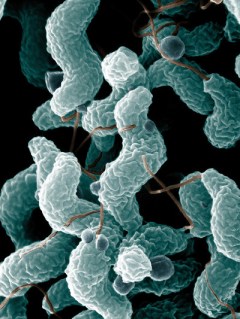
Norway – Norway officials trying to ID water contamination source – Campylobacter

NF Chronicle

Campylobacter

Image CDC

COPENHAGEN, Denmark (AP) — Norwegian authorities said Tuesday they were trying to identify the source of water contamination that has sent dozens of people in southern Norway to the hospital.

Since Thursday, 55 people — including 13 children — from Askoey, an island north of Bergen, have been hospitalized following the contamination. All have been discharged. Norwegian news agency NTB reported that in all, some 2,000 people had fallen sick.

A 1-year-old child on the island died last week of an infection in the digestive tract, but it was not clear whether it was linked to the contamination.

He said tests showed that the bacteria Campylobacter has been found in 36 cases.

Research – How flow shapes bacterial biofilms

Science Daily

Although we tend to think of them as solitary sojourners of the world, bacteria are actually very social organisms. In fact, the vast majority of bacteria live on surfaces by forming “biofilms”: three-dimensional communities hosting thousands to millions of bacteria of such bustling activity that scientists describe them as “bacterial cities.”

Bacteria form biofilms by attaching to each other on a wide variety of surfaces: the bottom of oceans, lakes or rivers, medical equipment and even internal organs, like the intestine, lungs, and teeth — the latter is the familiar dental plaque, a large source of income for dentists.

In short, biofilms are the preferred lifestyle of bacteria. They grow wide and thick, forming a new, social dynamic among their member microorganisms, while also defending them: biofilms can be notoriously inaccessible to antibiotics, which is why they have drawn a lot of medical research.

But looking at biofilms can also give us clues about broader social dynamics that have shaped the evolution of species across the entire planet, like cooperation, competition etc. And it is such questions that drive the work of Alexandre Persat, director of EPFL’s Microbial Mechanics Lab.

India – Six hospitalised due to food poisoning in Shamli

Business Standard

Six people were hospitalised in a suspected poisoning case in Uttar Pradesh’s district on Sunday, police said.

The victims complained of headache, stomach pain and vomiting after eating at their home in Umerpur village under Thana Bhawan Police Station limits, they said.

According to reports, the victim family ate a potato curry in the meal prior to falling sick.

UK – Listeria outbreak: Action was taken to protect vulnerable patients, experts insist

The Telegraph

Listeria warnings were not issued to the public until it was confirmed by test results because experts were confident it had been contained and vulnerable patients protected.

Three patients have been killed by hospital sandwiches and 43 NHS trusts placed on alert in one of the worst cases of food poisoning in the health service.

Six people were diagnosed with a serious listeria infection between April 25 and May 15.