Category Archives: Virus

RASFF Alerts – Norovirus – Oysters – Blue Berries

RASFF-Logo

RASFF – norovirus (presence /25g) in frozen blue berries from South America, via the Netherlands in Belgium

RASFF – norovirus in live oysters (Cassostrea gigas) from France in Italy

RASFF – norovirus (suspicion) in live oysters from France in the Netherlands

RASFF – norovirus (GI, GII) in live oysters from France in Italy

RASFF – norovirus (GI, GII /2g) in live oysters from France in Italy

RASFF – foodborne outbreak suspected (norovirus) to be caused by live oysters from the United Kingdom in the UK

RASFF – withdrawal of live bivalve molluscs harvested in France because of possible contamination with norovirus in France

RASFF – norovirus (GII /2g) in live oysters (Crassostrea gigas) from France in Italy

RASFF Alerts -Norovirus – Live Oysters

RASFF-Logo

RASFF – norovirus in live oysters (Crassostrea gigas) from France in Italy

RASFF – foodborne outbreak suspected to be caused by norovirus in live oysters from France in Denmark

RASFF– withdrawal of live bivalve molluscs harvested in France because of possible contamination with norovirus in France

USA – 170 people ill in possible Norovirus outbreak at Yosemite National Park

The Hill norovirus-1080x655

Around 170 people who visited Yosemite National Park this month have reported becoming ill with gastrointestinal illnesses, with at least two confirmed cases of norovirus, park officials said Thursday.

The National Park Service began investigating after visitors and employees reported being sick and are continuing to investigate the circumstances surrounding the illness and conduct interviews with affected people.

“The overwhelming majority of the reported cases are consistent with norovirus,” park officials said in a statement.

The majority of those who became ill spent time in Yosemite Valley around the first week of January. Park officials say there has been a decline in new cases in the past several days. While those who reported becoming ill had symptoms of norovirus, park officials say some might have had food poisoning or the flu.

RASFF Alerts – Norovirus – Oysters

RASFF-Logo

RASFF – foodborne outbreak suspected to be caused by live oysters from France in Italy

RASFF – foodborne outbreak caused by and norovirus in live oysters from France in Sweden

RASFF – norovirus (presence) in oysters (Crasosstrea gigas) from France in the Netherlands

RASFF – withdrawal of live bivalve molluscs harvested in France because of possible contamination with norovirus in France

RASFF – withdrawal of live bivalve molluscs harvested in France because of possible contamination with norovirus in Denmark

RASFF – withdrawal of live bivalve molluscs harvested in France because of possible contamination with norovirus in France

RASFF – withdrawal of cupped oysters (huitres creuses) harvested in France because of possible contamination with norovirus in the Netherlands

RASFF – norovirus in frozen oysters (Crassostrea gigas) from South Korea, via the Netherlands and via Sweden in Finland

France – More than 1,000 sick in France from contaminated raw shellfish

Food Safety News

The number of people in France who have become ill after eating contaminated raw shellfish has jumped to more than 1,000. The outbreak has spurred international recalls.

A total of 1,033 people have been sickened and 21 needed hospital treatment, according to Santé publique France. A previous update listed the number of illnesses at 668.

Sweden, Italy and the Netherlands have all also reported outbreaks linked to live oysters from France. Products have been recalled due to a risk of norovirus contamination in Luxembourg, Switzerland, Hong Kong and Singapore.

Mats Lindblad, a communicable disease coordinator at Livsmedelsverket (National Food Agency of Sweden), said 31 people are sick in the country.

Hong Kong – Import and sale of shellfishes harvested in production areas 35.11 and 35.06 in France suspended

CFS

Issue Date 10.1.2020
Source of Information Centre for Food Safety
Food Product Shellfishes
Product Name and Description Shellfishes harvested in production areas 35.11 and 35.06 in France
Reason For Issuing Alert
  • The CFS received a notification from the Rapid Alert System for Food and Feed (RASFF) of the European Commission that shellfishes harvested in the abovementioned areas which were suspected to be contaminated with norovirus were under recall.
  • The CFS immediately followed up with major local importers and retailers. Preliminary investigation found that a local importer had imported not ready-to-eat mussels from the abovementioned areas into Hong Kong which were on sale in its supermarkets.
Action Taken by the Centre for Food Safety
  • For the sake of prudence, the CFS has immediately suspended the import into and sale within Hong Kong of all shellfishes harvested in the two areas concerned.
  • The importer concerned had already voluntarily stopped sale and removed from shelves of the affected product for the sake of prudence.
  • The CFS is tracing the distribution of the affected product.
  • The CFS has informed the French authorities of the import suspension and will also notify the local trade.
  • The CFS will continue to follow up on the incident and take appropriate action to safeguard food safety and public health.
Advice to the Trade Stop using or selling the affected product harvested in the abovementioned areas concerned immediately.
Advice to Consumers
  • One may be infected by norovirus or other pathogenic microorganism if consuming undercooked shellfish which is contaminated. So, shellfish should be thoroughly cooked before consumption.
  • Young children, elderly people, pregnant women and others with weakened immune systems should pay special attention when consuming shellfish.
Further Information The CFS press release

France -Collective food-borne infections suspected of being linked to the consumption of raw shellfish, epidemiological report as of January 8, 2020

Sante Publique France

Cases of TIAC suspected of being linked to the consumption of raw shellfish in mainland France have been reported since December 2019.

A collective food poisoning (TIAC) ​​is defined by the appearance of at least 2 cases of illness with a similar symptomatology, generally gastrointestinal, the cause of which can be related to the same food or meal. Any person (doctor, manager of collective catering establishments, consumer, etc.) who is aware of an episode that may be a TIAC, must declare this suspicion of TIAC to the administration (Regional Health Agency (ARS) and / or the Departmental Directorate (for social cohesion) and for the protection of populations (DD (CS) PP). This declaration involves local information from the other structure (ARS or DD (CS) PP).

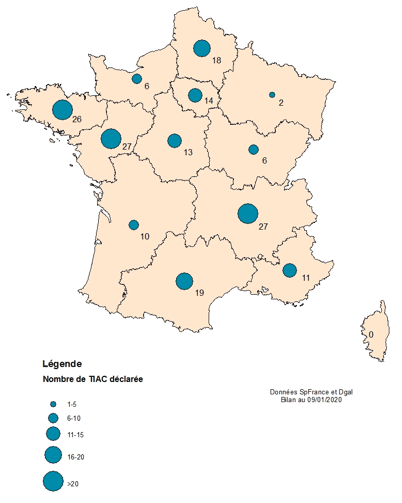
Since the beginning of December 2019, 179 compulsory declarations (DO) of collective food poisoning (TIAC) ​​suspected of being linked to the consumption of raw shellfish, mainly oysters, have been sent to Santé publique France. The reports come from the majority of regions in mainland France (see Figure 1).

Figure 1 – Number of TIAC suspected of being linked to the consumption of raw shellfish, by reporting region. Metropolitan France, December 1, 2019 – January 8, 2020.
Figure 1 - Number of TIAC suspected of being linked to the consumption of raw shellfish, by reporting region.  Metropolitan France, December 1, 2019 - January 8, 2020.

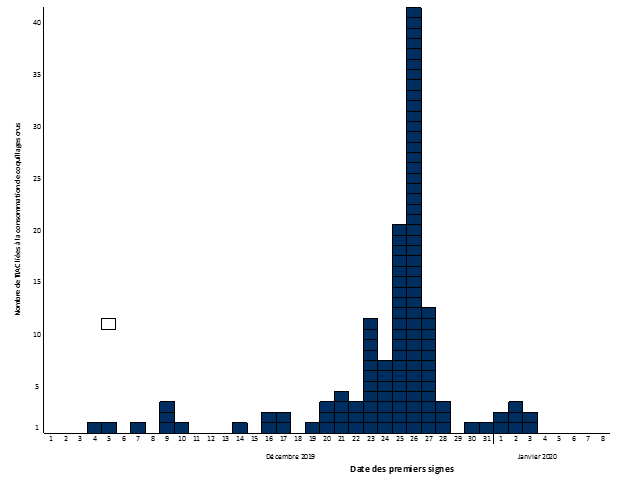
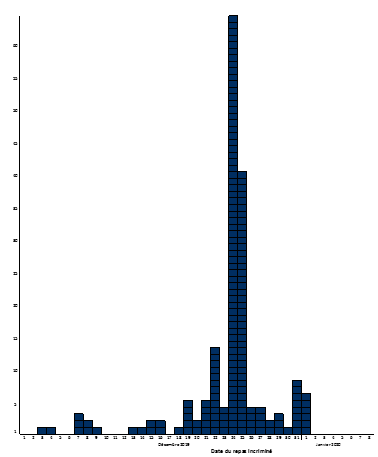
The vast majority (138/179, 77%) of these TIAC occurred from December 23 (Figures 2 and 3). A peak of patients is observed around December 25-27 (Figure 2). The offending meals are grouped around December 24-25 (Figure 3).

A total of 1,033 people were sick, of whom 21 (2%) were hospitalized. Most of them are people over the age of 15. Of the 595 patients with age information, 19 (3.1%) were children under the age of 15. The symptoms, mainly diarrhea and vomiting, as well as the incubation times, are compatible with infections with norovirus or other enteric viruses. Stool tests performed to date by the National Reference Center for Gastroenteritis Viruses have confirmed the presence of norovirus and other enteric viruses.

Figure 2 – Number of TIAC suspected of being linked to the consumption of raw shellfish by date of first signs of patients (information available for 125/179 TIAC). December 1, 2019 – January 8, 2020.
Figure 2 - Number of TIAC suspected of being linked to the consumption of raw shellfish by date of first signs of patients (information available for 125/179 TIAC).  December 1, 2019 - January 8, 2020.
Figure 3 – Number of TIAC suspected of being linked to the consumption of raw shellfish by date of the offending meal (information available for 176/179 TIAC). December 1, 2019 – January 8, 2020.
Figure 3 - Number of TIAC suspected of being linked to the consumption of raw shellfish by date of the offending meal (information available for 176/179 TIAC).  December 1, 2019 - January 8, 2020.

The number of TIAC suspected of being linked to the consumption of raw shellfish is significantly higher than in previous years. Each year between 25 and 120 TIAC suspected of being linked to the consumption of shellfish are reported to Public Health France, of which between 4 and 30 occurred during the December-January periods.

Following reports from TIAC suspected of being linked to the consumption of raw shellfish, the Directorate General for Food (DGAL) in conjunction with the Departmental Directorates in charge of protecting populations (DD (CS) PP) is carrying out an investigation traceability in order to trace back to the production area for suspected shellfish and confirmation analyzes are carried out on the areas concerned. To date, several areas have been closed due to contamination by noroviruses. Zone closings can be viewed on this site:
http://www.atlas-sanitaire-coquillages.fr/ (“Statutes” section)

Cruise Ship – Norovirus – What you need to know.

Cruise Critic

With cruise ship “outbreaks” regularly appearing in the news, awareness of Norovirus — an extremely common and highly contagious virus that causes gastroenteritis — has been significantly raised.
But before you reconsider that long-awaited cruise vacation because of gloom-and-doom reports on television and in your daily paper, know these facts:

  • Norovirus is not a “cruise ship” virus, nor does it limit itself to sea-going vessels.
  • Norovirus spreads swiftly wherever there are many people in a small area, including nursing homes, restaurants, hotels, dormitories … and cruise ships.
  • The common cold is the only illness more common, and the Centers for Disease Control and Prevention in Atlanta estimates that there are more than 20 million cases of Norovirus annually.
  • Norovirus is associated with cruise travel simply because health officials are required to track illnesses on ships (and are not at hotels and resorts); therefore, outbreaks are found and reported more quickly at sea than on land.

Here’s everything you need to know about Norovirus — and how to avoid getting sick on your next cruise vacation. See the link above.

Research – Inactivation of Murine Norovirus on Fruit and Vegetable Surfaces by Vapor Phase Hydrogen Peroxide

Journal of Food Protection

ABSTRACT

Vapor phase hydrogen peroxide (H2O2) can be utilized to inactivate murine norovirus (MNV), a surrogate of human norovirus, on surface areas. However, vapor phase H2O2 inactivation of virus on fruits and vegetables has not been characterized. In this study, MNV was used to determine whether vaporized H2O2 inactivates virus on surfaces of various fruits and vegetables (apples, blueberries, cucumbers, and strawberries). The effect of vapor phase H2O2 decontamination was investigated with two application systems. Plaque assays were performed after virus recovery from untreated and treated fresh produce to compare the quantity of infective MNV. The Mann-Whitney U test was applied to the test results to evaluate the virus titer reductions of treated food samples, with significance set at P ≤ 0.05. The infective MNV populations were significantly reduced on smooth surfaces by 4.3 log PFU (apples, P < 0.00001) and 4 log PFU or below the detection limit (blueberries, P = 0.0074) by treatment with vapor phase H2O2 (60 min, maximum of 214 ppm of H2O2). Similar treatments of artificially contaminated cucumbers resulted in a virus titer reduction of 1.9 log PFU. Treatment of inoculated strawberries resulted in 0.1- and 2.8-log reductions of MNV. However, MNV reduction rates on cucumbers (P = 0.3809) and strawberries (P = 0,7414) were not significant. Triangle tests and color measurements of untreated and treated apples, cucumbers, blueberries, and strawberries revealed no differences in color and consistency after H2O2 treatment. No increase of the H2O2 concentration in treated fruits and vegetables compared with untreated produce was observed. This study reveals for the first time the conditions under which vapor phase H2O2 inactivates MNV on selected fresh fruit and vegetable surfaces.

HIGHLIGHTS
  • Produce was treated with vapor phase H2O2 for 60 min (maximum of 260 ppm of H2O2).

  • A 4-log reduction in MNV was achieved by H2O2 treatment on apples and blueberries.

  • Reductions of MNV on treated strawberries and cucumbers were not significant.

RASFF Alerts – Norovirus – Foodborne Outbreak – Live Oysters –

RASFF-Logo

RASFF – foodborne outbreak suspected to be caused by live oysters (Crassostrea gigas) from France

RASFF – foodborne outbreak suspected to be caused by live oysters (Crassostrea gigas) from France

RASFF – foodborne outbreak caused by live oysters from France, via the Netherlands in Sweden

RASFF – norovirus in live mussels from France in Switzerland

RASFF – norovirus in live bouchot mussels from France in the Netherlands

RASFF – norovirus in oysters from France in the Netherlands

RASFF – withdrawal of bivalve molluscs harvested in France because of possible contamination with norovirus in Luxembourg