Category Archives: Shigella

Research – USA – Westin Shigella Outbreak sickens 32 linked to ill food service workers – 2023

Marler Blog

The Alameda County Public Health Department, Los Angeles Department of Public Health, and California Department of Public Health (CDPH) investigated an outbreak of shigellosis associated with a Kaiser Permanente union delegate conference held at the Westin Bonaventure Hotel in downtown Los Angeles from August 21 to August 24, 2023. The event included 269 attendees from across California. This outbreak was assigned the code “OB20233135.”

USA – Shigella Outbreak sweeping Spokane

Food Poison Journal

Source Unknown

• Total Cases: 147

• Shigella Species Type:

– 101 (68.7%) sonnei

– 5 (3.4%) flexneri

– 41 (27.9%) species not yet available.

• Severity of Disease:

– 67 (45.6%) of the cases have been hospitalized due to shigella.

– 1 (0.7%) death has been attributed to shigella.

Research – Biocide Tolerance and Impact of Sanitizer Concentrations on the Antibiotic Resistance of Bacteria Originating from Cheese

MDPI

Abstract

In this study, we determined and identified the bacterial diversity of different types of artisanal and industrially produced cheese. The antibiotic (erythromycin, chloramphenicol, kanamycin, ampicillin, clindamycin, streptomycin, tetracycline, and gentamicin) and biocide (peracetic acid, sodium hypochlorite, and benzalkonium chloride) resistance of clinically relevant bacteria was determined as follows: Staphylococcus aureusMacrococcus caseolyticusBacillus sp., Kocuria variansEscherichia coliEnterococcus faecalisCitrobacter freundiiCitrobacter pasteuriiKlebsiella oxytocaKlebsiella michiganensisEnterobacter sp., Enterobacter cloacaeEnterobacter sichuanensisRaoultella ornithinolyticaShigella flexneri, and Salmonella enterica. Also, the effect of the sub-inhibitory concentration of three biocides on antibiotic resistance was determined. The microbiota of evaluated dairy products comprise diverse and heterogeneous groups of bacteria with respect to antibiotic and disinfectant tolerance. The results indicated that resistance was common in the case of ampicillin, chloramphenicol, erythromycin, and streptomycin. Bacillus sp. SCSSZT2/3, Enterococcus faecalis SRGT/1, E. coli SAT/1, Raoultella ornithinolytica MTT/5, and S. aureus SIJ/2 showed resistance to most antibiotics. The tested bacteria showed sensitivity to peracetic acid and a different level of tolerance to benzalkonium chloride and sodium hypochlorite. The inhibition zone diameter of antibiotics against Enterococcus faecalis SZT/2, S. aureus JS11, E. coli CSKO2, and Kocuria varians GRT/10 was affected only by the sub-inhibitory concentration of peracetic acid.

USA – Shigella hits Yakima County

Food Poison Journal

According to a media release sent by the Yakima Health District, there is currently a Shigella outbreak in Yakima County.

According to YHD, 72 cases have been reported from January 1, 2023 to October 16, 2023.

The 72 cases is compared to the 10 reported last year during that time.

According to YHD, Shigella is a bacteria that can easier spread between humans. Shigella causes illness.

You can become infected with Shigella by touching surfaces contaminated with the bacteria or by coming into contact with someone who is currently infected.

Belgian officials search for source of Shigella infections

Food Safety News

Belgian authorities have temporarily closed an events venue linked to more than 50 Shigella infections.

The Federal Agency for the Safety of the Food Chain (FASFC) and the Flemish Departement Zorg reported that over recent weekends, people had been infected with Shigella after attending the Zandberghoeve venue in Beernem. The source of contamination may be an infected person or a contaminated food or object.

Earlier this year, Zorg en Gezondheid (The Flemish Care and Health Agency) merged with another body to form Departement Zorg.

USA – Shigella Outbreak hits conference at Westin Bonventure in Los Angeles

Food Poison Journal

Outbreak of Shigellosis likely associated with a Conference at Westin Bonventure Hotel Venue in Downtown Los Angeles, August 21-24, 2023.

Alameda County Public Health Department, in coordination with the California Department of Public Health (CDPH), is investigating an outbreak of shigellosis likely associated with a union delegate conference held at a hotel venue in downtown Los Angeles from August 21-24, 2023.

The event included an estimated 300+ attendees from across California. As of August 31, 2023, CDPH is reporting six shigellosis cases from four California local health jurisdictions among event attendees, including Alameda County residents.

At least three/six cases were PCR+ for Shigella; culture and additional subtyping are pending. Known illness onset dates were on 8/25/23; at least two patients have been hospitalized. As of September 1, 2023, Alameda County is reporting three shigellosis cases to CDPH, all of whom attended this event.

Research USA – FoodNet 2022 Preliminary Data

CDC

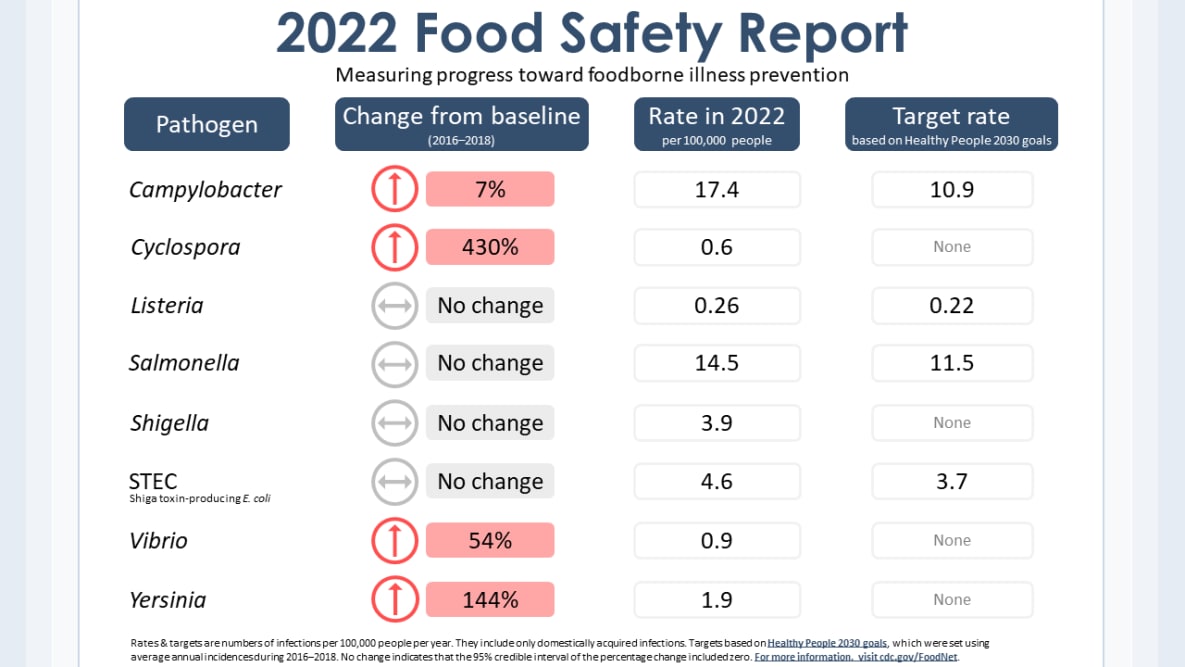
Graphic showing progress in 2022 toward foodborne illness prevention, with changes from the 2016–2018 baseline, rates in 2022, and target rates based on Healthy People 2030 goals. Rates increased for Campylobacter, Cyclospora, Vibrio, and Yersinia and did not change for Listeria, Salmonella, Shigella, and Shiga toxin-producing E. coli. Rates for Campylobacter, Listeria, Salmonella, and Shiga toxin-producing E. coli are all higher than their established target rates.

This year’s report summarizes 2022 preliminary surveillance data. It describes 2022 incidence compared with the average incidence for 2016–2018, the reference period used for the U.S. Department of Health and Human Services (HHS) Healthy People 2030 goals. The report also summarizes cases of hemolytic uremic syndrome (HUS) during 2021.

  • In 2022, enteric (intestinal) infections monitored by FoodNet generally returned to or exceeded levels observed in 2016–2018 (before the COVID-19 pandemic).
    • Incidence of CampylobacterListeriaSalmonella, and Shigella infections did not change in 2022 compared with 2016–2018.
    • Incidence of Cyclospora, STEC, Vibrio, and Yersinia infections increased in 2022 compared with 2016–2018.
  • Campylobacter and Salmonella remain the top causes of enteric infections monitored by FoodNet.
  • Increased use of CIDTs contributed to the increased detection of infections.
  • FoodNet data show lack of progress during 2022 toward Healthy People 2030 goals for reducing foodborne illness. Concerted efforts are needed to implement effective prevention strategies to reduce disease burden.

Research – Foodborne Outbreak of Extended Spectrum Beta-lactamase Producing Shigella sonnei Associated with Contaminated Spring Onions in the United Kingdom

Science Direct

Shigella - kswfoodworld

Image CDC

Abstract

Globalization of the food supply chain has created conditions favorable for emergence and spread of multidrug-resistant (MDR) foodborne pathogens. In November 2021, the UK Health Security Agency detected an outbreak of 17 cases infected with the same strain of MDR extended spectrum beta-lactamase (ESBL)-producing Shigella sonnei. Phylogenetic analysis of whole-genome sequencing data revealed the outbreak was closely related to strains of S. sonnei isolated from travelers returning to the UK from Egypt. None of the outbreak cases reported travel and all 17 cases reported eating food from a restaurant/food outlet in the week prior to symptom onset, of which 11/17 (64.7%) ate at branches of the same national restaurant franchise. All 17 cases were adults and 14/17 (82.4%) were female. Ingredient-level analyses of the meals consumed by the cases identified spring onions as the common ingredient. Food chain investigations revealed that the spring onions served at the implicated restaurants could be traced back to a single Egyptian producer. The foodborne transmission of ESBL-producing bacteria is an emerging global health concern, and concerted action from all stakeholders is required to ensure an effective response to mitigate the risks to public health.

USA- CDC – BEAM Dashboard – (Bacteria, Enterics, Amoeba, and Mycotics)

CDC

The BEAM (Bacteria, Enterics, Amoeba, and Mycotics) Dashboard is an interactive tool to access and visualize data from the System for Enteric Disease Response, Investigation, and Coordination (SEDRIC). The BEAM Dashboard provides timely data on pathogen trends and serotype details to inform work to prevent illnesses from food and animal contact. Currently, the dashboard focuses on data for Salmonella, Shiga toxin-producing E. coli (STEC), Shigella and Campylobacter bacteria and multistate outbreaks, but it will eventually include additional pathogens, antimicrobial resistance data, and epidemiologic data from outbreak investigations.

Frequently Asked Questions (FAQ)

For additional questions, please contact simso@cdc.gov. Please take BEAM Dashboard Evaluation Survey if you would like to provide any feedback or have any comments.

Research – Major pathogens rise in Ireland in 2022

Food Safety News

Campylobacter, Salmonella, E. coli, and Listeria infections all increased in Ireland in 2022, according to the latest figures.

Data from the Health Protection Surveillance Centre (HPSC), which is part of the Health Service Executive (HSE), shows the number of reports for the four pathogens rose compared to 2021.

Notifications of Salmonellosis doubled and the number of E. coli infections passed 1,000.

Full reports on these four pathogens and for outbreaks have not been published since 2018 because of the impact of the COVID-19 pandemic response and limited capacity at HPSC.

Campylobacter infections went up from 3,147 in 2021 to 3,619 in 2022.

Salmonella cases doubled from 173 in 2021 to 342 in 2022 but this is similar to 2018 and 2019 levels.

More than 1,000 Shiga toxin-producing E. coli (STEC) notifications were noted. Up from 962 in 2021.

A total of 18 listeriosis cases were recorded, up from 15 in 2021. Fourteen were men and four were women. Fifteen cases were in the over-65 age group while two were less than 1 to 4 years old.

Figures also show three cases of Bacillus cereus foodborne infection or intoxication compared to none in 2021.

The published data, which covers 2018 to 2022, reveals two cases of botulism, although it is unclear if food was the cause. There was also one report of brucellosis in 2022. All other years reported no notifications of these diseases.

There were 17 yersiniosis cases in 2022 compared to 18 in 2021. Cryptosporidiosis declined from 845 in 2021 to 566 in 2022.

Shigellosis went up from 70 in 2021 to 157 in 2022. Norovirus also increased from 439 in 2021 to 990 in 2022.