Category Archives: Mould Toxin

RASFF Alert- Mycotoxin – Ergot Alkaloids – Rye

European Food Alerts

RASFF

ergot (Claviceps purpurea) alkaloids (4948 mg/kg – ppm) in rye from Germany in Austria

RASFF Alert – Mycotoxin -Fumonsins – Organic Corn Waffles

European Food Alerts

RASFF

fumonisins (sum B1+B2: 890; 1130 µg/kg – ppb) in organic corn waffles from Slovakia in Germany

RASFF Alerts – Ochratoxin A – Pistachios

European Food Alerts

RASFF

ochratoxin A (32.8 µg/kg – ppb) in pistachios from the United States in Switzerland

RASFF Alerts -Afaltoxin – Banku Mix – Crushed Chillies – Dried Figs – Pistachios – Groundnut Kernels

European Food Alerts

RASFF

aflatoxins (B1 = 106; Tot. = 119 µg/kg – ppb) in banku mix from Ghana in the UK

RASFF

aflatoxins (B1 = 10.3; Tot. = 11.5 µg/kg – ppb) in crushed chillies from India in Italy

RASFF

aflatoxins (B1 = 13.4; Tot. = 16.7 µg/kg – ppb) in dried figs from Turkey in Italy

RASFF

aflatoxins (Tot. = 26.3 mg/kg – ppm) in pistachios from the United States, via Turkey in Germany

RASFF

aflatoxins (B1 = 132; Tot. = 147 µg/kg – ppb) in shelled pistachios from Iran in France

RASFF

aflatoxins (B1 = 7.1; Tot. = 9.5 µg/kg – ppb) in groundnut kernels from Argentina in the Netherlands

Ireland – Recall of a Batch of Castlewood Farm Organic Apple Juice due to an Elevated Level of Patulin – Mycotoxin

FSAI

Summary
Category 1: For Action
Alert Notification: 2020.95
Product: Castlewood Farm Organic Apple Juice; pack size 750ml
Batch Code: Best Before October 2021
Country Of Origin: Ireland

Message:

Castlewood Farm is recalling the above batch of its Organic Apple Juice due to an elevated level of patulin.  Patulin is a toxic contaminant produced naturally by a number of moulds found in and on fruit. Point-of-sale recall notices will be displayed in stores supplied with the implicated batch.

Nature Of Danger:

While patulin does not present an immediate risk to consumers, its presence is unacceptable and long-term consumption could cause an effect on human health. If consumed in large quantities over a period of time, patulin may cause damage to the immune system, nervous system and gastrointestinal tract.

Action Required:

Manufacturers, wholesalers, distributors, caterers & retailers:

Retailers are requested to remove the implicated batch from sale and to display a point-of-sale recall notice in stores where the affected batch was sold.

Consumers:

Consumers are advised not to consume the implicated batch.

Apple Juice Label
Apple Juice Bottle

Research – Effect of Blanching on Aflatoxin Contamination and Cross-Contamination of Almonds

Journal of Food Protection

ABSTRACT

Blanching of almonds was examined for reducing the aflatoxin content of contaminated nuts. Almonds with intact pellicles were spiked with aflatoxin B1 (AFB1) and blanched at 85°C. Following blanching, almond kernels and pellicles contained 20 and 19% of the spiked AFB1, respectively. The blanching water contained an additional 41% of the spiked AFB1. In a separate study, postblanching water was spiked with AFB1 and used for subsequent blanching of uncontaminated almonds. The resulting blanched kernels acquired 3.3% of the AFB1 from the spiked water, demonstrating a low level of cross-contamination from reused contaminated blanching water. The effect of the blanching temperature on partitioning of AFB1 from almonds to blanching water was significant at a 20-ppb spiking level, but not at 100 ppb. AFB1 levels that were unaccounted for in the mass balance of blanching components were presumed to be lost due to binding to water-solubilized almond components and were independent of pH and blanching time. Blanching reduced total aflatoxins in naturally contaminated almonds by 13 to 76%, depending on almond quality, as well as blanching time and temperature. These results indicate that the association between almond components and aflatoxin generated through mold contamination is more complex than in spiking experiments.

HIGHLIGHTS
  • Blanching and pellicle removal reduced aflatoxin in spiked almonds by up to 80%.
  • Low-level cross-contamination occurred in almonds blanched in contaminated water.
  • Aflatoxin reduction in naturally contaminated almonds by blanching was variable.

RASFF Alerts – Aflatoxin – Groundnuts – Dried Figs – Pistachios – Brown Basmati Rice – Hazlenut Kernels – Almonds – Chilli Powder

European Food Alerts

RASFF

aflatoxins (B1 = >48; Tot. = >60 µg/kg – ppb) in groundnuts from Nigeria in Poland

RASFF

aflatoxins (B1 = 15.3 mg/kg – ppm) in dried figs from Turkey in Sweden

RASFF

aflatoxins (B1 = 22.2; Tot. = 24.3 µg/kg – ppb) in pistachios from Iran, dispatched from Hong Kong in Italy

RASFF

aflatoxins (B1 = 24; Tot. = 27 µg/kg – ppb) in brown basmati rice from India in the Netherlands

RASFF

aflatoxins (B1 = 12.9; Tot. = 15.1 / B1 = 19.9; Tot. = 44.5 µg/kg – ppb) in dried figs from Turkey in Germany

RASFF

aflatoxins (B1 = 7.56; Tot. = 9.59 µg/kg – ppb) in hazelnut kernels from Georgia in Bulgaria

RASFF

aflatoxins (B1 = 5.8; Tot. = 6.5 µg/kg – ppb) in unshelled groundnuts from the United States in Germany

RASFF

aflatoxins (B1 = 8; Tot. = 10 µg/kg – ppb) in pistachio kernels from the United States, dispatched from Turkey in Belgium

RASFF

aflatoxins (B1 = 24 µg/kg – ppb) in almonds from Spain, via Germany in Finland

RASFF

aflatoxins (B1 = 5.3; Tot. = 6.6 µg/kg – ppb) in groundnuts kernels from Nigeria in the UK

RASFF

aflatoxins (B1 = 9.5; Tot. = 10.1 µg/kg – ppb) in chilli powder from India in the UK

RASFF

aflatoxins (B1 = 87.2; Tot. = 170.8 µg/kg – ppb) in dried figs from Turkey in Sweden

RASFF Alerts – Ochratoxin A – Pastry Flour – Dried Figs

European Food Alerts

RASFF

ochratoxin A (5.6 µg/kg – ppb) in pastry flour from Belgium in Belgium

RASFF

ochratoxin A (19.4 µg/kg – ppb) in dried figs from Turkey, via Germany in Austria

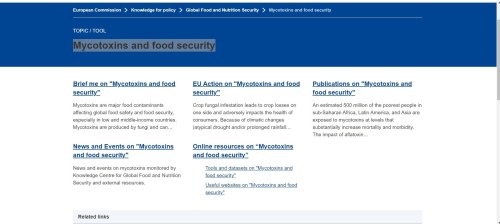
Research – Mycotoxins and food security

EU

eu

Research – Mycotoxins in Beverages

MDPI

Mycotoxins are secondary metabolites produced by fungi that contaminate raw materials such as cereals, fruits, dried fruits, coffee, and grapes when they have been produced or maintained in a temperature and/or humidity conditions that favour fungi growth. In general, mycotoxins are very resistant to temperature and remain stable during food preparation and processing [1].Therefore, food prepared from contaminated raw materials can retain the levels of these compounds.Several beverages are produced based on raw materials prone to be contaminated, such as beer from cereals, wine from grapes, coffee, and more. Moreover, and due to the fact that one fungal speciescan produce various of these metabolites [2], the most likely scenario is the co-occurrence of several mycotoxins in one food product.

Mycotoxins have different toxic effects on human health. They can be divided into acute effects,due to the ingestion of high levels of toxins in a short time period, and into chronic effects, due to the ingestion of low quantities for a long time. These chronic effects are the most common ones and they have been described as hepatotoxicity, immune diseases, carcinogenicity, genotoxicity, endocrine andreproductive effects, mutagenicity, teratogenicity, nausea, vomiting and diarrhea, among others [2].All the above make the presence of these compounds in human foods a global problem regarding food safety and also regarding economics, due to the loss of lots of contaminated raw materials or food products and its impact on global trade [3].In order to protect human health, legislative organisms promote the monitorization of these toxins in raw materials and foods, along with the regulation of maximum levels that can be present in some food products.

This Special Issue “Mycotoxins in Beverages” comprises three research articles and three reviews related to the presence of these toxins in beverages and covers different aspects. The research articles are devoted to the presence of mycotoxins in beer and milk. The reviews collect, on the one hand,information regarding mycotoxin presence in wine and in beverages obtained from tropical crops, and,on the other, new approaches for detecting ochratoxin A and other compounds in beverages.