Category Archives: Microbiology

Research -Processing plant and machinery sanitation and hygiene practices associate with Listeria monocytogenes occurrence in ready-to-eat fish products

Science Direct

Listeria monocytogenes causes the foodborne illness listeriosis, which exhibits high fatality among people in risk groups. The incidence of listeriosis has increased in Europe, which raises concerns about L. monocytogenes occurrence in foodstuffs. Ready-to-eat seafood products are considered particularly risky vehicles. Poor hygiene at processing facilities predisposes them to L. monocytogenes contamination, which can be controlled by stringent self-checking system measures. We examined the association of fish-processing plant operational and hygiene practices with the occurrence of L. monocytogenes in vacuum-packaged gravad (cold-salted) and cold-smoked salmon and rainbow trout products. Product sampling of 21 fish-processing plants was carried out, and operational procedures relating to L. monocytogenes control were surveyed using an in-depth risk assessment questionnaire. L. monocytogenes occurred only in sliced and mainly in gravad products of seven fish-processing plants. Shortages in preventive measures were discovered predominantly among the L. monocytogenes positive fish-processing plants. Using generalized linear modeling, we identified the following features associated with L. monocytogenes product contamination: the number of processing machines, deficiencies in the processing environment and machinery sanitation, and staff movement from areas of low toward high hygiene. Furthermore, performing frequent periodic thorough sanitation alongside everyday sanitation practices associated with a decreased risk of product contamination.

RASFF Alerts – Animal Feed – Salmonella – Meat Meal – Dried Pork Haemoglobin- Layer Feed – Dried Silkworm Pupae

RASFF-Logo

RASFF – Salmonella enterica ser. Infantis (present /25g) in meat meal from Germany in Germany

RASFF – Salmonella (presence) in dried pork haemoglobin from Germany in Poland

RASFF – Salmonella enterica ser. Mbandaka (present /25g) in layer feed from Belgium in Belgium

RASFF – Salmonella (presence /25g) in dried silkworm pupae from India in Germany

Europe -How Common is Legionnaires’ Disease in Europe?

Legionella Control

In this article the water safety experts at Legionella Control International ask the question… how common is Legionnaires’ disease in Europe, and what can be done to prevent it? It examines data from the ECDC (European Centre for Disease Prevention and Control) including records of how many people catch Legionnaires’ disease in Europe, and typical mortality rates. It then looks at what key steps can be taken to control the spread of the disease, including legionella risk assessment and the development and implementation of a Water Safety Plan or WSP.

Research – Stability of Listeria monocytogenes in wheat flour during extended storage and isothermal treatment

Science Direct

Foodborne pathogens including Salmonella have been implicated in recent recalls of low-water activity (aw) foods, such as peanut butter, almond flour, wheat, flour and dry milk powder, and are primary concerns for the microbiological safety of dry food products. Although there are an increasing number of studies on Salmonella thermal resistance conducted in low-moisture foods, little information is available on Listeria monocytogenes thermal resistance in those products. This study evaluated the survival of L. monocytogenes in wheat flour during long-term storage as well as its thermal resistance in wheat flour equilibrated to aw 0.30, 0.45, and 0.60. L. monocytogenes survived in wheat flour at both aw 0.31 and 0.56 during 6 months of storage at room temperature, with populations decreasing about 2.52 and 6.27 logs at aw 0.31 and 0.56, respectively. Equilibration in low-aw flour enabled L. monocytogenes to become more resistant to thermal treatment. At treatment temperature between 70 and 80 °C, D-values increased with decreasing aw. For aw 0.30. 0.45, and 0.60 (measured at room temperature), respectively, D-value (in min) ranges for 70–80 °C were 37.10–7.08, 17.44–3.13, and 16.85–1.59. The z-values were 12.9, 14.2, and 9.9 °C for aw 0.30, 0.45, and 0.60, respectively. These data highlight the need for vigilance when processing dry foods, and provide valuable information for the industry to validate thermal processing for control of L. monocytogenes in low-moisture foods. This study also offers insight into the development of thermal inactivation strategies to control L. monocytogenes and other foodborne pathogens in foods with similar matrices.

USA- Romaine in the cross-hairs – FDA to test lettuce for pathogens

Food Poison Journal

The FDA is conducting a small, focused assignment to collect samples of raw agricultural commodity (RAC) romaine lettuce to test for Salmonella spp. and pathogenic Escherichia coli (also known as Shiga Toxin-producing E. coli or STEC), microbial hazards repeatedly linked to foodborne illnesses associated with romaine lettuce consumption. The assignment begins this month (November 2019) and is expected to last one year.

USA -Quest Beef Cat Food Recalled For Possible Salmonella

Food Poisoning Bulletin

Go Raw, LLC is recalling its 2 pound frozen bags of Quest Beef Cat Food for possible Salmonella contamination. No illnesses have been reported to date in connection with this issue.

The Quest Beef Cat Food is sold in 2 pound bags, and has the UPC number UPC 6-91730-17101-8 with lot number N128. The Minnesota Department of Agriculture took a sample of the product and tested it for Salmonella; it tested positive.

The firm conducted its own test and it was negative. But, Salmonella may not be evenly distributed throughout the cat food, which is typical, which explains the discrepancy.

Sweden -Sweden reports increase in Cryptosporidium, most in Stockholm

Outbreak News Today crypto

Swedish health officials, aka Folkhalsomyndigheten have reported an increase in the parasitic infection, cryptosporidiosis in recent weeks, particularly in November.

About half of the country’s regions have reported cases in all ages, but primarily in adults. Most cases are seen in the Stockholm region.

The Public Health Agency and the National Food Agency have started an outbreak investigation to identify if there are one or more common sources of infection that are unknown so far. As part of the investigation, cases are interviewed about what they ate and drank before they became ill.

USA -Outbreak of Listeria Infections Linked to Deli-Sliced Meats and Cheeses

CDC

This investigation is over. This outbreak is a reminder that deli products, such as sliced meats and cheeses, can have Listeria bacteria. People who are at higher risk for Listeria infection should avoid eating hot dogs, lunch meats, cold cuts, and other deli meats, unless they are heated to an internal temperature of 165°F or until steaming hot just before serving.

CDC and several states, along with the U.S. Department of Agriculture’s Food Safety and Inspection Service and the U.S. Food and Drug Administration, investigated a multistate outbreak of Listeria infections linked to deli-sliced meats and cheeses. A single, common supplier of deli products was not identified.

Canada – Food Recall Warning – Farm Boy brand cheese balls recalled due to Listeria monocytogenes

CFIA

Ottawa, November 17, 2019 – Farm Boy is recalling Farm Boy brand cheese balls from the marketplace due to possible Listeria monocytogenes contamination. Consumers should not consume the recalled products described below.

Recalled product

Brand Product Size UPC Codes
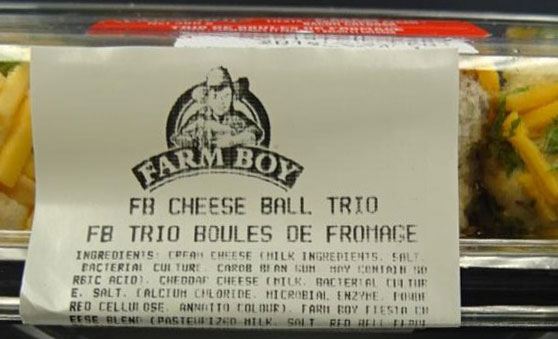
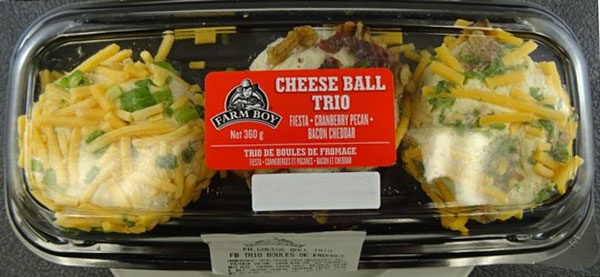
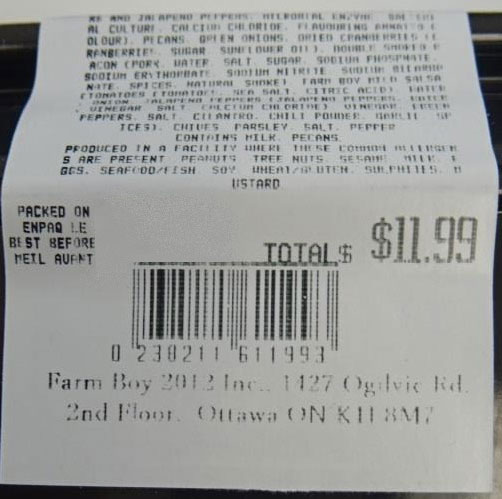
Farm Boy Cheese Ball Trio – Fiesta, Cranberry Pecan, Bacon Cheddar and/or “FB Cheese Ball Trio” 360 g Starting with 0 238211 All units sold up to and including November 17, 2019
Farm Boy “FB Blue Cheese & Walnut Ball” 180 g Starting with 0 238274 All units sold up to and including November 17, 2019
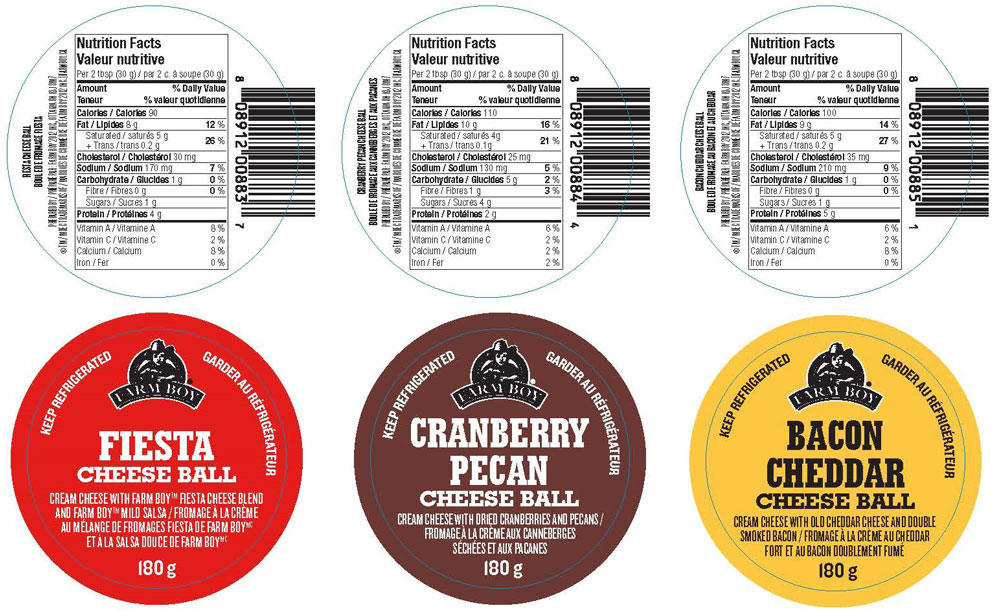
Farm Boy Cranberry Pecan Cheese Ball and/or “FB Cran Pecan Cheese Ball” 180 g 8 08912 00884 4 or Starting with 0 232337 All units sold up to and including November 17, 2019
Farm Boy Fiesta Cheese Ball and/or Farm Boy Fiesta Cheese Ball 180 g 8 08912 00883 7 or Starting with 0 238283 All units sold up to and including November 17, 2019
Farm Boy “FB Wht Choc Pecan Cran Ball” 180 g Starting with 0 238275 All units sold up to and including November 17, 2019
Farm Boy Bacon Cheddar Cheese Ball and/or “FB Bacon Chedd. Cheese Ball” 180 g 8 08912 00885 1 or Starting with 0 238284 All units sold up to and including November 17, 2019

Illnesses

There have been no reported illnesses associated with the consumption of these products.

Product photos

Printer ready version of photos

  • Farm Boy Cheese Ball Trio – 360 grams (side)
  • Farm Boy Cheese Ball Trio – 360 grams (outer label)
  • Farm Boy Cheese Ball Trio – 360 grams (UPC)
  • Farm Boy Cheese Ball – 180 grams (pre-printed labels)
  • Farm Boy Cheese Ball – 180 grams (store-printed labels)

Research – Decontamination of Bacillus cereus in cardamom (Elettaria cardamomum) seeds by infrared radiation and modeling of microbial inactivation through experimental models

Wiley Online 

In this work, infrared (IR) irradiation was used for inactivation of Bacillus cereus in cardamom seeds. The effect of IR power (100, 200, and 300 W), sample distance from radiation source (5, 10, and 15 cm) and holding times (0–11 min) was investigated on B. cereus count, as well as cardamom seeds color and temperature profiles. Inactivation of B. cereus on cardamom seeds during IR processing was demonstrated by experimental models. The highest reduction of B. cereus count (5.11 Log CFU/g) was achieved after 8 min IR irradiation at 300 W power and 15 cm distance. Measurement of temperature profiles revealed that there was a significant difference (p < .05) between surface and center temperatures of the cardamom seeds. The green color (a* value) of cardamom seeds was slightly affected and the highest color change was observed at 200 W IR, 10 cm distance and 10 min irradiation that resulted in an increase of a* from −3.05 ± 0.96 to −0.05 ± 0.44. In conclusion, IR irradiation could be successful for decontamination of cardamom seeds without severe alteration of its quality. Among the experimental models for microbial inactivation during IR processing, the Double Weibull model had the highest coefficient value of determination (R2 = 0.9966).