Category Archives: Microbiology Risk

India – Over 100 Students Fall Sick Due To Suspected Food Poisoning In Karnataka

NDTV

Mangaluru: 

At least 137 nursing and paramedical students fell ill due to suspected food poisoning at a private hostel in Mangaluru’s Shaktinagar on Monday.

The students were rushed to various private hospitals in the city at night.

The students had developed stomach ache, vomiting and diarrhoea since 2 am on Monday.

City police commissioner N Shashi Kumar said that the police are trying to find the reason behind the incident.

“At about 9 pm, around 400-500 people gathered in front of city hospital in the city. Most of them are students and the rest are their family members. Since morning 2 am more than 100 girl students have complained of food poisoning and hospitalised. 137 students were admitted to different hospitals in the city. We are trying to find out the reason,” Shashi Kumar said.

Research – Tackle Foodborne Illness When Ordering Takeout or Delivered Foods

FSIS USDA

The Super Bowl is the biggest and most anticipated sporting event of the year. Friends and families “huddle” and consume foods and snacks for the duration of the game while cheering for their favorite team. This iconic annual event is often celebrated by ordering takeout and delivered foods, which if left out too long, can cause foodborne illness.

Leaving food out at room temperature is a big food safety penalty. Bacteria that can cause foodborne illness will start to grow to dangerous levels in the range of temperatures between 40 F and 140 F when left out for over two hours or one hour if above 90 F. This range of temperatures is called the Danger Zone.

To avoid foodborne illness during the big game, follow this game plan:

  • Keep cold foods cold and hot foods hot. Cold foods should be kept under 40 F on the buffet table by nesting serving dishes of food in bowls of ice. Hot foods should be kept above 140 F. A preheated oven, chafing dishes, preheated warming trays or slow cookers can be used to keep food hot.
  • Don’t serve all food at once. Use small platters and replace them often with fresh refrigerated platters of food, rather than adding fresh food to a serving dish already on the table. Hot foods should be reheated to 165 F as measured with a food thermometer. When reheating in the microwave, cover the food for even heating. Check the temperature of the food in several places with a food thermometer, as some microwaved foods can have cold spots.

For more information, call the USDA Meat and Poultry Hotline at 1-888-MPHotline (1-888-674-6854) or email MPHotline@usda.gov to reach a food safety expert or chat live at ask.usda.gov from 10 a.m. to 6 p.m. Eastern Time, Monday through Friday.

Research – Repeated cross-sectional study identifies differing risk factors associated with microbial contamination in common food products in the United Kingdom

Science Direct

Abstract

All foods carry microbes, many of which are harmless, but foods can also carry pathogens and/or microbial indicators of contamination. Limited information exists on the co-occurrence of microbes of food safety concern and the factors associated with their presence. Here, a population-based repeated cross-sectional design was used to determine the prevalence and co-occurrence of Escherichia coli, Klebsiella spp., Salmonella spp. and Vibrio spp. in key food commodities – chicken, pork, prawns, salmon and leafy greens. Prevalence in 1,369 food samples for these four target bacterial genera/species varied, while 25.6% of all samples had at least two of the target bacteria and eight different combinations of bacteria were observed as co-occurrence profiles in raw prawns. Imported frozen chicken was 6.4 times more likely to contain Salmonella than domestic chicken, and imported salmon was 5.5 times more likely to be contaminated with E. coli. Seasonality was significantly associated with E. coli and Klebsiella spp. contamination in leafy greens, with higher detection in summer and autumn. Moreover, the odds of Klebsiella spp. contamination were higher in summer in chicken and pork samples. These results provide insight on the bacterial species present on foods at retail, and identify factors associated with the presence of individual bacteria, which are highly relevant for food safety risk assessments and the design of surveillance programmes.

Lithuania – Three pathogens found in chicken linked to illnesses

Food Safety News

Three people have fallen sick in Lithuania after eating chicken contaminated with Salmonella, Listeria and Campylobacter.

The Kaunas Department of the State Food and Veterinary Service (VMVT Kaunas) received information from the National Public Health Center (NVSC) about three illnesses from chicken wings sold at a café.

Officials from VMVT Kaunas inspected the outlet and found several non-compliances including instances of cross-contamination, hygiene violations at the premises and by employees as well as improper waste management. Operations at the establishment were suspended.

As part of an investigation into the source of infection, VMVT inspectors took samples of surfaces, drinking water and chicken wings for microbiological analysis. Lab testing found Salmonella, Listeria monocytogenes and Campylobacter in the chicken.

Research – UK group updates hygiene advice for butchers

Food Safety News

An association for butchers and small abattoirs in England and Wales has updated food hygiene advice.

National Craft Butchers (NCB) has reviewed existing assured advice and launched a food safety management system for butchers.

Since partnering with Horsham District Council in 2013, NCB members have been able to register for a Primary Authority (PA) system and the legally backed food hygiene advice it provides.

Primary Authority enables businesses to form a partnership with one local authority, which then provides assured advice on complying with environmental health and trading standards rules that other regulators must respect.

Developed with Primary Authority partner Horsham District Council, and member advice service, Safer Food Scores, the NCB guide is intended as a reference to ensure compliance and best practice standards are achieved in retail butchery.

USA – CDC Fact Sheet – Surveillance System Overview: National Shiga toxin-producing Escherichia coli (STEC) Surveillance

CDC

Surveillance System Overview:

National Shiga toxin-producing Escherichia coli (STEC) Surveillance Shiga toxin-producing Escherichiacoli (STEC) are estimated to cause more than 265,000 illnesses each year in the United States, with more than 3,600 hospitalizations and 30 deaths

(STEC infections often cause diarrhea, sometimes bloody.

Some patients with STEC infection develop hemolytic uremic syndrome (HUS), a severe complication characterized by renal failure, hemolytic anemia, and thrombocytopenia that can be fatal.

Most outbreaks of STEC infection and most cases of HUS in the United States have been caused by STEC O157. Non-O157 STEC have also caused US outbreaks. Although all STEC infections are nationally notifiable, for several reasons many cases are likely not recognized

Not all persons ill with STEC infection seek medical care, healthcare providers may not obtain a specimen for laboratory diagnosis, or the clinical diagnostic laboratory may not perform the necessary diagnostic tests. Accounting for under-diagnosis and under-reporting, an estimated 96,534 STEC O157 and 168,698 non-O157 infections occur each year

STEC transmission occurs through consumption of contaminated foods, ingestion of contaminated water, or direct contact with infected persons (e.g., in child-care settings) or animals or their environments.

USA – 130 Las Vegas Elementary School Students ‘Projectile Vomiting’ After Mysterious Illness Outbreak

People

A gastrointestinal illness outbreak at a Las Vegas elementary school left at least 130 students “projectile vomiting”, according to local reports.

Teachers at the Wayne N. Tanaka Elementary School in Nevada asked the ill students to line up outside the school as they repeatedly “projectile vomited” during the incident on Jan. 27, according to 8 News Now.

Officials with the Clark County School District (CCSD) and Southern Nevada Health District (SNHD) have not said what caused the illness but confirmed they are investigating the incident.

A spokesperson for the Southern Nevada Health District (SNHD) told 8 News Now, “During a foodborne illness outbreak, people are interviewed about what they ate before they got sick when possible food contamination is confirmed using epidemiological and laboratory information.

“Gastrointestinal illnesses can have many causes,” the spokesperson added.

USA – Kerry Inc. Pleads Guilty and Agrees to Pay $19.228 Million in Connection with Insanitary Plant Conditions Linked to 2018 Salmonella Poisoning Outbreak

Justice

Food and ingredient manufacturing company Kerry Inc. pleaded guilty today to a charge that it manufactured breakfast cereal under insanitary conditions at a facility in Gridley, Illinois, that was linked to a 2018 salmonellosis outbreak.

Pursuant to a plea agreement filed with a criminal information in federal court in Peoria, Illinois, Kerry pleaded guilty to a misdemeanor count of distributing adulterated cereal marketed as Kellogg’s Honey Smacks. The company also agreed to pay a criminal fine and forfeiture amount totaling $19.228 million. If the guilty plea is accepted by the court, the $19.228 million fine and forfeiture will constitute the largest-ever criminal penalty following a criminal conviction in a food safety case.

“Consumers depend on food manufacturers to take appropriate steps to ensure food safety,” said Principal Deputy Assistant Attorney General Brian Boynton, head of the Justice Department’s Civil Division. “The Department is committed to holding accountable those who fail to meet this obligation.”

“Today’s announcement should serve as a reminder that food manufacturers have a critical responsibility to produce and sell food that is safe for American consumers to eat,” said Assistant Commissioner Justin D. Green for the Food and Drug Administration’s (FDA) Office of Criminal Investigations. “We will continue to pursue and bring to justice those who put the public health at risk by allowing contaminated foods to enter the U.S. marketplace.”

The criminal information unsealed today alleges that Kerry manufactured Kellogg’s Honey Smacks cereal under insanitary conditions and distributed it in violation of the Food, Drug, and Cosmetic Act. According to the plea agreement, tests performed as part of Kerry’s environmental monitoring program found numerous instances of Salmonella in the environment at the Gridley facility. During the time period June 2016 to June 2018, routine environmental tests detected Salmonella in the plant approximately 81 times, including at least one positive Salmonella sample each month. According to the plea agreement, employees at the Gridley facility routinely failed to implement corrective and preventative actions (CAPAs) to address positive Salmonella tests.

Research – Antibacterial and Anti-Biofilm Properties of Diopside Powder Loaded with Lysostaphin

MDPI

Abstract

Background: Diopside-based ceramic is a perspective biocompatible material with numerous potential applications in the field of bone prosthetics. Implantable devices and materials are often prone to colonization and biofilm formation by pathogens such as Staphylococcus aureus, which in the case of bone grafting leads to osteomyelitis, an infectious bone and bone marrow injury. To lower the risk of bacterial colonization, implanted materials can be impregnated with antimicrobials. In this work, we loaded the antibacterial enzyme lysostaphin on diopside powder and studied the antibacterial and antibiofilm properties of such material to probe the utility of this approach for diopside-based prosthetic materials. Methods: Diopside powder was synthesized by the solid-state method, lysostaphin was loaded on diopside by adsorption, the release of lysostaphin from diopside was monitored by ELISA, and antibacterial and anti-biofilm activity was assessed by standard microbiological procedures. Results and conclusions: Lysostaphin released from diopside powder showed high antibacterial activity against planktonic bacteria and effectively destroyed 24-h staphylococcal biofilms. Diopside-based materials possess a potential for the development of antibacterial bone grafting materials.

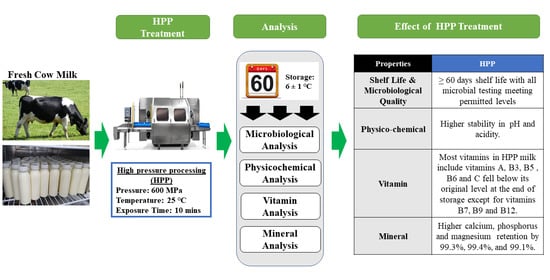
Research – Microbiological, Physicochemical and Nutritional Properties of Fresh Cow Milk Treated with Industrial High-Pressure Processing (HPP) during Storage

MDPI

Abstract

The safety, shelf life, and quality of fresh cow milk treated using industrial High-Pressure Processing (HPP) treatment at 600 MPa for 10 min was studied to identify the novelty of this non-thermal technology in milk processing. Changes in microbiological and physicochemical properties, including nutritional values of vitamins and amino acid profiles, were measured for a 60-day storage period at 6 °C +/− 1 °C. The HPP treatment produced milk that met all microbial safety requirements and exhibited a shelf life beyond 60 days in a hot and humid region. High physicochemical stability was achieved, with consistent pH and undetectable titratable acidity. The HPP treatment successfully retained all vitamins and minerals, including calcium (99.3%), phosphorus (99.4%), and magnesium (99.1%). However, the 60-day storage caused some degradation of Vitamin A (25%), B3 (91%), B5 (35%), B6 (80%), and C (85%), and minerals, including potassium (5%) and zinc (18%) when compared with fresh milk. This research has shown that the adoption of advanced treatment with HPP is very beneficial to the dairy industry in preserving milk quality in terms of its physicochemical and nutritional properties and extending its storage shelf life beyond 60 days.