Category Archives: Microbial Spoilage

USA – Haleon Issues Voluntary Nationwide Recall of Robitussin Honey CF Max Day Adult and Robitussin Honey CF Max Night time Adult Products Due to Microbial Contamination

FDA

FOR IMMEDIATE RELEASE – January 24, 2024 – Warren, NJ, Haleon is voluntarily recalling eight lots of Robitussin Honey CF Max Day Adult and Robitussin Honey CF Max Night time Adult to the consumer level. The product is being recalled due to microbial contamination.

In immunocompromised individuals, the use of the affected product could potentially result in severe or life-threatening adverse events such as fungemia or disseminated fungal infection. In non-immunocompromised consumers, the population most likely to use the product, life-threatening infections are not likely to occur. However, the occurrence of an infection that may necessitate medical intervention cannot be completely ruled out.

To date, Haleon has not received any reports of adverse events related to this recall.

Robitussin Honey CF Max Day and Nighttime are cough syrups indicated for the temporary relief of symptoms occurring with cold or flu, hay fever, or other respiratory allergies. This recall covers only the following lots:

Product Lot Number Expiry Date
ROBITUSSIN HONEY CF MAX
DAY ADULT 4OZ
T10810 31OCT2025
ROBITUSSIN HONEY CF MAX
DAY ADULT 8OZ
T08730
T08731
T08732
T08733
T10808
31MAY2025
31MAY2025
31MAY2025
31MAY2025
30SEP2025
ROBITUSSIN HONEY CF MAX
NT ADULT 8OZ
T08740 T08742 30JUN2026
30JUN2026

Haleon is notifying its distributors and customers directly and has provided them with instructions for the return of all recalled products. Consumers that have purchased the product listed should stop consumption immediately. Please call our Consumer Relations team at +1-800-245-1040 (Monday through Friday 8 AM to 6 PM Eastern Time) or reach out via email to mystory.us@haleon.com.

Consumers should contact their physician or healthcare provider if they have experienced any problems that may be related to taking or using this product.
Research -New Detection Tools for Clostridium Perfringens, Total Viable Bacteria in Poultry Production

Food Safety

Ancera has unveiled the release of two new microbial detection tools designed to identify and enumerate Clostridium perfringens and total viable bacteria (TVB) in poultry. The assays are designed to address critical challenges within the poultry industry, from live operations to processing, and help companies increase productivity, food safety, and interventional efficacy.

Ancera’s TVB assay is the first true non-enrichment, microbial quantitation assay focused on same-shift process improvement and quality control at the plant. The tool provides quantifiable microbial information enabling integrators to understand whether their processes are working to reduce microbial load. Once fully commercialized, the technology will produce results within a single working shift, unlocking real-time trend analysis and decision-making for improved compliance and sanitation. The new assay represents a significant reduction from traditional 48–72 hour turnaround times, decreasing the risk of compliance and recall risk.

Research – Process Hygiene Criterion for Campylobacter and Number of Campylobacter Enteritis Cases in Northwest Germany

MDPI

Abstract

Campylobacteriosis is the most commonly reported bacterial foodborne disease in the European Union. Its transmission is often associated with the consumption of poultry meat. In 2018, Regulation (EC) No. 2017/1495 introduced a process hygiene criterion and with this, the testing requirements for Campylobacter. The results of microbiological testing for Campylobacter of chicken carcass neck skin samples from several slaughter lines in Northwest Germany collected by the food business operators and contamination levels (cfu/g Campylobacter) of these samples were analysed from 2018 to 2021. Classification into three different categories was made based on contamination levels. The proportion of highly contaminated (category three) neck samples (>1000 cfu/g) decreased from 2018 to 2021. Our analysis showed a relationship between the number of neck samples with high Campylobacter contamination levels (>1000 cfu/g) and human cases in Northwest Germany. Spearman’s rank test (p < 0.01) showed a higher correlation in 2018 (0.66) and 2019 (0.58) compared to 2020 and 2021. Campylobacter enteritis cases in Northwest Germany stayed at a low level in 2020 and 2021. It remains unclear whether the decrease in reported Campylobacter enteritis cases is related to a decrease in Campylobacter levels on chicken carcasses or due to other reasons like underreporting during the COVID-19 pandemic, and therefore must be investigated in further analyses.

Canada – Réserve Festive brand Strong Cider recalled due to possible bursting bottles – Microbial Spoilage

CFIA

Summary

Product
Strong Cider
Issue
Food – Microbial Contamination – Non harmful (quality or spoilage)
What to do

Do not use, sell, serve or distribute the affected product.

Audience
Retail
Distribution
Quebec

Réserve Festive brand Strong Cider recalled due to possible bursting bottles.

Research – Prevention and controlof microbiological hazardsin fresh fruits and vegetables Parts 1 & 2: General principle

FAO

FAO & WHO. 2023. Prevention and control of microbiological hazards in fresh fruits and vegetables – Parts 1 & 2: General principles. Meeting report. Microbiological Risk Assessment Series, No. 42. Rome.
https://doi.org/10.4060/cc8490

Executive summary
Introduction
The purpose of the meetings was to collect, review and discuss relevant measures
for control of microbiological hazards from primary production to point of sale in
fresh, ready-to-eat (RTE), and minimally processed fruits and vegetables, including
leafy vegetables.
The scope of the meetings included aspects of primary production in open fields
or in protected facilities (such as high and low tunnels, production under cover,
greenhouses and net houses, and address hydroponic and aquaponic systems,
and other systems as required) and post-harvest activities, including activities
performed prior to packing, minimal processing, distribution, maintenance of
the cold chain where applicable, transportation, and handling at point of sale.
Emphasis was placed on the identification and evaluation of solutions to reduce
microbiological risks that result in foodborne illnesses associated with fresh fruits
and vegetables produced in various regions of the world, taking into consideration
their effectiveness and sui

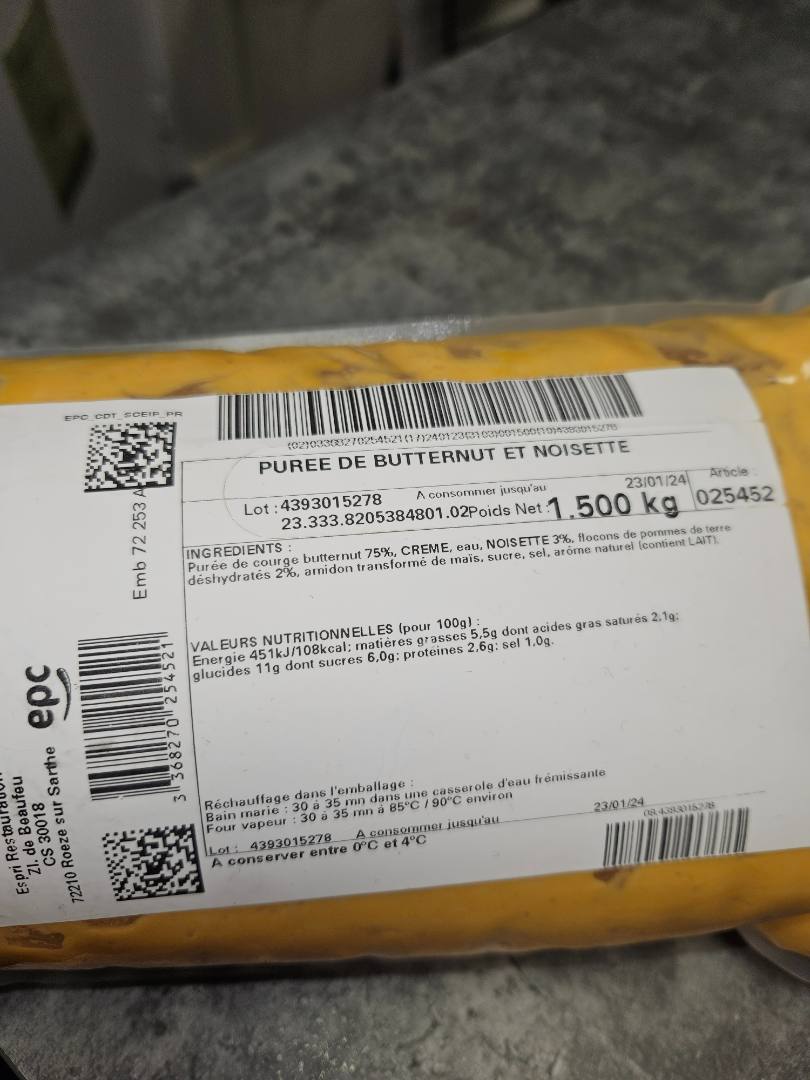
France – BUTTERNUT HAZELNUT PUREE 1.5KG – Microbiological Safety/Spoilage

Gov France

Product category
Food
Product subcategory
Soups, sauces and condiments
Product brand name
EPC
Model names or references
00025452.002 BUTTERNUT HAZELNUT PUREE 1.5KG
Product identification
GTIN Batch Date
3368270254521 Lot No. = 4393015278 with sublot 23.333.8205384801.02 This is indeed the lot ending in 02 Use-by date 01/23/2024
Products List
identification_table.pdfAttachment
Packaging
1.5kg vacuum bag
Start/end date of marketing
From 12/13/2023 to 12/27/2023
Storage temperature
Product to keep in the refrigerator
Health mark
FR72 253 002 CE
Further information
Orange butternut puree in 1.5kg vacuum bag Lot number = 4393015278 with sublot 23.333.8205384801.02 This is indeed the lot ending with 02
Geographical sales area
Whole France
Distributors
RHD

Research – Lactic acid bacteria and spoilage bacteria: Their interactions in Escherichia coli O157:H7 biofilms on food contact surfaces and implications for beef contamination

Wiley Online

Abstract

This research explores the interaction between Shiga toxin-producing Escherichia coli (STEC) O157:H7 and bacteria species commonly found in beef processing environments, specifically CarnobacteriumLactobacillusComamonasRaoultella, and Pseudomonas. The study investigated how various environmental conditions impact the formation of biofilms and the ability of O157:H7 to transfer from multispecies biofilm onto beef surfaces. For this purpose, a mixture of lactic acid bacteria (LAB), spoilage bacteria (106 CFU/mL), and E. coli O157 (103 CFU/mL) were combined as follows: LAB (T1)Carnobacterium piscicola + Lactobacillus bulgaricus + O157:H7, an spoilage bacteria (T2)Comamonas koreensis + Raoultella terrigena + O157:H7, an spoilage bacteria (T3)Pseudomonas aeruginosa + C. koreensis strain + O157:H7 and only O157:H7 as control (T4). Multispecies biofilms were developed on thermoplastic polyurethane (TPU) and stainless steel (SS) coupons at 10 and 25°C for 6 days, washed and stored for 6, 30, and 60 days at wet (60%–90% RH) and dry (20%–50%, RH) conditions. To evaluate O157:H7 transfer, beef cubes (3 × 3 × 1 cm) were placed on the coupons, followed by a 50-g weight (7.35 kPa). The experiment was repeated three times in triplicate for each strain combination. Results demonstrate that biofilms formed at 10°C were generally weaker (less biomass) than those at 25°C. Regardless of temperature, more viable O157:H7 cells were transferred to beef from moist biofilms on TPU surfaces. At 25°C, T3 biofilm exhibited the lowest O157:H7 transfer to beef by 1.44 log10 CFU/cm2 (p < 0.01). At 10°C, none of the multispecies biofilm (T1–T3) affected the number of O157:H7 transfers to beef (p > 0.05). Notably, O157:H7 was not detected on food contact surfaces with 30 and 60-day-old dry biofilms (T1–T4). Through enrichment, E. coli O157:H7 was recovered from multispecies biofilms T1, T2, and T3. Findings from this study imply that multispecies biofilms contribute to the persistence of O157:H7 under dry conditions, regardless of temperature. These results underscore the intricate influence of multiple environmental factors—including surface type, biofilm age, humidity, temperature, and the presence of other bacterial species—on the risk of beef contamination facilitated by biofilms.

EU – Nestle recalls infant formula due to Cronobacter risk

Food Safety News

Nestlé has recalled infant formula in several countries because of the potential presence of Cronobacter sakazakii.

The affected product is EXPERT PRO HA 1, which has different batch numbers depending on the country it was marketed.

Infant formula from Germany was sent to Bulgaria, Croatia, Czech Republic, Denmark, Finland, Greece, Hungary, Norway, Poland, Romania, Slovakia, and Sweden, according to a notice on the EU’s Rapid Alert System for Food and Feed (RASFF).

In Denmark, it was sold to a few stores and online webshops from Nov. 29 to Dec. 13, 2023. The Danish version NAN EXPERTPRO HA 1 800-grams has article number 12489069, batch number 33120742C2, and an expiration date of 11.2025.

In Norway, the recall applies to 90 units sold to pharmacies, including online pharmacies. NAN EXPERTPRO HA 1 has article number 12468459, batch number 33120742C1, and a best-before date of 11.2025. Products were distributed between Dec. 7 and 12, 2023.

In the Czech Republic and Slovakia, BEBA EXPERT PRO HA 1, 800-gram with batch number 33140742F3 is involved.

The product’s batch number and expiration date are at the bottom of the can. No other products or batches are affected.

No positive products or illnesses

Research – The Use of Predictive Microbiology for the Prediction of the Shelf Life of Food Products

MDPI

Abstract

Microbial shelf life refers to the duration of time during which a food product remains safe for consumption in terms of its microbiological quality. Predictive microbiology is a field of science that focuses on using mathematical models and computational techniques to predict the growth, survival, and behaviour of microorganisms in food and other environments. This approach allows researchers, food producers, and regulatory bodies to assess the potential risks associated with microbial contamination and spoilage, enabling informed decisions to be made regarding food safety, quality, and shelf life. Two-step and one-step modelling approaches are modelling techniques with primary and secondary models being used, while the machine learning approach does not require using primary and secondary models for describing the quantitative behaviour of microorganisms, leading to the spoilage of food products. This comprehensive review delves into the various modelling techniques that have found applications in predictive food microbiology for estimating the shelf life of food products. By examining the strengths, limitations, and implications of the different approaches, this review provides an invaluable resource for researchers and practitioners seeking to enhance the accuracy and reliability of microbial shelf life predictions. Ultimately, a deeper understanding of these techniques promises to advance the domain of predictive food microbiology, fostering improved food safety practices, reduced waste, and heightened consumer confidence.

RASFF Alert- Bombage and microbiological deviations – canned peeled tomatoes

RASFF

Bombage and microbiological deviations in canned peeled tomatoes from Italy in Germany