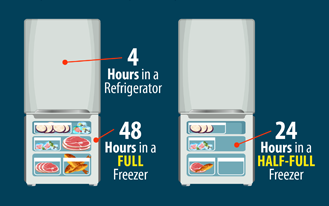
Foods may be unsafe to eat after a disaster or emergency. To prevent foodborne illness, prepare for emergencies and take key steps during and after power outages, floods, and other emergencies.

Foods may be unsafe to eat after a disaster or emergency. To prevent foodborne illness, prepare for emergencies and take key steps during and after power outages, floods, and other emergencies.
New Zealand Food Safety is approaching its target to reduce rates of campylobacteriosis, the country’s most common foodborne illness, a new report published today has found.
Annual report concerning Foodborne Diseases in New Zealand 2023 [PDF, 5 MB]
The report, prepared for New Zealand Food Safety by the Institute for Environmental and Scientific Research (ESR), found that the rate of New Zealand-acquired foodborne illness caused by the bacteria Campylobacter has fallen from 88 to 77 cases per 100,000 population over the past 4 years.
“New Zealand Food Safety has made reducing campylobacteriosis rates a key priority, and we’ve made great strides in recent years,” says New Zealand Food Safety deputy director-general Vincent Arbuckle.
“Rates of infection more than halved between 2006 and 2020. In 2020 we set a target to reduce the rate by a further 20%, taking it to 70 cases per 100,000 by the end of 2024.
“These latest results show this goal is in sight, which is a testament to the combined and sustained work of government and industry over time.
“The Campylobacter Action Plan, put in place to help tackle the issue, mainly focuses on steps to reduce the levels of Campylobacter through the poultry food chain. We have worked with government, industry and NGOs right across the poultry food chain through the Campylobacter governance group with representatives from Ministry of Health, Poultry Industry Association of New Zealand, Foodstuffs North Island, Foodstuffs South Island, Woolworths NZ, and Consumer NZ.”
The poultry industry has continued to improve processing practices over time, resulting in a sustained reduction in the proportion of birds that have detectable levels of Campylobacter at the end of primary processing.
While changes in the food supply chain have achieved good results, consumer awareness remains an important part of the effort, Mr Arbuckle says.
“We know that about half of all foodborne illness is caused at home. These illnesses can be prevented with good food preparation techniques as well as proper cooking and storage.
“To support prevention of Campylobacter at home we run public education campaigns which focus on giving people information they can use to keep themselves safe.
“While it is rewarding to see campylobacteriosis rates falling, there is more work to do. The symptoms of campylobacteriosis can be unpleasant for healthy adults and the consequences for the very young and people over 65 can be serious.”
The report also provides data on other foodborne illnesses in New Zealand, including listeriosis, which remains steady with 37 cases notified this year, Mr Arbuckle said.
“Listeria is common in the environment and while case of illness are low, listeriosis can have tragic consequences, including death. Of the notified cases, 26 people were in the 60-plus age group, and 7 people died with listeriosis this year.
“There are a range of practical measures people can take at home to reduce their risk from Listeria. More information is available on our website.
Listeria infection: symptoms and advice
New Zealand Food Safety ran a Listeria education campaign in June targeting pregnant people and those aged over 60.
By the numbers:
Media release: Simple steps to avoid life-threatening listeriosis
Campylobacter infection: symptoms and advice
For further information and general enquiries, call MPI on 0800 00 83 33 or email info@mpi.govt.nz
For media enquiries, contact the media team on 029 894 0328.
The FDA is investigating a new outbreak of E. coli O157:H7 infections that has sickened 25 people.
The Food and Drug Administration has not reported where the patients live or how old they are. The agency has begun traceback efforts, but is not yet reporting what food or foods are being traced.
E. coli is particularly dangerous and often results in the hospitalization of patients. Some patients develop a type of kidney failure and others develop brain injuries. Death is more likely in patients infected with E. coli O157:H7 than other types of E. coli.
The Centre for Health Protection (CHP) of the Department of Health is today (August 30) investigating two epidemiologically linked food poisoning clusters affecting nine persons, and reminded the public to maintain personal, food and environmental hygiene to prevent foodborne diseases.
The first cluster involved two males and four females, aged between 36 and 46, who developed abdominal pain, diarrhoea, nausea, vomiting, and fever about 10 to 15 hours after having dinner at a restaurant in Mong Kok on August 28.
The other cluster involved one male and two females, aged between 28 and 30, who developed similar symptoms about nine to 31 hours after having dinner at the same restaurant on the same day.
Among the nine affected persons, five of them sought medical advice. Two of them required hospitalisation. The stool specimen of one affected person was positive for Vibrio parahaemolyticus upon laboratory testing. All patients are in stable condition.
Initial investigations by the CHP revealed that the affected persons had consumed common food and the food concerned was clam in preserved fish sauce. The incident might have been caused by Vibrio parahaemolyticus.
Personnel from the Centre for Food Safety (CFS) of the Food and Environmental Hygiene Department conducted an inspection at the restaurant, took food sample for examination, and instructed the premises concerned to suspend the sale of relevant food as well as carry out cleaning and disinfection of the premises. The CFS has also provided health education related to food safety and environmental hygiene to the staff of the premises. The investigations of the CHP and the CFS are ongoing.
Latest update: More illnesses and deaths have been reported in this outbreak. Listeria is a hardy germ that can remain on surfaces, like meat slicers, and foods, even at refrigerated temperatures. It can also take up to 10 weeks for some people to have symptoms of listeriosis. Do not eat recalled deli meats. Some of the products have sell by dates into October 2024.
More than 120 people, including women and children, were hospitalised due to food poisoning after consuming items made from buckwheat flour, officials said on Tuesday.
A team from the District Food and Drug Administration raided and sealed the shops of two vendors supplying the contaminated buckwheat flour (kuttu atta), they said, adding a case has been registered against them.
The incident was reported from several villages in the Farah police station area of Mathura district last night. All victims are stable, the officials said
In 2023, South Korea experienced a significant increase in food poisoning cases compared to the previous three years during the COVID-19 pandemic. The country’s Ministry of Food and Drug Safety reported 359 cases affecting 8,789 patients, representing a 1.5-fold increase in cases and more than double the number of patients compared to the 2020 to 2022 average.
The analysis revealed a concentration of food poisoning incidents during the summer months, with 33.7% of cases occurring from July to September. Surprisingly, September saw the highest number of cases and patients, with 43 incidents affecting 1,590 individuals. July followed closely with 41 cases and 1,563 patients, while August recorded 37 cases with 977 patients.
Thirty-five people have sought medical treatment for acute symptoms after allegedly eating banh mi (Vietnamese sandwiches) from a vendor in Jhubei City (竹北), the Hsinchu County Public Health Bureau said yesterday.
The bureau said that since Saturday, it has received several reports of suspected food poisoning from hospitals.
The vendor has been ordered to temporarily suspend its business, it said, adding that tests were being conducted to determine whether the people had food poisoning, with results expected in about two weeks.
Patient counts in two outbreaks of Cyclospora cayetanensis have jumped in the past week.
Cyclospora cayetanensis is a parasite often associated with fresh produce.
For the outbreak of Cyclospora cayetanensis illnesses linked to a not yet identified product, the case count has increased from 2 to 21. The outbreak was first posted by the Food and Drug Administration on Aug. 8. The agency has begun traceback efforts but has not reported what food or foods are being traced.
In other outbreak news, an additional illness has been confirmed in a Salmonella Newport outbreak, bringing the total to three. The FDA first posted the outbreak on Aug. 7. The source of the pathogen has not yet been determined. The FDA has begun traceback efforts but has not reported what food or foods are being traced.

 FoodWorld