Category Archives: Foodborne Illness

Research – Local Salmonella Enteritidis restaurant outbreak investigation in England provides further evidence for eggs as source in widespread international cluster, March to April 2023

Eurosurveillance

An outbreak of food-borne infection linked to a restaurant was reported to the UK Health Security Agency (UKHSA) East of England Health Protection Team (HPT) in early April 2023. Whole genome sequencing (WGS) results indicated  Enteritidis infection, with all cases in a 5-single nucleotide polymorphism (SNP) cluster falling into a wider genomically diverse 10-SNP cluster investigated in several countries. We identified additional cases in the 5-SNP cluster with no known links to the restaurant, and historical cases reported since July 2022.

Our investigations aimed to define common exposures for cases in the 5-SNP cluster to determine the likely source of infection and implement control measures.

A confirmed case was defined as a person with laboratory-confirmed  Enteritidis infection belonging to the 5-SNP cluster 1.2.3.18.180.7268.% [1] in England since 1 March 2023. A probable case was defined as a person with gastroenteritis or confirmed  spp. infection in England who dined at the restaurant of interest from 1 March to 1 April 2023. Confirmed cases were further categorised as having known, unknown or no exposure to the restaurant.

In early April 2023, UKHSA was notified via Accident and Emergency doctors, general practitioners, and a local authority environmental health (EH) department of multiple cases of gastroenteritis following food consumption at a restaurant, with attendance or take-away dates in late March. We identified  Enteritidis as the causative organism.  isolates are routinely sent to the UKHSA Gastrointestinal Bacteria reference unit (GBRU) for sequencing [2]. The outbreak cases were confirmed to be within a 5-SNP cluster defined at UKHSA as 1.2.3.18.180.7268.% matching the Enterobase cgMLST hierarchical cluster HC2_316378 [3], falling into a wider genomically diverse cluster 1.2.3.18.180.%/HC5_2301 that is subject to several national and international investigations.

Cases identified through initial case notifications were interviewed using generic food history questionnaires; for cases notified since 2 May 2023, a bespoke menu-based questionnaire was used. Early cases were re-interviewed with the bespoke questionnaire completed by telephone or online. Additional cases identified through WGS were contacted to establish whether they were linked to the restaurant, and if so, asked to complete the bespoke questionnaire by telephone or online. Cases who did not reveal exposure to the restaurant completed a modified  trawling questionnaire focussed on poultry products.

Sweden – Increase in cases of illness with Campylobacter infection

Folkhalsomyndigheten

Campylobacter kswfoodworld

In recent weeks, there has been an increase in the number of people who have contracted campylobacter infection. The rise in the number of cases is preceded by an increase in campylobacter in broiler flocks. Good hygiene when handling raw chicken reduces the risk of becoming infected.

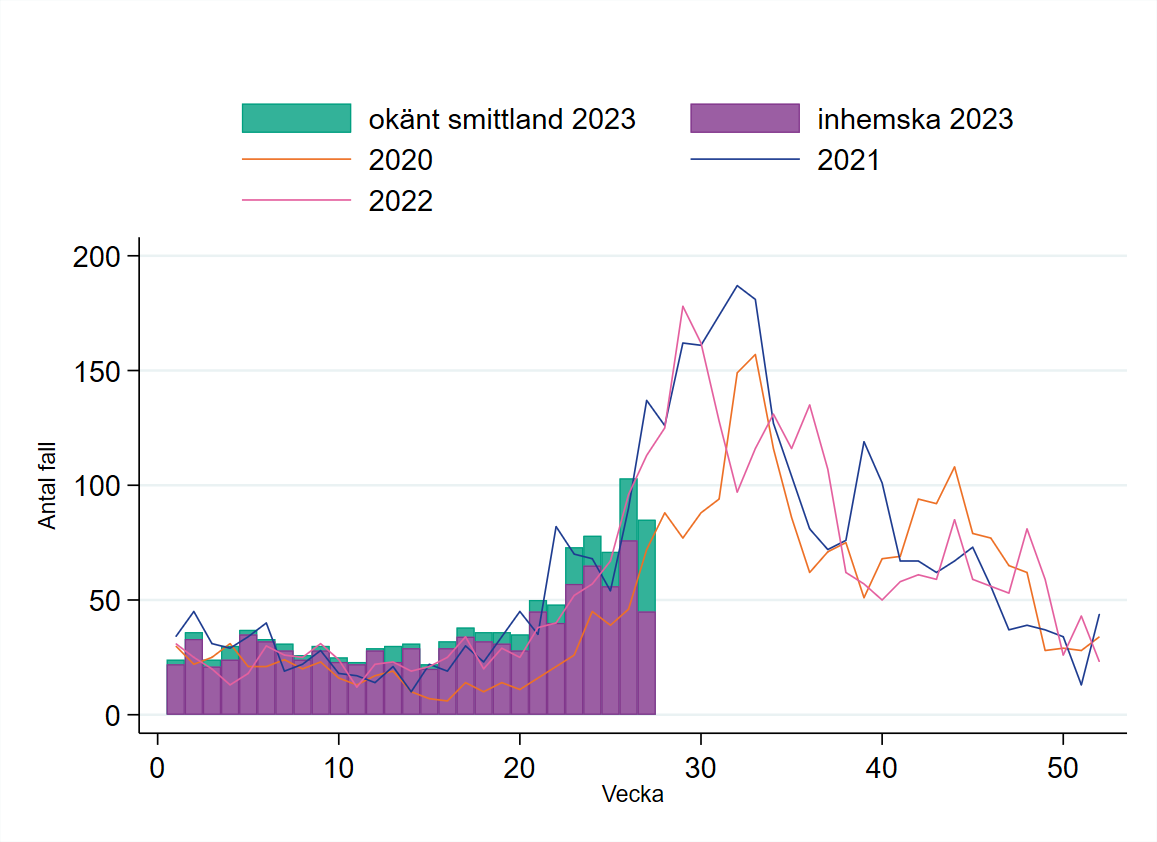
There has been an increase in the number of people who have been infected by the intestinal bacteria campylobacter in recent weeks. During week 26, the number of reported cases increased further compared to previous weeks and the increase looks set to continue.

Figure: The number of reported cases of campylobacter per week infected in Sweden or with an unknown country of infection (230706). Week 27 is not yet complete.

The number of sick people increased from week 21 to 60 cases per week from 30 cases.  In week 26, the cases increased further, a similar increase is seen in 2020-2022.

From mid-June, an increase in the occurrence of campylobacter in Swedish broiler flocks has also been observed. Previous studies have shown a connection between campylobacter infection and the consumption of fresh chicken, where around a third of those who have contracted the disease have been linked to fresh chicken. Campylobacter infection in humans is more common in summer as is the presence of campylobacter in broiler flocks.

RASFF Alert- Salmonella Outbreak

RASFF

Salmonella Enteritidis outbreak after consumption of meals at a hotel origin Poland in Czech Republic

Sweden sees another rise in illnesses for 2022


Food Safety News

Most foodborne infections rose in Sweden in 2022 compared to the year before, according to the latest figures.

A report by the National Veterinary Institute (SVA), Folkhälsomyndigheten (the Public Health Agency of Sweden), Livsmedelsverket (the Swedish Food Agency) and Jordbruksverket (Swedish Board of Agriculture) showed a rise for Campylobacter, Salmonella, Listeria, and E. coli infections. Some of this was because of increased travel and more people being infected abroad.

A total of 5,165 cases of campylobacteriosis were reported in 2022 and 57 percent of these were domestic. This is up on more than 4,000 cases in 2021. For domestic infections in 2022, the median age was 51 with a range of 0 to 101. More men, 54 percent, than women were sick.

A correlation between human cases and Campylobacter-positive broiler batches underscores the need for further preventive measures, said the report.

USA – No reduction in human illnesses from poultry-caused Salmonella

Food Safety News

“While the prevalence of Salmonella contamination in regulated poultry products has decreased by more than 50 percent in recent years, there has not been a reduction in human illnesses attributable to poultry,” a new USDA report says.

USDA’s Food Safety and Inspection Service (FSIS) has released a survey of Not-Ready-to-Eat Breaded and Stuffed Chicken Products for Salmonella. The June report was prepared by FSIS’s Laboratory Quality Assurance, Response, and Coordination (LQARCS) staff in the Office of Public Health.

According to the survey report: “FSIS worked with the Food Emergency Response Network to test for the presence of Salmonella and sanitary indicator aerobic organism counts using the current validated methods employed by 11 state public health and agriculture laboratories. From July 1, 2022, to September 30, 2022, the laboratories purchased approximately 15 samples of the product per month from nearby retail locations.

USA – Notes from the Field: Multistate Outbreak of Escherichia coli O157:H7 Infections Linked to a National Fast-Food Chain — United States, 2022

CDC

In August 2022, the Michigan Department of Health and Human Services alerted CDC to an approximately fivefold increase in regional cases of Escherichia coli O157:H7 infection. Whole genome sequencing was used to characterize isolates from laboratory-confirmed infections in ill persons. Initial patient interviews indicated that many had consumed meals from the same national fast-food chain. Federal, state, and local officials initiated an investigation to identify the outbreak source and prevent additional cases. This activity was reviewed by CDC and was conducted consistent with applicable federal law and CDC policy.*

CDC defined a case as an E. coli O157:H7 infection with an isolate highly related to the outbreak strain (within 0–2 alleles) by core genome multilocus sequence typing, with illness onset during July 26–August 24, 2022. PulseNet, CDC’s national molecular subtyping network for enteric disease surveillance, detected 109 cases from six states, including Michigan (67; 61%), Ohio (24; 22%), Indiana (11; 10%), Pennsylvania (four; 4%), Kentucky (two; 2%) and New York (one; 1%). The median patient age was 22 years (range = 1–94 years), and 49 (45%) were female. Fifty-two (48%) patients were hospitalized, and 13 (12%) developed hemolytic-uremic syndrome, a recognized complication of E. coli O157:H7 infection; no deaths occurred.

Salmonella outbreak ongoing with 130 sick; Listeria incident over in UK

Food Safety News

Investigations into a Salmonella outbreak are ongoing but a Listeria outbreak has ended, according to the Food Standards Agency (FSA).

More than 130 people are sick with Salmonella Mbandaka after eating chicken products from Ukraine. Four patients were admitted to hospitals and one person died.

In response to repeated non-compliance with partly cooked chicken products from Ukraine, a system of Intensified Official Controls (IOC) was started in April. This included a requirement that the next 10 imported consignments from the implicated establishment would be subject to extra inspections.

Because of continued breaches of food safety requirements, this was escalated to Imposed Checks in May. These physical, documentary and testing inspections will remain in place until a minimum of 30 consecutive favorable results are achieved.

The UK importer has stopped receipt of the steam-cooked chicken product until the issue is resolved and is testing all their uncooked product on arrival into the UK for Salmonella. An investigation by Ukrainian authorities has resulted in risk management measures being taken at the facilities of the manufacturer.

In late 2022, the European Centre for Disease Prevention and Control (ECDC) reported that Finland had 89 cases while a few patients also lived in the Czech Republic, Estonia, France, Germany, Ireland, the Netherlands, and Israel.

Russia – Mass Food Poisoning at Summer Health Camp as Multiple Children Hospitalized

Newsweek

A large number of children have reported symptoms consistent with food poisoning at a summer health camp in Russia’s southeastern Amur Oblast, according to local authorities.

The regional prosecutor’s office said 70 children fell sick at the White Mountains camp, with symptoms including abdominal pain and vomiting. Eight were hospitalized and the camp was suspended, state-run news agency Tass reported.

Reports that children had fallen ill at the health camp began circulating on social media on Thursday, sparking an investigation into how the facility had complied with sanitary and hygienic requirements.

Research – Does Vegan Cheese Pose a Food Safety Risk?

Food Poisoning Bulletin

Recently, the Centers for Disease Control and Prevention (CDC) published an analysis of a Salmonella outbreak linked to vegan cheese made from cashews. The 2021 outbreak linked to Jule’s cashew brie marked the second time since 2014 that illnesses in multiple states were linked to cashew cheese.

Does vegan cheese pose a food safety risk? If it’s made from nuts, it might.

Cashews and Kill Steps

The CDC’s 2021 report on the Jule’s brie Salmonella outbreak states that whole genome sequencing tests on the Salmonella strain cultured from patients produced the same genetic “fingerprint,” meaning the patients were exposed to the same source of contaminated food. Investigators found this outbreak strain in samples of Jule’s cheese, in the facility where it was made, and in the specific lot of raw cashews used to make the cheese.

The CDC’s recent analysis of the outbreak states that U.S. Food and Drug Administration (FDA) investigators identified cashews as the ingredient that was the likely source of contamination and noted that no lethality treatment, or “kill step” such as pasteurization or irradiation was performed before cashew processing.

Similarly, a kill step was also omitted in the manufacture of The Cultured Kitchen cashew cheese linked to the 2014 Salmonella outbreak. Tests performed during that investigation revealed the presence of the outbreak strain in samples of the cheese collected from a patient’s home and in a batch of fermenting, raw, cashews collected from the facility where the product was made.

USA – Salmonella Outbreak at Solano County Jails Sickens 117

Food Poisoning Bulletin

A Salmonella outbreak at Solano County jails in California has allegedly sickened more than a hundred inmates, according to the Vallejo Sun. All three jails in that county have ill inmates, and the outbreak has lasted more than a week, a spokesperson for the Solano County Sheriff’s Office told that outlet.

There are three jails in that county, including the Stanton Correctional Facility, the Claybank Detention Facility, and the Solano County Justice Center Detention Facility. Trinity Services Group provides the food for all three jails, and the Solano County Department of Health has been working with that establishment to clean their facility and to test food for contamination.