Category Archives: Foodborne Illness

RASFF Alert – Foodborne Outbreak suspected (Salmonella)

RASFF-Logo

RASFF –   to be caused by and Salmonella (present /25g) in eggs from Spain in the Netherlands

Contagion Live – Outbreak Monitor – Listeria monocytogenes

Contagion Live111111


USA – More than 70 cases of foodborne illness reported in Hidalgo County

The Monitor cyclo

EDINBURG — Hidalgo County health officials are warning residents about the growing number of parasites found in leafy vegetables that could cause medical concerns for vulnerable populations.

More than 70 cases of cyclosporiasis have been reported to the Hidalgo County Health and Human Services office, chief administrative officer Eddie Olivarez said Monday.

“It’s a public health concern we not only have in the Rio Grande Valley, but in the state of Texas, and even throughout the nation,” Olivarez said. “We’ve had over 70 cases in Hidalgo County; over 300 cases in the state of Texas and there’s over 1,200 cases in the United States. So much so, that the CDC (Centers for Disease Control) is concerned about it and putting out alerts in reference to this particular parasite.”


Spain – Listeria outbreak hits Spain, Most in Andalusia – Pork Meatloaf

Outbreak News Today Products from La Mechá that have been taken off the market.

An outbreak of listeriosis in Spain has sickened about 155 people to date, killing one, according to the health authorities. The Spanish Health Ministry said it was looking into another 523 suspected cases.

The outbreak has primarily affected Andalusia in the Seville region; however, cases have also been recorded in Asturias, Extremadura, Madrid, Catalonia and Aragon.

Unfortunately, a 90-year-old Andalusia woman has become the first fatal victim.

The Spanish Agency for Food Safety and Nutrition (AESAN) has already warned about a roasted meat product of the brand “La Mechá” made by Magrudis SL not to consume it.

El Pais

An outbreak of listeriosis in Spain caused by meat produced by a firm in the southern Spanish province of Seville is now having international repercussions. The country’s Health Ministry has activated alert and communication systems with the European authorities and the World Health Organization (WHO) “given the possibility that cases might be detected in other countries.” The move, according to ministerial sources, is a precaution in case any tourists visiting the country may have contracted the infection after consuming contaminated products in Spain. So far there have been no registered cases outside of the country.

The current outbreak of the bacterial infection has its source in pork meatloaf – known in Spanish as ‘carne mechada’

The current outbreak of the bacterial infection has its source in pork meatloaf – known in Spanish as carne mechada – sold under the brand name La Mechá, and produced by the Seville-based company Magrudis S.L.

A total of 53 people – including 23 pregnant women – are currently hospitalized in Andalusia due to the bacterial infection, three of whom are in intensive care. So far, one person has died from the outbreak: a 90-year-old woman who passed away in the early hours of Monday in a Seville hospital.


USA – Nearly 600 sickened by Cyclospora since May – over 200 by Mexican Basil

Food Poison Journal

The number of reported cases of domestically acquired illnesses caused by cyclospora has increased from the previous month and remains elevated in the United States since May 1, 2019.

As of July 23, 2019, 580 laboratory-confirmed cases of cyclosporiasis were reported to CDC by 30 states, District of Columbia and New York City in people who became ill since May 1, 2019 and who had no history of international travel during the 14-day period before illness onset.

At this time, multiple clusters of cases associated with different restaurants or events are being investigated by state public health authorities, CDC, and FDA.

One multistate outbreak of Cyclospora infections has been linked to fresh basil imported from Siga Logistics de RL de CV of Morelos, Mexico . It is unknown at this time if other reported cases of Cyclospora infection in the United States this season are linked to fresh basil.

USA – Basil Cyclospora Outbreak Has Sickened 205 in 11 States

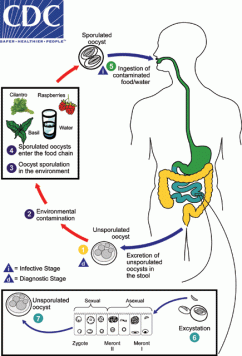
Food Poisoning Bulletin Cyclospora_LifeCycle201

The FDA has updated the basil cyclospora outbreak that has now sickened at least 205 people in 11 states. That’s an increase of 73 patients since the last update which was posted on July 25, 2019. Five people have been hospitalized because they are so sick. The basil in question is imported from Mexico by Siga Logistics de RL de CV from Morelos. That facility recalled basil on July 24, 2019.

Research – Occurrence of Escherichia coli O157:H7 in Pest Flies Captured in Leafy Greens Plots Grown Near a Beef Cattle Feedlot

Journal of Food Protection

ABSTRACT

Leafy greens are leading vehicles for Escherichia coli O157:H7 foodborne illness. Pest flies can harbor this pathogen and may disseminate it to produce. We determined the occurrence of E. coli O157:H7–positive flies in leafy greens planted up to 180 m from a cattle feedlot and assessed their relative risk to transmit this pathogen to leafy greens. The primary fly groups captured on sticky traps at the feedlot and leafy greens plots included house flies (Musca domestica L.), face flies (Musca autumnalisL.), stable flies (Stomoxys calcitrans L.), flesh flies (family Sarcophagidae), and blow flies (family Calliphoridae). E. coliO157:H7 carriage rates of house, face, flesh, and blow flies were similar (P > 0.05), ranging from 22.3 to 29.0 flies per 1,000 flies. In contrast, the carriage rate of stable flies was lower at 1.1 flies per 1,000 flies (P < 0.05). Differences in carriage rates are likely due to the uses of fresh bovine feces and manure by these different pest fly groups. E. coli O157:H7 carriage rates of total flies did not differ (P > 0.05) by distance (ranging from 0 to 180 m) from the feedlot. Most fly isolates were the same predominant pulsed-field gel electrophoresis types found in feedlot surface manure and leafy greens, suggesting a possible role for flies in transmitting E. coli O157:H7 to the leafy greens. However, further research is needed to clarify this role and to determine set-back distances between cattle production facilities and produce crops that will reduce the risk for pathogen contamination by challenging mechanisms like flies.

HIGHLIGHTS
  • E. coli O157:H7 was common in flies captured in leafy greens plots near a feedlot.

  • E. coli O157:H7 carriage rates of house, face, flesh, and blow flies were similar.

  • Stable flies had lower E. coli O157:H7 carriage than the other four fly groups.

  • E. coli O157:H7 carriage of total flies was not affected by distance up to 180 m.

  • Research is needed to determine risk for leafy green contamination by pest flies.

Research – Domestic Kitchen Microbiological Contamination and Self-Reported Food Hygiene Practices of Older Adult Consumers

Journal of Food Protection

ABSTRACT

Because of increased susceptibility, older adults have an increased risk of foodborne infection, and data suggest elevated incidence; therefore, food hygiene is essential to reduce the risk. Research suggests older adults’ inadequate knowledge and negative attitudes toward food hygiene may increase implementation of unsafe food practices. Data on microbiological contamination of domestic kitchens of older adults are lacking. Therefore, this study aimed to determine microbiological contamination of domestic kitchens of older adults. Food contact surfaces and equipment (n = 1,292) in domestic kitchens (n = 100) of older adults (≥60 years) were analyzed to isolate aerobic bacteria, Enterobacteriaceae, Staphylococcus aureus, and Listeria spp.; self-reported hygiene practices were also recorded. Highest contamination levels were determined on in-use cleaning equipment (dish brushes, dishcloths, sponges) with aerobic bacteria <9.3 log CFU per item, Enterobacteriaceae <8.8 log CFU per item, and S. aureus <7.0 log CFU per item. Reported usage length of dish brushes was significantly correlated (P< 0.05) with Enterobacteriaceae contamination. Significant correlations (P < 0.05) were determined between contamination and reported cleaning frequency of refrigerators. Contamination of hand towels in single-occupant households was significantly greater (P < 0.05) than in multioccupant households. The study facilitates novel comparison between reported hygiene practices with microbial contamination, suggesting older adults fail to implement adequate and regular hygiene practices that may increase the possibility of cross-contamination in the domestic kitchen and the associated risk of foodborne illness. Data from this study have determined a need for older adults to improve food hygiene practices in the domestic kitchen.

HIGHLIGHTS
  • In-use dish brushes and dishcloths were most commonly contaminated with high counts of bacteria.

  • Correlations existed between dishcloth contamination and multiple kitchen sites.

  • Reported dish brush usage length was significantly correlated with contamination level.

  • Reported time since cleaning of refrigerators was positively correlated with contamination levels.

  • Inadequate and irregular hygiene practices may increase foodborne illness risk to older adults.

Research – A Bacteriophage Cocktail Eliminates Salmonella Typhimurium from the Human Colonic Microbiome while Preserving Cytokine Signaling and Preventing Attachment to and Invasion of Human Cells by Salmonella In Vitro

Journal of Food Protection

ABSTRACT

Nontyphoidal Salmonella strains continue to be a major cause of foodborne illness globally. One intriguing approach to reducing the risk of salmonellosis is the direct ingestion of phages targeting Salmonella to enhance natural gut resilience and provide protection during foodborne disease outbreaks. We evaluated the ability of a prophylactically administered bacteriophage cocktail, the foodborne outbreak pill (FOP) targeting Escherichia coli O157:H7, Listeria monocytogenes, and Salmonella, to resolve a Salmonella infection in the Simulator of the Human Intestinal Microbial Ecosystem (SHIME), a simulated gut platform populated by the human intestinal microbiome of healthy donors. The FOP preparation eliminated Salmonella enterica serovar Typhimurium from the colon compartment of the SHIME platform but health-associated metabolites, such as short-chain fatty acids and lactate, remained stable or increased in a donor-dependent manner. In studies of human intestinal cells, pretreatment of Salmonella Typhimurium with the FOP cocktail preserved lipopolysaccharide-stimulated signaling in a Caco-2–THP-1 Transwell system and prevented destruction of the Caco-2 monolayer by Salmonella. Adhesion and invasion of intestinal epithelial cells by Salmonella—a critical factor in Salmonella pathogenesis—was blunted when the bacteria were incubated with the FOP preparation before addition to the monolayer. The FOP phage cocktail was effective for (i) eliminating Salmonella from a simulated human gut without disturbing the indigenous microbiota and (ii) reducing the risk of invasion by Salmonella into the intestinal epithelia. These results suggest that the FOP preparation may be of value for reducing the risk of salmonellosis in humans, e.g., during foodborne disease outbreaks.

Ireland -Outbreak in Ireland tied to Romanian pork; other countries report illnesses

Food Safety News

Eight people are part of a Salmonella outbreak in Ireland linked to pork from Romania. Five of them were admitted to hospitals. Infected people also have been identified in other countries.

One person was sickened by Salmonella Bredeney in August 2018. The other seven people fell ill between May 4 and June 3, this year. Those stricken are six adult males and two children who are siblings. There have not been any deaths.

Pork product recall

Andromi Toba de Casa was recalled last month

In mid-July, Andromi Toba de Casa 500-gram packages with a use-by date of Aug. 4 and with the lot number 17 from Romania were recalled because of the presence of Salmonella. The chilled cooked pork preparation is sold in Polonez stores throughout Ireland.