Category Archives: Food Safety

France- VIETNAMESE RAVIOLI- Listeria monocytogenes

Gov france

Identification information of the recalled product

  • Product category Feed
  • Product subcategory Meats
  • Product brand name NGOC XUYEN SAIGON
  • Model names or references BANH CUON
  • Identification of products
    Date
    Use-by date 19/10/2022
  • Storage temperature Product to be stored in the refrigerator
  • Health mark DEGORATION N°75-113-018
  • Geographic area of ​​sale ILE-DE-FRANCE
  • Distributors TANG BROTHER

Practical information regarding the recall

  • Reason for recall listeria monocytogenes <10ufc/g
  • Risks incurred by the consumer Listeria monocytogenes (causative agent of listeriosis)

Italy – High quality cooked ham 150 g – Listeria monocytogenes

Salute

Brand : Sapori di cascina

Name : High quality cooked ham 150 g

Reason for reporting : Recall due to microbiological risk

Publication date : 18 October 2022

Documentation

Documentation

Spain – Extension of the alert due to the presence of Listeria monocytogenes in liver sausage

ACSA

As an extension of the information transmitted on September 30, 2022, the competent authority of Andalusia has informed that as a result of the follow-up activities of the alert for the presence of Listeria monocytogenes in liver sausage, it has become aware of the existence of Listeria monocytogenes in a batch of chorizo ​​produced by the same company, which has marketed it in different presentations (rosary and horseshoe, in spicy and normal variety), under its own trademark and another brand.

The updated data for the products involved are:

  • Name of the product on the label: EMBUTIDO DE HÍGADO MORCILLA EL BOSQUE
  • Brand: CHACINAS EL BOSC 
  • Authorization number: 10.024902/CA
  • Lot numbers: 120922
  • Best before date: 12/03/2023.


  • Product name on the label: MORCILLA HÍGADO
  • Brand: HERMANOS GOMEZ JIMENEZ DE VILLAMARTIN
  • Authorization number: 10.024902/CA
  • Lot numbers: 120922
  • Best before date: 12/03/2023  


  • Product name on the label: MORCILLA HÍGADO
  • Brand: LA TRASTIENDA IBÉRICA
  • Authorization number: 10.024902/CA
  • Lot numbers: 120922
  • Best before date: 12/03/2023


  • Product names on the label: CHORIZO ROSARIO, CHORIZO ROSARIO PICANTE, CHORIZO HERRADURA, CHORIZO HERRADURA PICANTE
  • Brands: CHACINAS EL BOSQUE Y HERMANOS GÓMEZ JIMENEZ DE VILLAMARTIN SL
  • No. of authorization: 024902/CA
  • Lot number: 150922
  • Best before date: 15/03/2023

Also, in application of the precautionary principle, the company is withdrawing the products made and put on the market after September 13, 2022, all with the identification mark 10.024902/CA.

  • Product name on the label: CABEZA LOMO MECHADA
  • Brand: CHACINAS DEL BOSQUE
  • No. of authorization: 024902/CA
  • Batch number: 130922 Best before date: 13/03/2023
  • Batch number: 200922 Best before date : 09/20/2023


  • Product name on the label: SALCHICHÓN EXTRA
  • Brand: CHACINAS DEL BOSQUE
  • No. of authorization: 024902/CA
  • Batch number: 1 50922
  • Best before date: 15/03/2023


  • Product name on the label: SALCHICHÓN IBERICO CASERO
  • Brand: CHACINAS DEL BOSQUE
  • No. of authorization: 024902/CA
  • Lot number: 150922
  • Best before date: 15/03/2023


  • Product name on the label : BUCHE
  • Brand: CHACINAS DEL BOSQUE
  • No. of authorization: 024902/CA
  • Lot number: 210922
  • Best before date: 21/03/2023


  • Product name on the label : BUCHE PRADO
  • Brand: GOURMET DEL SUR
  • No. of authorization: 024902/CA
  • Lot number: 140922
  • Best before date: 14/03/2023


  • Product name on the label : LIVER SAUSAGE
  • Brand: GOURMET DEL SUR
  • No. of authorization: 024902/CA
  • Lot number: 190922
  • Best before date: 19/03/2023


  • Name of the product on the label : MORCILLA EL BOSQUE
  • Brand: HERMANOS GÓMEZ JIMENEZ DE VILLAMARTÍN SL
  • No. of authorization: 024902/CA
  • Lot number: 190922
  • Best before date: 19/03/2023


  • Name of the product on the label : COOKED SOUGH
  • Brand: CHACINAS EL BOSQUE
  • No. of authorization: 024902/CA
  • Lot number: 190922
  • Best before date: 09/19/2023


  • Product name on the label: CHORIZO ROSARIO PICANTE
  • Brand: HERMANOS GÓMEZ JIMENEZ DE VILLAMARTIN SL
  • Brand: CHACINAS EL BOSQUE
  • No. of authorization: 024902/CA
  • Lot number: 220922
  • Best before date: 22/03/2023


  • Product name (on label): CHORIZO ROSARIO
  • Brand: HERMANOS GÓMEZ JIMENEZ DE VILLAMARTIN SL
  • Brand: CHACINAS EL BOSQUE
  • No. of authorization: 024902/CA
  • Lot number: 220922
  • Best before date: 22/03/2023


  • Product name (on label): CHORIZO HERRADURA
  • Brand: HERMANOS GÓMEZ JIMENEZ DE VILLAMARTIN SL
  • Brand: CHACINAS EL BOSQUE
  • No. of authorization: 024902/CA
  • Lot number: 220922
  • Best before date: 22/03/2023

These products were distributed by the company in the province of Cadiz, Seville (Los Palacios and Seville).

The product CABEZA LOMO MECHADA was distributed to one point of sale in Barcelona and two in Madrid.

With the available information there is no record of any notified case associated with this alert.

As a precautionary measure,  people who have any of the products listed above at home are advised to refrain from consuming it and return it to the point of sale.

If you have consumed this product from the affected batch and have symptoms compatible with listeriosis (fever, headache, vomiting or diarrhoea), it is recommended to go to a health centre.


Research – USDA Releases Proposed Regulatory Framework to Reduce Salmonella Infections Linked to Poultry Products

FSIS USDA

The U.S. Department of Agriculture’s (USDA) Food Safety and Inspection Service (FSIS) today released a proposed regulatory framework for a new strategy to control Salmonella contamination in poultry products and reduce foodborne illnesses attributed to these products. The agency is hosting a virtual public meeting on Nov. 3, 2022, to seek input from stakeholders on the proposed framework.

The Centers for Disease Control and Prevention (CDC) estimates that Salmonella bacteria cause approximately 1.35 million human infections and 26,500 hospitalizations in the United States every year. Of those infections, over 23% are attributed to poultry consumption. Foodborne illness can have a devastating impact, both personally and financially, on people’s lives, the cost of which reverberates through the economy. Data from USDA’s Economic Research Service (ERS) show the total cost for foodborne Salmonella infections in the United States is a staggering $4.1 billion annually and the cost for the loss of productivity to the economy $88 million. These are real costs to real people that can and should be prevented.

“We know that Salmonella in poultry is a complex problem with no single solution,” said USDA Deputy Under Secretary Sandra Eskin. “However, we have identified a series of strategic actions FSIS could take that are likely to drive down Salmonella infections linked to poultry products consumption, and we are presenting those in this proposed framework.”

“This is a historic first step toward final product standards that are science-based, risk-based, enforceable, and effective at protecting our vulnerable loved ones,” said Amanda Craten, board member of STOP Foodborne Illness. “As a parent of a child who suffered from Salmonella illness and is left with permanent injury, I have advocated and engaged in the process to modernize poultry standards to ensure no child has to experience the devastation of a preventable, virulent Salmonella illness. I’m thankful that USDA is making the prevention of illnesses like my son Noah’s a priority.”

The proposed framework has been shaped by months of information-gathering and discussions with a wide range of stakeholders, researchers, and scientists. The proposed framework consists of three key components that, together, support a comprehensive approach to controlling Salmonella in poultry.

  • Requiring that incoming flocks be tested for Salmonella before entering an establishment;
  • Enhancing establishment process control monitoring and FSIS verification; and
  • Implementing an enforceable final product standard.

The framework under consideration also addresses cross-cutting issues of testing for Salmonella, the impact on small and very small establishments and data sharing.

Dr. Craig Hedberg, a professor at University of Minnesota School of Public Health and Co-Director of the Minnesota Integrated Food Safety Center of Excellence, agrees that this framework “is an important step towards moving away from hazard-based regulation toward risk-based regulation. Focusing on levels of Salmonella and highly virulent strains of Salmonella rather than just the presence or absence of Salmonella should reduce the number of illnesses associated with poultry.”

Dr. Angie Siemens, Vice President for Food Safety, Quality and Regulatory at Cargill, said, “In alignment with our strong commitment to food safety, Cargill supports the need to develop a public health risked based approach to assist in meeting the Healthy People 2030 Salmonella targets. We look forward to reviewing the FSIS Salmonella framework and engaging in a robust dialogue on this issue.”

FSIS is soliciting input on all aspects of the draft framework, related to the three components as well as the cross-cutting issues. An online copy of the proposed framework is available at: https://www.fsis.usda.gov/inspection/inspection-programs/inspection-poultry-products/reducing-salmonella-poultry/proposed.

Read Full Press Release

USA – FDA Releases New, Prevention Strategies to Enhance Food Safety

FDA

Two image collage depicting Bulb Onions on the right, and mushrooms on the left side of the image. The blue FDA logo is in the upper right corner of the image.

Protecting consumers from foodborne illness requires both rapid response when outbreaks occur, and focused attention on preventing outbreaks from happening.

Mark Moorman, Ph.D
Mark Moorman, Ph.D

Over the last decade, following enactment of the U.S. Food and Drug Administration’s Food Safety Modernization Act (FSMA), the FDA has investigated more outbreaks and conducted more research to advance our scientific understanding of the pathogens that contaminate our food — than any other time in history. We now know more than ever about the reoccurrence of contributing factors that can cause contamination of certain foods by specific disease-causing bacteria and how all parts of the food safety system – which includes the FDA and other government agencies, state and local health departments, the food industry, and others – can work together to keep such contamination from happening.

The FDA is compiling these learnings into a series of Prevention Strategies to Enhance Food Safety that identify and target specific patterns that have emerged with certain food-hazard pairings. The strategies contain recommendations to guide the work of preventing future foodborne illnesses.

USA – Old Europe Cheese Listeria Outbreak holds at six sick in six States

Food Poison Journal

Epidemiologic and Traceback Data

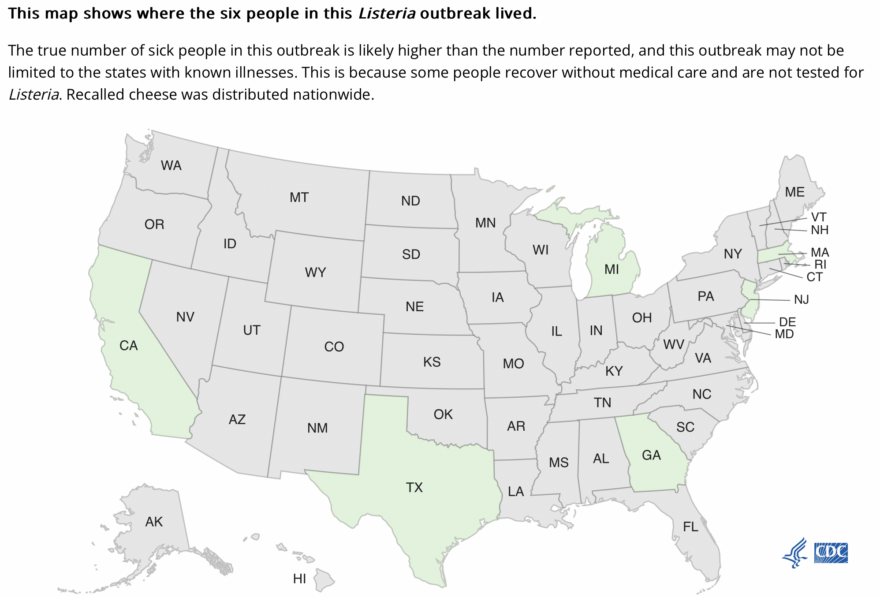
As of September 28, 2022, six people infected with the outbreak strain of Listeria have been reported from six states (see map). Sick people’s samples were collected from August 6, 2017, to August 5, 2022 (see timeline).

Sick people range in age from 56 to 83 years, with a median age of 78, and 67% are female. Five people have been hospitalized, and no deaths have been reported.

The true number of sick people in this outbreak is likely higher than the number reported, and the outbreak may not be limited to the states with known illnesses. This is because some people recover without medical care and are not tested for Listeria. In addition, recent illnesses may not yet be reported as it usually takes 3 to 4 weeks to determine if a sick person is part of an outbreak.

USA – Seaweed products recalled for potential to cause botulism poisoning

Food Safety News

recalled Royalty Moss seaweed

The Michigan Department of Agriculture and Rural Development has recalled lemonade and gel products sold by Royalty Sea Moss.

After a complaint from the Maryland Department of Health, an investigation found that Royalty Sea Moss, based out of Mt. Pleasant, MI, produced products with inadequate processing controls that are needed to stop the growth of foodborne pathogens, according to the department.

Royalty Sea Moss also does not have a license to manufacture, hold or sell products, which is a violation against the Michigan Food Law of 2000, officials said.

Italy – Fontina DOP – STEC E.coli

Salute

Brand : Pascoli Italiani

Denomination : Fontina DOP

Reason for reporting : Recall due to microbiological risk

Publication date : 18 October 2022

Documentation

Documentation

Norway – Troll Salmon AS withdraws smoked trout and sliced ​​smoked salmon due to suspicion of Listeria monocytogenes

Matportalen

Smoked salmon

Smoked salmon

Troll Salmon AS is recalling the following salmon and trout products: Smoked trout in slices 250g, 200g, 100g and smoked salmon in slices 250g, 120g and 100g. The products have expiry dates from 17.10. until 10.11.2022. The reason is the suspicion of Listeria Monocytogenes content in the products following the discovery of Listeria monocytogenes in the production environment.

Troll Salmon AS is recalling the following smoked salmon and trout products: Smoked trout in slices 250g, 200g, 100g and smoked salmon in slices 250g, 120g and 100g. The products have a use-by date from 17.10. until 10.11.2022. The reason is suspicion of indirect contamination in the products following the discovery of Listeria monocytogenes in the production environment.

19,872 packages of the goods in question have been sold in the following retail chains across the country: Rema 1000, Coop, and NorgesGruppen. In addition, the products are sold via oda.no. These items have now been withdrawn and are no longer for sale. Troll Salmon AS asks consumers who have bought these products to throw away or return the goods to the store.

Belgium – “Morbier” cheese made from raw milk- Salmonella

AFSCA

FASFC recall
Product: “Morbier” cheese made from raw milk.
Problem: Possible presence of Salmonella.


The FASFC is today recalling consumers of Morbier cheese made from raw milk (+ – 200g) in prepackaged pieces.

This recall follows a notification via the RASFF system (European Food and Feed Rapid Alert System) due to the possible presence of Salmonella.

The FASFC asks not to consume these products and to bring them back to the point of sale where they were purchased.

Product description :

– Product: Morbier raw milk cheese in prepackaged pieces

Article number EAN code Expiry date – DDM 
170027 29549771 12/10/2022 and 26/10/2022
177062 29565347 from 13/102022 to 27/10/2022 inclusive
169084 29515011 from 11/10/2022 to 27/10/2022 inclusive

– Weight: + – 200 g

The product is sold via several points of sale in Belgium .

For any additional information , you can contact the FASFC contact point for consumers: 0800/13.550 or pointdecontact@afsca.be .