Category Archives: Food Pathogen

USA – Listeria Illnesses and a Death reported in Texas, Florida, South Carolina, Pennsylvania and Maine linked to Almark Foods Hard-Boiled Eggs

Food Poison Journal

As of December 17, 2019, a total of seven people infected with the outbreak strain of Listeria monocytogenes have been reported from five states.

Listeria specimens from ill people were collected from April 10, 2017, to November 12, 2019. Ill people range in age from less than 1 to 82 years, with a median age of 75. Seventy-one percent of ill people are male. Of six ill people with information available, four hospitalizations have been reported. One death has been reported from Texas. One illness was reported in a newborn who was infected with Listeria while the mother was pregnant, but the newborn survived.

RASFF Alerts – Salmonella – Frozen Chicken Meat – Soft Cheese – Frozen Chicken Breast – Chilled Chicken Fillets – Chilled Chicken Breast – Sesame Seeds – Raw Beet Seeds -Frozen Turkey Broil with Apple and Raisins -Frozen Halal Bovine, Chicken and Turkey Kebab – Black Pepper

RASFF-Logo

RASFF – Salmonella enterica ser. Enteritidis (present /25g) and Campylobacter coli (present /25g) in frozen chicken meat from Germany in Austria

RASFF – Salmonella (present /25g) in soft cheese from France in the Netherlands

RASFF – Salmonella (presence /25g) in frozen chicken breasts from Brazil in the UK

RASFF – Salmonella enterica ser. Enteritidis (presence /25g) in chilled chicken fillets from the Netherlands in Belgium

RASFF – Salmonella enterica ser. Enteritidis (presence /25g) in chilled chicken breast from Poland in Slovakia

RASFF – Salmonella enterica ser. Typhimurium (presence /25g) in sesame seeds from India in Italy

RASFF – Salmonella enterica ser. Enteritidis (presence /25g) in chilled chicken breast fillets from Poland in Poland

RASFF – Salmonella enterica ser. Enteritidis (presence /25g) in chilled chicken from Poland in Poland

RASFF – Salmonella enterica ser. Gold Coast (presence /25g) in red beet seeds for sprouting from Italy in Norway

RASFF – Salmonella (presence /25g) in frozen turkey broil with apple and raisins from Belgium in Belgium

RASFF – Salmonella (in 5 out of 5 samples /25g) in frozen halal bovine, chicken and turkey kebab from Slovenia in Croatia

RASFF – Salmonella enterica ser. Enteritidis (presence /25g) in chilled chicken meat and wings from Poland in Italy

RASFF – Salmonella (presence /25g) in black pepper from Brazil in the Netherlands

USA – Lipton Knorr Chicken Soup Mixes Recalled For Possible Listeria monocytogenes

Food Poisoning Bulletin

Unilever United States is voluntarily recalling a limited quantity of Lipton Knorr chicken soup mixes for possible Listeria monocytogenes contamination, according to a press release from the company. The recall was issued on November 22, 2019 but doesn’t appear on the FSIS web site.

These recalled products were manufactured in the United States and Canada, and were distributed nationwide in the U.S. through retail stores and professional kitchens. No illnesses have been reported to date in connection with this recall. This recall is being issued out of an abundance of caution.

The recalled products include some dried chicken soup mixes with specific best by dates. No other Lipton, Knorr, or LeGoût products are affected by this recall.

Research – Inactivating foodborne pathogens in apple juice by combined treatment with fumaric acid and ultraviolet-A light, and mechanisms of their synergistic bactericidal action

Science Direct

We evaluated the bactericidal efficacy of the simultaneous application of ultraviolet-A (UV-A) irradiation and fumaric acid (FA) against Escherichia coli O157:H7, Salmonella enterica serovar Typhimurium, and Listeria monocytogenes in apple juice and as well as investigated the effects of this treatment on product quality. Further, we elucidated the mechanisms underlying their synergistic bactericidal action. Simultaneous UV-A light irradiation and 0.1% FA treatment for 30 min resulted in 6.65-, 6.27-, and 6.49-log CFU/ml reductions in E. coli O157:H7, S. Typhimurium, and L. monocytogenes, respectively, which involved 3.15, 2.21, and 3.43 log CFU reductions, respectively, and these were attributed to the synergistic action of the combined treatments. Mechanistic investigations suggested that the combined UVA-FA treatment resulted in significantly greater bacterial cell membrane damage and intracellular reactive oxygen species (ROS) generation. UVA-FA treatment for 30 min did not cause significant changes to the color, nonenzymatic browning index, pH, and total phenolic content of apple juice. These results suggest that combined UVA-FA treatment can be effectively used to control foodborne pathogens in apple juice without affecting its quality.

Hong Kong – CFS announces food safety report for October

CFS

The Centre for Food Safety (CFS) of the Food and Environmental Hygiene Department today (November 29) released the findings of its food safety report for the last month. The results of about 16,400 food samples tested were satisfactory except for 21 samples and they were announced earlier. The overall satisfactory rate was 99.9 per cent.

A CFS spokesman said about 1,800 food samples were collected for microbiological tests, some 5,500 samples were taken for chemical tests and the remaining 9,100 (including about 8,400 taken from food imported from Japan) were collected to test radiation levels.

The microbiological tests covered pathogens and hygiene indicators, while the chemical tests included pesticides, preservatives, metallic contaminants, colouring matters, veterinary drug residues and others.

The samples comprised about 4,200 samples of vegetables and fruit and their products; 1,100 samples of cereals, grains and their products; 1,300 samples of meat and poultry and their products; 1,200 samples of milk, milk products and frozen confections; 2,000 samples of aquatic and related products; and 6,600 samples of other food commodities (including beverages, bakery products and snacks).

The 21 unsatisfactory samples comprised eight frozen confection samples detected with counts of hygiene indicator organisms exceeding the legal limits; three crab samples, one vegetable sample and one rice sample detected with excessive cadmium; two silver cod samples detected with mercury exceeding the legal limit; a fresh beef sample found to contain sulphur dioxide; a pickled green mustard sample detected with excessive preservative; a roast drumstick sample found to contain excessive Bacillus cereus; a vegetable sample detected with excessive pesticide residue; a nutmeg powder sample contaminated with aflatoxins; and a chilled chicken sample found to contain veterinary drug residue.

The CFS has taken follow-up action on the unsatisfactory samples, including informing the vendors concerned of the test results, instructing them to stop selling the affected food items and tracing the sources of the food items in question.

Since the Pesticide Residues in Food Regulation (Cap 132CM) came into effect on August 1, 2014, as of October 31 this year, the CFS has taken over 189,500 food samples at import, wholesale and retail levels for testing for pesticide residues. The overall unsatisfactory rate is less than 0.2 per cent.

The spokesman added that excessive pesticide residues in food may arise from the trade not observing Good Agricultural Practice, e.g. using excessive pesticides and/or not allowing sufficient time for pesticides to decompose before harvesting. The maximum residue limit (MRL) of pesticide residues in food is not a safety indicator. It is the maximum concentration of pesticide residues to be permitted in a food commodity under Good Agricultural Practice when applying pesticides. In this connection, consumption of food with pesticide residues higher than the MRL will not necessarily lead to any adverse health effects.

The spokesman reminded the food trade to ensure that food for sale is fit for human consumption and meets legal requirements. Consumers should patronise reliable shops when buying food and maintain a balanced diet to minimise food risks.


Information – Food Net Fast – CDC Tool

FoodNet Fast

FoodNet Fast Logo


FoodNet Fast provides online access to information reported to the Foodborne Diseases Active Surveillance Network (FoodNet). FoodNet’s surveillance area includes about 15% of the U.S. population.

You can use FoodNet Fast tools to search data and see results displayed on interactive graphs and charts.

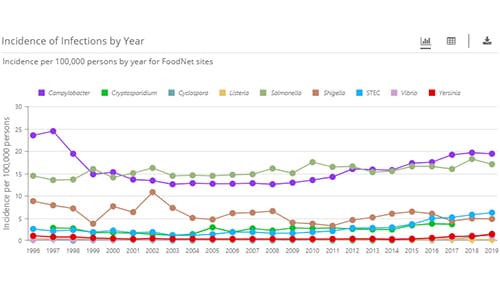
  • Pathogen Surveillance Tool: See how rates of illness have changed in FoodNet’s surveillance area since 1996 for nine pathogens transmitted commonly through food: Campylobacter, Cryptosporidium *, Cyclospora, Listeria, Salmonella, Shiga toxin-producing Escherichia coli (STEC), Shigella, Vibrio, and Yersinia.
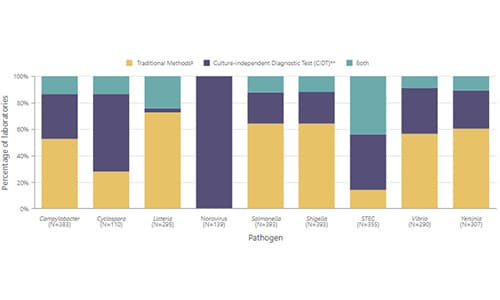
  • Diagnostic Laboratory Practices Tool: Find out how diagnostic testing practices in FoodNet’s surveillance area have changed over time for 10 pathogens: Campylobacter, Cryptosporidium *, Cyclospora, Listeria, norovirus, Salmonella, STEC, Shigella, Vibrio, and Yersinia.
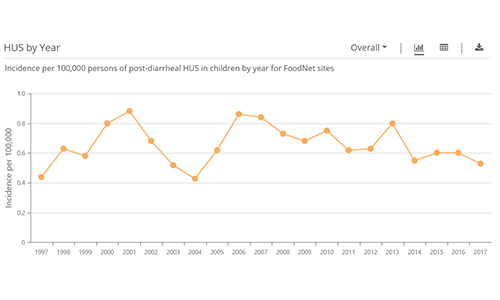
  • Hemolytic Uremic Syndrome (HUS) Surveillance Tool: HUS is a life-threatening condition, most often triggered by STEC infection. See how rates of pediatric HUS and STEC infection have changed in FoodNet’s surveillance area since 1997.

* As of January 1, 2018, FoodNet no longer conducts active surveillance for Cryptosporidium.

Background Information

Start exploring FoodNet Fast now – or click the boxes below for more information.

Pathogen Surveillance Tool FAQ

Graphic chart of Pathogen Surveillance Tool FAQ

Laboratory Practices Tool FAQ

Graphic chart of Laboratory Practices Tool FAQ

HUS Surveillance Tool FAQ

Graphic chart of Laboratory Practices Tool FAQ

Information – Handling Flour Safely: What You Need to Know

FDA

Flour is a raw food. It may not look like a raw food, but it usually is, just like fresh tomatoes or carrots. The grains from which flour is ground are grown in fields and, like all foods grown outdoors, they may be exposed to a variety of harmful bacteria like Salmonella and pathogenic Escherichia coli (E. coli).

5 Important Things to Know About Flour

  1. Flours most commonly used in home baking and cooking are made directly from raw grains.
  2. Processing raw grains into flour does not kill harmful bacteria.
  3. Many foods made with flour also contain raw eggs, which may contain harmful bacteria.
  4. Cooking is the only way to be sure that foods made with flour and raw eggs are safe.
  5. Never eat or taste raw flour, dough, or batter.

OUTBREAK

Since 2009 there have been several outbreaks of foodborne illness involving raw flour or raw flour-containing products like cake mixes and cookie dough. These have resulted in 168 known illnesses and 20 hospitalizations.

Dos and Don’ts of Handling Flour

Check out this list of DO’s and DON’Ts to help keep you and your family safe when handling raw flour.

  • DO follow package directions on baking mixes and other flour containing products for correct cooking temperatures and specified times.
  • DO keep all raw foods, like flour and eggs, separate from ready-to eat foods. Remember, flour is a powder and spreads easily.
  • DO refrigerate cookie and pastry dough according to package directions. Use a refrigerator thermometer to be sure your refrigerator is at a safe 40°F.
  • DO clean up carefully after working with flour or raw dough and eggs:
    • Wash hands thoroughly with soap and running water, and,
    • Wash utensils, bowls, baking pans and cutting boards, and countertops with warm, soapy water.
  • DO NOT eat or allow children to eat or play with raw dough products made with any brand of flour or baking mix before cooking.
  • DO NOT keep recalled flour. Throw it away.
  • DO NOT let children use raw dough for crafts or play clay.
  • DO NOT use products that contain raw flour, like cake mix to make milkshakes.
  • DO NOT use raw cookie dough in ice cream (the cookie dough in ice cream sold in stores has been treated to kill harmful bacteria).

USA – Ohio Romaine Outbreak Sickens 12 with E. coli O157:H7 Infections

Food Poisoning Bulletin

The Ohio romaine outbreak has sickened 12 people with E. coli O157:H7 infections, making it the state with the second most illnesses after Wisconsin, with 33 cases as of December 9, 2019. Overall, at least 102 people are sick across the country, with 58 hospitalized and 10 who have developed hemolytic uremic syndrome (HUS), a type of kidney failure.

Most romaine products, including baby romaine, chopped romaine, organic romaine, hearts of romaine, romaine in salad wraps, salad bowl kits, sandwiches, packages of precut lettuce, and salad mixes that contain romaine, may be marked with the growing region. This is a voluntary policy put into place after last year’s two romaine E. coli O157:H7 HUS outbreaks. If the label says “Salinas” anywhere, or if the package is unmarked, don’t eat the romaine.

The CDC and FDA have stated that there is one grower associated with all three E. coli O157:H7 romaine outbreaks that are ongoing, but that grower has not been named. Officials have inspected three farms in the Salinas region, but has not named those.

Canada -Food Recall Warning – Certain Coaticook brand Cheddar cheese recalled due to Listeria monocytogenes

CFIA

Recall date:
December 16, 2019
Reason for recall:
Microbiological – Listeria
Hazard classification:
Class 1
Company / Firm:
Laiterie Coaticook Ltée
Distribution:
Quebec
Extent of the distribution:
Consumer

Recall details

Ottawa, December 16, 2019 – Laiterie Coaticook Ltée. is recalling certain Coaticook brand Cheddar cheese from the marketplace due to possible Listeria monocytogenes contamination. Consumers should not consume the recalled products described below.

Recalled products

Brand Product Size UPC Codes
Coaticook Mild Cheddar Cheese 50 g 0 59263 60050 2 Best Before: 03MR20
Coaticook Mild Cheddar Cheese 180 g 0 59263 60180 6 Best Before: 03MR20
Coaticook Mild Cheddar Cheese 320 g 0 59263 60320 6 Best Before: 03MR20
Coaticook Mild Cheddar Cheese 2.27 kg 0260005 Best Before: 03MR20
Coaticook Mild Cheddar Cheese 1.15 kg 0260025 Best Before: 03MR20
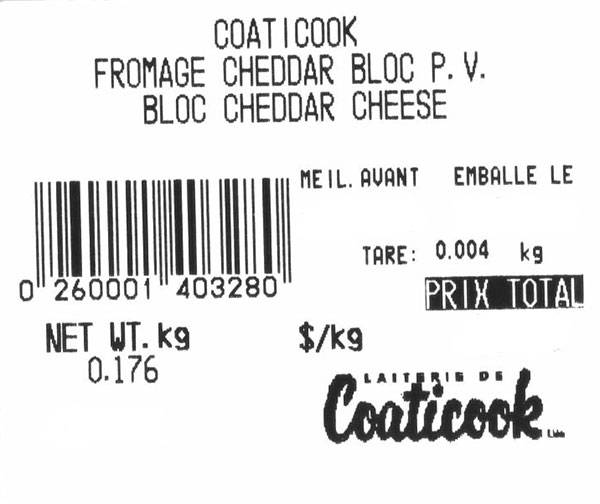
Coaticook Bloc Cheddar Cheese Variable Starting with
0 260001
Best Before: 03MR20
Coaticook Pointe Cheddar Cheese Variable Starting with 0 250006 Best Before: 03MR20

Illnesses

There have been no reported illnesses associated with the consumption of these products.

Product photos

Printer ready version of photos

  • Coaticook Mild Cheddar Cheese - 180 g
  • Coaticook Pointe Cheddar Cheese
  • Coaticook Bloc Cheddar Cheese

Russia -Salmonella sickens dozens in Khanty-Mansiysk, Russia

Outbreak News Today

Salmonella was laboratory confirmed in 35 of 73 pupils of Wonderland kindergarten in Khanty-Mansiysk who were infected with acute intestinal infection, city administrators report.

The Tass news service reports, “As of December 13, 73 cases were registered, four children were hospitalized in the children’s infectious ward of the district clinical hospital, and 35 children were laboratory confirmed with Salmonellosis group D,” Rimir Gimalov, the head of the public health department of the city administration, said in a statement.

According to local authorities, all necessary anti-epidemic measures are being carried out in the kindergarten. The institution was closed for quarantine.