Category Archives: Food Micro Blog

Research – Phenotypic and genotypic characterization of salmonella Enteritidis isolated from two consecutive Food-Poisoning outbreaks in Sichuan, China

Wiley Online

Abstract

Salmonella enterica serotype Enteritidis (SE) is a primary pathogen that causes foodborne diseases in humans. Although whole-genome sequencing (WGS) -based typing analyses have been increasingly used to investigate food-poisoning outbreaks, they are rarely applied to the epidemiology of multiple Salmonella outbreaks in Sichuan, China. This study therefore isolated SE from patients and food of two consecutive food-poisoning outbreaks during 2020 in Sichuan, China. We tracked outbreak origin using epidemiological investigation, serotyping, antimicrobial susceptibility testing (AST), pulsed-field gel electrophoresis (PFGE), and WGS. We also determined phylogenetic relationships using PFGE, whole and core genome multilocus sequence typing (wg/cgMLST), and whole-genome single nucleotide polymorphism (wgSNP) analyses. Epidemiological investigations identified a correlation between cake consumption and food poisoning. Thirteen strains isolated from patients and one strain isolated from the cake were confirmed as SE. Among the 14 strains, only six shared the same AST pattern (AMP-AMS-Sul-STR). Isolates from patients and cakes were indistinguishable in PFGE results. All four methods, namely PFGE, wgMLST, cgMLST, and wgSNP were appropriate for bacterial typing in SE-related outbreak investigation. However, wgSNP can assign 12 SE strains from the first outbreak to one cluster and assign two SE strains from the second outbreak to another cluster, while PFGE, wgMLST, cgMLST did not successfully distinguish the SE strains from different outbreaks. Thus, we conclude that SNP-based phylogenetic analysis might be a viable method for differentiating SE strains at the outbreak level.
Sweden – Salmonella sickens more than 50 in Sweden

Food Safety News

More than 50 people have fallen ill in a national outbreak of Salmonella in Sweden with the source yet to be identified.

A total of 54 confirmed cases of Salmonella Typhimurium have been reported from 20 different regions in the country from Sept. 17 to Oct. 5.

Patients are aged between 8 and 86 years old; 31 of them are women.

Cases have been connected by whole genome sequencing of patient samples. This means they are suspected of having been infected by a common source, according to the Public Health Agency of Sweden (Folkhälsomyndigheten).

Local infection control units, the Swedish Food Agency (Livsmedelsverket) and Folkhälsomyndigheten are investigating the outbreak to identify the source of infection, which is suspected to be a food with wide distribution in Sweden.

Patient interviews to compile information about what those sick have eaten before falling ill are ongoing. Answers will be used to form a hypotheses about the source and compared to what people in a control group that are not part of the outbreak have eaten.

The incident doesn’t appear to be connected to a Salmonella Typhimurium outbreak that is ongoing in Denmark. Officials believe the outbreak in Sweden is caused by a different source because the strains don’t cluster.

USA – Old Europe Cheese Listeria Outbreak holds at six sick in six States

Food Poison Journal

Epidemiologic and Traceback Data

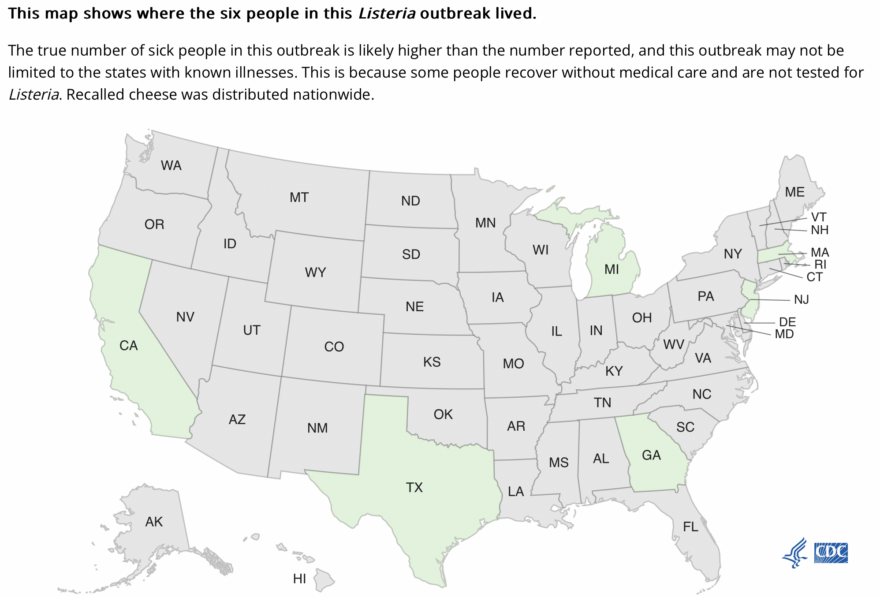
As of September 28, 2022, six people infected with the outbreak strain of Listeria have been reported from six states (see map). Sick people’s samples were collected from August 6, 2017, to August 5, 2022 (see timeline).

Sick people range in age from 56 to 83 years, with a median age of 78, and 67% are female. Five people have been hospitalized, and no deaths have been reported.

The true number of sick people in this outbreak is likely higher than the number reported, and the outbreak may not be limited to the states with known illnesses. This is because some people recover without medical care and are not tested for Listeria. In addition, recent illnesses may not yet be reported as it usually takes 3 to 4 weeks to determine if a sick person is part of an outbreak.

USA – Big Olaf’s Ice Cream Listeria Outbreaks stands at 25 sick with 24 hospitalized with 1 death

Food Poison Journal

Epidemiologic Data

Since the last update on July 13, 2022, two more illnesses have been reported. As of August 2, 2022, a total of 25 people infected with the outbreak strain of Listeria monocytogenes have been reported from 11 states (see map). Thirteen sick people are residents of Florida and ten reported traveling to Florida before getting sick. Illnesses started on dates ranging from January 24, 2021, to June 24, 2022 (see timeline).

Sick people range in age from less than one to 92 years, with a median age of 72, and 56% are male. Of 25 people with information available, 24 have been hospitalized. One death in a person who was not pregnant has been reported from Illinois. Five people got sick during their pregnancy, and one person’s illness resulted in a fetal loss.

The true number of sick people in an outbreak is likely higher than the number reported, and the outbreak may not be limited to the states with known illnesses. This is because some people recover without medical care and are not tested for Listeria. In addition, recent illnesses may not yet be reported as it usually takes 3 to 4 weeks to determine if a sick person is part of an outbreak.

USA – Seaweed products recalled for potential to cause botulism poisoning

Food Safety News

recalled Royalty Moss seaweed

The Michigan Department of Agriculture and Rural Development has recalled lemonade and gel products sold by Royalty Sea Moss.

After a complaint from the Maryland Department of Health, an investigation found that Royalty Sea Moss, based out of Mt. Pleasant, MI, produced products with inadequate processing controls that are needed to stop the growth of foodborne pathogens, according to the department.

Royalty Sea Moss also does not have a license to manufacture, hold or sell products, which is a violation against the Michigan Food Law of 2000, officials said.

Italy – Fontina DOP – STEC E.coli

Salute

Brand : Pascoli Italiani

Denomination : Fontina DOP

Reason for reporting : Recall due to microbiological risk

Publication date : 18 October 2022

Documentation

Documentation

USA – Michigan hit hardest in Falafel E. coli Outbreak

Food Poison Journal

As of October 7 2022, 20 people infected with the outbreak strain of E. coli O121 have been reported from 6 states (see map). Illnesses started on dates ranging from July 13, 2022, to September 13, 2022 (see timeline).


Sick people range in age from less than 1 to 71 years, with a median age of 31, and 79% are female. Of 14 people with information available, 5 have been hospitalized, including 1 who developed hemolytic uremic syndrome, a serious condition that can cause kidney failure. No deaths have been reported.

The true number of sick people in this outbreak is likely higher than the number reported, and the outbreak may not be limited to the states with known illnesses. This is because some people recover without medical care and are not tested for E. coli. In addition, recent illnesses may not yet be reported as it usually takes 3 to 4 weeks to determine if a sick person is part of an outbreak.

State and local public health officials are interviewing people about the foods they ate in the week before they got sick. Among 18 people interviewed, 15 reported shopping at ALDI stores. Among these 15 ALDI shoppers, 6 reported eating Earth Grown brand frozen falafel purchased from ALDI in the week before getting sick.

Norway – Troll Salmon AS withdraws smoked trout and sliced ​​smoked salmon due to suspicion of Listeria monocytogenes

Matportalen

Smoked salmon

Smoked salmon

Troll Salmon AS is recalling the following salmon and trout products: Smoked trout in slices 250g, 200g, 100g and smoked salmon in slices 250g, 120g and 100g. The products have expiry dates from 17.10. until 10.11.2022. The reason is the suspicion of Listeria Monocytogenes content in the products following the discovery of Listeria monocytogenes in the production environment.

Troll Salmon AS is recalling the following smoked salmon and trout products: Smoked trout in slices 250g, 200g, 100g and smoked salmon in slices 250g, 120g and 100g. The products have a use-by date from 17.10. until 10.11.2022. The reason is suspicion of indirect contamination in the products following the discovery of Listeria monocytogenes in the production environment.

19,872 packages of the goods in question have been sold in the following retail chains across the country: Rema 1000, Coop, and NorgesGruppen. In addition, the products are sold via oda.no. These items have now been withdrawn and are no longer for sale. Troll Salmon AS asks consumers who have bought these products to throw away or return the goods to the store.

Belgium – “Morbier” cheese made from raw milk- Salmonella

AFSCA

FASFC recall
Product: “Morbier” cheese made from raw milk.
Problem: Possible presence of Salmonella.


The FASFC is today recalling consumers of Morbier cheese made from raw milk (+ – 200g) in prepackaged pieces.

This recall follows a notification via the RASFF system (European Food and Feed Rapid Alert System) due to the possible presence of Salmonella.

The FASFC asks not to consume these products and to bring them back to the point of sale where they were purchased.

Product description :

– Product: Morbier raw milk cheese in prepackaged pieces

Article number EAN code Expiry date – DDM 
170027 29549771 12/10/2022 and 26/10/2022
177062 29565347 from 13/102022 to 27/10/2022 inclusive
169084 29515011 from 11/10/2022 to 27/10/2022 inclusive

– Weight: + – 200 g

The product is sold via several points of sale in Belgium .

For any additional information , you can contact the FASFC contact point for consumers: 0800/13.550 or pointdecontact@afsca.be .

Denmark – Fermentation in damaged cans with kidney beans and white beans – Microbial Contamination

DVFA

REMA Distribution A/S is recalling several lots of tins of kidney beans in brine and kidney beans in chilli sauce as well as white beans in tomato sauce.

Small perforations in the cans means that there is a risk of microbiological contamination of the contents and fermentation in the cans.

Recalled Foods , Published: October 14, 2022

Modified October 14, 2022

​​​​​​​Which food:
REMA1000 Kidney Beans in brine, 420g

Lot no: LU052../ LU053../ LU054../ LU055..

Best-before date: 30.11.2025

EAN barcode: 5705830004307

REMA1000 Kidney Beans in Chilli Sauce, 420g

Lot no: LU080../ LU081..

Best-before date: 30.11.2025

EAN barcode: 5705830004321

REMA1000 White Beans in Tomato Sauce, 420g

Lot no: LU089…/ LU090…/ LU091…/ LU159….

Best-before date: 30.11.2025

EAN barcode: 5705830004314

Sold in:
REMA1000 stores throughout the country

Company that is recalling:
REMA Distribution A/S

Reason:
An error occurred during the packaging of the products, which means that the cans may be perforated and thus contaminated. The products are therefore unsuitable as food.

Risk:
The small perforations in the cans create a risk that fermentation may occur in the products and that the contents of the cans may be exposed to microbiological contamination with e.g. bacteria. The perforation can also mean that the products can develop a different smell.

Advice to consumers:
The Danish Food and Food Administration advises consumers to return the products to the store where they were bought, or to discard them.