Category Archives: Food Inspections

Information – Food Net Fast – CDC Tool

FoodNet Fast

FoodNet Fast Logo


FoodNet Fast provides online access to information reported to the Foodborne Diseases Active Surveillance Network (FoodNet). FoodNet’s surveillance area includes about 15% of the U.S. population.

You can use FoodNet Fast tools to search data and see results displayed on interactive graphs and charts.

  • Pathogen Surveillance Tool: See how rates of illness have changed in FoodNet’s surveillance area since 1996 for nine pathogens transmitted commonly through food: Campylobacter, Cryptosporidium *, Cyclospora, Listeria, Salmonella, Shiga toxin-producing Escherichia coli (STEC), Shigella, Vibrio, and Yersinia.
  • Diagnostic Laboratory Practices Tool: Find out how diagnostic testing practices in FoodNet’s surveillance area have changed over time for 10 pathogens: Campylobacter, Cryptosporidium *, Cyclospora, Listeria, norovirus, Salmonella, STEC, Shigella, Vibrio, and Yersinia.
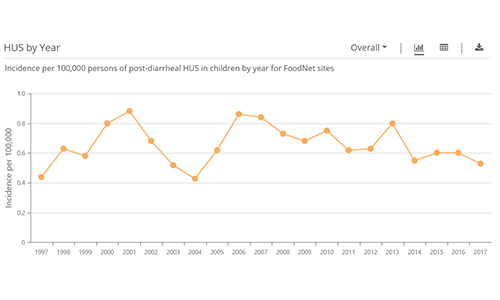
  • Hemolytic Uremic Syndrome (HUS) Surveillance Tool: HUS is a life-threatening condition, most often triggered by STEC infection. See how rates of pediatric HUS and STEC infection have changed in FoodNet’s surveillance area since 1997.

* As of January 1, 2018, FoodNet no longer conducts active surveillance for Cryptosporidium.

Background Information

Start exploring FoodNet Fast now – or click the boxes below for more information.

Pathogen Surveillance Tool FAQ
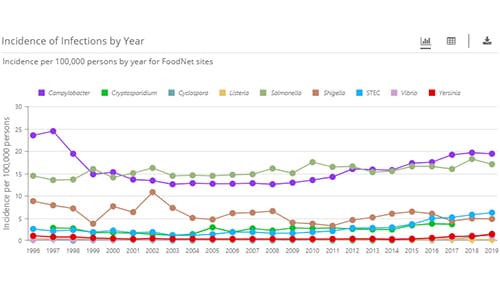
Graphic chart of Pathogen Surveillance Tool FAQ

Laboratory Practices Tool FAQ
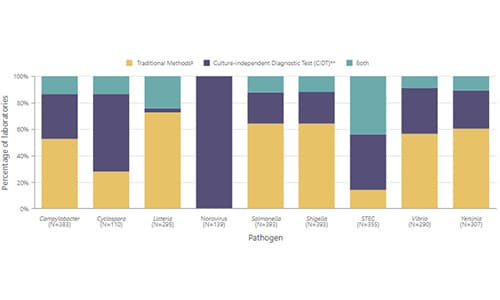
Graphic chart of Laboratory Practices Tool FAQ

HUS Surveillance Tool FAQ
Graphic chart of Laboratory Practices Tool FAQ

Canary Islands – Ciguatera outbreak reported in the Canary Islands

Outbreak News Today File:Gambierdiscus toxicus NOAA.png

Health officials with the Government of the Canary Islands have reported a possible outbreak of ciguatera after finding six cases of food poisoning after consuming black medregal (amberjack) in La Victoria de Acentejo, according to a El Dia report (computer translated).

Ciguatera is not unknown in the Canary Island reporting several cases annually and some 20 outbreaks in the past decade.

More than 400 species of fish, including barracuda, black grouper, blackfin snapper, cubera snapper, dog snapper, greater amberjack, hogfish, horse-eye jack, king mackerel, and yellowfin grouper have been implicated in this food borne illness that’s relatively common in several areas of the world.

This toxin is the result of the accumulation of marine algae and the toxins they produce passing up the food chain. These marine algae hang on to dead coral and seaweed. They are then eaten by herbivore fish which are subsequently eaten by predatory reef fish which concentrates the toxin in its tissue. People get this food borne toxin from eating these contaminated larger fish. The reef fishes are more likely to get contaminated during storms and other turbulence.


Information – Handling Flour Safely: What You Need to Know

FDA

Flour is a raw food. It may not look like a raw food, but it usually is, just like fresh tomatoes or carrots. The grains from which flour is ground are grown in fields and, like all foods grown outdoors, they may be exposed to a variety of harmful bacteria like Salmonella and pathogenic Escherichia coli (E. coli).

5 Important Things to Know About Flour

  1. Flours most commonly used in home baking and cooking are made directly from raw grains.
  2. Processing raw grains into flour does not kill harmful bacteria.
  3. Many foods made with flour also contain raw eggs, which may contain harmful bacteria.
  4. Cooking is the only way to be sure that foods made with flour and raw eggs are safe.
  5. Never eat or taste raw flour, dough, or batter.

OUTBREAK

Since 2009 there have been several outbreaks of foodborne illness involving raw flour or raw flour-containing products like cake mixes and cookie dough. These have resulted in 168 known illnesses and 20 hospitalizations.

Dos and Don’ts of Handling Flour

Check out this list of DO’s and DON’Ts to help keep you and your family safe when handling raw flour.

  • DO follow package directions on baking mixes and other flour containing products for correct cooking temperatures and specified times.
  • DO keep all raw foods, like flour and eggs, separate from ready-to eat foods. Remember, flour is a powder and spreads easily.
  • DO refrigerate cookie and pastry dough according to package directions. Use a refrigerator thermometer to be sure your refrigerator is at a safe 40°F.
  • DO clean up carefully after working with flour or raw dough and eggs:
    • Wash hands thoroughly with soap and running water, and,
    • Wash utensils, bowls, baking pans and cutting boards, and countertops with warm, soapy water.
  • DO NOT eat or allow children to eat or play with raw dough products made with any brand of flour or baking mix before cooking.
  • DO NOT keep recalled flour. Throw it away.
  • DO NOT let children use raw dough for crafts or play clay.
  • DO NOT use products that contain raw flour, like cake mix to make milkshakes.
  • DO NOT use raw cookie dough in ice cream (the cookie dough in ice cream sold in stores has been treated to kill harmful bacteria).

USA – Ohio Romaine Outbreak Sickens 12 with E. coli O157:H7 Infections

Food Poisoning Bulletin

The Ohio romaine outbreak has sickened 12 people with E. coli O157:H7 infections, making it the state with the second most illnesses after Wisconsin, with 33 cases as of December 9, 2019. Overall, at least 102 people are sick across the country, with 58 hospitalized and 10 who have developed hemolytic uremic syndrome (HUS), a type of kidney failure.

Most romaine products, including baby romaine, chopped romaine, organic romaine, hearts of romaine, romaine in salad wraps, salad bowl kits, sandwiches, packages of precut lettuce, and salad mixes that contain romaine, may be marked with the growing region. This is a voluntary policy put into place after last year’s two romaine E. coli O157:H7 HUS outbreaks. If the label says “Salinas” anywhere, or if the package is unmarked, don’t eat the romaine.

The CDC and FDA have stated that there is one grower associated with all three E. coli O157:H7 romaine outbreaks that are ongoing, but that grower has not been named. Officials have inspected three farms in the Salinas region, but has not named those.

UK – Scotland -FSS issues festive food poisoning warning

HPS

17 December 2019

Article: 53/5007

Food Standards Scotland (FSS) is reminding people to reduce the risk of food poisoning over the festive period by ensuring they follow good food safety practices.

Results from the latest FSS Food in Scotland Consumer Tracking Survey reveal that almost three-quarters of Scots (72%) completely fill their fridge at least some of the time, but only 12% always remember to check the temperature when it’s full. This is an essential measure, as a fridge temperature between zero and five degrees centigrade will help slow the growth of food poisoning bacteria, whilst overfilling can raise the fridge temperature.

FSS has created a downloadable food safety checklist which serves as a reminder when carrying out the different stages of preparing, cooking and eating Christmas dinner, as well as storing leftovers.

Source: FSS, 13 December 2019

Canada -Food Recall Warning – Certain Coaticook brand Cheddar cheese recalled due to Listeria monocytogenes

CFIA

Recall date:
December 16, 2019
Reason for recall:
Microbiological – Listeria
Hazard classification:
Class 1
Company / Firm:
Laiterie Coaticook Ltée
Distribution:
Quebec
Extent of the distribution:
Consumer

Recall details

Ottawa, December 16, 2019 – Laiterie Coaticook Ltée. is recalling certain Coaticook brand Cheddar cheese from the marketplace due to possible Listeria monocytogenes contamination. Consumers should not consume the recalled products described below.

Recalled products

Brand Product Size UPC Codes
Coaticook Mild Cheddar Cheese 50 g 0 59263 60050 2 Best Before: 03MR20
Coaticook Mild Cheddar Cheese 180 g 0 59263 60180 6 Best Before: 03MR20
Coaticook Mild Cheddar Cheese 320 g 0 59263 60320 6 Best Before: 03MR20
Coaticook Mild Cheddar Cheese 2.27 kg 0260005 Best Before: 03MR20
Coaticook Mild Cheddar Cheese 1.15 kg 0260025 Best Before: 03MR20
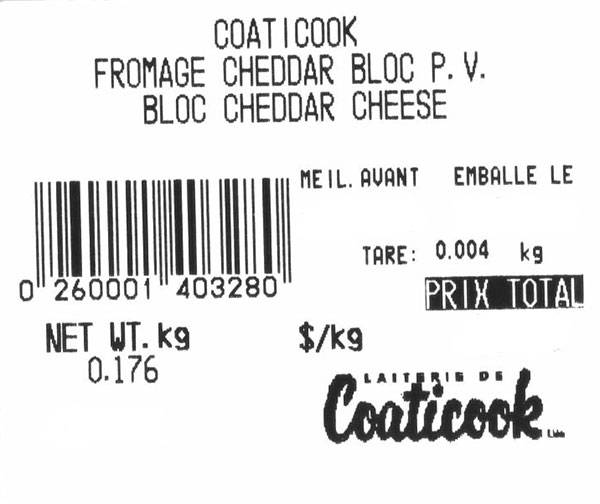
Coaticook Bloc Cheddar Cheese Variable Starting with
0 260001
Best Before: 03MR20
Coaticook Pointe Cheddar Cheese Variable Starting with 0 250006 Best Before: 03MR20

Illnesses

There have been no reported illnesses associated with the consumption of these products.

Product photos

Printer ready version of photos

  • Coaticook Mild Cheddar Cheese - 180 g
  • Coaticook Pointe Cheddar Cheese
  • Coaticook Bloc Cheddar Cheese

Russia -Salmonella sickens dozens in Khanty-Mansiysk, Russia

Outbreak News Today

Salmonella was laboratory confirmed in 35 of 73 pupils of Wonderland kindergarten in Khanty-Mansiysk who were infected with acute intestinal infection, city administrators report.

The Tass news service reports, “As of December 13, 73 cases were registered, four children were hospitalized in the children’s infectious ward of the district clinical hospital, and 35 children were laboratory confirmed with Salmonellosis group D,” Rimir Gimalov, the head of the public health department of the city administration, said in a statement.

According to local authorities, all necessary anti-epidemic measures are being carried out in the kindergarten. The institution was closed for quarantine.

FSA – Yaadgaar recalls Rasmalai due to contamination with Listeria monocytogenes

FSA

Yaadgaar is recalling Rasmalai because Listeria monocytogenes has been found in the product. This product also displays a best before date, instead of a use-by date.

Product details

Rasmalai

Pack size 4 pieces
Best before all best before dates up to and including 1 January 2020

Risk statement

The presence of Listeria monocytogenes in the product listed above.

Symptoms caused by this organism can be similar to flu and include high temperature, muscle ache or pain, chills, feeling or being sick and diarrhoea. However, in rare cases, the infection can be more severe, causing serious complications, such as meningitis.

Some people are more vulnerable to listeria infections, including those over 65 years of age, pregnant women and their unborn babies, babies less than one month old and people with weakened immune systems.

Action taken by the company

Yaadgaar is recalling the above product. Point of sale notices will be displayed in all retail stores that are selling this product. These notices explain to customers why the products are being recalled and tell them what to do if they have bought the product. Please see the attached notice.

Our advice to consumers

If you have bought any of the above product do not eat it. Instead, return it to the store from where it was bought for a full refund.

USA – Lincoln Correctional Center Salmonella Outbreak Sickens 6 in Nebraska

Food Poisoning Bulletin

A Lincoln Correctional Center Salmonella outbreak in Nebraska has sickened at least six inmates, according to a press release by the Nebraska Department of Correctional Services. Food poisoning outbreaks at prisons and jails are fairly common because of close quarters and serving large quantities of food.

USA -Statement on new findings and current status of the romaine lettuce E. coli O157:H7 outbreak investigation

FDA

Today, the U.S. Food and Drug Administration is providing an update on our investigation of an outbreak of E. coli O157:H7 illnesses linked to romaine lettuce. The FDA takes our responsibility of protecting the public from unsafe food very seriously and is committed to providing the public with more information as it becomes available.

Outbreaks Reported

Early on, based on test results provided by the Maryland Department of Health, our investigation pointed to farms in Salinas, California, as potential sources of contaminated romaine lettuce based on the initial, limited number of reported illnesses. The FDA, in partnership with the California Department of Public Health and the California Department of Food and Agriculture, rapidly mobilized in November to concurrently deploy inspection teams to the farms identified through the initial traceback investigation. The on-site investigations at these farms included collecting a wide-variety of samples for lab testing, including water, soil, soil amendments, scat and swab samples. While the majority of these samples tested negative for the outbreak strain, final results are pending and the Wisconsin Department of Health Services recently reported that it had isolated E. coli O157:H7 from a particular bag of pre-washed, chopped romaine lettuce.

The FDA has also been tracking two additional and separate outbreaks of E. coli O157:H7.

Earlier this week, the FDA, U.S. Centers for Disease Control and Prevention (CDC), and the Canadian Food Inspection Agency announced an outbreak linked to Fresh Express Sunflower Crisp Chopped Salad Kits. To date, the CDC reported eight confirmed cases in the U.S. across three states associated with this cluster of illnesses.The Public Health Agency of CanadaExternal Link Disclaimer also reports 24 cases in six Canadian provinces.

Concurrently, the FDA has been working with health officials in Washington State regarding an outbreak of E. coli O157:H7 associated with romaine consumption at a local restaurant chain. Washington State officials reported 10 confirmed and three probable cases in this outbreak with all reports of exposure in early to mid-November.

It should be noted; these are currently being considered as three separate outbreaks caused by three different strains of E. coli O157:H7.