Category Archives: Food Hygiene

Ireland – Recall of Tesco Finest St Felicien Du Dauphine Unpasteurised Cheese due to the Possible Presence of Shiga toxin-producing E. coli

FSAI

Message:

Tesco is recalling all batches of Tesco Finest St Félicien Du Dauphiné unpasteurised cheese, due to the possible presence of Shiga toxin-producing Eschericia coli.  Point-of-sale recall notices will be displayed in Tesco stores advising consumers not to eat the affected cheese.

Nature Of Danger:

Shiga toxin-producing Escherichia coli (STEC), also known as Verocytotoxigenic E. coli (VTEC), are a specific group of E. coli.  While most E. coli are harmless and live in the intestines of healthy humans, STEC produce a powerful toxin which can cause severe illness. Symptoms include abdominal cramps and diarrhoea which is sometimes bloody. Usually there is little or no fever, and patients recover within 5 to 10 days.  In some people however, particularly children under 5 years of age and the elderly, the infection can cause a complication called haemolytic uraemic syndrome (HUS), in which the red blood cells are destroyed and the kidneys can stop working properly.  The time between the initial infection and the first symptoms appearing is typically between 3 and 4 days but can range between 1 and 8 days.

Tesco Cheese


USA – E. coli O26 Outbreak Associated with Seattle Cafe Mario Ends Unsolved

Food Poisoning Bulletin

The E. coli O26 outbreak that was associated with Cafe Mario at the Nintendo of America campus in Redmond, Washington state is over and is unsolved, according to the King County Health Department. The outbreak, which happened in 2018, sickens 22 people who developed symptoms consistent with a Shiga toxin-producing E. coli (STEC) infection.

UK – Fromagerie Alpine recalls Saint Félicien and Saint Marcellin raw cow’s milk cheese because of possible contamination with E. coli

FSA

Product details

Tesco Finest Saint Félicien du Dauphiné Cheese

Pack size 180g
Lot number All lot numbers from 032 to 116
Use by All date codes
Xavier David, Saint Marcellin PGI (sold by Harrods)

Pack size 80g
Lot number All lot numbers from 032 to 116
Use by All date codes between 8 March 2019 and 16 June 2019

No other Fromagerie Alpine products are known to be affected.

Ireland – Tesco Ireland has issued an urgent recall on cereal bars over fears they could contain salmonella.

Buzz IE 

Tesco Ireland has issued an urgent recall on cereal bars over fears they could contain salmonella.

The bug, which is found in the digestive tracts of wild and domestic animals, can cause food poisoning if eaten.

The supermarket chain is now recalling two batches of the four-packs of Tesco Apricot, Almond & Yogurt Bars.

The two batch codes that are being recalled are 9100 and 9101.

Canada – Updated Food Recall Warning – Feeding Change brand Young Thai Coconut Meat recalled due to Salmonella

CFIA Feeding Change - Young Thai Coconut Meat

Recall details

Ottawa, May 1, 2019 – The food recall warning issued on April 14, 2019 has been updated to include additional product information. This additional information was identified during the Canadian Food Inspection Agency’s (CFIA) food safety investigation.

FeedingChange Canada is recalling Feeding Change brand Young Thai Coconut Meat from the marketplace due to possible Salmonella contamination. Consumers should not consume the recalled product described below.

Recalled products

Brand Name Common Name Size Code(s) on Product UPC
Feeding Change Young Thai Coconut Meat 454 g Best By : JUN 01 2020
CM 152181A
Best By : JUN 13 2020
CM 164181A
Best By : JUN 14 2020
CM 165181A
Best By : JUN 18 2020
CM 169181A
0 91037 12927 7

French Cheese – STEC E.coli 026 – Germany and Canada

Food Safety News

Ecoli Istock

Image CDC

Canada is one of a number of countries that has received raw milk cheese linked to an outbreak of E. coli O26 in France.

French authorities reported 13 cases of hemolytic uremic syndrome (HUS) in young children since March 21. HUS is a severe complication of E. coli infection that causes kidney failure and can occur a week or more after the onset of diarrhea.

Food Poison Journal

Two types of French cheese have been recalled in Germany over fears they could be contaminated with E.coli O26, just a few days after a similar scare in France, the German food safety authority announced on Tuesday.

French cheesemaker, Fromagerie Alpine, has been asked to recall its cheeses Saint-Felicien and Saint-Marcellin, sold in Germany under the name “Xavier David, tradition of good cheese, Alpine”, the authority said.

The decision was a precaution over concerns the brands could have been contaminated with the bacteria E.coli type 026, commonly found in the intestines of humans, livestock and other animals.

Canada – Le Pic brand “Saint-Félicien” cheese recalled due to E. coli O26

CFIA Le Pic - Saint-Félicien

Recall details

Ottawa, April 29, 2019 – La Fromagerie Hamel is recalling Le Pic brand “Saint-Félicien” cheese from the marketplace due to possible E. coli O26 contamination. Consumers should not consume the recalled product described below.

Recalled products

Brand Name Common Name Size Code(s) on Product UPC
Le Pic Saint-Félicien 180 g All codes up to and including April 29, 2019 0 20060641300 0

USA – E. coli O26 outbreak associated with Sodexo’s Café Mario sickens 22

Food Poison Journal

Public Health investigated an outbreak of Shiga toxin-producing E. coli (STEC) associated with I Love Sushi and Café Mario at Nintendo of America campus in Redmond. Café Mario is operated by Sodexo and is not open to the public. I Love Sushi is a food establishment that operates out of Café Mario once a week.

This outbreak appears to be over. After a thorough investigation, we do not have enough evidence to connect I Love Sushi to this outbreak.. No single food item prepared by Café Mario has been identified as the source of the illnesses. Everyone who reported illness has recovered.

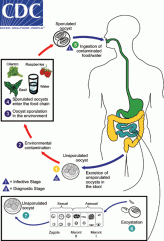
Information – Annual snapshot of foodborne illnesses shows Cyclospora spike

CIDRAP Cyclospora_LifeCycle201

In its annual report summing up the latest trends with pathogens that are common sources of foodborne illness, the Centers for Disease Control and Prevention (CDC) said today that the incidence of most illnesses increased in 2018, especially Cyclospora infections.

A team from the CDC and partners in 10 states that are part of the FoodNet surveillance network looked at levels for 2018 and compared them with levels for 2015 through 2017. The pathogens they tracked included Campylobacter, Cryptosporidium, Cyclospora, Listeria, Salmonella, Shiga toxin-producing Escherichia coli (STEC), Shigella, Vibrio, and Yersinia. They published their findings today in the latest edition of Morbidity and Mortality Weekly Report.

In preliminary findings for 2018, the FoodNet system flagged 25,606 infections, 5,893 hospitalizations, and 120 deaths. They note that the incidence for most infections is rising, including Campylobacter and Salmonella. However, they added an important caveat that some of the increase might be partly due to the increased use of culture-independent diagnostic tests (CIDTs), which can identify pathogens not regularly found by other testing methods — complicating data interpretation.

USA – 53,200 and 113,424 pounds of raw ground beef products recalled in E. coli O103 Outbreak – more recalls likely

Food Poison Journal

As of this week, a total of 156 people infected with the outbreak strain of E. coli O103 have been reported from 10 states – Minnesota, Illinois, Indiana, Ohio, Kentucky, Tennessee, Virginia, Mississippi, Georgia and Florida.

To date there have been two recalls.  Link between two producers of meat and the recalls remain unclear (How are the two connected?  Presumably a common supplier?) except that both recalls were prompted by positive E. coli O103 tests on “Unopened, intact, packages of ground beef collected as part of the ongoing investigation tested positive for E. coli O103 at an FSIS laboratory.”

It is likely that more recalls will happen as FSIS, CDC and state health authorities continue their efforts to find the source.

Food Poison Journal

What we know is that illnesses began March 1 and it is now almost May 1 – why did it take so long to figure out that 177 people with E. coli O103 were linked to ground beef? Why do we do not yet know the original source of the contamination?  Why is the public not being told the location where known illnesses occurred? Finally, are more people going to get sick?