
RASFF – high count of Escherichia coli (up to 3500 MPN/100g) in live clams (Venus Gallina) from Italy in Italy
RASFF – high count of Escherichia coli (up to 9.2 x 10² CFU/g) in betel leaves from Malaysia in the UK

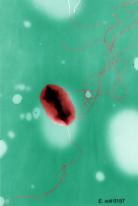
Image CDC
The food recall warning issued on October 7, 2019 has been updated to include additional product information. This additional information was identified during the Canadian Food Inspection Agency’s (CFIA) food safety investigation.
Industry is recalling various raw beef and raw veal products from the marketplace due to possible E. coli O157:H7 contamination. Consumers should not consume and distributors, retailers and food service establishments such as hotels, restaurants, cafeterias, hospitals and nursing homes should not sell or use the recalled products described in the link above.
This recall was triggered by the CFIA’s inspection activities. The CFIA is conducting a food safety investigation, which may lead to the recall of other products. If other high-risk products are recalled, the CFIA will notify the public through updated Food Recall Warnings.
The CFIA is verifying that industry is removing the recalled products from the marketplace.
There have been no reported illnesses associated with the consumption of these products.
Ottawa, October 8, 2019 – The food recall warning issued on October 4, 2019 has been updated to include additional product information. This additional information was identified during the Canadian Food Inspection Agency’s (CFIA) food safety investigation.
Ryding-Regency Meat Packers Ltd. (EST. 99) is recalling Ryding-Regency Meat Packers Ltd. brand raw beef products from the marketplace due to possible E. coli O157:H7 contamination. Food service establishments, retailers, distributors and manufacturers should not serve, use, or sell the recalled products described in the link above.
This recall was triggered by the CFIA’s inspection activities. The CFIA is conducting a food safety investigation, which may lead to the recall of other products. If other high-risk products are recalled, the CFIA will notify the public through updated Food Recall Warnings.
The CFIA is verifying that industry is removing the recalled products from the marketplace.
There have been no reported illnesses associated with the consumption of these products.
| ABSTRACT |
|---|
Consumption of spicy foods and hot sauces is currently a popular trend worldwide. Shelf-stable acidified sauces are commonly hot-filled to ensure commercial sterility, but cold-fill-hold processes might also be suitable if microbial safety and stability are ensured. For this study, model acidified hot pepper sauces were developed and characterized. The effects of sauce pH and of two different organic acids on the survival of Pichia manshurica and Lactobacillus curvatus isolated from contaminated commercial hot sauces and on pathogenic Escherichia coli O157:H7, Salmonella enterica, and Listeria monocytogenes were assessed. Full factorial designs with three levels for pH (3.2, 3.5, and 3.9) and two for organic acid (citric and acetic) were used to determine the effects of these factors and their interactions on the survival of the microorganisms. Commercially sterile sauces were independently inoculated and kept at ambient temperature. Microbial counts were determined at different sampling times, depending on the treatment evaluated. Sauces acidified to pH 3.2 with citric or acetic acid were inoculated with cocktails of five strains or serotypes of the three pertinent pathogens, and inactivation curves were determined. Trials were performed in triplicate. A greater than 5-log reduction of P. manshurica and L. curvatus was achieved in less than 6 h in sauces adjusted to pH 3.2 with acetic acid. Greater than 5-log reductions of pathogenic bacteria were achieved 0.5 h after inoculation in sauces acidified to pH 3.2 with acetic acid. In contrast, at least 48 h was required to guarantee the same inactivation for the most tolerant pathogen when citric acid was used. Thus, a cold-fill-hold process may be a suitable alternative for acidified hot pepper sauces. Based on survival of the microorganisms evaluated in this study, microbial safety and stability can be achieved by adjusting the pH to 3.2 or less by the addition of acetic acid.
| HIGHLIGHTS |
|---|
pH and acidifier influence safety and stability of cold-filled acidified sauces.
Safe and stable cold-filled sauces were obtained at pH 3.2 with acetic acid.
Results help establish science-based conditions for cold-filled products.
Ottawa, October 7, 2019 – The food recall warning issued on October 6, 2019 has been updated to include additional product information. This additional information was identified during the Canadian Food Inspection Agency’s (CFIA) food safety investigation.
Industry is recalling various raw beef and raw veal products from the marketplace due to possible E. coli O157:H7 contamination. Consumers should not consume and distributors, retailers and food service establishments such as hotels, restaurants, cafeterias, hospitals and nursing homes should not sell or use the recalled products described in the link above.
This recall was triggered by the CFIA’s inspection activities. The CFIA is conducting a food safety investigation, which may lead to the recall of other products. If other high-risk products are recalled, the CFIA will notify the public through updated Food Recall Warnings.
The CFIA is verifying that industry is removing the recalled products from the marketplace.
There have been no reported illnesses associated with the consumption of these products.
Out of an abundance of caution, The J. M. Smucker Company today announced a voluntary recall of specific lots of Robin Hood® All Purpose Flour distributed and sold in the U.S. due to possible E. coli contamination. This recall does not impact any Robin Hood® items sold in Canada.
No other items manufactured by The J. M. Smucker Company, including other Robin Hood® products distributed and sold in the U.S. or Canada, are impacted by this issue. No illnesses related to this issue have been reported to date.
The impacted products are as follows:
|
Product Name |
UPC Code – Case |
UPC Code – Item |
Lot Codes |
Best if Used By Dates |
|---|---|---|---|---|
| Robin Hood® All Purpose Flour (5 lb) | 0 51500 18010 2 | 0 51500 18010 5 | 8350 513 8351 513 8354 513 8355 513 |
6/16/2020 6/17/2020 6/20/2020 6/21/2020 |
These products were distributed by The J. M. Smucker Company to a variety of retailers in the U.S.
Consumers who have impacted product should stop using the products and should dispose of them. If consumers have questions or have products covered by this recall, they should email the Company by completing this formExternal Link Disclaimer or calling 888-569-6728, Monday through Friday, between 8:00 a.m. and 5:00 p.m. ET.
The recall is being conducted in cooperation with the U.S. Food and Drug Administration.
Health officials in Newfoundland and Labrador are reporting an E. coli outbreak in the province. The Department of Health and Community Services advises that there have been 22 confirmed cases of E.coli in the province this week, and Public Health officials within the department, as well as the regional health authorities are working with Service NL to investigate.
Posted in E.coli, food bourne outbreak, food contamination, food handler, Food Hygiene, Food Illness, Food Inspections, Food Micro Blog, Food Microbiology, Food Microbiology Blog, Food Poisoning, food recall, Food Safety, Food Safety Alert, Food Testing, Food Toxin, foodborne outbreak, foodbourne outbreak, outbreak, Uncategorized

Image CDC
An E. coli outbreak at the Acapulco Mexican Restaurant in Andover, Minnesota has been confirmed by Doug Schultz, Information and Communications Officer for the Minnesota Department of Health. He said, “We are investigating a cluster of STEC cases that ate at the Andover location.” That restaurant is located at 13753 Ibis St NW in Andover.
Posted in E.coli, food bourne outbreak, food contamination, Food Hygiene, Food Illness, Food Inspections, Food Micro Blog, Food Microbiology, Food Microbiology Blog, Food Pathogen, Food Poisoning, food recall, Food Safety, Food Safety Alert, Food Testing, Food Toxin, foodborne outbreak, foodbourne outbreak, outbreak, Uncategorized
Recall of King Arthur Flour Unbleached All-Purpose Flour
The United States of America Food and Drug Administration (USFDA) has
published an alert on the recall of King Arthur Flour Unbleached All-Purpose Flour due
to the potential presence of E. coli O26.
2 As there is import of the implicated product into Singapore, the Singapore Food
Agency (SFA) has directed the sole importer, Cold Storage, to recall the product. The
recall is completed.
3 Consumers who have purchased the affected product should not consume it.
They may contact Cold Storage at 1800 8918 100 for enquiries or exchange of the
product.
Ottawa, October 6, 2019 – The Beef Boutique Ltd. (EST. 639) is recalling The Beef Boutique Ltd. brand raw beef products from the marketplace due to possible E. coli O157:H7 contamination. Food service establishments, retailers, distributors and manufacturers should not serve, use, or sell the recalled products described below.
The following products have been sold in Alberta, British Columbia, and Ontario, and may have been distributed in other provinces or territories.
| Brand | Product | Size | UPC | Codes | Product number |
|---|---|---|---|---|---|
| The Beef Boutique Ltd. | BEEF BURGER-MAP 6 oz | Variable | None | Packed 19/06/12 |
2530450 |
| The Beef Boutique Ltd. | LEAN GROUND BEEF (H F) RWA | Variable | None | Packed 19/06/14 |
2614850 |
| The Beef Boutique Ltd. | LEAN GROUND BEEF 500 gm NTE:17% FAT |
Variable | None | Packed 19/06/12 |
2664250 |
This recall was triggered by the CFIA’s inspection activities. The CFIA is conducting a food safety investigation, which may lead to the recall of other products. If other high-risk products are recalled, the CFIA will notify the public through updated Food Recall Warnings.
The CFIA is verifying that industry is removing the recalled products from the marketplace.
There have been no reported illnesses associated with the consumption of these products.