Category Archives: Cyclospora

USA – Investigations of Foodborne Illness Outbreaks

FDA

What’s New

  • For the outbreak of Cyclospora cayetanensis illnesses (ref #1245) linked to a not yet identified product, the case count has increased from 2 to 21.
  • For the outbreak of Salmonella Newport (ref #1248) linked to a not yet identified product, the case count has increased from 2 to 3. FDA has initiated traceback.
  • For the outbreaks of Cyclospora cayetanensis (ref #1237 and ref #1239), these outbreaks are being combined into the Cyclospora cayetanensis outbreak (ref #1237) based on traceback information from FDA’s investigation and epidemiology provided by the Centers for Disease Control and Prevention (CDC). For the outbreak of Cyclospora cayetanensis (ref #1237), the case count has been adjusted from 26 to 44; this includes 16 cases from the combined Cyclospora cayetanensis (ref #1239) outbreak plus additional illnesses.
  • For the outbreak of Salmonella Typhimurium (ref #1234) linked to a not yet identified product, the case count has increased from 88 to 89.
  • For the investigation of illnesses (ref #1233) linked to Diamond Shruumz-brand Chocolate Bars, Cones, and Gummies, the advisory has been updated to include additional illnesses and laboratory results of product samples.
  • For the outbreak of Salmonella Africana and Salmonella Braenderup illnesses (ref #1227), FDA has updated the advisory to include additional investigational findings.

USA – Cyclosporiasis Outbreak (Caused by Ingestion of the Cyclospora Parasite) Affects Over 100 in North Carolina County

Food Poisoning News

The North Carolina Department of Health and Human Services (DHHS) has confirmed an outbreak of cyclosporiasis that has affected more than 100 people in Wake County, according to WRAL. The outbreak was identified in July, though the specific contaminated food item has not yet been identified.

According to DHHS, the outbreak appears to be over, but the investigation is ongoing into the source of the Cyclospora parasite. A spokeswoman for the department stated, “We have not identified the specific contaminated food item, and the outbreak appears to be over.”

USA- FDA- Investigations of Foodborne Illness Outbreaks

FDA

What’s New

  • An outbreak of Cyclospora cayetanensis illnesses (ref #1245) linked to a not yet identified product has been added to the table. FDA has initiated traceback.
  • An outbreak of Salmonella Newport (ref #1248) linked to a not yet identified product has been added to the table.
  • For the outbreak of Salmonella Irumu (ref #1235) linked to a not yet identified product, FDA has initiated sampling.
  • For the outbreak of Salmonella Typhimurium (ref #1234) linked to a not yet identified product, the case count has increased from 87 to 88.
  • For the investigation of illnesses (ref #1233) linked to Diamond Shruumz-brand Chocolate Bars, Cones, and Gummies, the advisory has been updated to include additional illnesses.
Date
Posted
Ref Pathogen
or
Cause of
Illness
Product(s)
Linked to
Illnesses

(if any)
Total
Case
Count
8/7/

2024

1245 Cyclospora
cayetanensis
Not Yet
Identified
2
8/7/

2024

1248 Salmonella
Newport
Not Yet
Identified
2
7/31/

2024

1237 Cyclospora
cayetanensis
Not Yet
Identified
26
7/31/

2024

1239 Cyclospora
cayetanensis
Not Yet
Identified
16
7/10/

2024

1235 Salmonella
Irumu
Not Yet
Identified
32
6/19/

2024

1234 Salmonella
Typhimurium
Not Yet
Identified
88
6/12/2024 1233 Not Yet
Identified
Chocolate,
Gummies,
Cones
See
Advisory
5/22/2024 1227 Salmonella
Africana
&
Braenderup
Cucumbers See
Advisory

USA – Research – FDA Releases Summary Report on Fresh Herbs Sampling Assignment

FDA

Today, the U.S. Food and Drug Administration (FDA) released findings from a sampling assignment that collected and tested both domestic and imported fresh basil, cilantro, and parsley. The assignment sought to estimate the prevalence of Cyclospora cayetanensis, Salmonella spp., and Shiga toxin-producing Escherichia coli (STEC) in these herbs as part of the FDA’s ongoing effort to help proactively ensure food safety.

From September 2017 to September 2021, the FDA collected and tested a total of 1,383 samples of fresh basil, cilantro, and parsley. The agency detected Salmonella spp. in 17 out of 1,358 samples, detected C. cayetanensis in 18 out of 812 samples, and detected STEC in 1 out of 1,350 samples. The FDA worked closely with the firm to quickly remove the contaminated products from the market. The sampling assignment took longer than anticipated, due to a nine month pause during the COVID-19 pandemic.

Fresh herbs contaminated with Salmonella spp., C. cayetanensis, and STEC can present a significant public health risk. From FY2000 through FY2016, cilantro was potentially linked to at least three outbreaks in the U.S. And since 2017, the U.S. has experienced at least six additional outbreaks involving basil, cilantro, and parsley. More than 1,200 illnesses and 80 hospitalizations were tied to these outbreaks. Thus, the FDA determined that sampling may help the agency assess the prevalence of pathogens in the commodities and identify common factors among contaminated samples, with the goal of helping to protect consumers.

Given the findings of the assignment, the FDA encourages industry to ensure its compliance with the agency’s Produce Safety RulePreventive Controls for Human Food Rule, and FSMA Final Rule on Requirements for Additional Traceability Records for Certain Foods, as applicable. Importers of fresh herbs should ensure their compliance with the agency’s Foreign Supplier Verification Programs Rule.

This sampling assignment was the agency’s first largescale field activity to focus on fresh basil, cilantro, and parsley. This data will help the agency develop guidance and update program priorities, including future sampling assignments and the prioritization of surveillance inspections. The FDA will continue to sample these fresh herbs for pathogens as warranted to protect consumers.

USA- Research – Reported Incidence of Infections Caused by Pathogens Transmitted Commonly Through Food: Impact of Increased Use of Culture-Independent Diagnostic Tests —Foodborne Diseases Active Surveillance Network, 1996–2023

CDC

Reducing foodborne disease incidence is a public health priority. This report summarizes preliminary 2023 Foodborne Diseases Active Surveillance Network (FoodNet) data and highlights efforts to increase the representativeness of FoodNet. During 2023, inci-
dences of domestically acquired campylobacteriosis, Shiga toxin- producing Escherichia coli infection, yersiniosis, vibriosis, and cyclosporiasis increased, whereas those of listeriosis, salmonellosis, and shigellosis remained stable compared with incidences during 2016–2018, the baseline used for tracking progress towards federal disease reduction goals. During 2023, the incidence and percent- age of infections diagnosed by culture-independent diagnostic
tests (CIDTs) reported to FoodNet continued to increase, and the percentage of cases that yielded an isolate decreased, affecting observed trends in incidence. Because CIDTs allow for diagnosis of infections that previously would have gone undetected, lack of progress toward disease reduction goals might reflect changing diagnostic practices rather than an actual increase in incidence. Continued surveillance is needed to monitor the impact of chang-
ing diagnostic practices on disease trends, and targeted prevention efforts are needed to meet disease reduction goals. During 2023, FoodNet expanded its catchment area for the first time since 2004. This expansion improved the representativeness of the FoodNet
catchment area, the ability of FoodNet to monitor trends in disease incidence, and the generalizability of FoodNet data.

USA – Alabama Cyclospora Outbreak 2023

Food Poison Journal

In the May of 2023, a significant increase in Cyclospora cases associated with a Mexican-style restaurant in Limestone County, Alabama was investigated by the Alabama Department of Public Health. An outbreak investigation was initiated on June 7, 2023. A case control study was launched on June 12. Exposures were reported between May 20 and June 6, 2023.

USA- 2023 – Alabama Cyclospora Outbreak Revealed

Food Poison Journal

In the May of 2023, a significant increase in Cyclospora cases associated with a Mexican-style restaurant in Limestone County, Alabama was investigated by the Alabama Department of Public Health. An outbreak investigation was initiated on June 7, 2023. A case control study was launched on June 12. Exposures were reported between May 20 and June 6, 2023.

Research – Editorial for the Special Issue Cyclospora cayetanensis and Cyclosporiasis

MDPI

This Special Issue presents important advances, particularly regarding the better detection methods now available, and reviews important aspects of C. cayetanensis and cyclosporiasis. It includes two publications about the epidemiology of the parasite in humans, one in Ghana and another in Colombia. The study in Ghana, one of the few studies of this parasite in Africa, confirmed that immunosuppressed patients are more prone and vulnerable to C. cayetanensis infection. In endemic countries, the most susceptible populations are children, foreign people, and immunocompromised patients, while in industrialized countries, C. cayetanensis affects people of any age [2]. The study in Colombia showed the high endemicity of C. cayetanensis in the Colombian Wiwa indigenous people and observed a higher prevalence of C. cayetanensis in the rainy season (July–November) compared to a previous study performed in the same area during the dry season (January–April) [4]. C. cayetanensis infection is remarkably seasonal, although it varies by geographical region most likely due to human activities, environmental contamination, and the optimal sporulation conditions in each area

USA – Nationwide Cyclospora Outbreak hits 2,272 with no source identified

Marler Blog

As of October 24, 2023, 41 jurisdictions, including 40 states and New York City, have reported a total of 2,272 laboratory-confirmed cases of cyclosporiasis.

These individuals had not traveled outside of the United States during the 14 days before they got sick. This is an increase of 315 cases since the last update on August 31, 2023.

Sick people ranged in age from 2 to 96 years, with a median age of 51, and 57% were female. The median illness onset date was June 24, 2023 (range: April 1 to August 31). Of 2,242 people with information available, 186 have been hospitalized. Zero deaths have been reported.

Research – USA -FDA -Cyclospora cayetanensis in Produce

FSIS USDA

Executive Summary of Findings
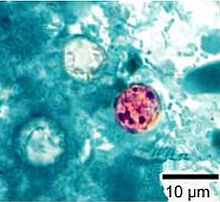
Cyclospora cayetanensis (C. cayetanensis) is a coccidian protozoan parasite, belonging
to the phylum Apicomplexa, order Eucoccidiorida, family Eimeriidae, described between 1993 to 1994 as a newly identified human gastrointestinal pathogen.

Within the genus Cyclospora, only C. cayetanensis is known to infect humans. However, recent advances in genomics separated C. cayetanensis into 3 proposed species, with the two new proposed species also considered parasitic to humans (Cyclospora ashfordi sp. nov. and Cyclospora henanensis sp. nov.).

For the purpose of this document and to reflect the proposed status of the new
nomenclature “C. cayetanensis” refers to all three species of Cyclospora parasitic in humans.
The parasite produces oocysts that are resistant to harsh environmental conditions and many
chemical treatments commonly used to reduce the presence of bacterial pathogens in the
specialty crop production environment and in agricultural inputs (e.g., agricultural water). C.
cayetanensis is the etiologic agent of cyclosporiasis, its host range is limited to humans.
Detected in association with human illness in many parts of the world, C. cayetanensis
previously was considered to be a pathogen acquired during childhood in developing nations.

In the United States, cyclosporiasis was previously associated with international travel or
consumption of contaminated imported foods. In recent years, the U.S. has seen an increase in cases and positive samples associated with domestically grown produce, both as raw
agricultural commodities and fresh cut. Laborers with the history of recent travel to countries
where C. cayetanensis is endemic have not been ruled out as the sources of the pathogen in
these outbreaks. Since 2016, the number of cyclosporiasis cases has increased approximately
3-fold, often linked to the consumption of leafy herbs and ready-to-eat salads. Fecal
contamination from symptomatic or asymptomatic carriers is, ultimately, the only known source of C. cayetanensis. The hypothesis that C. cayetanensis has become endemic in the production regions of the U.S. remains to be robustly supported. The hypothesis that farm workers with a history of recent travel to areas where the parasite is common are the likeliest source of the pathogen has not been ruled out. C. cayetanensis likely spreads via the fecal-environment-oral route when sanitation controls break down. Efforts have been made to develop molecular detection methods for C. cayetanensis in both food and environmental samples.

However, due to the high degree of genome-level conservation between C. cayetanensis and its close relatives that are not pathogenic in humans, results of some environmental surveys that relied solely on the PCR-based detection of ribosomal RNA genes likely overestimated the prevalence of C. cayetanensis. There remain significant knowledge and data gaps that hamper the implementation of effective measures to prevent the contamination of produce with the oocysts of this parasite. Awareness of the factors that can contribute to C. cayetanensis contamination of domestically grown and imported produce is key to developing an effective prevention and management strategy.