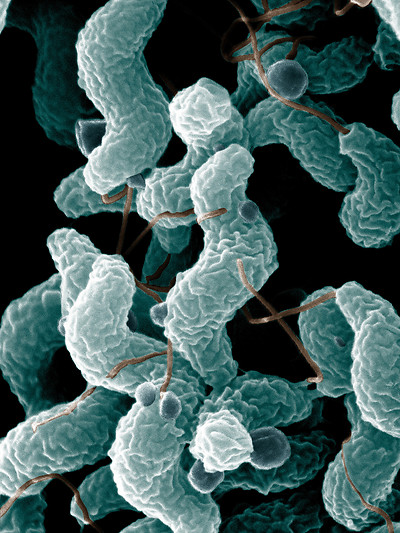
Category Archives: Campylobacter

UK – FSA Warning About Campylobacter in Chicken

Daily Telegraph imagesCAYZ5I84

The Food Standards Agency warned that around two thirds of all raw, shop-bought chicken in the UK is contaminated by campylobacter, which affects an estimated 500,000 people a year and kills around 100.

It said not enough was being done by manufacturers to prevent the spread of the bacteria and has called a “summit” meeting of food retail leaders at which it will ask them to plough more money into fighting the problem, rather than treating the current contamination levels as acceptable.

Research New Bacterial Identification Technology

Food Poisoning Bulletin

xTAG Gastrointestinal Pathogen Panel (GPP), which recently received approval from US Food and Drug Administration (FDA), is one lab test that can do the job of many,  expertly scanning a solitary stool sample for 11 different illness-inducing organisms.

To many, that sounds an impressive feat in an of itself. But considering that 179 million Americans are stricken with gastroenteritis every year, according to the Centers for Disease Control and Prevention (CDC), it’s also one that can come in handy. Infectious gastroenteritis is caused by certain viruses, bacteria, or parasites and can be spread easily through person-to-person contact or from contaminated food, water, and surfaces. Symptoms include vomiting and diarrhea.

The  xTAG can scan for  bacteria including Campylobacter, Clostridium difficile (C. difficile) toxin A/B, Escherichia coli (E. coli) O157, Enterotoxigenic Escherichia coli (ETEC) LT/ST, Salmonella, Shigella and Shiga‐like Toxin producing E. coli (STEC) stx 1/stx 2. It can scan for viruses including Norovirus and Rotavirus A. And it can scan for parasites such as Cryptosporidium and Giardia.

Research – Campylobacter in Chicken Factory Workers

Food Safety NewsimagesCAYZ5I84

New analysis of Campylobacter infections among workers at a Virginia poultry plant offers hints about which employees more likely to fall ill from the bacteria.

Government researchers examined health data for plant employees from January 2008 through May 2011 and found that 29 Campylobacter cases had been confirmed during that time period.

Their findings reveal three characteristics of workers who were more likely to be sickened:

  • Recently employed: A full 83 percent of these patients had worked at the plant less than a month before falling ill, suggesting that illness is more common among new employees.
  • Worked in the live-hang area: Those whose job involved hanging live chickens were far more likely to be infected than those working in other parts of the facility. Of those sickened, 62 percent worked in a live-hang area.
  • Resided in diversion centers: Almost all the employees who contracted Campylobacter infections (26 out of 29) lived in state-operated diversion centers. The authors say the high illness rate among this group may be due to the fact that diversion center residents are disproportionately assigned to live-hang areas, where they are more likely to be exposed to the bacteria.

The fact that new employees fell ill more frequently than those who had been there more than a month is consistent with findings from other studies, which have suggested that workers develop immunity to the bacteria during the first few weeks of work.

CDC – Report

UK – Restaurant Implicated in Campylobacter Cases

The Telegraph

Two customers at Blanc Brasserie, in Covent Garden, London, were left ill after eating pink lamb’s liver which was not cooked thoroughly enough, a court has been told. The restaurant has now been banned from serving the dish, after failing to heed a warning from council environmental health officers, Westminster Magistrates’ Court heard. The food had “presented an imminent risk of injury to health because the process of cooking”, the court was told. Blanc Brasseries will now pay £3,103 in costs and have confirmed they will comply with the order, as a spokeswoman said they were unable to cook the liver to council standards without compromising on taste.

“Brasserie Bar Co has not contested the EHO enforcement and will no longer serve liver in any of its restaurants,” she said.

EFSA Fact Sheets –

Antimicrobial Resistance

Campylobacter

Foodborne Zoonoses

Salmonella

European Food Alerts – Salmonella, Campylobacter, Aflatoxin, Yeast

RASFF – Salmonella in Frozen Beef Fat in Italy sourced in Lithuania

RASFF – Aflatoxin in Ogi in the UK sourced in Nigeria.

RASFF – Salmonella in Turkey Breast Fillets in Denmark sourced in Poland

Denmark– Yeast Growth in Lactose Free Youghurts causing blowing

Denmark – Campylobacter in Frisee Salad

France – Salmonella in Ham Burgers in France

Campylobacter Founb in US Raw Milk

Hot Springs Star

PIERRE – The South Dakota Department of Agriculture (SDDA) is reporting campylobacter bacteria was found in a sampling of raw (unpasteurized) milk from Black Hills Milk in Belle Fourche.

SDDA advises consumers that raw milk recently purchased from this business may contain harmful bacteria that can lead to campylobacter infection. Symptoms of this infection include diarrhea, nausea and vomiting, and can sometimes progress to more serious illness, such as kidney failure and other complications.

The implicated milk is sold at a retail outlet in Spearfish, Black Hills Farmers Market at Founder’s Park in Rapid City and other locations in the Black Hills. If you have purchased this raw milk, SDDA advises the product be discarded or returned.

According to the Center for Disease Control (CDC), pasteurized milk that is correctly handled in the dairy, bottled, sealed and refrigerated after pasteurization, and that is properly handled by the consumer, is very unlikely to contain illness-causing bacteria.

The SDDA requires producers selling raw milk to be permitted through the state, inspected once or twice a year depending on grade of milk and provide a monthly quality analysis.


New Zealand – Poorly Cooked Liver Two Dozen Food Poisoning Cases

Stuff.co.nz

Health officials are warning liver lovers to cook their offal properly, after more than two dozen cases of food poisoning in Wellington.

Twenty-six cases of campylobacter, linked to eating liver, had been reported to public health officials in the past year.

Cook liver in small batches for at least five minutes until juices are clear. Use separate cutting boards for raw meat, clean boards with hot soapy water and thoroughly clean kitchen utensils. Store raw liver products separately and well covered to prevent cross-contamination of other foods.

RASFF and Other Alerts – Mould, Listeria, Salmonella,Aflatoxins, STEC, Campylobacter

RASFF – Mould in Cheddar Cheese in Denmark sourced in the UK.

RASFF – Salmonella in Roasted Soya Beans in Belgium.

RASFF – Campylobacter in Fresh Whole Chicken in Denmark sourced in Germany.

RASFF – Salmonella in Galacto Oligosaccharide in Netherlands sourced in South Korea

RASFF – STEC E.coli Bovine Meat in Belgium

RASFF – Aflatoxins in Groundnuts in Netherlands sourced in Nicaragua.

Denmark – Undesirable bacteria in Yoghurt

Denmark – Mould on Cheese products.

Germany – Salmonella in Teewurst Sausage

Research – Campylobacter Cross Contamination in Abattoirs

NCBI MedPub 

Consumption of raw or undercooked poultry products contaminated with Campylobacter has been identified as a risk factor for human campylobacteriosis. We determined whether slaughtering of Campylobacter-positive flocks was associated with contamination of chicken products derived from Campylobacter-negative flocks slaughtered at the same abattoir. The presence of Campylobacter was investigated in 22 broiler farms 1 week prior to slaughter and in one abattoir on nine separate slaughter days. A total of 600 bulk packed chicken products were tested, with 198 (33.0%) of the products found to be Campylobacter positive. Of the 350 chicken products originating from Campylobacter-positive flocks, 180 (51.1%) were contaminated with the bacteria. In contrast, only 18 (7.2%) of 250 chicken products derived from Campylobacter-negative flocks were contaminated. In 14 of these 18 products, the Campylobacter isolates were identical to isolates obtained from the flock slaughtered immediately prior to the Campylobacter-negative flock. Notably, on 4/6 slaughter days, Campylobacter-negative flocks were slaughtered prior to the positive flocks, and Campylobacter was absent from all chicken products originating from the negative flocks. These results suggest that implementation of logistic slaughter (where Campylobacter-negative flocks are slaughter first) significantly decreases the prevalence of Campylobacter-positive chicken products.