Category Archives: Bacteria

USA – Listeria Issues – BI-LO – Taylor Farms – Reser Foods – Garden Fresh

Food Poisoning Bulletin

The FDA is announcing that the BI-LO store at 500 Furys Ferry Road in Martinez, Georgia is recalling Taylor Farms Spinach Antipasti Salad because it may be contaminated with Listeria monocytogenes bacteria. This is an expansion of an earlier recall by Reser’s Foods. No other BI-LO stores are affected by this recall.

The Taylor Farms Spinach Antipasti Salad was sold between October 19 and October 27, 2013. If you purchased this salad, return it to the place of purchase for a refund.

There are no reports of illness associated with the consumption of this product

Food Poisoning Bulletin

Taylor Farms Tennessee and Taylor Farms Maryland are recalling many broccoli salad kits because they were made with recalled ingredients from Reser’s Fine Foods. The kits may  be contaminated with Listeria monocytogenes.

You can see the list of products, along with the store where they were sold, the description, best if used by date, and production facility at the FDA web site.

Food Poisoning Bulletin

The recall of Garden Fresh Foods ready to eat chicken and ham products for possible Listeria monocytogenes contamination is expanding. THe previous recalls were for 25,748 pounds of product on September 25 and October 17, 2013. Now the company is recalling 103,080 additional pounds of food.

You can see the long list of recalled products, along with brand names, product code, and expiration dates, at the USDA web site.
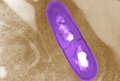
Research – Listeria’s Resistance to Disinfectants

University of Veterinary Science- ViennaEurofins Food Testing UK

Listeria poses a significant risk to human health. The main transmission route involves meat and dairy products, so it is important to treat dairies and food-processing plants regularly with disinfectants to kill bacteria. Unfortunately, listeria is developing resistance to the compounds that are most frequently used. Recent work in the group of Stephan Schmitz-Esser at the University of Veterinary Medicine, Vienna (Vetmeduni Vienna) has uncovered the mechanism for listeria’s resistance to one such agent, benzalkonium chloride. The findings have been published in the online journal Plos One.


Canada . Ecoli O157 Outbreak Update

E.coli Blog

The Public Health Agency of Canada, along with its health and food safety partners, is investigating 27 confirmed cases of E. coli O157:H7 illness; 12 in British Columbia, 10 in Alberta, 2 in Saskatchewan, 2 in Manitoba and 1 in Quebec.

These individuals became ill between mid-July and late-September.  There has been one death.

Certain contaminated cheese products manufactured by Gort’s Gouda Cheese Farm in Salmon Arm, British Columbia, have been identified as the source of the illnesses. The Canadian Food Inspection Agency (CFIA) has issued a Health Hazard Alert warning the public not to consume the affected product.

RASFF Alerts – DSP – Mussels – Hepatitis A- Frozen Berries – E.coli – Clams – Mussels

RASFF -Diarrhoeic Shellfish Poisoning (DSP) toxins – okadaic acid (188 µg/kg – ppb) in chilled mussels (Mytlius Galloprovincialis) from Spain in Italy

RASFF -hepatitis A virus in frozen mixed berries processed in Italy, with raw material from Poland, Serbia, Chile, Bulgaria, Sweden and Bosnia and Herzegovina in Italy

RASFF -high count of Escherichia coli (5400 MPN/100g) in clams (Venus verrucosa) from Greece in Italy

RASFF -too high count of Escherichia coli (3500 MPN/100g) in chilled mussels from France

RASFF -too high count of Escherichia coli (9200; 2400 MPN/100g) in chilled mussels (Mytilus galloprovincialis) from Spain in Italy

RASFF Alerts – Listeria monocytogenes – Smoked Bacon – Smoked Salmon

RASFF-Listeria monocytogenes (<10 CFU/g) in chilled bacon from Germany in France

RASFF-Listeria monocytogenes (<10 CFU/g) in chilled smoked salmon from Ireland in France


RASFF Alerts – Salmonella – Chicken – Pork

RASFF -Salmonella enteritidis (presence /25g) in chilled chicken quarter from Poland in the Czech Republic

RASFF -Salmonella enteritidis (presence /25g) in chiled chicken breast fillets from Poland in the Czech Republic

RASFF -Salmonella typhimurium (presence /25g) in chilled pork loins from Germany in Denmark

RASFF -Salmonella enteritidis (presence /25g) in frozen whole chicken from Poland in Italy

RASFF -Salmonella typhimurium (presence /25g) in pork spare ribs from Germany in Denmark

RASFF – Alerts – Aflatoxin – Peanut -Dried Figs – Ochratoxin – Dried Figs

RASFF -aflatoxins (B1 = 6.0; Tot. = 7.0 µg/kg – ppb) in peanut bar from Ukraine in Germany

RASFF -ochratoxin A (12.7 µg/kg – ppb) in dried halve figs from Turkey in Germany

RASFF -aflatoxins (B1 = 9.0; Tot. = 11.7 µg/kg – ppb) in peanuts from Madagascar in Belgium

RASFF -aflatoxins (B1 = 81.1; Tot. = 102 µg/kg – ppb) in peanut butter from Benin in Belgium

RASFF -aflatoxins (B1 = 47; Tot. = 55.3 / B1 = 0.8; Tot. = 2.3 µg/kg – ppb) in dried figs from Turkey in Germany


RASFF Alerts – Salmonella in Feed – Soyabean

RASFF – Salmonella spp. (presence in 1 out of 5 samples /25g) in soybean meel from Argentina in Latvia

Research – Salmonella

Food Poisoning BulletinSalm

Salmonella is naturally occurring. In the wake of outbreaks, like the one linked to Foster Farms chicken, it’s an often-repeated phrase meant to assuage consumer fears and absolve corporate responsibility. But the phrase leaves out a key piece of information, where Salmonella naturally occurs.

Salmonella lives in the intestines of humans and other animals. It doesn’t “naturally occur” on the boneless, skinless chicken breasts or the wings and drumsticks you buy at the store. It gets there through a process of contamination. People can only get Salmonella infections when they eat or drink foods that have microscopic amounts of human or animal fecal matter on them.

Food Safety News

The mishandling or undercooking of raw chicken meat associated with the recent Foster Farms Salmonella outbreak has sickened nearly 340 people across 20 states and Puerto Rico since March and has caused concern among consumers, consumer groups, and food-safety advocates about the safety of our food system and the efficacy of testing systems designed to keep our nation’s food supply safe.

Currently, federal law under USDA allows for 7.5 percent of whole chicken carcasses to be contaminated with pathogenic bacteria such as Salmonella and Campylobacter. This means that products contaminated with Salmonella and Campylobacter have become common and are frequently shipped from production facilities to stores. It is up to the consumer to follow safe handling and cooking practices to avoid being sickened.

USDA Food Safety and Inspection Service guidelines require microbiological sampling to monitor raw poultry for harmful pathogenic bacteria such as Salmonella and Campylobacter, but the regulations are not necessarily enforceable because no strains of Salmonella and Campylobacter are classified as adulterants.

Canada – CFIA Update Listeria monocytogenes

CFIA

The public warning issued on October 24, 2013 has been updated to include additional products and Best Before dates.

The Canadian Food Inspection Agency (CFIA) and Reser’s Fine Foods Inc. are warning the public not to consume the salad products described in the link above, because they may be contaminated with Listeria monocytogenes.

There have been no reported illnesses associated with the consumption of these products.

The manufacturer, Reser’s Fine Foods Inc., Beaverton, Oregon, USA, is voluntarily recalling the affected products from the marketplace.  The CFIA is monitoring the effectiveness of the recall.