Category Archives: ASP

RASFF Alert – ASP Marine Biotoxins – Scallops

RASFF

ASP toxins in scallop shell from UK in France

RASFF Alert – Domoic Acid – ASP – Scallop Shells

RASFF

Domoic acid in scallop shells, from the UK in the Netherlands, France and Belgium

Domoic acid is a kainic acid-type neurotoxin that causes amnesic shellfish poisoning. It is produced by algae and accumulates in shellfish, sardines, and anchovies.

Hong Kong – Food Safety Bulletin 95th Issue

CFS

Feature Article

Shellfish Poisoning

The Centre for Food Safety (CFS) received in April 2023 a referral from the Centre for Health Protection of a suspected case of diarrhoetic shellfish poisoning in which the affected persons developed diarrhoea, nausea, vomiting and abdominal pain within an hour after consuming venus clams at a restaurant.  This article gives a brief introduction on shellfish poisoning.

What is Shellfish Poisoning?

Shellfish poisoning is caused by shellfish toxins produced by certain species of algae.  When shellfish eat toxin-producing algae, the toxins can accumulate in their tissue.  Consumption of shellfish containing shellfish toxins by humans can cause a variety of gastrointestinal and neurological illnesses, known as shellfish poisoning.  Examples of shellfish that have been involved in shellfish poisoning include mussels, clams, oysters, scallops and geoducks.

Numerous shellfish toxins have been discovered around the world; they could cause different types of shellfish poisoning.  Five major types of shellfish poisoning are discussed below:

(i) Paralytic shellfish poisoning (PSP) — caused by paralytic shellfish toxins (PSTs), which are a group of water-soluble alkaloid neurotoxins, including saxitoxins (STXs).

(ii) Diarrhoetic shellfish poisoning (DSP) — caused by diarrhoetic shellfish toxins (DSTs), which are a group of lipid-soluble polyether toxins, including okadaic acid (OA).

(iii) Neurotoxic shellfish poisoning (NSP) — caused by neurotoxic shellfish toxins (NSTs), which are a group of lipid-soluble polyether toxins, including brevetoxins (BTXs).

(iv) Amnesic shellfish poisoning (ASP) — caused by amnesic shellfish toxins (ASTs), including the water-soluble amino acid domoic acid (DA).

(v) Azaspiracid shellfish poisoning (AZP) — caused by azaspiracid shellfish toxins (AZTs), including the lipid-soluble toxin azaspiracid (AZA).

Characteristics of Shellfish Toxins

Different groups of shellfish toxins display multifarious chemical structures, which can be broadly classified into amino acids (DA), alkaloids (STXs) and polyketides (OA, BTXs and AZA).

The reasons why some algae produce shellfish toxins remain unknown.  These toxins are secondary metabolites with no explicit function for the algae.  They are probably used by the algae to compete for space, defence against predators or prevent the overgrowth of other organisms.

In general, shellfish toxins are heat stable, odourless, tasteless and not destroyed by cooking, freezing or other food preparation procedures.  It is hard to distinguish between toxic and non-toxic shellfish visually.

Bioaccumulation of Shellfish Toxins in Bivalve Molluscs

Algae are part of the natural diet of bivalve molluscs.  After shellfish has ingested shellfish toxin-producing algae, shellfish toxins will accumulate and concentrate in their internal organs, such as hepatopancreas of bivalves (Figure 1).  Generally speaking, the adductor muscle contains only a low level of shellfish toxins.
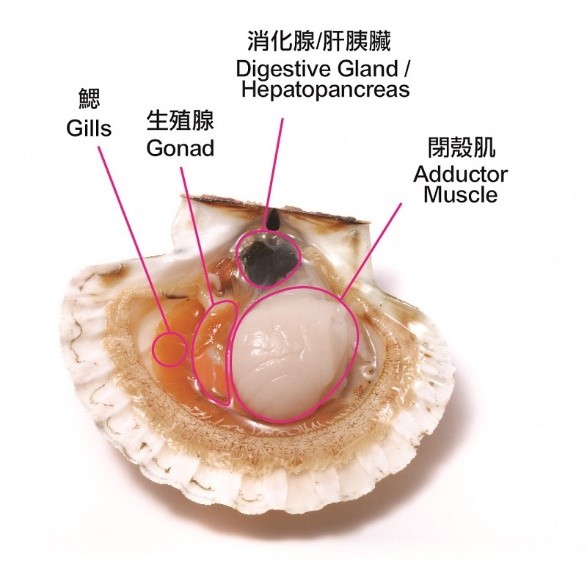
Figure 1: Internal parts of a scallop

Symptoms of Shellfish Poisoning

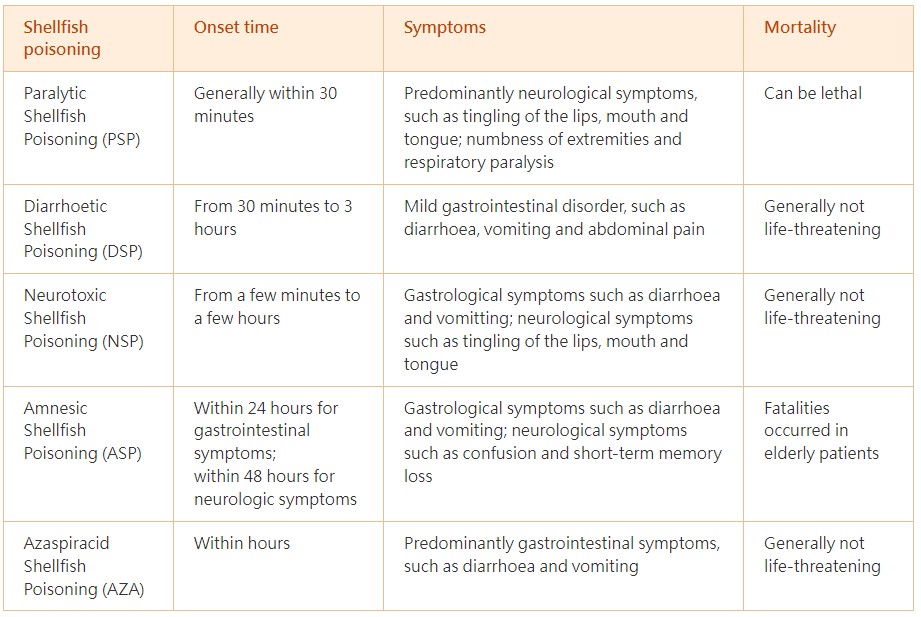
Shellfish toxins can cause a wide variety of symptoms in humans, depending on the type and amount of toxins ingested.  Symptoms of different types of shellfish poisoning are summarised below:
Safety Levels of Shellfish Toxins

The toxicity of various shellfish toxins was evaluated by a joint expert working group of the Food and Agriculture Organization of the United Nations (FAO), the World Health Organization (WHO) and the Intergovernmental Oceanographic Commission of UNESCO in 2004.  Acute reference doses (ARfDs) (i.e. the amount of toxins that can be ingested in a period of 24 hours or less without appreciable health risk) have been established for these shellfish toxins.  In addition, the Codex Alimentarius Commission (Codex) has established the maximum levels (MLs) for shellfish toxins in edible parts (the whole or any part intended to be eaten separately) of live bivalve molluscs.  While the ARfDs are critical in assessing the safety of food in terms of the level of shellfish toxins contained, Codex MLs are the levels recommended by Codex to be permitted in shellfish.
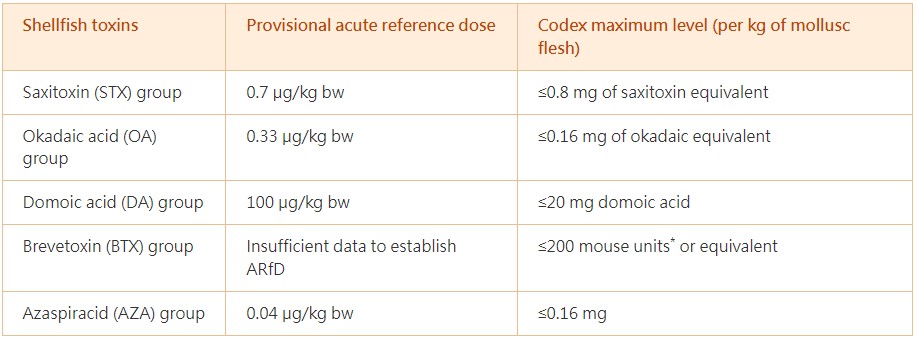
*An estimate of toxicity of the toxin made by mouse bioassay.

Key Points to Note

  • Shellfish toxins are heat stable, odourless, tasteless and not destroyed by cooking, freezing or other food preparation procedures.
  • It is hard to distinguish between toxic and non-toxic shellfish visually.
  • In general, shellfish toxins accumulate and concentrate in the internal organs of bivalves. 

Advice to Consumers 

  • Purchase shellfish from reliable sources.
  • To reduce the health risk of shellfish poisoning, remove and discard all internal organs of shellfish where possible before consumption.
  • Seek medical attention immediately if you feel ill after eating shellfish.

RASFF Alerts – ASP Toxins – Tellins

RASFF

ASP toxins in Tellins from France in Spain

Research – The monitoring program for algal toxins in shellfish 2021

Mattilsynet

In general, less poisonous shells were detected during the covid-19 years 2020 and 2021 than in the three previous years. We cannot determine whether this is due to fewer samples or less blooms of toxic algal plankton.

In 2021, a total of 723 shell samples were taken and analyzed for various toxins; 384 samples from the Norwegian Food Safety Authority’s annual monitoring program (including the Mussel Alert) and 339 samples from the producers’ own control samples. 

The number of samples from the industry was somewhat fewer in 2021 because demand for shells was lower due to covid-19 with closed restaurants and hotels.

On the monitoring of algal toxins in shellfish

The Norwegian coast is monitored throughout the year for marine algal toxins in shells in connection with commercial harvesting and trade in addition to the Mussel Alert.

The shell samples are analyzed for both the fat-soluble toxins DSP (OA group), AZA, YTX and PTX and the water-soluble toxins with the neurotoxin PSP (STX group), and for the amnesia toxin ASP (DA group).

What did we investigate? Mostly mussels, but also some scallops, flat oysters, Pacific oysters, cockles, knife clams, O-clams, carpet clams, sand clams, circle clams, king snails and sea urchins
Time range: 2021
What were we looking for? The algae toxins DSP, YTX, PTX and AZA, PSP and ASP.
What did we find? Around 98 per cent of all submitted mussels were below the limit value for DSP (OA group).

For PSP (STX group) around 95 per cent were below the limit value, while around 99 per cent were below the limit value for ASP.

For the toxin groups YTX, PTX and AZA, all samples were below given limit values.

Mussels: Had the most detections of DSP and PSP above the limit value, but ASP was also detected above the limit value

Scallops : PSP and ASP were detected above the limit value

Flat oysters : PSP was detected above the limit value in Western Norway for a period in April

PSP : As in previous years, was mainly detected in the spring and early summer.

DSP : The detections above the limit value were distributed throughout the year from April to October with a peak in September. This is consistent with previous years where DSP mainly performs in late summer and autumn.

France – Product recall: Medium shells sold at retail – ASP Toxins

Oulah

Product recall: Medium shells sold at retail

ENCOUNTERED PROBLEM

ASP marine biotoxins (amnesia toxins)

PROPOSED SOLUTION

Do not consume and bring back to the point of sale.

Food poisoning caused by these toxins results in digestive disorders (vomiting, abdominal pain, diarrhea) within 2 to 24 hours of ingestion of the contaminated shellfish. These disorders may be followed by feelings of dizziness, persistent headaches, disorientation, and possibly recent memory loss.

FURTHER INFORMATION


▸ Start date / End of marketing
Since 05/11/2021


▸ Health mark
FR.29.158.500.CE


▸ Distributors
CARREFOUR LECLERC POMONA POISSONNERIES – INDEPENDENT MARKETS


▸ Source
FURIC MAREE

Luxembourg – RECALL: MEDIUM SHELLS (CERASTODERMA EDULE) OF THE BRAND THAËRON – ASP Toxins

SAP

Thaëron is recalling the following products:

Last name Medium Cockles (Cerastoderma edule)
Mark Thaeron
Unit 500 g
Bar code 3661737000281
Use by date (DLC) 05/19/21
Lot 13221
Last name Medium Cockles (Cerastoderma edule)
Mark Thaeron
Unit 1000 g
Bar code 3293580000974
Use by date (DLC) 05/19/21
Lot 13221

Danger  : Contains amnesic toxins (ASP)

Consumption of these products can be dangerous for health. The symptoms are: diarrhea, vomiting (within 2 to 24 hours) and neurological symptoms (headache, confusion, disorientation or even amnesia). 

Sale in Luxembourg by: Auchan

A sale by other operators cannot be excluded.

Source of information: Auchan recall notification

Communicated by: Government Commission for Quality, Fraud and Food Safety .

France – Product recall: Thaëron France Pavilion shellfish Thaëron 300g tray -ASP Toxins

Oulah

Product recall: Thaëron France Pavilion shellfish Thaëron 300g tray

ENCOUNTERED PROBLEM

Possible presence of ASP toxins

PROPOSED SOLUTION

Do not consume and return to the point of sale for reimbursement.

These shells come from a fishing area contaminated by a toxin-producing algae. In the event of the appearance of gastrointestinal and / or neurological symptoms, consult your doctor, telling him that you have consumed shellfish contaminated with ASP phycotoxins.

FURTHER INFORMATION

▸ Barcode
3661737004869


▸ Lot
13221


▸ DLC – DDM
05/19/2021


▸ Start date / End of marketing
since 05/13/2021


▸ Health mark
FR 29 236 500 CE


▸ Source
https://www.supercasino.fr/

France – Product recall: Keraliou brand Tellines – ASP Toxins

Oulah

Product recall: Keraliou brand Tellines

ENCOUNTERED PROBLEM

ASP toxin above the authorized threshold. ASP marine biotoxins (amnesia toxins)

PROPOSED SOLUTION

Do not consume and bring back to the point of sale.

Food poisoning caused by these toxins results in digestive disorders (vomiting, abdominal pain, diarrhea) within 2 to 24 hours of ingestion of the contaminated shellfish. These disorders may be followed by feelings of dizziness, persistent headaches, disorientation, and possibly recent memory loss.

FURTHER INFORMATION

▸ Barcode
• 3529960019992
• 3529960015307

▸ Lot
• MB377761
• MB37766
• MB37773TEL

▸ DDM

▸ Packaging
1 and 3 kg bag delivered to distributors. Bulk resold to consumers

▸ Marketing
From 03/29/2021 to 03/31/2021

▸ Health mark
FR 29.189.525 CE

▸ Consumer service contact
0622819352

▸ Source
https://rappel.conso.gouv.fr/

RASFF Alert – Amnesic Shellfish Poisoning (ASP) toxins – Tellins

European Food Alerts

RASFF

withdrawal of live tellins (Donax trunculus) harvested in France because of possible contamination with Amnesic Shellfish Poisoning (ASP) toxins in France