Monthly Archives: March 2020

Research – Bacteria form biofilms like settlers form cities

Science Daily biofilm

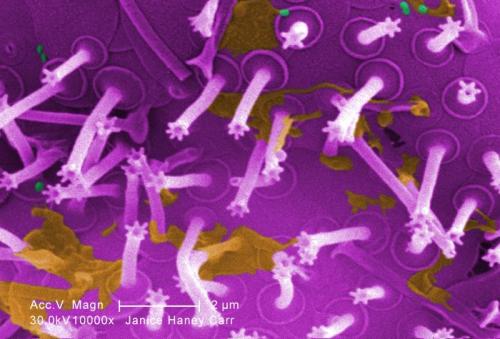
Biofilms are composed of bacteria living in a densely packed and organized community. Research paired high-level imaging tools with an algorithm to track a biofilm as it formed. Biofilm growth at multiple scales, they found, mimics aspects of how cities emerge from individual settlers.

The findings show that, as individual bacteria multiply and grow into a dense and sticky biofilm, such as the community that forms dental plaque, their growth patterns and dynamics mirror those seen in the growth of cities.

“We take this ‘satellite-level’ view, following hundreds of bacteria distributed on a surface from their initial colonization to biofilm formation,” says Hyun (Michel) Koo, a professor in Penn’s School of Dental Medicine and senior author on the work. “And what we see is that, remarkably, the spatial and structural features of their growth are analogous to what we see in urbanization.”

This new perspective on how biofilms grow could help inform efforts to either promote the growth of beneficial microbes or break up and kill undesirable biofilms with therapeutics.

Research – Coronavirus: no evidence that food is a source or transmission route

EFSA

EFSA is closely monitoring the situation regarding the outbreak of coronavirus disease (COVID-19) that is affecting a large number of countries across the globe. There is currently no evidence that food is a likely source or route of transmission of the virus.

EFSA’s chief scientist, Marta Hugas, said: “Experiences from previous outbreaks of related coronaviruses, such as severe acute respiratory syndrome coronavirus (SARS-CoV) and Middle East respiratory syndrome coronavirus (MERS-CoV), show that transmission through food consumption did not occur. At the moment, there is no evidence to suggest that coronavirus is any different in this respect.”

The European Centre for Disease Prevention and Control (ECDC) has said that while animals in China were the likely source of the initial infection, the virus is spreading from person to person – mainly via respiratory droplets that people sneeze, cough, or exhale. More information on coronavirus and food can be found in this FAQ by the BfR, Germany’s risk assessment body.

Scientists and authorities across the world are monitoring the spread of the virus and there have not been any reports of transmission through food. For this reason, EFSA is not currently involved in the response to the COVID-19 outbreaks. However, we are monitoring the scientific literature for new and relevant information.

Research – COVID-19 and the Food Industry

New Food Magazine

While we hear reassurance from food safety bodies such as the European Food Safety Authority (EFSA) that “there is currently no evidence that food is a likely source or route of transmission of COVID-19,” we are all still, surely, feeling a little uncertain. Is our food truly safe? What impact will this unprecedented pandemic have on the food and beverage industry further down the line?

EFSA’s Chief Scientist, Marta Hugas, said that “experiences from previous outbreaks of related coronaviruses, such as severe acute respiratory syndrome coronavirus (SARS-CoV) and Middle East respiratory syndrome coronavirus (MERS-CoV), show that transmission through food consumption did not occur” and that we – industry and consumer alike – can be confident that this translates to COVID-19.

Research – Thermal Resistance of Foodborne Pathogens and Enterococcus faecium NRRL B-2354 on Inoculated Pistachios

JFP

Process control validations require knowledge of the resistance of the pathogen(s) of concern to the target treatment, and, in some cases, the relative resistance of surrogate organisms. Selected strains of Escherichia coli O157:H7 (five strains), Listeria monocytogenes (five strains), and Salmonella enterica (five strains) as well as Salmonella Enteritidis phage type (PT) 30 and nonpathogenic Enterococcus faecium NRRL B-2354 were inoculated separately (as individual strains) onto inshell pistachios. The thermal tolerance of each strain was compared via treatment of inoculated pistachios to hot oil (121°C) or hot water (80°C) for 1 min. Survivor curves in hot oil or hot water (0.5 to 6 min, n = 6 to 15) were determined for one or two of the most resistant strains of each pathogen, as well as E. faecium NRRL B-2354 and Salmonella Enteritidis PT 30, and the Weibull model was fit to the data. A pilot-scale air-impingement oven was used to compare the thermal tolerance of E. faecium NRRL B-2354 and Salmonella Enteritidis PT 30 on pistachios with or without a brining pretreatment and at either dry (no steam) or 30% humidity (v/v) oven conditions. No significant difference in the time to a 4-log reduction in hot oil or hot water was predicted for any of the strains evaluated, on the basis of the 95% confidence interval. In the pilot-scale oven, E. faecium NRRL B-2354 was more thermally resistant than Salmonella in a broad set of differing treatments, treatment times, and temperatures. Salmonella is a suitable target pathogen of concern in pistachios for thermal processes because no other pathogen tested was more thermally resistant under the conditions evaluated. E. faecium NRRL B-2354 was at least as thermally resistant as Salmonella under all conditions evaluated, making it a good potential surrogate for Salmonella on pistachios.

Research – Occurrence and characteristics of Listeria monocytogenes in ready-to-eat meat products in Poland

JFP

Listeria monocytogenes is a potential hazard for food safety and therefore public health. The aim of the present study was to determine the prevalence and characteristics of L. monocytogenes in Polish ready-to-eat (RTE) meat products in retail. Among the 184 439 food samples collected within the framework of national official control and monitoring program only 0.3% were  positive for L. monocytogenes. A significant group of products that did not meet the criteria were RTE meat products. This group accounted for 40% of all non compliant samples. A total of 70 L. monocytogenes isolates from RTE meat products (meat, sausages and delicatessen products with meat) were examined. The majority of the tested isolates (51%) belonged to serogroup 1/2a-3a, followed by 1/2c-3c (21%), 1/2b-3b-7 (14%) and 4ab-4b-4d-4e (13%). Serogroup 4a-4c was not present among the tested isolates. All L. monocytogenes isolates harbored the virulence-associated genes inlA, inlC, inlJ and lmo2672 . The llsX marker was detected in twelve of 70 (17%) isolates. Ampicillin resistance was the most common resistance phenotype and was identified in 83% of L. monocytogenes isolates. A low incidence of resistance to amoxicillin/clavunate acid (6% isolates)  was also detected. All L. monocytogenes isolates were susceptible to chloramphenicol, gentamicin, ciprofloxacin, meropenem, sulfamethoxazole-trimethoprim, tetracycline and erythromycin. This work provides useful information regarding contamination of RTE meat products with L. monocytogenes, which may have implications for food safety risk.

Research – Researchers turn to air sampling to detect Campylobacter in chicken flocks

Food Safety News


A project led by the National Food Institute, Technical University of Denmark, has developed a test method to improve the likelihood of identifying Campylobacter-positive chicken flocks.

Being able to identify Campylobacter-positive flocks before they arrive at the slaughterhouse allows them to be slaughtered after the negative flocks to avoid cross-contamination along the production line.

The method was worked on in the EU project, AIR-SAMPLE, which began in January 2018 and runs until June 2020. Other partners are the Istituto Zooprofilattico Sperimentale dell’Abruzzo e del Molise “Giuseppe Caporale” in Italy, Veterinary Research Institute in the Czech Republic, National Veterinary Research Institute in Poland and Norwegian Veterinary Institute.

The aim was to develop and validate air sampling as a low-cost and multi-purpose alternative to fecal droppings or boot swabs for surveillance, monitoring and eradication of Campylobacter in confined and biosecured broiler production operations.

Philippines – 2 dead from food poisoning in Negros

Tempo

BACOLOD CITY – Two members of a family died while three others were hospitalized due to food poisoning in Hinoba-an, Negros Occidental Tuesday.

Fatalities were brothers aged seven and eight.

Police Major Clifford Batadhay, town police chief, said the children’s father gathered crabs locally known as “kumong-kumong” or “krukudlong” here Monday. The following day, they cooked it and ate it for breakfast.

USA – Clover Sprouts E. coli O103 Outbreak Updated: 39 Sick, 2 Hospitalized

Food Poisoning Bulletin

The Centers for Disease Control and Prevention (CDC) has updated the clover sprouts E. coli O103 outbreak that is associated with Jimmy John’s restaurants and Chicago Indoor Garden raw clover sprouts. Since the last update on February 26, 2020, 25 more patients who live in two states have been identified. Twenty-four of the new patients live in Utah, and Florida has been added to the state count.

Australia – Salmonella – Salad Products

FSANZ

Quality Produce International Loose Leaf Lettuce Company Lettuce Products 

​20 March 2020

Product information

Quality Produce International is conducting a recall of Asian Vegetable Mix 500g, Lettuce Mizuna 500g, Prepack Asian Mix 200g, Special Mix 1kg, Special Mix 200g, Swiss Chard 500g, Tatsoi Baby 500g Loose Leaf Lettuce Company products. The products have been available for sale at various IGA stores and independent retailers in WA.

Date markings

All Best Before 21/03/20 – 28/03/20

Problem

The recall is due to microbial (Salmonella) contamination.

Food safety hazard

Food products contaminated with Salmonella may cause illness if consumed.

Country of origin

Australia

What to do​

Any consumers concerned about their health should seek medical advice and should return the products to the place of purchase for a full refund.

For further information please contact:

Quality Produce International

08 9455 2777

mail@qualityproduce.com.au

Australia – Salmonella – Salad Products

FSANZ

Foodies Choice Gourmet Greek Salad with Quinoa + Kale

​Date published: 20 March 2020

Product information

Fresh Frontier is conducting a recall of Foodies Choice Gourmet Greek Salad with Quinoa + Kale. The product has been available for sale at IGA, Farmer Jacks, Gilberts Fresh, Rawsters, and SUPA IGA in Western Australia.

Date markings

USE BY 23/3/2020, 24/3/2020, 25/3/2020

Fresh Frontier Gourmet Greek Salad

Problem

The recall is due to microbial (Salmonella) contamination.

Food safety hazard

Food products contaminated with Salmonella may cause illness if consumed.

Country of origin

Australia

What to do​

Any consumers concerned about their health should seek medical advice and should return the product to the place of purchase for a full refund.

For further information please contact:

Fresh Frontier
08 6162 9958
www.freshfrontier.com.au