Monthly Archives: January 2020

RASFF Alerts – Norovirus – Foodborne Outbreak – Live Oysters –

RASFF-Logo

RASFF – foodborne outbreak suspected to be caused by live oysters (Crassostrea gigas) from France

RASFF – foodborne outbreak suspected to be caused by live oysters (Crassostrea gigas) from France

RASFF – foodborne outbreak caused by live oysters from France, via the Netherlands in Sweden

RASFF – norovirus in live mussels from France in Switzerland

RASFF – norovirus in live bouchot mussels from France in the Netherlands

RASFF – norovirus in oysters from France in the Netherlands

RASFF – withdrawal of bivalve molluscs harvested in France because of possible contamination with norovirus in Luxembourg

RASFF Alert – Listeria monocytogenes – Chilled Duck Liver Mousse and Pork and Chicken Mousse

RASFF-Logo

RASFF – Listeria monocytogenes in chilled duck liver mousse and pork and chicken liver mousse with ceps and black mushrooms from France

RASFF Alerts – Animal Feed – Salmonella – Sunflower Seed Pellets – Soy Pellets – Fish Meal

RASFF-Logo

RASFF – Salmonella enterica ser. Senftenberg (presence /25g) in sunflower seed pellets from Ukraine, via the Netherlands in Belgium

RASFF – Salmonella enterica ser. Senftenberg (present /25g) in soy pellets from Italy in Belgium

RASFF – Salmonella enterica ser. Ohio (presence /25g) in fish meal from Denmark in Belgium

India – Food poisoning leaves 2 dead, 22 in hospital

Times of India

KANNUR: Two inmates how now  died and 22 others have been hospitalised following food poisoning at a destitute home near Oduvally. The inmates suffered food poisoning apparently after they consumed ghee rice, chicken curry and salad.


France – Hundreds ill in France after eating contaminated raw shellfish – Noroviurs?

Food Safety News

More than 650 people have fallen ill in France this past month after eating contaminated raw shellfish.

Since the start of December 2019, Santé publique France has received 123 reports of collective food poisoning suspected to be linked to consumption of raw shellfish, mainly oysters.

The majority, 87 of the 123 alerts, occurred from Dec. 23, 2019, and forward. A peak of illnesses hit from December 25 to 27.

A total of 668 people were sick and 17 needed hospital treatment. Most are more than 15 years old. Of the 415 patients with age information available, 15 were younger than 15.

Much higher than recent years
Symptoms, mainly diarrhea and vomiting, as well as incubation times, are consistent with norovirus or other enteric virus infections. Stool tests have confirmed the presence of these viruses. Symptoms of norovirus appear one to two days after being infected and typically last for two or three days.

USA – Fresh Location Announces Product Recall Due to Possible Listeria Contamination

FDA

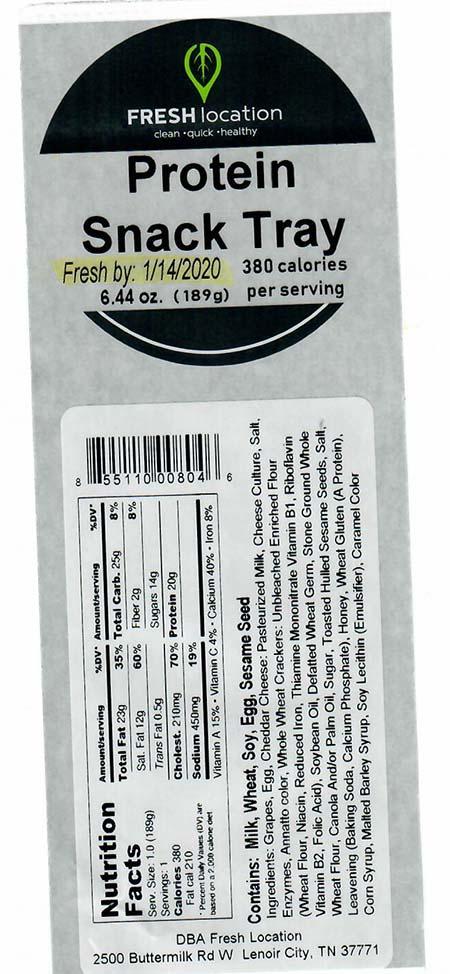
Fresh Location, of Lenoir City, Tennessee is recalling:

  • Protein Snack Tray 6.44 oz total weight packaged in a 4-compartment plastic tray with UPC: 8-5511000804-6 and with Fresh by lot dates of: 12/21/19, 12/22/19, 12/24/19, 12/27/19, 12/28/19, 12/29/19, 12/31/19, 01/03/20, 01/04/20
  • Protein Trail Mix 3.52 oz total weight packaged in a 10.5 ounce plastic cup with UPC: 8-5511000813-8 and with Fresh by lot dates of: 12/23/19, 12/24/19, 12/26/19, 12/29/19, 12/30/19, 12/31/19, 01/02/20, 01/05/20, 01/06/20

Due to possible contamination of Listeria monocytogenes, an organism which can cause serious and sometimes fatal infections in young children, frail or elderly people, and others with weakened immune systems.

Almark Foods which manufactures the Hard-Boiled at the Gainesville facility may be associated with a Listeria monocytogenes outbreak that has been linked to several reported illnesses and one reported death.

Affected product could have been delivered in the following states through convenience stores, micro markets, hospitals, hotels and vending machines: Illinois, Missouri, Tennessee, Georgia, South Carolina, North Carolina, Kentucky, Virginia, Indiana, and Mississippi.

Label, Fresh Location Protein Snack Tray

Europe – Officials raise concerns over safety of Polish poultry products – Salmonella

Wattagnet

An increasing number of food safety alerts linked to Salmonella in poultry have been issued in Poland, according to the report. This has led to the establishment of official sampling procedures in poultry slaughterhouses. The auditors noted that these systems have been revealing higher rates of Salmonella detection than the companies’ own checking systems.


Bulgaria – Chicken meat infected with Salmonella from Poland

Poultry Med

At least 100 tons of chicken infected with salmonella has reached the Bulgarian market. Some of the meat, imported from Poland, has been seized and so far there are no reporters of consumers infected with salmonella. Poland is the major producer of poultry meat in the European Union. the majority of poultry meat exports are directed to the internal EU market.
This is not the first time that poultry products imported from Poland are contaminated with Salmonella. Salmonella has been detected in 16 tons of poultry imported to the Czech Republic from Poland in April-May 2019.
In 2018 The EU has reported  almost 1,500 people sickened by Salmonella linked to Polish eggs in an outbreak that has lasted more than six years and affected 18 countries.

Australia – Food safety in an emergency

FSANZ

food safety in an emergency infographic. for a more detailed explaination email information@foodstandards.gov.au


Australia -Food safety advice for bush fires and power outages

Food Safety Council

The Food Safety Information Council today issued food safety advice for consumers about bush fires and power outages.

‘Here are some key food safety points after a fire:

  • throw out any food that has been near a fire, including food in cans and jars even if it appears ok
  • any raw food, or food in packaging such as cardboard, plastic wrap, screw-topped jars and bottles should also be thrown out
  • throw out food from a refrigerator as the refrigerator seal isn’t airtight, fumes can get inside
  • wash cooking utensils exposed to fire-fighting chemicals in soapy hot water, then sanitise in 1 tablespoon of chlorine bleach per 2 litres of water and rinse.
  • When you dispose of food, wrap it in newspaper and place in the rubbish bin. A small volume of food may be safely buried.
  • Where larger quantities have to be disposed of your local government’s environmental health officer should be contacted. Without correct disposal, fly breeding, animal and pest scavenging may result and increase the risk of the spread of infectious diseases.

‘If your power has gone out your food will remain safe in your refrigerator for 2 hours. If it has been more than 4 hours, throw the food out. Don’t open the fridge door during the power cut, unless necessary. The best option is to keep the refrigerated foods as cold as possible by not opening the door unless necessary to remove food to eat or check the temperature after 2 hours. or place items in the freezer. If this is not possible:

  • Remove ice bricks from the freezer and place in an esky.
  • Remove all meats, poultry, dairy and potentially hazardous food (for example dips, pâté, ham, prepared and cooked food) from the refrigerator and place in an cooler with frozen bricks or gel packs.
  • Salted butter, margarine and hard cheeses will remain safe at room temperature.
  • Place the ice or ice bricks throughout the stored food to ensure an even temperature. Make sure the lid of the cooler has a good seal.
  • If the temperature of the food stored in an cooler or refrigerator reaches more than 5 °C for less than 2 hours you should find alternative refrigeration at less than 5 °C or, if possible, freeze or use immediately.
  • Food stored in a refrigerator or esky at more than 5 °C for 4 hours or more should be thrown out.
  • Freezers that are in good condition and operate at minus 15 °C or below can keep foods at safe temperatures for between 1 and 2 days. If the freezer door is kept shut, a full freezer can keep food chilled for up to 48 hours, while a half full freezer can be kept food chilled for 24 hours.
  • It is important that the doors of freezers are not opened unless necessary. Opening and closing the doors will reduce the time the contents will remain at safe temperatures.
  • Foods that have partly defrosted or defrosted but remain very cold (5 °C or less) can be refrozen.  Remember that some food types, for example ice cream which will thaw other foods defrost. Although there is no safety issue, some foods become icy or their texture will be damaged when refrozen and may not be usable after defrosting and refreezing.
  • If your food has been in a freezer where the temperature has reached more than 5 °C for more than 2 hours, but less than 4 hours, it should be consumed immediately.
  • Food stored in a freezer for more than 4 hours at more than 5 °C should be thrown out.

‘Also remember to throw out food that was being cooked when the power failed if cooking cannot be completed properly within 2 hours. If food is already properly cooked, eat it within 2 hours or throw it out,’ Ms Buchtmann concluded

Media contact Lydia Buchtmann 0407626688