Category Archives: Yersinia

Sweden – Yersinia (Sweden, January 2021–) – Increase in cases of yersinia infection.

Folkhalsomyndigheten#

kswfoodworld.com

Since the second week of January, more than twice as many people have contracted yersinia infection as during the same period in the immediately preceding years. An increased number of patients has mainly been observed in the regions of Stockholm, Västra Götaland and Halland, which together account for 33 of the total of 48 disease cases reported since 11 January. Of the patients, a majority are aged 11-40 and most are women (figure). In the ongoing investigation, the Swedish Public Health Agency collaborates with the infection control units in the affected regions to try to identify the source of the infection through interviews of the cases and surveys.

As part of the outbreak investigation, the Swedish Public Health Agency also collects yersinia isolates from disease cases in the affected regions. The isolates are typed using whole genome sequencing (analysis of the genome of the bacterium) to clarify who has been affected by a common source of infection.

Figure. Distribution by age and sex of persons reported to be infected with yersinia infection 11 January – 2 February 2021.
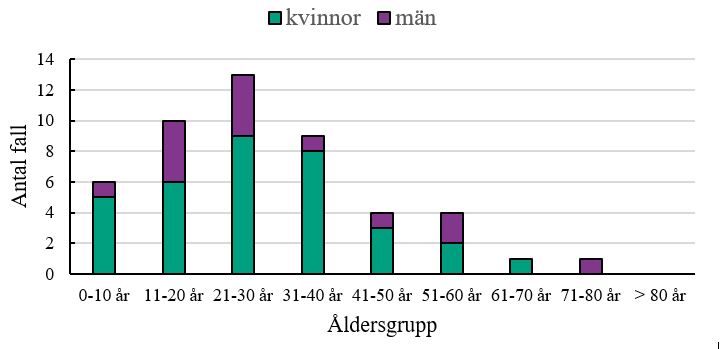
Figure.  Distribution by age and sex of persons reported to be infected with yersinia infection 11 January – 2 February 2021.
New Zealand – Yersiniosis in New Zealand

MDPI

The rate of yersiniosis in New Zealand (NZ) is high compared with other developed countries, and rates have been increasing over recent years. Typically, >99% of human cases in NZ are attributed to Yersinia enterocolitica (YE), although in 2014, a large outbreak of 220 cases was caused by Yersinia pseudotuberculosis. Up until 2012, the most common NZ strain was YE biotype 4. The emergent strain since this time is YE biotype 2/3 serotype O:9. The pathogenic potential of some YE biotypes remains unclear. Most human cases of yersiniosis are considered sporadic without an identifiable source. Key restrictions in previous investigations included insufficient sensitivity for the isolation of Yersinia spp. from foods, although foodborne transmission is the most likely route of infection. In NZ, YE has been isolated from a variety of sick and healthy domestic and farm animals but the pathways from zoonotic reservoir to human remain unproven. Whole-genome sequencing provides unprecedented discriminatory power for typing Yersinia and is now being applied to NZ epidemiological investigations. A “One-Health” approach is necessary to elucidate the routes of transmission of Yersinia and consequently inform targeted interventions for the prevention and management of yersiniosis in NZ View Full-Text

Sweden – Sweden reports increase in Yersinia cases

Outbreak News Today

Yersinia p

The Swedish Public Health Agency, or Folkhälsomyndigheten reports an increase in cases of Yersinia infections since the second week of January, according to a February 3 release.

They say more than twice as many people have contracted Yersinia infection as during the same period in the immediately preceding years.

An increased number of patients has mainly been observed in the regions of Stockholm, Västra Götaland and Halland, which together account for 33 of the total of 48 disease cases reported since 11 January.

Europe – Yersiniosis – Annual Epidemiological Report for 2019

ECDC

Yersinia p

For 2019, 29 countries reported 7 048 confirmed yersiniosis cases in the EU/EEA. The overall notification rate of 1.7 per 100 000 population remained stable from 2015 to 2019. The highest rates were reported by Finland, Lithuania and Czechia. The highest rate was detected in 0–4 year-old children, with 7.2 per 100 000 population for males and
5.9 per 100 000 population for females.

Download

Research – Impact of a Combination of UV-C Irradiation and Peracetic Acid Spray Treatment on Brochothrix thermosphacta and Yersinia enterocolitica Contaminated Pork

MDPI

Efficient ways of decontamination are needed to minimize the risk of infections with Yersinia (Y.) enterocolitica, which causes gastrointestinal diseases in humans, and to reduce the numbers of Brochothrix (B.) thermosphacta to extend the shelf-life of meat. While many studies have focused on a single treatment of peracetic acid (PAA) or UV-C-irradiation, there are no studies about a combined treatment on meat. Therefore, in the present study, pork was inoculated with either Y. enterocolitica or B. thermosphacta, and was treated with a combination of 2040 mJ/cm2 UV-C irradiation followed by a 2000 ppm PAA spray treatment (30 s). Samples were packed under modified atmosphere and stored for 1, 7, or 14 days. The samples were examined for Y. enterocolitica and B. thermosphacta content, chemical and sensory effects, and meat quality parameters. For Y. enterocolitica, a significant reduction of up to 2.16 log10 cfu/cm2 meat and for B. thermosphacta, up to 2.37 log10 cfu/cm2 meat was seen on day 14 after UV-C/PAA treatment compared to the untreated controls.

Norway – Yersinia outbreak in Norway linked to salad

Food Safety News

Yersinia p

A Yersinia outbreak in Norway has been solved and declared over just days after it was announced.

Folkehelseinstituttet (the Norwegian Institute of Public Health) said the national outbreak of Yersinia enterocolitica O3 was likely caused by a pre-mixed salad product.

Less than a week earlier, the agency had announced an investigation into a recent rise in Yersinia infections.

The outbreak started in mid-November and involved 10 confirmed patients. All of them are women aged 11 to 59 years old who became ill in mid to late November with the last case on Nov. 26. Three people live in Viken, two each in Oslo, Innlandet, and Vestland, and one in Telemark and Vestfold.

Norway – Yersinia enterocolitica outbreak reported in Norway

Outbreak News Today

Yersinia p

The Norwegian Institute of Public Health has discovered an increased incidence of the gastrointestinal bacterium Yersinia enterocolitica O3. So far, infection has been detected in 10 people who live in several counties. Outbreak investigation has been initiated in collaboration with relevant municipal chief physicians, the Veterinary Institute and the Norwegian Food Safety Authority.

The National Institute of Public Health collaborates with the municipal health service, the Norwegian Food Safety Authority and the Norwegian Veterinary Institute to map whether patients can have a common source of infection. The patients are interviewed and the local Norwegian Food Safety Authority takes samples from food products in the homes of those who are infected, if residues are available, in order to identify the source of the outbreak if possible.

Norway – Yersinia enterocolitica outbreak linked to pre-washed spinach product

Outbreak News Today 

In a follow-up on the Yersinia enterocolitica O3 outbreak that started in mid-May in Norway, health officials are now saying based on an analysis of patient interviews and purchase information show that 22 of 23 cases (96%) state that they have eaten a pre-washed spinach product the week prior to illness. In one case, it has not been possible to conduct an interview.

Finland – Decline in foodborne outbreaks likely due to COVID-19 measures

Food Safety News

More than four times fewer suspected food and waterborne epidemics have been reported in Finland in the past few months.

Between March and May, four suspected foodborne outbreaks were reported, compared with an average of 18 in previous years, according to the Finnish Institute for Health and Welfare (THL).

The agency believes this is because of the coronavirus pandemic and associated limitations and recommendations. When hands are washed diligently and food is prepared for smaller groups, there are fewer epidemics, the THL reported.

Suspected pathogens in the four outbreaks are Campylobacter, Yersinia, and norovirus.


Norway – Norway investigates source of Yersinia increase

Food Safety News

kswfoodworld.com

Image CDC

Officials in Norway are investigating an increase in Yersinia infections in the past month.

The Norwegian Institute of Public Health (Folkehelseinstituttet) reported a Yersinia enterocolitica O3 infection has been detected in 13 people living in several counties.

Outbreak investigations to find the source of infection have been started with local authorities, the Veterinary Institute and Norwegian Food Safety Authority (Mattilsynet).

Patients are between 2 and 57 years old and most are women. They live in Agder, Oslo, Rogaland and Trøndelag.

Bacteria with similar DNA profiles have been found in all 13 people and samples were taken during the last two weeks of May and first week of June.