Category Archives: WGS

Research – A cross-border outbreak of Salmonella Bareilly cases confirmed by whole genome sequencing, Czech Republic and Slovakia, 2017 to 2018

Eurosurveillance

spp. are the third most common cause of bacterial food-borne illnesses worldwide and the second most commonly reported zoonotic agents in the European Union (EU). The bacterial genus  consists of  and  species. More than 2,500 serotypes of  have been identified so far , many of them commonly infecting animals (e.g. poultry, pigs, cattle) and humans. The distribution of predominant serovars in each country are affected by changes in the global food and livestock trade, international travel, and human migration.

 subsp.  serovar Bareilly ( Bareilly) belongs to the C1 serogroup (antigenic formula 6, 7, 14: y: 1,5) and was first identified in India in 1928. In the United Kingdom (UK), 31% of all  Bareilly human cases identified between 2005 and 2009 were attributed to travel from India. Since 2004,  Bareilly has most commonly been isolated from spices. Contaminated mung bean seeds were the likely source of a  Bareilly outbreak in the UK in 2010, with total of 231 cases. In an outbreak of salmonellosis in the United States, which comprised 410 cases of  Bareilly across 28 states and the District of Columbia, tuna scrape imported from India was identified to be the source using whole genome sequencing (WGS)-based methods.

Since 2016,  Bareilly has been among the top 20  serotypes associated with human diseases in the European Union/European Economic Area (EU/EEA) . Between 2006 and 2016,  Bareilly was among the top 25 serotypes detected in humans in the Czech Republic, with the annual incidence ranging from 0.04 to 0.23 per 100,000 inhabitants (data from the Czech national electronic communicable diseases notification system). According to data from the Czech national control programme for  in poultry,  Bareilly was identified in broiler flocks with a prevalence of up to 0.06%.

Salmonellosis has been a mandatory notifiable disease in both the Czech Republic and Slovakia since 1951. Regional public health officers notify case-based data to the national electronic communicable diseases notification system (EpiDat/ISIN in the Czech Republic and the Epidemic Intelligence Information System (EPIS) in Slovakia). Both systems record data on all cases that meet the definition of a confirmed case in accordance with the European Commission Implementing Decision 2119/98/EC. The information on  serovar, which is provided by routine microbiological laboratories handling human samples, is included in the reporting systems. These laboratories typically test for a limited spectrum of serovars only, and  Bareilly is usually not included. The Czech and Slovak National Reference Laboratories (NRLs) (the Czech NRL is a part of the National Institute of Public Health in Prague, the Slovak NRL is part of the Public Health Authority in Bratislava) provide serotyping of less common serovars and confirm results from routine microbiological laboratories on request.

There are several options to confirm the relatedness of  isolates in laboratories. Macro-restriction analysis followed by pulsed-field gel electrophoresis (PFGE) is usually a suitable method for the detection and investigation of  outbreaks. However, in some cases, it does not provide sufficient discriminatory power to distinguish outbreak isolates. Therefore, WGS-based typing methods are now increasingly applied as molecular epidemiology tools to assist in outbreak investigations.
Investigation – Foodborne outbreak in British Columbia related to raw milk Gouda-like products, 2018

Gov

Abstract

Background: In 2018, a Shiga toxin-producing Escherichia coli O121 outbreak that affected seven individuals was associated with raw milk Gouda-like cheese produced in British Columbia, Canada.

Objectives: To describe the Ecoli O121 outbreak investigation and recommend greater control measures for raw milk Gouda-like cheese.

Methods: Cases of Ecoli O121 were identified through laboratory testing results and epidemiologic surveillance data. The cases were interviewed on exposures of interest, which were analyzed against Foodbook Report values for British Columbia. Environmental inspection of the dairy plant and the cheese products was conducted to ascertain a source of contamination. Whole genome multi-locus sequence typing (wgMLST) was performed on all positive Ecoli O121 clinical and food isolates at the provincial laboratory.

Results: Four out of the seven cases consumed the same raw milk Gouda-like cheese between August and October 2018. The implicated cheese was aged longer than the required minimum of 60 days, and no production deficiencies were noted. One sample of the implicated cheese tested positive for Ecoli O121. The seven clinical isolates and one cheese isolate matched by wgMLST within 6.5 alleles.

Conclusion: Raw milk Gouda and Gouda-like cheese has been implicated in three previous Shiga toxin-producing E. coli outbreaks in North America. It was recommended product labelling to increase consumer awareness and thermization of milk to decrease the risk of illness associated with raw milk Gouda and Gouda-like cheese.

Introduction

Shiga toxin-producing Escherichia coli (STEC) is a major cause of foodborne illness in North America. STEC infections cause diarrheal illness and may lead to severe complications, such as hemolytic uremic syndrome, and death. The incidence rate of O157 STEC illness has been decreasing, whereas the rate of non-O157 STEC, including O121, has been increasing in many countries, likely due to changes in laboratory methods of detection. Outbreaks of STECO121 have been associated with raw flour, fresh or frozen produce, dairy and beef products 

The risk of STEC due to unpasteurized dairy products has been previously described . Between 2002 and 2013, three Ecoli O157 outbreaks associated with raw milk Gouda cheeses aged for at least 60 days were reported in North America, including one associated with a British Columbia (BC) dairy plant. Following each outbreak, public health professionals recommended strengthening control measures to decrease the risk associated with raw milk Gouda cheeses . None of these changes had been implemented in Canada by 2018.

In November 2018, another STEC outbreak associated with a raw milk Gouda-like cheese occurred in BC (population: 5.1 million).

The objective of this article is to describe the outbreak investigation and findings and reiterate the need for greater control measures related to raw milk Gouda-like cheese.

UK – An outbreak of human listeriosis associated with frozen sweet corn consumption: Investigations in the UK

Science Direct

The use of Whole genome sequencing (WGS) identified a multi-country outbreak of human listeriosis associated with consumption of frozen sweet corn produced in Hungary. The purpose of this report was to summarise information on the cases occurring in the UK which were part of this outbreak and outline investigations on the presence of Listeria monocytogenes in the affected food chain.

Prior to the international recall of this product in 2018, 12 UK cases of listeriosis were identified as infected by the outbreak strain between 2015 and 18. Epidemiological and microbiological investigations confirmed these cases as belonging to the outbreak. A further case occurred in 2019 and a contaminated frozen pack from one of the implicated batches of sweet corn was recovered from the patient’s domestic freezer.

The outbreak strain was also detected in products from a sandwich manufacturer in 2018 which added frozen sweet corn directly to sandwich fillings. The sandwich manufacturer’s sweet corn was supplied by a distributor in England which obtained frozen products from the Hungarian manufacturer implicated in the outbreak. Within the distributor’s premises, 208 food and environmental samples were taken: L. monocytogenes was detected in 44% of 70 samples of frozen sweet corn and 5% of 79 other foods.

The outbreak strain was detected in the frozen sweet corn, in one other frozen food (mixed vegetables) and in the factory environment. The outbreak strain was also recovered from frozen beans on retail sale in the first four months of 2019. Five other L. monocytogenes strains together with two other Listeria species were detected in samples from the importer’s premises. One of the L. monocytogenes strains in the importer’s factory, which was distinct from the outbreak strain, was also recovered from sweet corn collected from the sandwich manufacturer, sweet corn tested in England in 2013 and 2016 and the blood of two cases of human listeriosis which occurred in England in 2014. This report shows how analysis by WGS provides evidence to understand complex food chains.

This report also highlights risks for transmission of human listeriosis from frozen sweet corn and the potential for misuse of this food as a ready-to-eat product.

Research – Scotland – WHOLE GENOME SEQUENCE TYPING AND ANALYSIS OF NON-O157 STEC

Click to access WGS_Typing_and_Analysis_of_Non-O157_STEC_-_Jan_2020_v3.pdf

Europe – Multi-country cluster of Listeria monocytogenes ST1247 in five EU countries

ECDC

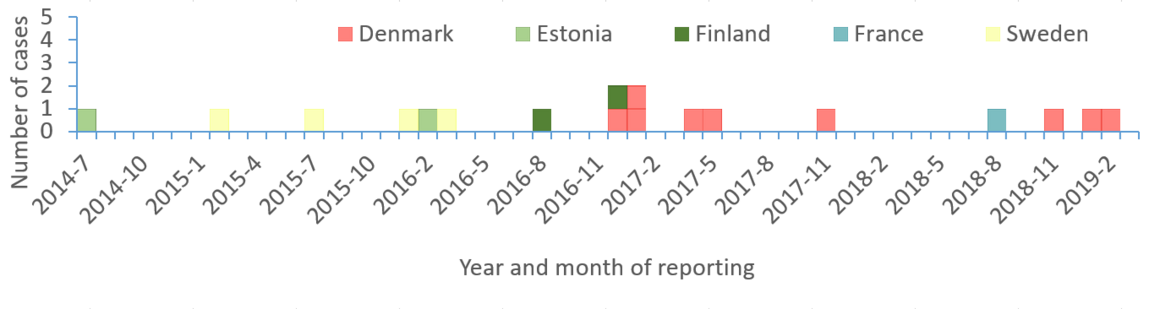
ECDC has identified a microbiological link between an outbreak of nine Listeria monocytogenes ST1247 cases in Denmark and nine additional cases reported between 2014 and 2018 in Estonia (2 cases) Finland (2), France (1) and Sweden (4).  In Denmark, the outbreak investigation is led by Statens Serum Institut (SSI), the Danish Veterinary and Food Administration and the DTU Food Institute.

Whole Genome Sequencing (WGS) analysis performed at the national level and by ECDC found all isolates from the 18 cases within two allelic differences from each other (core genome MLST using Moura scheme, 1540 of 1748 loci detected in all 18 isolates). The latest case was reported in Denmark in February 2019 (Figure 1).

Figure 1: Distribution of Listeria monocytogenes isolates by country and time of reporting 2014-2019 (n=18)

Figure 1: Distribution of Listeria monocytogenes isolates by country and time of reporting 2014-2019 (n=18)

A large-scale study led by ECDC on whole genome sequencing shows that most listeria outbreaks such as this one remain undetected. The study, published in 2018, suggests that more than half of the severe listeriosis cases in the European Union belong to clusters, many of which are not being picked up fast enough by the current surveillance system.

Listeria monocytogenes causes listeriosis, which primarily affects pregnant women, newborns, and adults with a weakened immune system. Listeriosis is a relatively rare but potentially severe food-borne disease that has been reported in increasing numbers in the EU/EEA countries since 2008. In 2016, 2 536 cases were reported, including 247 deaths.


USA – Whole Genome Sequencing Solves Cake Mix Salmonella Outbreak

Food Poisoning Bulletin

For the first time, whole genome sequencing solved a Salmonella outbreak associated with cake mix, according to a study published in the Center For Disease Control and Prevention’s Weekly Morbidity and Mortality Report. This cake mix Salmonella outbreak was associated with Duncan Hines products.

Whole Genome Sequencing Solves Cake Mix Salmonella Outbreak

Research – Changes detected in the genome sequences of Escherichia coli, Listeria monocytogenes, Vibrio parahaemolyticus, and Salmonella enterica after serial subculturing

Canadian Science Publishing

Whole genome sequencing (WGS) is rapidly replacing other molecular techniques for identifying and subtyping bacterial isolates. The resolution or discrimination offered by WGS is significantly higher than that offered by other molecular techniques, and WGS readily allows infrequent differences that occur between 2 closely related strains to be found. In this investigation, WGS was used to identify the changes that occurred in the genomes of 13 strains of bacterial foodborne pathogens after 100 serial subcultures. Pure cultures of Shiga-toxin-producing Escherichia coliSalmonella entericaListeria monocytogenes, and Vibrio parahaemolyticus were subcultured daily for 100 successive days. The 1st and 100th subcultures were whole-genome sequenced using short-read sequencing. Single nucleotide polymorphisms (SNPs) were identified between the 1st and final culture using 2 different approaches, and multilocus sequence typing of the whole genome was also performed to detect any changes at the allelic level. The number of observed genomic changes varied by strain, species, and the SNP caller used. This study provides insight into the genomic variation that can be detected using next-generation sequencing and analysis methods after repeated subculturing of 4 important bacterial pathogens.

Denmark -WGS project helps Denmark uncover Campylobacter outbreak

Food Safety News

Fifty people are ill in Denmark from Campylobacter after eating chicken meat but authorities believe the actual number of patients may be much higher.

Statens Serum Institut (SSI), Danish Veterinary and Food Administration (Fødevarestyrelsen) and DTU Food – National Food Institute are investigating the Campylobacter jejuni outbreak.

Campylobacter is the main cause of bacterial intestinal infections in Denmark and more than 4,500 cases were registered in 2018.

The same type of Campylobacter, sequence type 122, identified in patients by whole genome sequencing has also been found in chicken meat from one slaughterhouse, named as HKScan in Vinderup, a town in Northwestern Jutland.

Research -ECDC strategic framework for the integration of molecular and genomic typing into European surveillance and multi-country outbreak investigations

ECDC ecdclogo

Executive summary

This report summarises the progress made in the areas of EU-wide enhanced molecular typing for disease surveillance, genomic surveillance, and multi-country outbreak support. It also documents how Member States use Whole Genome Sequencing (WGS) in public health operations and reviews the current evidence for the effectiveness of WGS.

The proposed strategic framework sets out a revised list of priority pathogens/diseases for medium-term integration in 2019–2021. Over this period, ECDC proposes to prepare for and/or implement support to multi-country outbreak investigations, continuous EU surveillance, and sentinel surveillance. Depending on preparedness for reporting of high-quality sequence data, the following applications and pathogens are particularly relevant:

  • Support to multi-country outbreak investigations through sequence-based typingCampylobacter spp., Clostridium difficile, hepatitis A virus, Legionella spp., Listeria monocytogenes, multidrug-resistant Mycobacterium tuberculosis (MDR TB), Neisseria meningitidisSalmonella enterica, Shiga-toxin producing E. coli, West Nile virus and emerging multi- or extensively drug-resistant (MDR or XDR) bacteria, new pathogens or new modes of transmission of healthcare-associated or community pathogens.
  • EU-wide sequence-based continuous surveillance: influenza virus, Listeria monocytogenes, MDR TB, Neisseria meningitidisSalmonella enterica and Shiga-toxin producing E. coli.
  • Sentinel surveillance or surveys: antibiotic-resistant Neisseria gonorrhoeae, Bordetella pertussis, carbapenem- or colistin-resistant Enterobacteriaceae, carbapenem-resistant Acinetobacter baumannii, HIV-transmitted drug resistance, and Streptococcus pneumoniae.

The report further outlines the technological steps that are necessary to develop an integrated analytical framework and operational platform that combine sequence-based typing data with epidemiological data at the European level.

The strategic framework was revised following comments from National Focal Points for Microbiology and Surveillance (October 2018) and the ECDC Advisory Forum (February 2019).

Research – Utility of Whole Genome Sequencing To Describe the Persistence and Evolution of Listeria monocytogenes Strains within Crabmeat Processing Environments Linked to Two Outbreaks of Listeriosis

Journal of Food Protection

This article describes the identification and investigation of two extended outbreaks of listeriosis in which crabmeat was identified as the vehicle of infection. Comparing contemporary and retrospective typing data of Listeria monocytogenes isolates from clinical cases and from food and food processing environments allowed the detection of cases going back several years. This information, combined with the analysis of routinely collected enhanced surveillance data, helped to direct the investigation and identify the vehicle of infection. Retrospective whole genome sequencing (WGS) analysis of isolates provided robust microbiological evidence of links between cases, foods, and the environments in which they were produced and demonstrated that for some cases and foods, identified by fluorescent amplified fragment length polymorphism, the molecular typing method in routine use at the time, were not part of the outbreak. WGS analysis also showed that the strains causing illness had persisted in two food production environments for many years and in one producer had evolved into two strains over a period of around 8 years. This article demonstrates the value of reviewing L. monocytogenes typing data from clinical cases together with that from foods as a means of identifying potential vehicles and sources of infection in outbreaks of listeriosis. It illustrates the importance of reviewing retrospective L. monocytogenes typing alongside enhanced surveillance data to characterize extended outbreaks and inform control measures. Also, this article highlights the advantages of WGS analysis for strain discrimination and clarification of evolutionary relationships that refine outbreak investigations and improve our understanding of L. monocytogenes in the food chain.