Category Archives: Uncategorized

Research – Aflatoxin Contamination of Dried Insects and Fish in Zambia

Journal of Food Protection

Dried insects and fish are important sources of income and dietary protein in Zambia. Some aflatoxin-producing fungi are entomopathogenic and also colonize insects and fish after harvest and processing. Aflatoxins are carcinogenic, immune-suppressing mycotoxins that are frequent food contaminants worldwide. Several species within Aspergillus section Flavi have been implicated as causal agents of aflatoxin contamination of crops in Africa. However, aflatoxin producers associated with dried fish and edible insects in Zambia remain unknown, and aflatoxin concentrations in these foods have been inadequately evaluated. The current study sought to address these data gaps to assess potential human vulnerability through the dried fish and edible insect routes of aflatoxin exposure. Caterpillars (n = 97), termites (n = 4), and dried fish (n = 66) sampled in 2016 and 2017 were assayed for aflatoxin by using lateral flow immunochromatography. Average aflatoxin concentrations exceeded regulatory limits for Zambia (10 μg/kg) in the moth Gynanisa maja (11 μg/kg), the moth Gonimbrasia zambesina (Walker) (12 μg/kg), and the termite Macrotermes falciger (Gerstacker) (24 μg/kg). When samples were subjected to simulated poor storage, aflatoxins increased (P < 0.001) to unsafe levels in caterpillars (mean, 4,800 μg/kg) and fish (Oreochromis) (mean, 23 μg/kg). The L strain morphotype of A. flavus was the most common aflatoxin producer on dried fish (88% of Aspergillus section Flavi), termites (68%), and caterpillars (61%), with the exception of Gynanisa maja, for which A. parasiticus was the most common (44%). Dried fish and insects supported growth (mean, 1.3 × 10⁹ CFU/g) and aflatoxin production (mean, 63,620 μg/kg) by previously characterized toxigenic Aspergillus section Flavi species, although the extent of growth and aflatoxigenicity depended on specific fungus-host combinations. The current study shows the need for proper storage and testing of dried insects and fish before consumption as measures to mitigate human exposure to aflatoxins through consumption in Zambia.
Research – Mycotoxins Will Pose Greater Threat to Feed Safety, Hindering Industry Productivity and Sustainability

Biomin

“Mycotoxins are among the most important safety risks for the future livestock feed industry and security of the feed supply chain,” stated Dr Gunther Antonissen of Ghent University in Belgium.

Fungi-produced mycotoxins endanger more than feed safety and security. They also hamper productivity, adding additional cost to the feed and food industry while also affecting the environment.

“Due to their negative effects on farm animal productivity and health, mycotoxins prevent the animal protein industry from achieving an efficient and sustainable use of natural resources,” observed Dr. Wulf-Dieter Moll of the BIOMIN Research Center.

Harmful mycotoxins do not have to contaminate feed in high concentrations to make their negative effects felt in farm animals. “At present, clinical mycotoxicosis caused by high doses is rare,” explained Dr Antonissen.

“However, also the ingestion of low to moderate levels of these toxins cause an array of metabolic, physiologic and immunologic disturbances, with the gastrointestinal tract as one of the major target organs,” he added.

Research – Fungal diversity and frequency carried by housefly (Musca domestica L.) and their relation with stored grains in rural areas of Pakistan

Wiley Online fly

Abstract

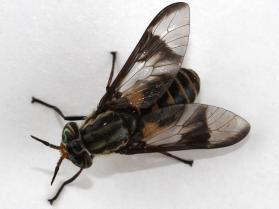
Housefly (Musca domestica L.) contaminates food by transferring microbes. Fungi carried by houseflies cause postharvest losses by food spoilage produce mycotoxins and spread various infectious diseases in human beings and animals. This study was planned to determine the diversity and frequency of fungal species carried by houseflies and their relation with stored grains. Houseflies in the vicinity of stored wheat and rice grains were collected from the rural areas of four districts of Pakistan. Overall, 897, 631, and 687 fungal species were isolated from houseflies, rice, and wheat grains, respectively. Aspergillus and Fusarium species followed by Alternaria and Penicillium species were found dominant in houseflies, rice, and wheat grains. Correlation analyses revealed a significant association between most of the fungal species isolated from houseflies, wheat, and rice grains. The study concludes that a strong correlation of fungi exists between stored grains and houseflies around the unhygienic storage places.

Practical applications

It is highly important to understand the role of houseflies in spreading various fungal species to stored grains, particularly in our persisting rural grain storage system. Our study is first of its kind in which we have studied the correlation of fungal diversity and abundance between houseflies, wheat, and rice grains stored in the same vicinity/place/house. Our findings show a strong correlation in fungal diversity and abundance, isolated from flies and stored grains. This study demonstrates the role of houseflies in the dispersal of various fungal species to contaminate the stored grains. Therefore, appropriate measures should be taken to control the houseflies or their entrance to store houses. There is a strong need to give awareness and improve the grain storage system in houses, especially in rural areas, by food regulating authorities.

Research – Effect of organic matter and pH on the resistance of Salmonella Typhimurium and Salmonella Derby in scalding water from pig slaughter

Wiley Online  Salm2

Abstract

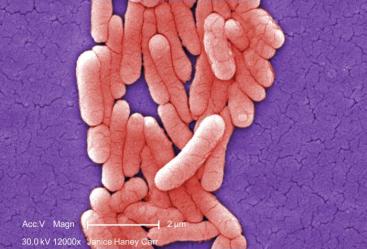
The thermal resistance of Salmonella Typhimurium and Derby was evaluated simulating the pig slaughter scalding process in water with different pH values and organic matter concentrations. In samples of scalding water tanks collected at 0, 2, and 4 hr during the slaughter, Salmonella serotypes were quantified at 0, 1, 3, and 5 min of heating at 62 °C. Variations of water with different pH levels and organic matter contents were also analyzed. A general reduction of 3.19 log CFU/mL in the scalding water and a D value of 1.65 min was observed. Salmonella was more sensitive to hot water in an alkaline pH, and the organic matter was not able to interfere with the survival of Salmonella. We conclude that the accumulation of organic matter in the scalding process was not relevant for the survival of Salmonella and that the water alkalinization was important in improving the elimination of this microorganism.

Practical applications

To know the behavior of Salmonella in different stages of pig slaughter is important for establishing parameters of process, limits, or actions in the control of the contamination program.

This study may contribute novel predictions about Salmonella elimination in the scalding stage and provide evidence about factors that can modify the kinetics of reduction, such as the accumulation of organic matter in the scalding tank during the slaughter of pigs and the different pH levels of the water used in this process. This article demonstrated that the addiction of calcium oxide to the scalding water may contribute to the control of Salmonella in the scalding process by reducing the destruction time.

Sweden – E. coli update: 80 confirmed cases

Outbreak News Today 


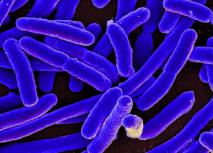
CDC E.coliIn a follow-up on the E. coli O157:H7  outbreak  in Sweden,  the Norwegian Public Health Authority  is now reporting 80 confirmed cases and approximately 50 suspect cases to date, according to a Folkhalsomyndigheten news release this week (computer translated).

The cases have been reported from several counties, but mostly from Uppsala and Västra Götaland.

RASFF Alerts – Salmonella – Cardomon Powder – Chicken Meat – Sesame Seeds – White Sesame Seeds – Anise Powder – Gelatine – Chicken Legs – Turkey Breast Fillets – Liquid Eggs – Raw Eggs

kswfoodworld food safety poisoning

RASFF-Salmonella enterica ser. Agona (present /25g) in fresh and frozen chicken meat from Lithuania in Lithuania

RASFF-Salmonella (presence /25g) in sesame seeds from Uganda in Germany

RASFF-Salmonella (presence /25g) in sesame seeds from Uganda in Germany

RASFF-Salmonella (presence /25g) in white sesame seeds from Nigeria in Poland

RASFF-Salmonella (present /25g) in anise powder from Spain in Germany

RASFF-Salmonella enterica ser. Typhimurium (presence /25g) in gelatine from Germany, packaged in Italy in Italy

RASFF-Salmonella (presence /25g) in sesame seeds from Uganda in Germany

RASFF-Salmonella enterica ser. Enteritidis (presence /25g) in frozen boneless chicken legs from Poland in Croatia

RASFF-Salmonella enterica ser. Typhimurium monophasic (1 ,4, [5], 12:i:-) (presence /25g) in chilled turkey breast fillets from Poland in Belgium

RASFF-Salmonella group D (1out of 5 samples /25g) in liquid eggs from the Netherlands in the Netherlands

RASFF-Salmonella (presence /25g) in white sesame seeds from Nigeria, via Lebanon in Poland

RASFF-Salmonella enterica ser. Enteritidis (present /25g) in raw eggs from Malta in Malta

RASFF-Salmonella in organic cardamom powder from Guatemala in the Netherlands

RASFF Alerts – Listeria monocytogenes – Cooked Prawns – Smoked Salmon – Cooked Falafel – Bacon

kswfoodworld food safety poisoning

RASFF-Listeria monocytogenes (presence /25g) in cooked prawns from Spain in Croatia

RASFF-Listeria monocytogenes (present /25g) in smoked Norwegian salmon from the Netherlands in the Netherlands

RASFF-Listeria monocytogenes (> 1500 CFU/g) in chilled pre-cooked falafel from France in France

RASFF-Listeria monocytogenes (<10 CFU/g) in bacon from Italy in France

RASFF Alert- Ochratoxin A – Organic Oats

kswfoodworld food safety poisoning

RASFF-ochratoxin A (69 µg/kg – ppb) in organic oats from the Czech Republic in Germany

RASFF Alerts – Staphylococcus aureus – Noodles – Infant Formula

kswfoodworld food safety poisoning

RASFF -coagulase-positive Staphylococcus (1 700 000 CFU/g) in noodles from Germany in Austria

RASFF-Staphylococcus aureus in infant formula from the Netherlands in the Netherlands

RASFF Alert – Mould -Infant Formula

kswfoodworld food safety poisoning

RASFF-fungi in infant formula from the Netherlands in the Netherlands