Category Archives: Uncategorized

Pakistan – PIMS treats 3000 people for food poisoning during Eidul Azha

Pakistan Today

As many as 3,000 patients complaining of food poisoning visited the Pakistan Institute of Medical Sciences (PIMS) during Eidul Azha holidays, according to PIMS Media Coordinator Dr Waseem Khawaja.

Dr Khawaja said, “About 1,200 anti-tetanus injections were administered to those who came with injuries due to traffic accidents, doing wheelies, falling from swings and sustaining cuts while slaughtering sacrificial animals or cutting meat.”

“Some people also came with injuries from animal bites and free of cost treatment and medicines were provided to them,” he added.

The doctor explained, “During Eidul Fitr holidays, we get fewer patients but on the occasion of Eidul Azha the number increases because people don’t eat a balanced diet and the portion of protein increases in their diet.”

India – Minor dies in Pub-Panery food poisoning case of Udalguri

Nenow

In a latest development in the food poisoning case where over 50 people including women and children were admitted to the Panery Subsidiary Health Centre in Udalguri district of Assam on August 18 last, one Jinti Kalita, aged eight years and a Class-III student of Pub Paneri HS School who was undergoing treatment died on August 21 at Gauhati Medical College and Hospital (GMCH).

UK – Furious Brit reveals Egyptian hotel where Thomas Cook couple mysteriously died previously ‘served him raw chicken on holiday’

The Sun

Paul, from Oxford, shared with The Sun Online gruesome photos showing red raw chicken he claims he was served at the hotel.

He said: “There was a party of six of us that went. My wife was treated for gastroenteritis, my 16-year-old daughter went down with a vomiting and diarrhoea bug and two days before leaving I had really bad stomach cramps and diarrhoea.

USA – McDonald’s Breakfast Sandwiches Might Be Linked To 22 Food Poisoning Cases

Delish.com

Fresh off of the news that McDonald’s was pulling salads from about 3,000 locations after a parasite outbreak that infected at least 436 people, the chain is now dealing with another possible issue with food safety, though on a much smaller scale.

As Business Insider reports, 22 people have reported that they have become sick with common food poisoning symptoms like nausea, vomiting, and diarrhea between the dates of August 4 to 21. The New York Department of Health interviewed 15 of those people, and they all said that they had eaten breakfast sandwiches at a McDonald’s location in Jamestown, New York.

Advertisement – Continue Reading Below

“McDonald’s is fully cooperating with this investigation and is readily following all recommendations of the State and County Health Departments while this investigation continues,” the department said in a collaborative statement with the Chautauqua County Department of Health.

The franchise’s owner has temporarily closed the location to clean the food-preparation area, review food prep, and obtain a fresh supply of ingredients. Breakfast sandwiches from the restaurant, as well as patient samples, have been sent for testing at the New York State’s Public Health Laboratory in Albany.

USA – FSIS Issues Public Health Alert for Empire Kosher Poultry, Inc. Raw Chicken Products due to Possible Salmonella Contamination

USDA USDA

WASHINGTON, August 24, 2018 – The U.S. Department of Agriculture’s Food Safety and Inspection Service (FSIS) and Empire Kosher Poultry, Inc. are issuing a public health alert out of an abundance of caution due to concerns about Salmonella illnesses reported in the northeastern and mid-Atlantic United States that may be associated with raw chicken products.

The Empire Kosher brand raw chicken items, which may include raw whole chicken, raw chicken parts, were produced and sold to consumers from September 2017 to June 2018.

On June 18, 2018, FSIS was notified of multiple Salmonella I 4,[5],12:i:- illnesses within the northeastern  and mid-Atlantic United States. Working in conjunction with public health partners, FSIS determined that there is a potential link between Empire Kosher brand raw chicken products and this illness cluster. Based on available epidemiological information, multiple case-patients have been identified in the northeastern and mid-Atlantic United States, many of whom reported consumption of Empire Kosher brand chicken products. Approximately half of affected case-patients have been hospitalized due to illness with illness onset dates ranging from September 2017 to June 2018. FSIS continues to work with the company and public health partners and will provide updated information should it become available.

Canada – Food Recall Warning – Certain Greenbelt Microgreens brand microgreens recalled due to Listeria monocytogenes

CFIA

Recall details

Ottawa, August 25, 2018 – Greenbelt Greenhouse Ltd. is recalling certain Greenbelt Microgreens brand microgreens from the marketplace due to possible Listeria monocytogenes contamination. Consumers should not consume the recalled products described below.

Recalled products

Brand Name Common Name Size Code(s) on Product UPC
Greenbelt Microgreens Broccoli Microgreens 75 g best before
08/26/18
8 90082 00016 2
Greenbelt Microgreens Spicy Microgreen Mix 75 g best before
08/28/18
8 90082 00000 1

Canada – Updated Food Recall Warning – Randsland brand Super Salad Kit recalled due to Listeria monocytogenes

CFIA

Recall details

Ottawa, August 26, 2018 – The food recall warning issued on August 16, 2018 has been updated to include additional product information. This additional information was identified during the Canadian Food Inspection Agency’s (CFIA) food safety investigation.

Randsland Farms Inc. is recalling Randsland brand Super Salad Kit from the marketplace due to Listeria monocytogenes. Consumers should not consume the recalled product described below.

Recalled products

Brand Name Common Name Size Code(s) on Product UPC
Randsland Super Salad Kit 454 g 083118 0 57225 00005 6

UK – Diamond Food Sales recalls frozen Indian mackerel due to presence of Histamine

FSA

Diamond Food Sales Ltd is recalling batches of frozen Indian mackerel due to the presence of Histamine.

Product details

FROZEN INDIAN MACKEREL WHOLE ROUND

Pack size Net Weight 630g Gross Weight 700 g
Batch code 7224208000553 (Barcode)
Best before FEBRUARY 2020
FROZEN MACKEREL HEADLESS 2 FOR 5.50

Pack size Net Weight 630g Gross Weight 700g
Batch code 7224209187499 (Barcode)
Best before 10 AUG 2019
INDIAN MACKEREL WHOLE 2 FOR £5

Pack size Net Weight 630g Gross Weight 700g
Batch code 7224209000927 (Barcode)
Best before 10 DEC 2019

No other Diamond Food Sales products are known to be affected.

Risk statement

High levels of Histamine can cause Scombrotoxin poisoning with symptoms resembling an allergic reaction, nausea, headache, vomiting, diarrhoea, itching, oral burning sensation, red rash, flushing of the face and hypotension.

Research – Genotypic and Phenotypic Characterization of Salmonella Isolated from Fresh Ground Meats Obtained from Retail Grocery Stores in the Brookings, South Dakota, Area

Journal of Food Protection

Salmonella is one of the most common foodborne pathogens found in retail fresh meat products. The purpose of this study was to characterize the Salmonella that is found in common types of fresh ground meats available to consumers in grocery stores in the Brookings, South Dakota, area. Salmonella serotypes were detected in 50 (19%) of 261 retail fresh ground meat samples, with 2 (2%) of 115 ground turkey samples, 6 (14%) of 42 chicken samples, and 42 (40%) of 104 ground pork samples testing positive for Salmonella. The Salmonella isolates were sequenced using an Illumina MiSeq genome sequencer. The resulting genomic sequences were analyzed to determine the serotypes of the isolates and to detect the presence of virulence and antibiotic resistance genes. The Salmonella isolated from the ground meats belonged to 23 different serotypes. The predominant serotype isolated from ground chicken was Enteriditis (5 of 6, 83%). Among the ground pork isolates, the most common serotypes were the potential monophasic variant of Typhimurium (5 of 42, 12%), Uganda (5 of 42, 12%), Anatum (4 of 42, 10%), Derby (3 of 42, 7%), Infantis (3 of 42, 7%), and London (3 of 42, 7%). Among the 45 Salmonella isolates tested to determine their resistance to common veterinary antibiotics, 25 (56%) were found to be susceptible to all 14 antibiotics tested, 11 (24%) were resistant to 1 antibiotic, 4 (9%) were resistant to 2 antibiotics, 1 (2%) was resistant to 3 antibiotics, 2 (4%) were resistant to 4 antibiotics, 1 (2%) was resistant to 8 antibiotics, and 1 (2%) was resistant to 10 antibiotics. The most common antibiotic resistances observed in this study were to streptomycin (15 of 45, 33%), tetracycline (11 of 45, 24%), and sulfisoxazole (7 of 45, 16%). The results of phenotypic evaluation of antibiotic resistance profiles of Salmonella isolates correlated well with the antibiotic resistance genes detected in the genomic sequences of the isolates.


Research – Multilocus Sequence Subtypes of Campylobacter Detected on the Surface and from Internal Tissues of Retail Chicken Livers

Journal of Food Protection 

campy2

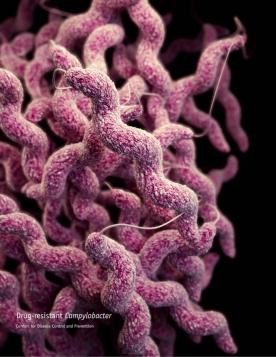
Foodborne campylobacteriosis has been traced to undercooked chicken liver. The objectives of this study were to determine the prevalence of Campylobacter associated with chicken livers at retail and to determine which subtypes are detected on the surface and in the internal tissues of the livers. Fifteen packages of fresh chicken livers, each representing a unique combination of processing plant and sell-by date, were collected at each of three retail grocery stores in Georgia. Three intact, undamaged livers per container (n = 45) were selected and sampled using each three methods: outside swab, inside swab accessed by pressing through a heat-sterilized outer surface, and whole liver blended in enrichment broth. Each liver sample with 0.1 mL of exudate from packages was cultured for Campylobacter by plating on Campy-Cefex agar. The most prevalent Campylobacter colony type from each positive sample was subjected to whole genome sequencing and multilocus sequence typing. Campylobacter was detected in at least one sample from every package. Surface swabs were positive for 29 of 45 livers, but significantly fewer swabs of internal tissue were positive, 14 of 45 (P < 0.01). Campylobacter was detected in 30 of 45 blended whole liver samples. Multiple subtypes were detected from eight livers. In four livers, a different subtype was dominant on the surface than was dominant internally. In one liver, three subtypes were detected. Various subtypes of Campylobacter can be readily isolated from fresh retail chicken livers; therefore, undercooked chicken livers pose a food safety risk.