Category Archives: Toxoplasmosis

UP researchers caution against parasites in raw vegetables, seafood – Toxoplasma

UPD

Scientists from the University of the Philippines (UP) are gently reminding the public to thoroughly wash and cook their market-bought fresh produce and seafood as a precautionary measure against parasites.

The parasite that causes toxoplasmosis, called Toxoplasma gondii (T. gondii), is one of the most infectious parasites in the world: it affects almost a third of the world’s population, most especially vulnerable groups such as the pregnant and immunocompromised. While most people infected with the disease do not present any symptoms, some may suffer flu-like symptoms, such as fever, headache, and muscle aches. But in severe cases, toxoplasmosis can cause inflammation of the brain and blurry vision. Infected parents’ newborn infants may suffer from excessive fluid in the brain and developmental issues. Fortunately, treatments are available for toxoplasmosis, hence symptomatic individuals are advised to seek timely medical attention.

Cielo Emar M. Paraoan, Ren Mark D. Villanueva, and Marie Christine M. Obusan of the UP Diliman College of Science’s Institute of Biology (UPD-CS IB) found that T. gondii is fairly common in vegetables and oysters that they sampled from local markets in Central Luzon. Among the vegetables tested were lettuce, cabbage, carrots, cauliflower, and mung bean sprouts.

Research – Toxoplasmosis: Epidemiology, Prevention and Control

MDPI

Book cover: Toxoplasmosis: Epidemiology, Prevention and Control

Summary

Scientific motivation to publish this book comes from the increased interest in the study of toxoplasmosis, showed all over the world. Though the Toxoplasma gondii infection was first discovered in 1908, toxoplasmosis remains a today’s research topic, a realm of questions and dilemmas that interest both the veterinarians and the human doctors. Studies in the field are directed to the epidemiology of the disease, the sources of infection, epidemiological chains, being underlined the important feature in the transmission of this parasite: the ability to pass from one intermediate host to another intermediate host without passing through the final host – felids. An increased prevalence of toxoplasmosis in humans and animals, as well as the difficulty of coproscopic diagnosis of toxoplasmosis in cats, expensive serological examinations in both animals and humans, lack of diagnostic methods accessible to veterinarians in slaughterhouses, cultural and culinary differences of human patients, which can influence the prevalence of the disease, motivate the scientific and practical importance of the proposed book and reveal the importance of this topic for animal and human health. So, the proposed book will contain informations regarding the etiology and history of Toxoplasma gondii infection and also the parasite’s morphology and biology. This work will contain a very detailed epidemiology of the toxoplasmosis from all over the world and for all species of animals. This chapter will include also personal findings of the authors about the Toxoplasma gondii seroprevalence in domestic animals from Romania. In the last part of the book we will present the main methods for toxoplasma diagnosis. At the end of the book we will synthesize the main routes for T. gondii infection and the recommendations for reducing toxoplasmosis seroprevalence.

Research – 10 surprising facts about the ‘mind-control’ parasite Toxoplasma gondii

Live Science

Toxoplasma gondii is a single-celled protozoan parasite that invades the cells of a variety of host organisms, including humans, and causes a disease known as toxoplasmosisT. gondii is sometimes nicknamed the “mind-control parasite” because toxoplasmosis can cause a range of neurological and behavioural changes in infected animals, although most human infections have no clear symptoms.

The pathogen is one of the most common infectious parasites in the world and could lay dormant in up to half of the world’s population, as well as almost any warm-blooded animal species. But there is still much we don’t know about this extremely weird parasite.

From its unusual affinity for cats to its ties to schizophrenia, at the link above are 10 surprising facts about T. gondii.

Research – Foodborne Parasites and Their Complex Life Cycles Challenging Food Safety in Different Food Chains

MDPI

Abstract

Zoonotic foodborne parasites often represent complex, multi host life cycles with parasite stages in the hosts, but also in the environment. This manuscript aims to provide an overview of important zoonotic foodborne parasites, with a focus on the different food chains in which parasite stages may occur. We have chosen some examples of meat-borne parasites occurring in livestock (Taenia spp., Trichinella spp. and Toxoplasma gondii), as well as Fasciola spp., an example of a zoonotic parasite of livestock, but transmitted to humans via contaminated vegetables or water, covering the ‘farm to fork’ food chain; and meat-borne parasites occurring in wildlife (Trichinella spp., Toxoplasma gondii), covering the ‘forest to fork’ food chain. Moreover, fish-borne parasites (Clonorchis spp., Opisthorchis spp. and Anisakidae) covering the ‘pond/ocean/freshwater to fork’ food chain are reviewed. The increased popularity of consumption of raw and ready-to-eat meat, fish and vegetables may pose a risk for consumers, since most post-harvest processing measures do not always guarantee the complete removal of parasite stages or their effective inactivation. We also highlight the impact of increasing contact between wildlife, livestock and humans on food safety. Risk based approaches, and diagnostics and control/prevention tackled from an integrated, multipathogen and multidisciplinary point of view should be considered as well.

Research -The annual cost of foodborne illness in Australia

FSANZ

Executive summary
Foodborne illness causes a significant health burden in Australia. Estimates of both the extent of foodborne illness and the costs arising from illness are essential for measuring the impact on the population.
In 2010 it was estimated that Australians experience almost 16million episodes of gastroenteritis each year, with about one quarter of these due to contaminated food. This report updates these numbers to circa 2019 and estimates the associated costs to individuals and the health system. As foodborne disease interventions are often targeted at specific causes of illness, costs are also provided for ten high-priority pathogens.
We estimate that foodborne illness and its sequelae costs Australia AUD 2.44billion each year. The largest component of this cost is lost productivity due to non-fatal illness, followed by premature mortality and direct costs (including hospitalisations and other health care use).
While costs due to lost productivity are lower under the more conservative friction cost model, it remains the largest component cost for foodborne illness due to all causes. The pathogen with the highest individual cost is Campylobacter (AUD 365millionper year), while norovirus, other pathogenic E. coli, and Salmonella are all estimated to cost Australians over AUD 100 million each year. Lost productivity is the largest component cost for most pathogens, although premature mortality is the largest cost for pathogens that typically cause more severe illness, such as Listeria monocytogenes, Shiga toxin-producing Escherichia Coli, and Salmonella.
Significant advances in this report include the incorporation of estimated willingness to pay to avoid pain and suffering based on a discrete choice experiment from another FSANZ commissioned study, and the use of a simulation approach to estimating costs which provides uncertainty intervals on all estimates. A costing tool is provided with this report to allow estimates to be updated in the future.
Costs associated with surveillance for foodborne pathogens and related to outbreak investigations are considered separately to the model. Likewise, industry costs due to outbreaks such as lost sales, disposal of products, recall costs, enforcement related costs and potential business costs are not included in the costing model. Key limitations in this work include the lack of data on the long-term burden and health care usage associated with sequelae or ongoing illness due to toxoplasmosis and listeriosis. These costs are not included in this report due to unavailability of data. Costs of pain and suffering, which we approximate using willingness to pay to avoid pain and suffering, are relatively low compared to those estimated for other countries, which may represent differences in underlying preferences across countries and could suggest that greater international standardisation of methods and data collection may be required.

This report demonstrates that foodborne illness results in a substantial cost to Australia and that interventions to improve food safety across industry, retail, and consumers are needed to improve public health. Pathogen-specific costing estimates allow policy makers to target such interventions at individual pathogens, with the end goal of reducing the burden due to foodborne illness.

Research – Toxoplasma gondii Antibodies in Raw Milk and Sera of Cows in China

MDPI

Toxoplasma gondii is a worldwide food-borne protozoa that has harmful influences on animal and human health. Raw milk containing T. gondii has been considered as one of the possible infectious sources for humans. Although China is one of the world’s leading milk consumers, there is still no study to investigate the seroprevalence of T. gondii in raw cow milk in China; especially for cows in rural areas. Thus, we conducted this study to examine the specific anti-T. gondii IgG-antibody in the raw milk and sera of domestic cows in China. In total, 894 cows were randomly selected from rural areas in northeastern China. The positive rate of T. gondii in the milk and serum samples were 6.38% (57/894) and 7.16% (64/894), respectively. Moreover, a history of abortion (OR = 2.03, 95% CI: 1.11–3.72, p = 0.022) was identified as the only risk factor for T. gondii infection in the studied cows. This study investigated the seroprevalence of T. gondii in the raw milk and sera of cows in China; it provided timely and useful data for public health and food safety, especially in rural areas. View Full-Text

Research – Toxoplasma gondii in Foods: Prevalence, Control, and Safety

MDPI

Toxoplasma gondii is an obligate intracellular parasite that causes toxoplasmosis, with approximately one third of the population around the world seropositive. The consumption of contaminated food is the main source of infection. These include meat products with T. gondii tissue cysts, and dairy products with tachyzoites. Recently, contamination has been detected in fresh products with oocysts and marine products. Despite the great health problems that are caused by T. gondii, currently there are no standardized methods for its detection in the food industry. In this review, we analyze the current detection methods, the prevalence of T. gondii in different food products, and the control measures. The main detection methods are bioassays, cell culture, molecular and microscopic techniques, and serological methods, but some of these do not have applicability in the food industry. As a result, emerging techniques are being developed that are aimed at the detection of multiple parasites simultaneously that would make their application more efficient in the industry. Since the prevalence of this parasite is high in many products (meat and milk, marine products, and vegetables), it is necessary to standardize detection methods, as well as implement control measures. View Full-Text

Research – Pathogens can hitch a ride on plastic to reach the sea

Phys Org

Microplastics are a pathway for pathogens on land to reach the ocean, with likely consequences for human and wildlife health, according to a study from the University of California, Davis.

The study, published April 26 in the journal Scientific Reports, is the first to connect microplastics in the ocean with land-based pathogens. It found that microplastics can make it easier for disease-causing pathogens to concentrate in plastic-contaminated areas of the ocean.

The pathogens studied—Toxoplasma gondii, Cryptosporidium (Crypto) and Giardia—can infect both humans and animals. They are recognized by the World Health Organization as underestimated causes of illness from shellfish consumption and are found throughout the ocean.

“It’s easy for people to dismiss plastic problems as something that doesn’t matter for them, like, ‘I’m not a turtle in the ocean; I won’t choke on this thing,'” said corresponding author Karen Shapiro, an infectious disease expert and associate professor in the UC Davis School of Veterinary Medicine. “But once you start talking about disease and health, there’s more power to implement change. Microplastics can actually move germs around, and these germs end up in our water and our food.”

Research – Contamination of Soil, Water, Fresh Produce, and Bivalve Mollusks with Toxoplasma gondii Oocysts: A Systematic Review

MDPI

Toxoplas

Toxoplasma gondii is a major foodborne pathogen capable of infecting all warm-blooded animals, including humans. Although oocyst-associated toxoplasmosis outbreaks have been documented, the relevance of the environmental transmission route remains poorly investigated. Thus, we carried out an extensive systematic review on T. gondii oocyst contamination of soil, water, fresh produce, and mollusk bivalves, following the PRISMA guidelines. Studies published up to the end of 2020 were searched for in public databases and screened. The reference sections of the selected articles were examined to identify additional studies. A total of 102 out of 3201 articles were selected: 34 articles focused on soil, 40 focused on water, 23 focused on fresh produce (vegetables/fruits), and 21 focused on bivalve mollusks. Toxoplasma gondii oocysts were found in all matrices worldwide, with detection rates ranging from 0.09% (1/1109) to 100% (8/8) using bioassay or PCR-based detection methods. There was a high heterogeneity (I= 98.9%), which was influenced by both the sampling strategy (e.g., sampling site and sample type, sample composition, sample origin, season, number of samples, cat presence) and methodology (recovery and detection methods). Harmonized approaches are needed for the detection of T. gondii in different environmental matrices in order to obtain robust and comparable results.

Research – Introduction to the Special Issue: Microbiological Safety and Quality of Foods

MDPI

Recent shifts in food production, processing and distribution, linked to the globalization of the food trade and the need to meet new consumers habits, are continuously challenging global food systems. Every effort is being made to ensure healthy and safe, food that is crucial to guarantee public health and wellbeing.
Despite the advancements in food safety management, foodborne diseases (FBD) still remain an important problem worldwide, with a significant negative impact on human health and countries’ economies and development. It has been determined that food unsafe for consumption causes 600 million cases of FBD every year, and 25% of all foods produced globally are lost due to microbial spoilage. Serious outbreaks have occurred, involving both developing and industrialized countries, showing how food safety is a transnational challenge and that a strong joint commitment between food safety authorities is needed.
Despite this awareness, the full extent of the impact of food contamination is still unknown. Foodborne contaminants are numerous, including viruses and bacteria, parasites, chemicals, toxins and allergens that cause a wide range of conditions. Globally, FBD caused by bacteria are more common than those caused by viruses and parasites. [1]. Moreover, between one-third and one-half of all human infectious diseases have a zoonotic origin. Among bacteria, Campylobacter, followed by Salmonella, are the major etiological agents of FBD, while, among viruses, norovirus is the foremost enteric pathogen of foodborne disease worldwide [2].
The most common foodborne parasites instead are protozoa such as Cryptosporidium spp., Giardia intestinalis and Toxoplasma gondii; roundworms such as Trichinella spp. and Anisakis spp.; and tapeworms such as Diphyllobothrium spp. and Taenia spp. [3]. In particular, Anisakiasis is an emerging zoonosis caused by the fish parasitic nematode Anisakis. Humans are accidental hosts that become infected by eating raw or undercooked fish that contain viable Anisakis spp. larvae.
The major determinants for the incidence of FBD are unsafe raw food, abused temperature, inadequate storage, improper handling, undercooking and cross contamination [4]. Food from animal sources, fresh produce and ready-to-eat (RTE) foods are the most at risk. In particular, RTE foods are an emerging issue concerning food safety. Furthermore, they have been demonstrated to contain antimicrobial-resistant strains. Since these products are consumed without any further treatment, they could serve as a vector for the spread of antibiotic-resistant microorganisms, posing a significant threat to public health [5].
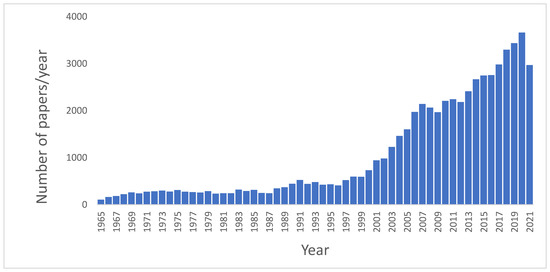
The importance of these topics is documented by the increasing number of papers published related to Food Safety. In a basic search using PubMed database, from 1945 to 2021, selecting as the search topic “Microbiological food safety”, a total of 54,210 results were obtained.
Although the first articles concerning microbiological food safety date from 1946, and since then a dozen articles appear in the following years, it is not until 1965 that a significant number of articles are published every year. Figure 1 shows the evolution of the number of papers per year (from 1965 to 2021) published regarding Microbiological food safety. As can be seen in this figure, approximately 80% of these papers have been published in the last 20 years, and the number continues to rise, revealing an increasing and ever-present interest towards the topic addressed in this Special Issue.
Foods 11 00673 g001 550