Category Archives: Technology

Research- Predictive microbial modeling of E. faecium NRRL B-2354 inactivation during baking of a multi-component low-moisture food

Journal of Food Protection

Validating baking ovens as a microbial kill step, using thermal inactivation models, is desirable; however, traditional isothermal models may not be appropriate for these dynamic processes, yet they are being used by the food industry. Previous research indicates that the impact of additional process conditions, such as process humidity, should be considered when validating thermal processes for the control of microbial hazards in low-moisture foods. In this study, the predictive performance of traditional and modified thermal inactivation kinetic models accounting for process humidity were assessed for predicting bacterial inactivation of Enterococcus faecium NRRL B-2354 in a multi-ingredient composite food during baking. Ingredients (milk powder, protein powder, peanut butter, and whole wheat flour), individually inoculated to ~6 logCFU/g and equilibrated to a water activity of 0.25, were mixed to form a dough. An isothermal inactivation study was conducted for the dough to obtain traditional D- and z- values (n=63). In a separate experiment, cookies were baked under four dynamic heating conditions: 135℃/high humidity, 135℃/low humidity, 150℃/high humidity, and 150℃/low humidity. Process humidity measurements, time-temperature profiles for the product core, surface, and bulk air, and microbial survivor ratios were collected for the four conditions at six residence times (n=144). The traditional isothermal model had a poor root mean square error (RMSE) of 856.51 log (CFU/g), significantly overpredicting bacterial inactivation during the process. The modified model accounting for the dynamic time-temperature profile and process humidity data yielded a better predictive performance with a RMSE of 0.55 log CFU/g. The results demonstrate the importance of accounting for additional process parameters in baking inactivation models, and that model performance can be improved by utilizing model parameters obtained directly from industrial-scale experimental data.
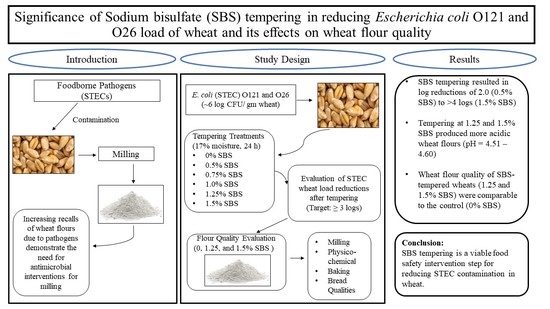
Research – Significance of Sodium Bisulfate (SBS) Tempering in Reducing the Escherichia coli O121 and O26 Load of Wheat and Its Effects on Wheat Flour Quality

MDPI

The occurrence of recalls involving pathogenic Escherichia coli-contaminated wheat flours show the need for incorporating antimicrobial interventions in wheat milling. The objectives of this study were to assess the efficacy of sodium bisulfate (SBS) tempering in reducing E. coli O121 (ATCC 2219) and O26 (ATCC 2196) wheat load and to evaluate the impact of effective (≥3.0 log reductions) SBS treatments on wheat flour quality. Wheat grains were inoculated with E. coli (~6 log CFU/g) and tempered (17% moisture, 24 h) using the following SBS concentrations (%wheat basis): 0, 0.5, 0.75, 1.0, 1.25, and 1.5% SBS. Reductions in E. coli O121 and O26 wheat load at different time intervals (0.5, 2, 6, 12, 18, and 24 h) during tempering were evaluated. The addition of SBS during tempering resulted in E. coli (O121 and O26) log reductions of 2.0 (0.5% SBS) to >4.0 logs (1.5% SBS) (p ≤ 0.05). SBS tempering (1.25 and 1.5% SBS) produced acidic wheat flours (pH = 4.51–4.60) but had comparable wheat flour properties in terms of composition, dough, and bread-making properties relative to the control (0% SBS). SBS tempering reduced the E. coli O121 and O26 load of wheat after tempering with minimal effects on wheat flour quality. View Full-Text

Research – Low-Temperature Virus vB_EcoM_VR26 Shows Potential in Biocontrol of STEC O26:H11

MDPI

Shiga toxin-producing Escherichia coli (STEC) O26:H11 is an emerging foodborne pathogen of growing concern. Since current strategies to control microbial contamination in foodstuffs do not guarantee the elimination of O26:H11, novel approaches are needed. Bacteriophages present an alternative to traditional biocontrol methods used in the food industry. Here, a previously isolated bacteriophage vB_EcoM_VR26 (VR26), adapted to grow at common refrigeration temperatures (4 and 8 °C), has been evaluated for its potential as a biocontrol agent against O26:H11. After 2 h of treatment in broth, VR26 reduced O26:H11 numbers (p < 0.01) by > 2 log10 at 22 °C, and ~3 log10 at 4 °C. No bacterial regrowth was observed after 24 h of treatment at both temperatures. When VR26 was introduced to O26:H11-inoculated lettuce, ~2.0 log10 CFU/piece reduction was observed at 4, 8, and 22 °C. No survivors were detected after 4 and 6 h at 8 and 4 °C, respectively. Although at 22 °C, bacterial regrowth was observed after 6 h of treatment, O26:H11 counts on non-treated samples were >2 log10 CFU/piece higher than on phage-treated ones (p < 0.02). This, and the ability of VR26 to survive over a pH range of 3–11, indicates that VR26 could be used to control STEC O26:H11 in the food industry. View Full-Text

Research – Evaluation of Lactose Oxidase as an Enzyme-Based Antimicrobial for Control of L. monocytogenes in Fresh Cheese

MDPI

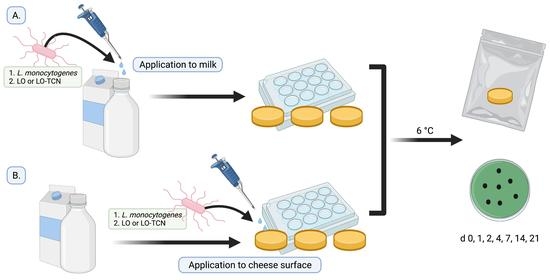
Listeria monocytogenes is a ubiquitous pathogen that can cause morbidity and mortality in the elderly, immune compromised, and the fetuses of pregnant women. The intrinsic properties of fresh cheese—high water activity (aW), low salt content, and near-neutral pH—make it susceptible to L. monocytogenes contamination and growth at various points in the production process. The aim of this study was to investigate the ability of lactose oxidase (LO), a naturally derived enzyme, to inhibit the growth of L. monocytogenes in fresh cheese during various points of the production process. Lab-scale queso fresco was produced and inoculated with L. monocytogenes at final concentrations of 1 log CFU/mL and 1 CFU/100 mL. LO and LO sodium thiocyanate (TCN) combinations were incorporated into the milk or topically applied to the finished cheese product in varying concentration levels. A positive control and negative control were included for all experiments. When L. monocytogenes was inoculated into the milk used for the cheese-making process, by day 28, the positive control grew to above 7 log CFU/g, while the 0.6 g/L treatment (LO and LO + TCN) fell below the limit of detection (LOD) of 1.3 log CFU/g. In the lower inoculum, the positive control grew to above 7 log CFU/g, and the treatment groups fell below the LOD by day 21 and continued through day 28 of storage. For surface application, outgrowth occurred with the treatments in the higher inoculum, but some inhibition was observed. In the lower inoculum, the higher LO and LO-TCN concentrations (0.6 g/L) reduced L. monocytogenes counts to below the LOD, while the control grew out to above 7 log CFU/g, which is a >5 log difference between the control and the treatment. These results suggest that LO could be leveraged as an effective control for L. monocytogenes in a fresh cheese. View Full-Text

Research – Prevalence of Listeria species and Listeria monocytogenes on Raw Produce Arriving at Frozen Food Manufacturing Facilities

Journal of Food Protection

Ubiquity of Listeria monocytogenes in the environment impacts the food industry and presents concerns for frozen food facilities. This study determined the prevalence and numbers of Listeria species and L. monocytogenes on raw produce arriving at frozen food facilities. Raw produce was collected using multi-level blinding protocols to ensure anonymity of participants and avoid traceback. Five raw vegetables were selected: corn, carrots, green beans, peas, and spinach. Raw products were collected after arrival at the facilities but before any cleaning or other pre-processing steps that are typically performed inside the facility. The FDA BAM method for detection of Listeria spp. and L. monocytogenes was followed, with PCR screening followed by selective plating methods. Listeria numbers were estimated from positive samples using MPN methodology. A total of 290 samples were collected, with 96 and 17 samples positive for Listeria spp. (33.1%) and L. monocytogenes (5.9%), respectively. Enumeration data for the 96 Listeria spp. samples indicated 82 samples had greater than 100 MPN Listeria spp./g and 14 samples less than 100 MPN Listeria spp./g. The prevalence of Listeria spp. varied by commodity: spinach (66.7%), peas (50%), corn (32.2%), green beans (22.2%), and carrots (13%). L. monocytogenes prevalence was determined in corn (13.6%), peas (6.3%), and green beans (4.2%) arriving at processing facilities. Such data was previously unavailable to frozen vegetable processors and is valuable in implementing process control standards. The prevalence and pathogen concentration data from raw commodities found in this study can provide the industry information to conduct more accurate quantitative risk assessments and provide a baseline to model and target appropriate pathogen reduction steps during processing.

Research – “Aquaponics offers solutions to foodborne illness outbreaks”

Horti Daily

Soilless growing offers a viable alternative to growing crops in a low-risk environment for many microbial sources. Aquaponics, which is often greenhouse-grown, is an innovative way of growing fish and plants in rural or urban settings. For years, commercial aquaponic farms have obtained food safety certifications from Global GAP, USDA Harmonized GAP, Primus GFS, and the SWF Food Safety Program, in addition to being certified USDA organic (Aquaponic Association, 2019) and sold commercially across North America.

In an aquaponic system, the healthy microbes actually serve as biological control agents against pathogenic bacteria making their survival minimal (Fox, 2012). While aquaponics produce is not immune to all pathogenic contamination, it is one of the safest agriculture methods against pathogenic risk.

NEW FOOD SAFETY GUIDE – Ensuring Food Safety in the Cold Chain

Cold Chain Federation

The Cold Chain Federation has published the first ever handbook on managing food safety specifically for temperature-controlled storage and distribution.

The handbook, Ensuring Food Safety in the Cold Chain, brings together the latest information on compliance, best practice and recommendations for managing the key food safety risks in the cold chain and insights into likely future considerations, the new guide meets the industry’s need for a holistic, comprehensive and up-to-date cold chain food safety reference guide.

For a copy of the guide e-mail: compliance@coldchainfed.org.uk.

Research – High Hydrostatic Pressure Treatment Ensures the Microbiological Safety of Human Milk Including Bacillus cereus and Preservation of Bioactive Proteins Including Lipase and Immuno-Proteins: A Narrative Review

MDPI

Breast milk is the nutritional reference for the child and especially for the preterm infant. Breast milk is better than donated breast milk (DHM), but if breast milk is not available, DHM is distributed by the Human Milk Bank (HMB). Raw Human Milk is better than HMB milk, but it may contain dangerous germs, so it is usually milk pasteurized by a Holder treatment (62.5 °C 30 min). However, Holder does not destroy all germs, and in particular, in 7% to 14%, the spores of Bacillus cereus are found, and it also destroys the microbiota, lipase BSSL and immune proteins. Another technique, High-Temperature Short Time (HTST 72 °C, 5–15 s), has been tried, which is imperfect, does not destroy Bacillus cereus, but degrades the lipase and partially the immune proteins. Therefore, techniques that do not treat by temperature have been proposed. For more than 25 years, high hydrostatic pressure has been tried with pressures from 100 to 800 MPa. Pressures above 400 MPa can alter the immune proteins without destroying the Bacillus cereus. We propose a High Hydrostatic Pressure (HHP) with four pressure cycles ranging from 50–150 MPa to promote Bacillus cereus germination and a 350 MPa Pressure that destroys 106 Bacillus cereus and retains 80–100% of lipase, lysozyme, lactoferrin and 64% of IgAs. Other HHP techniques are being tested. We propose a literature review of these techniques. View Full-Text

Research – Effect of UVC light-emitting diodes on pathogenic bacteria and quality attributes of chicken breast

Journal of Food Protection

This study aimed to investigate the inactivation of foodborne pathogens and the quality characteristics of fresh chicken breasts after Ultraviolet-C light-emitting diode (UVC-LED) treatment. Fresh chicken breasts were separately inoculated with Salmonella Typhimurium, Escherichia coli O157:H7, and Listeria monocytogenes at an initia population of 6.01, 5.80, and 6.22 log 10 CFU/cm 2 , respectively, then were treated by UVC-LED at 1000 to 4000 mJ/cm 2 . UVC-LED irradiation could inactivate the tested bacteria in a dose-dependent manner. After UVC-LED treatment at 4000 mJ/cm 2 , the populations of S . Typhimurium, E . coli O157:H7, and L . monocytogenes on chicken breasts were decreased by 1.90, 2.25, and 2.18 log 10 CFU/cm 2 , respectively. No significant ( P > 0.05) changes were found in the color, pH value, texture properties, and thiobarbituric acid reactive substances (TBARS) values of chicken breasts following the UVC-LED radiation at doses up to 4000 mJ/cm 2 . Overall, this study indicates that UVC-LED is a promising technology to reduce the number of microorganisms while maintaining the physico-chemical characteristics of poultry meat.

Research – Microbial Inactivation and Quality Preservation of Chicken Breast Salad Using Atmospheric Dielectric Barrier Discharge Cold Plasma Treatment

MDPI

Microbiological safety of ready-to-eat foods is paramount for consumer acceptability. The effects of in-package atmospheric dielectric barrier discharge cold plasma (ADCP) treatment on the microbiological safety and quality of model chicken salad (CS) were investigated in this study. CS, packaged in a commercial polyethylene terephthalate container, was treated with ADCP at 24 kV for 2 min. The inactivation of indigenous mesophilic bacteria, Salmonella, and Tulane virus in CS; growth of indigenous mesophilic bacteria and Salmonella in CS; and quality of CS during storage at 4 °C were then investigated. ADCP inactivated indigenous mesophilic bacteria, Salmonella, and Tulane virus by 1.2 ± 0.3 log CFU/g, 1.0–1.5 ± 0.2 log CFU/g, and 1.0 ± 0.1 log PFU/g, respectively. Furthermore, it effectively retarded the growth of the microorganisms, while not significantly affecting the color of chicken, romaine lettuce, and carrot, and the antioxidant capacity of all vegetables throughout storage at the tested temperatures (p > 0.05). The color, smell, and appearance of all vegetables evaluated on day 0 were not significantly different in the sensory test, regardless of the treatment (p > 0.05). Collectively, ADCP treatment effectively decontaminates packaged CS without altering its quality-related properties. View Full-Text