Category Archives: Protozoan

Research – What Is Cyclospora?

Food Poisoning News

Cyclospora cayetanensis is a protozoan parasite that causes the diarrheal illness known as cyclosporiasis. People acquire this infection by consuming food or water contaminated with feces containing Cyclospora. Cyclosporiasis was not previously a reportable disease in the U.S., so its rise in prevalence is due in large part to the increased availability of tests that can detect Cyclospora. It is now a nationally notifiable disease, so physicians are required to report cases of this infection.

The first three cases of cyclosporiasis were reported in 1977 and 1978, but the parasite that was causing the illnesses could not at that time be identified as Cyclospora cayetanensis; it was not until 1979 that the correct identification was made.

Norway – Cyclospora, Toxoplasma and Cryptosporidium detected in berries sold in Norway

Fresh Plaza

water contamination

Cyclospora, toxoplasma and cryptosporidium have been detected in berries sold in Norway. Blueberries, strawberries and raspberries were tested for Echinococcus multilocularis, Toxoplasma gondii, Cyclospora cayetanensis and Cryptosporidium. Raspberries were the most contaminated, followed by strawberries and blueberries. Strawberries and raspberries were mainly tainted with Cryptosporidium, while blueberries were contaminated mostly with Cyclospora. Toxoplasma and Cyclospora were frequently found in raspberries, according to the study published in the journal Food Microbiology.

However, researchers said it was important to note that only DNA was detected, so there is no certainty that the intact, infective stages of parasites were present, and there is no information on viability.

In Norway, because of the short growing season, many berries come from abroad, with more than 13,000 tons imported in 2020. In total, 86 berry samples were from domestic fruit while others came from countries such as Peru, Morocco, Chile, Netherlands, Portugal and Poland.

Researchers said that while findings are cause for some degree of concern for Norwegian food safety authorities, encouraging consumers to wash berries before consumption could reduce the risk of infection.

Research -Surveillance of berries sold on the Norwegian market for parasite contamination using molecular methods

Science Direct

water contamination

The risk of foodborne parasite infection linked to the consumption of contaminated fresh produce has long been known. However, despite epidemiological links between the outbreaks and contaminated berries, few studies have assessed the magnitude of parasite contamination on fresh produce sold in Europe. The present study was aimed to address the knowledge gap on parasite contamination of berries sold in Norway. Samples of blueberries, strawberries, and raspberries were analysed by multiplex qPCR for detection of Echinococcus multilocularisToxoplasma gondii, and Cyclospora cayetanensis. In addition, a simplex qPCR method was employed for detecting contamination of the berries with Cryptosporidium spp. A total of 820 samples of berries, each of around 30 g (274 samples of blueberries, 276 samples of raspberries, and 270 samples of strawberries), were analysed. We found an overall occurrence of 2.9%, 6.6%, and 8.3% for T. gondii, C. cayetanensis, and Cryptosporidium spp., respectively, whereas E. multilocularis was not detected from any of the samples investigated. Strawberries and raspberries were most often contaminated with Cryptosporidium spp., whereas blueberries were contaminated mostly with C. cayetanensis. Detection of parasite contaminants on fresh berries indicates the need for a system to ensure the parasitological safety of fresh berries.

CPS – Funded Research Projects 2022 – Cyclospora

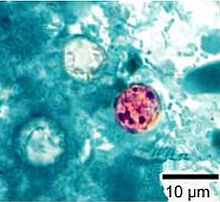
220px-Cyclospora_cayetanensis_stained

CPS

Cyclospora cayetanensis monitoring in agricultural water

The parasite Cyclospora Cayetanensis is producing illness in people consuming infected produce. Because this pathogen is in very low concentrations on actual produce, which makes it close to impossible to detect, and for prevention reasons, it is more effective to check for its presence in irrigation water, from where it is typically transferred on produce. However, even in water, this parasite is very difficult to detect. It only can be detected by lengthy molecular laboratory procedures such as PCR. One major problem for scientists to develop better and faster detection methods is the fact that there is no antibody or other recognition molecule that would be able to bind to the surface of this intact parasite.

We propose to design and synthesize, for the first time, aptamers, molecules that will be able to bind to intact Cyclospora Cayetanensis oocysts, and use them to design simple paper based colorimetric tests that can detect it in the field without the need of sample preparation or specialized laboratories. The paper based test will turn from pink to purple to indicate the water sample being tested is positive for this parasite, making this a very simple and easy to use detection method for Cyclospora Cayetanensis.

CPS

AFECCT: Assessing filtration efficacy for Cyclospora control

The reputation of growers and the health of consumers suffer when people contract foodborne illness from fresh produce contaminated with Cyclospora cayetanensis. Because filtration has been established as effective in concentrating parasites for environmental surveillance, we propose to establish how effectively filters remove such parasites from irrigation water. To achieve this, we will first conduct a series of filtration experiments using abundant parasites (of chickens) that pose no risk to the study team. We’ll then assess how well these filters reduce water contamination with Cyclospora. We will also determine whether any parasites surviving filtration are harmed in the process. We hope these findings will directly benefit growers seeking tools to mitigate risk, and hasten future research progress by validating a needed surrogate system for studying other interventions against this dangerous and enigmatic human parasite.


Research – Main Groups of Microorganisms of Relevance for Food Safety and Stability

NCBI

Microbiology is important to food safety, production, processing, preservation, and storage. Microbes such as bacteria, molds, and yeasts are employed for the foods production and food ingredients such as production of wine, beer, bakery, and dairy products. On the other hand, the growth and contamination of spoilage and pathogenic microorganisms is considered as one of the main causes to loss of foodstuff nowadays. Although technology, hygienic strategies, and traceability are important factors to prevent and delay microbial growth and contamination, food remains susceptible to spoilage and activity of pathogen microorganisms. Food loss by either spoilage or contaminated food affects food industry and consumers leading to economic losses and increased hospitalization costs. This chapter focuses on general aspects, characteristics, and importance of main microorganisms (bacteria, yeasts, molds, virus, and parasites) involved in food spoilage or contamination: known and recently discovered species; defects and alterations in foodstuff; most common food associated with each foodborne disease; resistance to thermal processing; occurrence in different countries; outbreaks; and associated symptoms.

Research – Effect of domestic freezing on the viability of Toxoplasma gondii in raw and dry-cured ham from experimentally infected pigs

Journal of Food Protection

Toxoplasma gondii is the causative agent of the parasitic disease toxoplasmosis, which is an important food borne zoonosis. Eating undercooked meat of infected animals has been considered the major transmission route of T. gondii to humans. The present study evaluates the efficacy of domestic freezing on the inactivation of T. gondii bradyzoites in raw and dry-cured ham. Meat (raw and dry-cured ham) of a pig experimentally orally inoculated with 4,000 oocysts of T. gondii VEG strain was subjected to domestic freezing of -20 ºC at different days. The effect was evaluated by bioassay in mice followed by qPCR. In raw ham and dry-cured ham, temperature of -20 ºC for 7 and 14 days respectively did not inactivate T. gondii . More studies are needed to find the right temperature and time needed to render the bradyzoites non-infectious for human. Meanwhile, the recommendations of freezing to inactivate T. gondii in raw or dry-cured meats must be revisited considered that it does not reduce the risk of infection.

USA – Cyclospora cases top 1000 in the US, 36 states reporting cases

Outbreak News Today

The Centers for Disease Control and Prevention (CDC) reported 156 additional Cyclospora cases in the past month, putting the total cases since May 2021.

The 1,020 laboratory-confirmed cases of cyclosporiasis were reported in people who had no history of international travel during the 14-day period before illness onset. Cases have been reported in 37 jurisdictions, including 36 states and New York City.

Seventy people required hospitalization for their illness.

Canada – Cyclospora investigation overview

PHAC

220px-Cyclospora_cayetanensis_stained

Cyclospora investigation overview (as of July 30, 2021)

Each spring and summer, Canada sees an increase in non-travel related Cyclospora illnesses reported to the Public Health Agency of Canada (PHAC). PHAC is working with its public health and food safety partners to identify possible ways infections are occurring in Canada. Previous Cyclospora illnesses have been linked to various types of imported fresh produce, including pre-packaged salad mix, basil, cilantro, berries, lettuce, and snow and snap peas. Learn more about the causessymptoms and risks of infection, as well as how to prevent and treat an illness.

At a glance
Investigation status Ongoing
Case count 48
Provinces/Territories
  • British Columbia (2)
  • Ontario (37)
  • Quebec (9)
Hospitalizations 1
Deaths 0
Gender 22 males
26 females
Age range in years 13 – 91
Recall NO
Public Health Notice NO

USA – CDC announces 208 confirmed Cyclospora cases with no clear common source

Food Poison Journal

220px-Cyclospora_cayetanensis_stained

As of July 13, 2021, 208 laboratory-confirmed cases of cyclosporiasis in people who had no history of international travel during the 14-day period before illness onset have been reported to CDC by 23 jurisdictions, including 22 states and New York City.

The median illness onset date is June 17, 2021 (range: May 1, 2021–July 3, 2021).

At least 21 people have been hospitalized; no deaths have been reported.

USA – FDA Releases Cyclospora Prevention, Response and Research Action Plan

FDA

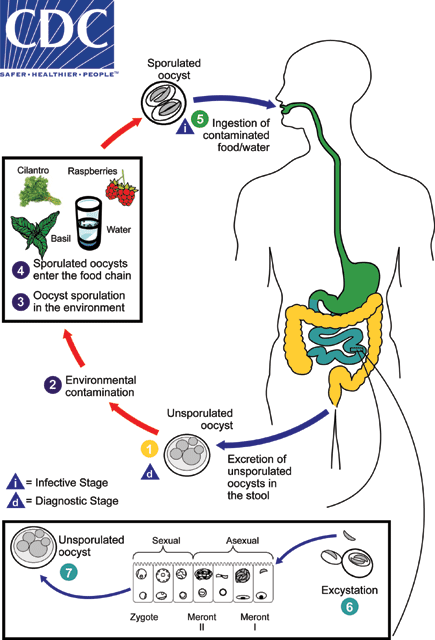
Cyclospora_LifeCycle201

As part of our ongoing efforts to combat foodborne illness and aligned with our New Era of Smarter Food Safety initiative, today, the U.S. Food and Drug Administration released the Cyclospora Prevention, Response and Research Action Plan. Modeled after our Leafy Greens Shiga toxin-producing E. coli (STEC) Action Plan, the plan focuses on improving prevention, enhancing response activities and filling knowledge gaps in order to help prevent Cyclospora contamination of foods and to help prepare for responding to future outbreaks.

Cyclosporiasis is a foodborne intestinal illness caused by Cyclospora cayetanensis. The most common symptoms of cyclosporiasis are diarrhea, weight loss, nausea and fatigue. Cyclospora is historically associated with imported produce or travel outside the U.S.; however, we have also detected Cyclospora in domestically produced foods in recent years.

The FDA first documented Cyclospora in domestically grown produce (cilantro) in 2018 as part of an ongoing sampling assignment of fresh herbs. The testing was done as part of a surveillance sampling, and the cilantro sample was not linked to any illnesses or outbreaks. Not long after, domestically grown produce was again associated with an outbreak linked to a salad mix. During the FDA’s investigations into this outbreak, Cyclospora was also detected in an unused package of the salad containing domestically grown produce.

The availability of new testing methods for Cyclospora developed at the FDA’s Center for Food Safety and Applied Nutrition played an important role in helping the FDA identify these positive samples of Cyclospora in the cilantro and in the salad mix. The number of reported cases of this foodborne illness has been rising in recent years, in part because of better diagnostic and detection methods. According to the Centers for Disease Control and Prevention, there have been roughly 6,000 domestically acquired cases of Cyclospora over the last three years. The number of reported cases typically rises during the spring and summer, usually in May, June and July. Rising case numbers and the emergence of Cyclospora contamination in domestically grown produce prompted the FDA to create the Cyclospora Task Force in 2019. The task force is comprised of multidisciplinary experts across the FDA and CDC, with the goal of reducing the public health burden of foodborne illness caused by Cyclospora in produce.

The task force formulated the action plan announced today, which will serve as a strategic guide to improve prevention, enhance response activities and fill knowledge gaps about the presence of Cyclospora in or on foods. In the area of prevention, the new action plan highlights how we’re addressing this food safety issue through the development and delivery of prevention-focused education materials and outreach to stakeholders. We’re also working with industry to encourage the development of rapid test kits to specifically detect Cyclospora to better facilitate industry testing and root cause analysis activities. In addition, we plan to collaborate with industry to look for ways to more effectively control Cyclospora in the environment and on farms.

In the area of response, the plan is focused on expanding laboratory capacity across the FDA, state, foreign partners and academia to sample and test for Cyclospora, providing greater capacity to investigate during outbreak events. The FDA is also developing a new investigational tool to help guide assessments of farms potentially implicated in a Cyclospora outbreak to determine potential sources and routes of contamination.

Given the emerging nature of Cyclospora contamination in domestic produce, a large number of action items in this plan are aimed at addressing knowledge gaps. In this area, the FDA intends to work with CDC to better understand the case distribution of cyclosporiasis across the U.S. and to advance genotyping methods in clinical, food and environmental samples that will allow us to genetically link clinical cases to food products and environments identified by traceback during an outbreak. As part of this plan, the FDA also intends to work with industry and academia to better understand the prevalence of Cyclospora in agricultural water and to encourage data sharing to help stakeholders identify trends associated with Cyclospora contamination. Our action plan underscores the importance of collaboration across industry, academia, state, federal and foreign government partners, and other stakeholders to reduce the risks and public health burden caused by foodborne Cyclospora. We’ll continue updating this plan as actions are completed and new actions are identified.

While the U.S. has one of the safest food supplies in the world, we are focused on making it better. The FDA is focused on working with all stakeholders to achieve the goals identified in this Cyclospora Prevention, Response and Research action plan.