Category Archives: outbreak

USA – West Virginia hepatitis A outbreak tops 100 cases

Outbreak News Today

As of May 18, 106 cases (98 confirmed, 3 probable, 5 suspect) have been seen. Three-quarters of the cases required hospitalization and no deaths have been reported.

Most (87%) of those cases in have occurred in Kanawha (59) and Putnam (28) counties, with Cabell at 10, and Boone, Jackson, Lincoln, Wayne and Wyoming counties having less than fivPe cases each.

This increase in cases has primarily been among IV and non-IV drug users, homeless or transient individuals, those who have been recently incarcerated, and are co-infected with hepatitis C. Viral sequencing has linked several cases with outbreaks in Kentucky and California.

Hepatitis A virus is excreted from the body through stool. It can live on surfaces for months. Individuals can get Hepatitis A from close personal contact with someone who has the illness, or from encountering food or surfaces and unknowingly ingesting even microscopic particles of contaminated human waste.

Research – Prevalence of Human Noroviruses in Commercial Food Establishment Bathrooms

Journal of Food Protection

Although transmission of human norovirus in food establishments is commonly attributed to consumption of contaminated food, transmission via contaminated environmental surfaces, such as those in bathrooms, may also play a role. Our aim was to determine the prevalence of human norovirus on bathroom surfaces in commercial food establishments in New Jersey, Ohio, and South Carolina under nonoutbreak conditions and to determine characteristics associated with the presence of human norovirus. Food establishments (751) were randomly selected from nine counties in each state. Four surfaces (underside of toilet seat, flush handle of toilet, inner door handle of stall or outer door, and sink faucet handle) were swabbed in male and female bathrooms using premoistened macrofoam swabs. A checklist was used to collect information about the characteristics, materials, and mechanisms of objects in bathrooms. In total, 61 (1.5%) of 4,163 swabs tested were presumptively positive for human norovirus, 9 of which were confirmed by sequencing. Some factors associated with the presence of human norovirus included being from South Carolina (odd ratio [OR], 2.4; 95% confidence interval [CI], 1.2 to 4.9; P < 0.05) or New Jersey (OR, 1.7; 95% CI, 0.9 to 3.3; 0.05 < P < 0.10), being a chain establishment (OR, 1.9; 95% CI, 1.1 to 3.3; P < 0.05), being a unisex bathroom (versus male: OR, 2.0; 95% CI, 0.9 to 4.1; 0.05 < P < 0.10; versus female: OR, 2.6; 95% CI, 1.2 to 5.7; P < 0.05), having a touchless outer door handle (OR, 3.3; 95% CI, 0.79 to 13.63; 0.05 < P < 0.10), and having an automatic flush toilet (OR, 2.5, 95% CI, 1.1 to 5.3; 0.05 < P < 0.10). Our findings confirm that the presence of human norovirus on bathroom surfaces in commercial food establishments under nonoutbreak conditions is a rare event. Therefore, routine environmental monitoring for human norovirus contamination during nonoutbreak periods is not an efficient method of monitoring norovirus infection risk.

USA – Multistate Outbreak of Burkholderia cepacia Complex Infections Associated with the Use of Medline Remedy Essentials No-Rinse Cleaning Foam

uuCDC 


Update May 21, 2018

CDC is collaborating with the Food and Drug Administration (FDA), state and local health departments, and healthcare facilities to investigate a recent outbreak of Burkholderia cepacia complex (Bcc) infections. As of May 21, 2018, CDC confirmed 15 cases of Bcc infections associated with use of Medline (Northfield, IL) Remedy Essentials No-Rinse Cleansing Foam. Seven infections were in patients in Pennsylvania, seven were in California, and one was in New Jersey. These patients were already hospitalized for acute conditions and acquired the infections while hospitalized.

As of May 8, 2018 FDA is advising health professionals and consumers to avoid using all lots of Medline Remedy Essentials No-Rinse Cleansing foam, manufactured by Shadow Holdings dba Bocchi Laboratories (Santa Clarita, CA), as these products might be contaminated with Bcc. Shadow Holdings dba Bocchi Laboratories has recalled certain lots of the product.

The FDA is investigating this matter further to determine whether any additional products or lots may present a risk to consumers.

B. cepacia complex bacteria are environmental pathogens. Infections can be transmitted through infection control lapses, including indirect contact via environmental surfaces. Person-to-person transmission is possible but less common. B. cepacia complex bacteria can grow in aqueous environments, can exhibit resistance to preservatives, and can cause contamination of liquid medications or other liquid products. These factors have led to previous healthcare-associated outbreaks of B. cepacia complex. For additional information on B. cepacia complex bacteria please visit: Burkholderia cepacia in Healthcare Settings(https://www.cdc.gov/hai/organisms/bcepacia.html).

Report adverse reactions or quality problems experienced with the use of this product to the FDA’s MedWatch Adverse Event Reporting program either online, by regular mail or by fax.

The product recall notice and list of products can be found here: Medline Canada, Corp. recalls Remedy Essentials Foaming Cleanser

FDA Alert May 7, 2018 – Multistate Outbreak of Burkholderia cepacia Infections Associated with the Use of Medline Remedy Essentials No-Rinse Cleaning Foam  

Additional updates will be posted as they become available.

USA – Salmonella outbreak over, but CDC says coconut threat lingers

Food Safety News

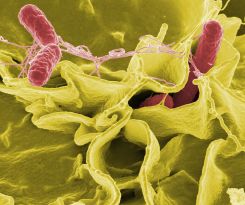
Federal officials say an outbreak of Salmonella traced to dried coconut appears to be over, but they are renewing their public warning about a lingering threat.

Fourteen people across eight states and the District of Columbia were confirmed with the outbreak strain of Salmonella Typhimurium. Three people were admitted to hospitals. The strain was also laboratory confirmed in unopened packages of the coconut. 

“This outbreak appears to be over. However, recalled dried coconut products have a long shelf life and may still be in people’s homes. Consumers unaware of the recall could continue to eat these products and potentially get sick,” according to an update posted Friday by the Centers for Disease Control and Prevention.

USA – Pious Lion pulls kratom after illness, positive Salmonella result

Food Safety News 


A reported illness in North Carolina and state testing that showed Salmonella contamination spurred the Pious Lion company to recall an undisclosed volume of kratom products.

“This is a very serious issue and consumers should take immediate action if they have these products in their homes. Consumers are advised to discard these products and are warned not to consume them,” said Joe Reardon, assistant commissioner of regulatory programs for the North Carolina agriculture department.  

The Asheville, NC, company said in a news release and on its Facebook page that it does not agree with the test results from North Carolina Department of Agriculture and Consumer Services Rapid Response Team.

“Due to concerns about salmonella tainted kratom products, we sent samples of our 9 strains to an independent 3rd party lab for testing. The results just came back and we’re pleased to inform you that all 9 samples came back negative for salmonella,” according to the Pious Lion statement.

USA – Plain Nuts Catering & Deli tied to Salmonella Outbreak

Food Poison Journal

Approximately 70 individuals have reported illness to the Health Department.

The Newton County Health Department is continuing to investigate an outbreak of Salmonella. The initial outbreak was reported to our office on May 4th due to illness among attendees at a closed, invitation only event held in Newton County on April 28th. During the process of investigating this event, the caterer that provided food for this event, Plain Nuts Catering & Deli, was investigated per protocol. All food and drink items along with other exposure possibilities were fully investigated. A survey was developed and sent out to event attendees to gather information on exposures and subsequent illness.

Aremenia – Food safety agents confirm Salmonella as cause of Armavir mass food poisoning incident

Armenpress Salmonella

YEREVAN, MAY 18, ARMENPRESS. The investigation into the mass poisoning incident in Armenia’s Armavir province continues.

The suspected cause – food poisoning – has been confirmed through lab tests.

Salmonellosis has been discovered in all victims.

63 from the overall 88 victims of the food poisoning have already been treated and discharged.

The healthcare ministry says they confirm that the cause was food poisoning.

Earlier the state service for food safety has dispatched agents to Armavir province to probe the suspected food poisoning incident in the plant of Tierras de Armenia – a viticulture and winemaker known for its Karas wines.

Earlier doctors said they suspected the cause of the poisoning to be a lunchtime snack which all of the employees consumed in the cafeteria of the plant.

Agents have taken samples from the facility and sent them for laboratory analysis.

Food safety agents also ceased the operation of a businesswoman’s food supply business in relation to the incident as a precaution. The businesswoman, Alvina Melkonyan, supplied Tierras de Armenia with lunch-time food on the day when the incident happened.

USA – Georgia Announces Salmonella Outbreak

Food Poison Journal

The outbreak was reported to our office on May 4th.  The investigation is ongoing.

We are still investigating the outbreak including identifying the source and commonalities among those that are ill.

Approximately 70 individuals have reported illness to the Health Department.

Many individuals have sought care with their primary physicians and/or urgent care.  At this point we are aware of four individuals who were hospitalized due to their illness.

South Africa – Listeriosis under control, says health minister

Health 24 


The listeriosis epidemic is under control after product recalls, Health Minister Aaron Motsoaledi said during his Budget Vote in Parliament.

Cape Town – The listeriosis epidemic is under control now that meat products from Enterprise and Rainbow Chicken have been recalled, Health Minister Aaron Motsoaledi told Parliament on Tuesday.

“Since the recall, we have had fewer than five cases a week in the past five weeks compared to 40 a week before the recall,” Motsoaledi said during his R205bn Budget Vote in Parliament

Health 24

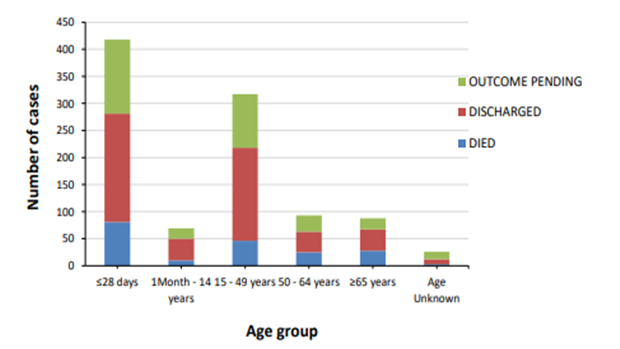
Health24 spoke to Dr Juno Thomas, the Head of the Centre for Enteric Diseases at the NICD, about the severity of the situation. She asserted that while the death toll has risen, it is important to look at the cases as they continue to decline: from 90 cases to 40 cases a week.

She also explained that Listeria affects people with weaker immune systems, making babies and the elderly more vulnerable to the illness. According to Dr Thomas, pregnant women with Listeriosis pass the illness on to the baby through the placenta, “hence the severity in the baby”.

Regarding the second highest group, Dr Thomas attributes this to two factors. “Firstly, women in that group are of childbearing age, and secondly this age group has the highest statistics for HIV, making them a risk factor.”

NICD – Listeria Outbreak Statistics

Information – Will Washing Romaine Lettuce Remove E. coli O157:H7?

Food Poisoning Bulletin 

Consumers are asking questions about this outbreak; namely, how can they protect themselves and their families? One of the questions is: will washing romaine lettuce and other produce eliminate the pathogenic bacteria?

The answer is, unfortunately, no. There are several reasons for this.

First, it only takes 10 Shiga toxin-producing E. coli bacteria to make a person very sick. That tiny amount is invisible to the eye. Washing romaine lettuce will not remove all the bacteria from microscopic surface of every leaf. Experts say that washing romaine lettuce and other produce can only reduce the number of bacteria that may be present, not completely eliminate them.

Second, pathogenic bacteria such as E. coli O157:H7 can form biofilms. These bacteria tend to cluster in small clumps so they can communicate with each other and protect each other. The bacteria produce a matrix made up of proteins, polysaccharides, and nucleic acids. The matrix is very dense and protects the bacteria from cleaning agents. It also protects the bacteria from antibiotics, and even desiccation. A simple rinse with water or a cleaning solution may not penetrate that biofilm.

And finally, the deeply crenelated surface of leafy greens provides lots of places for bacteria to hide. The same is true for other types of produce, especially cantaloupe. And, if there are tiny tears, bruises, or rips in the lettuce leaf, the bacteria can actually get inside. No amount of washing any kind of produce can reach the bacteria then.

The only thing that will kill E. coli bacteria is heat; the food must be heated to 160°F. There are very few recipes that call for cooked romaine lettuce. Grilling romaine lettuce halves will not increase the temperature enough to kill any bacteria that may be present.