Category Archives: Microbiology

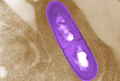
Research – Another Five Listeria – Five new species of Listeria (L. floridensis sp. nov, L. aquatica sp. nov., L. cornellensis sp. nov. L. riparia sp. nov., and L. grandensis sp. nov.)

IJSEM Eurofins Food Testing UK

Sampling of agricultural and natural environments in two US states (Colorado and Florida) yielded 18 Listeria-like isolates that could not be identified as previously described species using traditional methods. Using whole genome sequencing and traditional phenotypic methods we identified five new species, each with a genome wide average blast nucleotide identity (ANIb) of less than 85% to currently described species. Phylogenetic analysis based on 16S rDNA sequences and amino acid sequences of 31 conserved loci showed the existence of four well-supported monophyletic clades within the genus Listeria; (i) a clade representing L. monocytogenes, L. marthii, L. innocua, L. welshimeri, L. seeligeri and L. ivanovii, which we refer to as Listeria sensu stricto, (ii), a clade consisting of L. fleischmannii and two newly described species, L. aquatica sp. nov. (type strain FSL S10-1188T =DSM 26686T =BEI NR-42633T) and L. floridensis sp. nov. (type strain FSL S10-1187T =DSM 26687T =BEI NR-42632T), (iii) a clade consisting of L. rocourtiae, L. weihenstephanensis, and three new species, L. cornellensis sp. nov. (type strain TTU A1-0210T = FSL F6-0969T =DSM 26689T =BEI NR-42630T), L. grandensis sp. nov. (type strain TTU A1-0212T =FSL F6-0971T =DSM 26688T =BEI NR-42631T) and L. riparia sp. nov. (type strains FSL 10-1204T =DSM 26685T = BEI NR- 42634T), and a clade containing L. grayi. Genomic and phenotypic data suggest the novel species are nonpathogenic.

RASFF Alerts – Animal Feed – Salmonella – Dried Pet Food – Dog Chews

RASFF-Logo

RASFF -Salmonella spp. (presence /25g) in dried pet food from China in Germany

RASFF -Salmonella spp. (presence /25g) in dog chew from the Netherlands in Germany

UK – FSA – Consultation on Virus

FSA Virusds

The Advisory Committee on the Microbiological Safety of Food (ACMSF) is a scientific advisory committee that provides the FSA with independent expert advice. This helps the FSA ensure that policy development and consumer advice in relation to the microbiological safety of food are based upon sound science and relevant practical experience and expertise. The Committee’s terms of reference are to assess the risk to humans from microorganisms that are used or occur in or on food and to advise the FSA on any matters relating to the microbiological safety of food.

Since the publication of the 1998 ACMSF report on foodborne viral infections, with the exception of minor risk assessment work carried out on hepatitis E and avian influenza, no formal review has been carried out on foodborne viruses.

At the March 2010 ACMSF meeting the FSA asked the Committee to consider whether it was timely to carry out a review of foodborne viral infections, assessing the risk to consumers and highlighting any research and surveillance gaps.

The Committee agreed that an ad hoc group should be set up to revisit the issue of foodborne viruses in light of the significant developments in this area, so that an updated risk profile could be produced based on the findings.

The group met 13 times from November 2010 to July 2013 to assess the extent of viral foodborne infection in the UK.

The group considered information on all foodborne viruses including new and emerging viral pathogens and identified that the most important viruses associated with foodborne infection were norovirus, hepatitis A virus, and hepatitis E virus. These viruses are the focus of the group’s report, which concentrates mainly on viral foodborne infection in the UK. The report also gives consideration of two recent comprehensive reviews of viruses in food that have been published by WHO (2008) and EFSA (2011). The report provides key information that will be used to inform Risk Assessments and Risk Management on foodborne viruses across government.

The group’s draft report has now been approved by the full Committee and is attached for comment.

Canada – CFIA Recalls – Listeria monocyotgenes – Cheese and Bakery Products

CFIA CIFA

Federated Co-operatives Ltd. is recalling Co-op and Market Town Co-op brands bakery products from the marketplace due to possible Listeria contamination. Consumers should not consume the recalled products described below.

Recalled products

Brand Name Common Name Size Code(s) on Product UPC
Co-op California Garlic Bread None Best Before dates up to and including 14 MR 23 0 057316 130112
Co-op Garlic/Cheese Bread 250 g Best Before dates up to and including 14 MR 23 0 057316 073969
Co-op Garlic/Cheese Bread 2 Pk 450 g Best Before dates up to and including 14 MR 23 0 057316 146847
Market Town Co-op Pizza Bread 425 g Best Before dates up to and including 14 MR 23 0 057316 040305

CFIA

The Meat Shoppe Inc. is recalling The Meat Shoppe brand shredded cheese products from the marketplace due to possible Listeria contamination. Consumers should not consume the recalled products described below.

 Recalled products

Brand Name Common Name Size Code(s) on Product UPC
The Meat Shoppe Shredded Cheddar Cheese Variable Packed On dates from 2014JA08 up to and including 2014MR03 Starting with 200923
The Meat Shoppe Shredded Mozza Cheese Variable Packed On dates from 2014JA08 up to and including 2014MR03 Starting with 200922

Canada – CFIA – Recall – Chicken Breast – Listeria monocytogenes

CFIA Eurofins Food Testing UK

Freshouse Foods Ltd. is recalling Kirkland Signature brand Grilled Chicken Breast Strips from the marketplace due to possible Listeria contamination. Consumers should not consume the recalled product described below.

The following product is known to have been sold in Ontario, Quebec, New Brunswick, Nova Scotia, Newfoundland and Labrador, but may also have been sold in other provinces.

 Recalled products

Brand Name Common Name Size Code(s) on Product UPC
Kirkland Signature Grilled Chicken Breast Strips 2 x 500 g Best Before APR13-APR26, inclusive 0 96619 70787 4

RASFF Alerts – Aflatoxins – Pistachio Nuts – Peanuts – Ochratoxin – Black Pepper

RASFF-Logo

RASFF -aflatoxins (Tot. = 18.4 µg/kg – ppb) in pistachio nuts from Iran in Germany

RASFF -aflatoxins (B1 = 45.9; Tot. = 47.5 µg/kg – ppb) in peanut kernels from Mauritius, via the Netherlands in Germany

RASFF -aflatoxins (B1 = 60.5; Tot. = 68.0 µg/kg – ppb) in pistachio kernels from Iran, dispatched from Turkey in Italy

RASFF -aflatoxins (B1 = 6.6; Tot. = 7.5 µg/kg – ppb) in blanched peanuts from China in France

RASFF-aflatoxins (B1 = 29.8 µg/kg – ppb) in pistachio nuts from Turkey in Germany

RASFF -ochratoxin A (22.5 µg/kg – ppb) in whole black pepper from India in Belgium

RASFF Alert – Listeria monocytogenes – Enoki Mushrooms – Raw Milk Cheese – Cheese

Food Testing - Eurofins

RASFF -Listeria monocytogenes (1 out of 5 subsamples /25g) in chilled enoki mushrooms from South Korea, via the Netherlands in Greece

RASFF-Listeria monocytogenes (positive) in sheep’s milk to produce raw milk cheese from Spain in Portugal

RASFF -Listeria monocytogenes (–> 80 CFU/g) in chilled pasteurised sheep’s milk cheese from France

RASFF -Listeria monocytogenes (brie: 1200, 1810, 156000, 10000; camembert: 4700, 237000, 4000, 519000 CFU/g) in frozen brie and camembert from Germany

RASFF Alert – E.coli – Mussels – Clams -STEC in Beef

RASFF-Logo

RASFF -too high count of Escherichia coli (400 MPN/100g) in live mussels (Mytilus galloprovincialis) from Greece in Italy

RASFF -too high count of Escherichia coli (16.000 MPN/100g) in chilled clams (Tapes philippinarum) from Italy

RASFF – shigatoxin-producing Escherichia coli (STEC present in 12/15 samples) in frozen boneless beef meat from Argentina in Germany

RASFF Alerts – Animal Feed – Aflatoxins – Maize -Mais

RASFF-Logo

RASFF -aflatoxins (B1 = 62.7 µg/kg – ppb) in maize from Romania in Italy

RASFF -aflatoxins (B1 = 96.7 / B1 = 93.5 µg/kg – ppb) in mais from India in Italy

RASFF Alerts – Animal Feed – Salmonella – Dog/Cat Food – Egg White – Poultry – Dog Chews – Fish Meal

RASFF-Logo

RASFF -Salmonella in dried dog/cat food from China in Germany

RASFF -Salmonella (in 4 out of 5 samples /25g) and too high count of Enterobacteriaceae (>30000 CFU/g) in centrifuged egg white from Belgium

RASFF -Salmonella in processed animal proteins (poultry) from the Netherlands in Belgium

RASFF-Salmonella spp. (presence) in dog chews from Thailand in Spain

RASFF -Salmonella Tennessee (present /25g) in fish meal from Denmark in Sweden