Category Archives: Microbiology

Research – Synergistic antibacterial effect of nisin, ethylenediaminetetraacetic acid, and sulfite on native microflora of fresh white shrimp during ice storage

Wiley Online

This study aims to investigate the effectiveness of using nisin, ethylenediaminetetraacetic acid (EDTA), and sulfite alone or in combination in reducing Vibrio parahaemolyticus Salmonella enterica , and Pseudomonas fluorescens in broth and native microflora on raw Pacific white shrimp during ice storage. Nisin (50 ppm), EDTA (20 mM), alone or in combination were used to test on the growth of parahaemolyticus enterica , and fluorescens in broth. Nisin (50 ppm), EDTA (20 mM), sodium metabisulfite (1.25 and 0.625%), ice; alone or in combination were used on shrimps during 1°C storage for 10 days. Microbial and chemical changes were analyzed during shrimp storage. First, the combination of nisin and EDTA exhibited antibacterial effects against parahaemolyticus enterica , and fluorescens in broth. Second, in shrimp preservation, the combination of nisin, EDTA, and sulfite at a low dose of 0.625% exhibited higher antimicrobial activity than did a high dose of sulfite (1.25%). Based on aerobic bacteria counts, psychrotrophic bacteria, and TVB‐N, shrimp treatment with combination of nisin, EDTA, and low‐dose sulfite were still acceptable within 10 days of storage. Based on our findings, nisin and EDTA can be used to reduce uses of sulfite for shrimp preservation in the future.

Italy – Italy records nearly 80 HUS cases in 12 months

Food Safety News

Almost 80 hemolytic uremic syndrome (HUS) cases were registered between July 2019 and June 2020 in Italy.

The 77 patients came from 17 regions in the country while one person contracted HUS while abroad. Notification rates varied by region but were highest in Aosta Valley and higher than 1 case per 100,000 in Basilicata, Calabria, Liguria, Lombardy, Marche, Trento, and Bolzano.

Seventy of those affected were under 15 years of age. The median age of patients at the clinical onset of the disease was 2 years and 7 months for the past 12 months and the past decade.

USA – CDC Closes Atlanta Buildings After Finding Legionella

Outbreak News Today

CDC legionella

Image CDC

The CDC closed several buildings it leases in Atlanta after finding legionella bacteria in the plumbing. “During the recent closures at our leased space in Atlanta, working through the General Services Administration (GSA), CDC directed the landlord to take protective actions,” CDC told CNN.

“Despite their best efforts, CDC has been notified that Legionella, which can cause Legionnaires’ Disease, is present in a cooling tower as well as in some water sources in the buildings. Out of an abundance of caution, we have closed these buildings until successful remediation is complete.”

Research – Survival of Staphylococcus aureus and Salmonella enteritidis on salted sardines (Sardina pilchardus) during ripening

PubMed

The ripening period for salted sardines ranges from 4 to 6 months, depending on the season. Sometimes producing industries need to distribute the product earlier owing to market needs, and when this happens the product’s safety needs to be assured. The purpose of this work was to study the survival of Staphylococcus aureus and Salmonella Enteritidis on salted sardines during a ripening period of 115 days. Salted sardines were inoculated with pure cultures of S. aureus and Salmonella Enteritidis (10(5) CFU/g of fish on day 0). After 5 days of ripening, the water activity value for the sardines decreased from 0.93 to 0.69. The survival of both pathogens and that of total viable cells were evaluated during the ripening process. Total viable counts decreased by 2 log units over the 115-day ripening period. Salmonella Enteritidis and S. aureus survived for 60 and 90 days, respectively. Therefore, the use of a 90-day ripening period could be effective in assuring the safety of the final product.

USA – Cyclospora Outbreak in Texas

Outbreak News Today

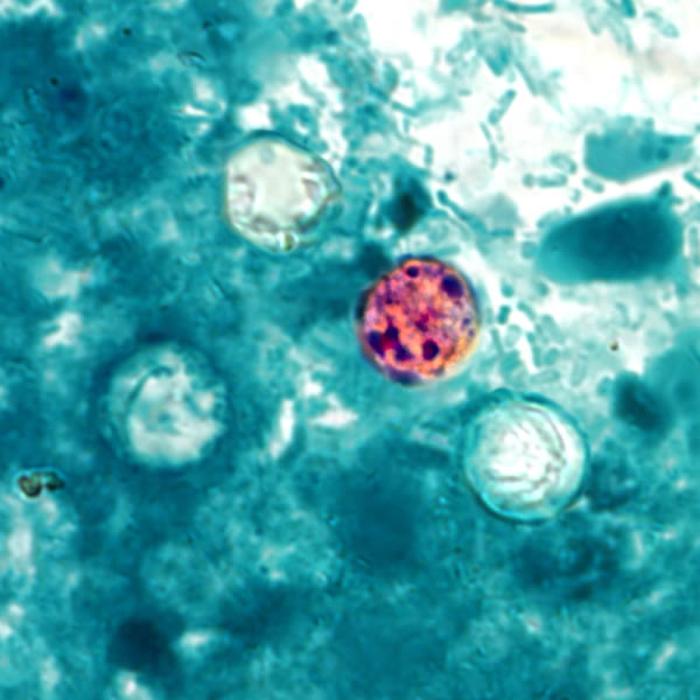
Austin Public Health (APH) announced it was investigating an outbreak of Cyclospora, an intestinal illness caused by a parasite, after at least 82 cases have been reported since June 1, 2020. This Austin-Travis County Cyclospora Outbreak does not yet have an identified source.

According to  APH Epidemiologist Janet Pichette, “While we may be in COVID-19 season, we cannot forget the other diseases and infections that are commonly present in our community. And as we have said time and time again, there are ways to prevent many of these diseases and infections, including cyclosporiasis – thoroughly wash fresh produce, wash your hands after handling fruits and vegetables, and separate produce from raw meat and seafood.”

Until a source is found, the APH reminds all Texas residents to wash their hands and their produce.

Research – Cold-sensitive staphylococci reveal a weakness

Science Daily

MRSA Staphylococcus KSW Food World

Image CDC

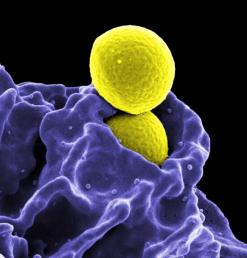
Staphylococcus aureus” — also known as “golden staph” — has the ability to develop in highly variable environmental conditions (on the skin, in the nose, on sterile surfaces, and so forth). Its great adaptability depends especially on a protein (an RNA helicase) involved in the degradation of RNA messengers that have become useless. In their attempts to have a better understanding of how this helicase works, scientists from the University of Geneva (UNIGE) discovered that it contributes to another physiological process, without any apparent link to the first: the synthesis of the fatty acids that are the essential constituents of the bacterial membrane. This advance, to be published in the journal PLoS Genetics, offers an interesting insight since fatty acid synthesis is precisely one of the targets favoured by numerous laboratories to fight this pathogen that is difficult to treat due to its resistance to antibiotics.

Golden staph (Staphylococcus aureus) is an opportunistic pathogenic bacterium that is capable of adapting to highly variable environments. It can be found in the nostrils of 25 to 30% of the population, although this is generally not a problem. However, the bacterium can take advantage of a drop in immunity or a surgical operation to trigger a real infection. And the problem with golden staph is its ability to develop resistance to antibiotic drugs, which often makes it difficult — sometimes impossible — to treat.

“My laboratory studies a protein, RNA helicase, which plays an important role in golden staph’s ability to adapt to very different environments,” begins Patrick Linder, a professor in the Department of Microbiology and Molecular Medicine in UNIGE’s Faculty of Medicine. “When the environment changes, the bacterium has to be able to synthesise new proteins that are more suitable and stop the production of others that are no longer useful. The helicase we’re interested in — called CshA — is involved in the degradation of the RNA, those molecules derived from the DNA and used in protein synthesis.”

Cold-sensitive bacteria

Oddly enough, when the helicase is absent (due, for example, to a genetic mutation), the researchers found that the cultured bacteria could no longer form colonies if the temperature dropped below a certain threshold (around 25°C).

The Geneva-based biologists undertook a series of experiments designed to improve our understanding of the link between golden staph’s sensitivity to cold, the degradation of the RNA and the adaptation capacity. They discovered that the same helicase is probably also required in another physiological process, namely the synthesis of fatty acids, which are the constituents of bacterial membranes.

“Using cultured golden staph stripped of helicases, we succeeded in isolating 82 gene mutations (appearing spontaneously in many different bacteria), which meant that their holders regained the ability to form colonies at 25°C,” continues Vanessa Khemici, a researcher in Patrick Linder’s laboratory and the article’s first author. “We identified almost all the affected genes, and no less than two thirds of them are involved in the fatty acid synthesis.”

The findings also helped the researchers understand that the lack of the helicase has the effect of deregulating the fatty acid synthesis and decreasing the flexibility of the membrane when the temperature drops. This prevents the membrane from fulfilling its functions properly and the bacterium from growing. In a second step, each of the 82 mutations succeeded in its own way in restoring the initial balance by acting on the different genetic levers involved in fatty acid synthesis.

Scientific controversy

“A section of the scientific community supports the idea that a future treatment against staphylococcus will involve a drug capable of inhibiting fatty acid synthesis,” notes Professor Linder, “but there is a controversy about it because some studies contradict this point of view.”

The results of the Geneva scientists do not provide a clear-cut answer or make it possible to directly develop a drug against these bacteria. Nevertheless, they fit into this context and provide a better understanding of golden staph’s fundamental mechanisms. The discovery of this unprecedented link between the fluidity of the membrane and adaptation to environmental change represents an important step in the fight against the bacterium. It is undoubtedly for these reasons that the journal decided to publish an overview in parallel with the article.


Story Source:

Materials provided by Université de GenèveNote: Content may be edited for style and length.


Journal Reference:

  1. Vanessa Khemici, Julien Prados, Bianca Petrignani, Benjamin Di Nolfi, Elodie Bergé, Caroline Manzano, Caroline Giraud, Patrick Linder. The DEAD-box RNA helicase CshA is required for fatty acid homeostasis in Staphylococcus aureusPLOS Genetics, 2020; 16 (7): e1008779 DOI: 10.1371/journal.pgen.1008779

UK – Sainsbury’s recalls by Sainsbury’s semi-skimmed UHT milk because of possible microbiological contamination

FSA

Sainsbury’s has taken the precautionary step of recalling by Sainsbury’s semi-skimmed less than 2% fat 1 litre UHT milk because of possible microbiological contamination that could lead to spoilage. This may make the product unsafe to consume.

Product details

by Sainsbury’s semi-skimmed less than 2% fat UHT milk
Pack size 1 litre
Best before 28 December 2020 and 29 December 2020

Risk statement

Possible microbiological contamination may make the product unsafe to consume.

Action taken by the company

Sainsbury’s is recalling the above product. Point of sale notices will be displayed in all retail stores that are selling this product. These notices explain to customers why the product is being recalled and tell them what to do if they have bought the product. Please see the attached notice.

Our advice to consumers

If you have bought any of the above product do not consume it. Instead, return it to the store from where it was bought for a full refund when next visiting for groceries and other essentials. Alternatively contact Sainsbury’s careline on 0800 636262.

Legionella – What Landlords Need to Know About Legionella

Legionella Control 

This article provides a compilation of the most frequently asked questions we receive from landlords about the control of legionella in their properties and what they need to do to comply with the law. It covers a range of popular questions with comprehensive answers from our experts, along with a number of free downloads (full versions) for key guides produced by the Health and Safety Executive dealing with the control of legionella including their ACOP L8 and HSG274 Parts 1, 2 and 3.

USA – Which Stores Sold Onions Recalled For Possible Salmonella?

Food Poisoning Bulletin

The newest Salmonella Newport outbreak has sickened at least  396 people in 34 states and has hospitalized 59. The outbreak is potentially linked to red onions sold by Thomson International. Those onions were recalled last week. But which stores sold the onions recalled for possible Salmonella contamination? And are products made with those onions recalled?

According to recall notices posted on their web sites, ALDI, Food Lion, Giant Eagle/Market District, Kroger, Publix, Stop & Shop/Giant Food Stores, Smiths, Fry’s, Fred Meyer, and Walmart allegedly sold these onions under various store names and brand names, and some were used to make other products such as salads and stir fries.

RASFF Alerts – Animal Feed – Salmonella – Sunflower Seed Pellets – Pet Food

RASFF-Logo

RASFF – Salmonella enterica ser. Senftenberg (presence /25g) in sunflower seed pellets from the Netherlands in Belgium

RASFF – Salmonella (presence /25g) in pet food from Spain in Italy