Category Archives: Microbiology

Norway – Norwegian surveillance finds low levels of Salmonella

Food Safety News

Norwegian cattle, swine and poultry are only rarely infected with Salmonella, according to the results of surveillance programs in 2020.

Occurrence of Salmonella in Norwegian production animals and animal products is very low compared to most other countries. Salmonellosis has increased in recent decades but the majority of infections are acquired abroad.

Surveillance covers live animals such as pigs, poultry and cattle, eggs and fresh meat from pigs and cattle. Any Salmonella isolated in the programs is notifiable to the Norwegian Food Safety Authority (Mattilsynet). The Norwegian Veterinary Institute coordinates the surveillance programs, examines fecal samples and reports the results. Private laboratories analyze samples collected at slaughterhouses and cutting plants.

Programs are approved by the EU Commission which allows Norway to require additional guarantees on Salmonella when importing live animals and food products of animal origin from the European Union.


Korea – Food poisoning bacteria found in 15 kimchi products from China

Korean Times

Yersinia p

Food poisoning bacteria were detected in 15 out of 289 kimchi products imported from China, according to the Ministry of Food and Drug Safety, Tuesday.

Two out of four Chinese salt-cured cabbage products were also found to have used preservatives that are not permitted in Korea.


It examined the 289 products from 55 Chinese companies imported here, and detected Yersinia enterocolitica, a type of food poisoning bacteria, in 15 of them.

Research – Scientists discover five new species of listeria, improving food safety

Eurekalert

Listeria kswfoodworld food safety food poisoning

Image CDC

While examining the prevalence of listeria in agricultural soil throughout the U.S., Cornell University food scientists have stumbled upon five previously unknown and novel relatives of the bacteria.

The discovery, researchers said, will help food facilities identify potential growth niches that until now, may have been overlooked – thus improving food safety.

“This research increases the set of listeria species monitored in food production environments,” said lead author Catharine R. Carlin, a doctoral student in food science. “Expanding the knowledge base to understand the diversity of listeria will save the commercial food world confusion and errors, as well as prevent contamination, explain false positives and thwart foodborne outbreaks.”

France – Product recall: JOSEP LLORENS brand chorizo ​​sarta picante – Salmonella

Oulah

Product recall: JOSEP LLORENS brand chorizo ​​sarta picante

ENCOUNTERED PROBLEM

Presence of salmonella

PROPOSED SOLUTION

People who may have this product are asked not to consume it and to return it to the point of sale where it was purchased.

Foodborne illness caused by salmonella results in gastrointestinal disturbances, diarrhea, vomiting and abdominal pain, often accompanied by fever; these symptoms may be more severe in young children, immunocompromised individuals and the elderly. The incubation period can range from 6 to 72 hours.
People who have consumed the products mentioned below and who have these symptoms are invited to consult their doctor, notifying him of this consumption.

FURTHER INFORMATION

▸ Barcode
8436004991341


▸ Lot
1021


▸ DLC – DDM
09/26/2021


▸ Health mark
ES 10.01760 / ZA


▸ Consumer service contact
For any further information, you can contact the Josep Liorens consumer service by dialing number: 06 89 02 05 18 – Non-surcharged call from Monday to Friday from 7 am to 3 pm.


▸ Source
https://www.carrefour.fr/

Research – Presumptive probiotic bacteria from traditionally fermented African food challenge the adhesion of enteroaggregative E. coli

Wiley Online

E.coli

Colonization of intestinal tract with the potential to exclude, displace, and inhibit enteric pathogens is principally dependent on the adhesion ability of probiotics. Therefore, probiotic efficacy is considered to be mainly determined by their adhesion ability. The current study reports the antagonistic effect of four lactic acid bacteria (LAB) on the adhesion profile of four diarrhoeagenic and one non‐diarrhoeagenic enteroaggregative Escherichia coli (EAEC). All the bacterial strains investigated adhered to the Caco‐2 cells. All the LAB tested competitively excluded, displaced, and inhibited at least three (non‐) diarrhoeagenic EAEC strains from adhesion (p < 0.05). In all, Lactobacillus plantarum, FS2 exhibited the strongest adhesion to the Caco‐2 cells, competitive exclusion (CE), displacement, and inhibition against most of the EAEC strains. Additionally, the competence to exclude, displace, and inhibit the EAEC from adhesion depended on both the pathogens and the LAB strains tested; signifying the participation of several mechanisms. Contrary to all the EAEC strains, gastro‐intestinal stress factors such as low pH (2.5) had no effect on the adhesion of the LAB. Unlike the gastro‐intestinal acidic conditions, bile salt conditioning (at pH 6.5) had no effect on the adhesion of both EAEC and LAB. In conclusion, all the LAB tested showed specific anti‐adherence effects including CE, displacement, and inhibition against the selected EAEC. The results indicate that all the LAB, particularly, the L. plantarum, FS2 had a good ability for exerting antagonistic effects against the selected EAEC for the prevention of gastrointestinal infection.

Research – Survey of New Zealand poultry consumers handling of raw poultry and food safety awareness to provide insight into risk factors for campylobacteriosis

Journal of Food Protection

CDC Campy

New Zealand (NZ) has a high rate of reported campylobacteriosis cases. Cross-contamination in home kitchens during poultry handling is considered to be the main factor in campylobacteriosis transmission. The main aim of this study was to measure NZ consumers’ food safety awareness and self-reported food safety practices associated with handling raw poultry. This study will contribute to the existing knowledge to explain the reasons behind the increase of campylobacteriosis incidents. Findings can help inform future consumer education campaigns to help reduce the incidence of campylobacteriosis in NZ. A cross-sectional survey comprised of 31 multiple-choice questions was designed, piloted, and utilized to collect information about the last time consumers purchased and prepared raw poultry at home. A street-intercept survey in public places, such as supermarkets in the Canterbury region, was used to recruit respondents for this study. A descriptive and inferential data analysis was performed, including a one-way ANOVA test used to compare the mean scored responses between the respondents among different socio-demographics. Overall, 301 valid responses were obtained. Scores, representing reported safe food safety practices ranged between 2 and 19 (maximum 21) with a mean score of 9.83 (standard deviation 3.50 with a standard error of 0.20). There was some variation of correctly answered questions by the respondents for food hygiene (25%), cross-contamination prevention (55%), temperature control and storage practices (49%), and food safety (52%). Approximately 30% of the respondents reported symptoms of a foodborne disease experience once to four times during the past 12 months. The study identified low adherence to current recommended food safety practices, including safe food storage and temperature control. The findings can be used to inform a communication campaign regarding food safety needs to be designed urgently in NZ to reduce the rate of campylobacteriosis.

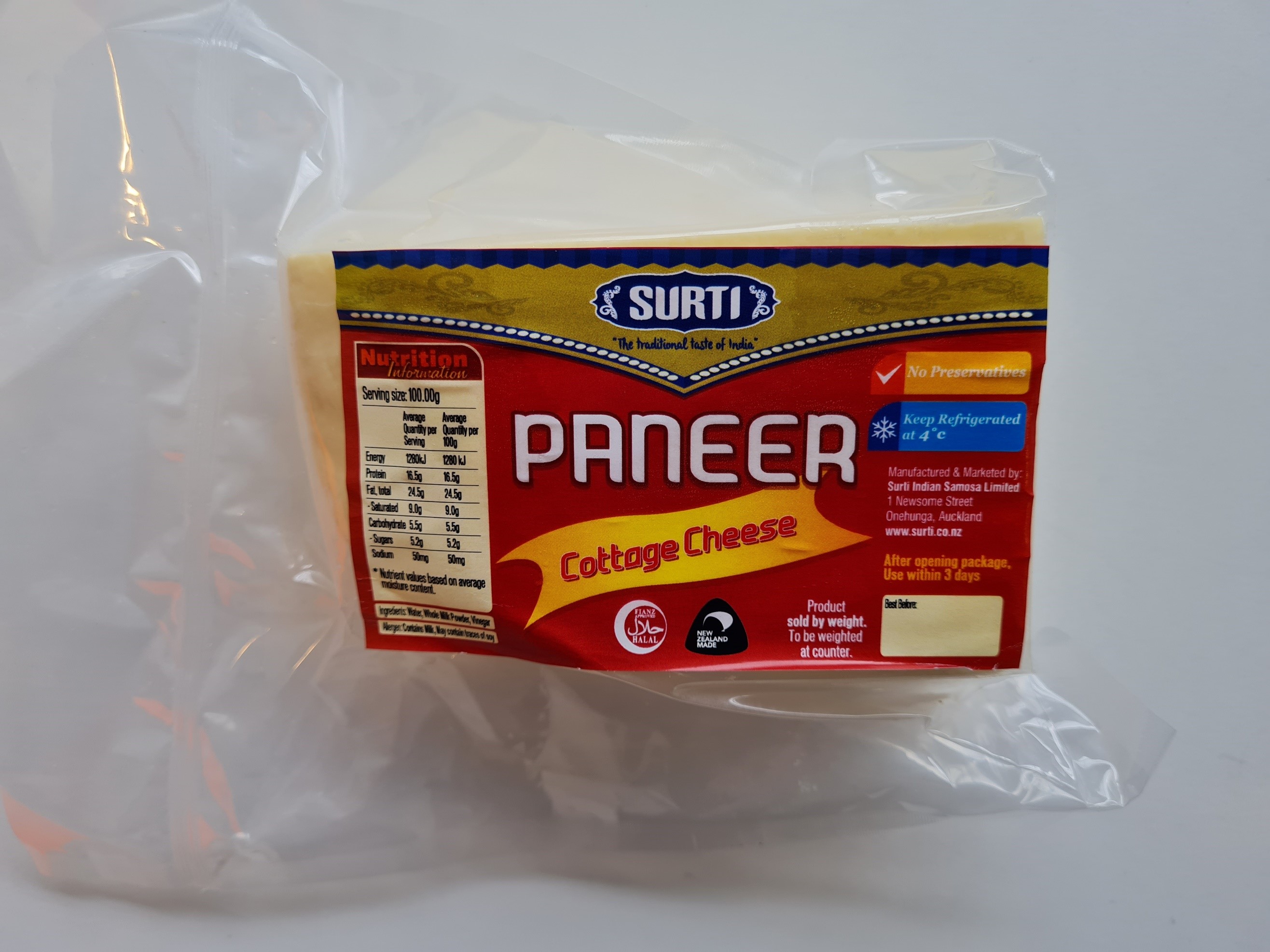
New Zealand – Surti brand Paneer – E.coli

MPI

Surti brand Paneer

18 May 2021: Surti Indian Samosa Limited is recalling a specific batch of Surti brand Paneer due to the possible presence of E.coli.

Surti brand Paneer (various weights).
Product identification

Product type

 Cheese

Name of product (size)

 Surti brand Paneer (various weights)

Date marking

Best before 30JUN21

Package size and description

The product is sold in plastic packaging of various weights of approximately 200g to 500g.

Distribution

The product is sold at ethnic retail stores throughout New Zealand.

Auckland

  • Angels Spice and Superette, 284 Blockhouse Bay Road, Avondale, Auckland
  • Arjun Supermarket, 5 Rankin Avenue, New Lynn Auckland
  • ARKH Food and Spices Limited, 1/222 Swanson Road, Auckland
  • Bikanervala, 2 White Swan Road, Mount Roskill, Auckland
  • Bombay Chinese, Queens Court, 368 Queen Street, Auckland
  • Chevalier Produce, 34 Fremlin Place, Avondale, Auckland
  • Continental Halal Meats and Spices, 57G Cavendish Drive, Manukau, Auckland
  • Get Fresh Mangere, 99 Westney Road, Mangere, Auckland
  • Get Fresh Otahuhu, 81 Station Road, Otahuhu, Auckland
  • Jay’s Fresh Mart Auckland, 59 Shirley Road, Papatoetoe, Auckland
  • Kelvin Fruit and Vege Shop Auckland, 8 Mahia Road, Manuwera, Auckland
  • Lotus Supermarket, 43B Cavendish Drive, Manukau, Auckland
  • Lotus Supermarket, 64 Stoddard Road, Mount Roskill, Auckland
  • Madinah Halal Meats, 1/16 Lambie Drive, Auckland
  • Massey Fruit and Vege, 1/2 Triangle Road, Massey, Auckland
  • Namaste Delhi Limited, 89 Great South Road, Epsom, Auckland
  • Om Sai Foods & Spices, 3A/7 Reeves Road, Pakuranga, Auckland
  • Patel Brothers Supermarket, 26 Carr Road, Mount Roskill, Auckland
  • Point Chev Fresh, 1104/D Great North Road, Point Chevalier, Auckland 1
  • Puhinui Superette, 202 Puhinui Road, Papatoetoe, Auckland
  • Raavi Foods And Spices Trading Limited, 421 Richardson Road, Mount Roskill Auckland
  • Saffron Foods Henderson, 214 Universal Drive, Henderson, Auckland
  • Spice Corner, 691 Manukau Road, Royal Oak, Auckland
  • Vege Oasis Mangere, 376 Massey Road, Mangere East, Auckland
  • Volt Convenience Store CBD, 107 Mayoral Drive, Auckland
  • Yogiji’s Food Mart, 7/251 Lincoln Road, Henderson, Auckland
  • Younus Halal Meat and Spices Limited, 1482B Dominion Road, Mount Roskill, Auckland

Christchurch

  • Krazy Price Mart Limited, 429 Tuam Street, Philipstown

Wellington

  • Indian Stores Limited, 218A Riddiford Street, Newtown

Notes

This recall does not affect any other Surti brand products.

Consumer advice

Customers are asked to check the date mark printed on the back of the product packaging.

Affected product should not be consumed unless it is cooked thoroughly (piping hot all the way through). There have been no reports of associated illness. However, if you have consumed any of this product and have any concerns about your health, seek medical advice.

Customers should return the product to their retailer for a full refund or cook thoroughly (piping hot all the way through).

Escherichia coli (E.coli) is a bacterium that normally lives in the intestines of people and other warm-blooded animals. Although most strains of E.coli are harmless, some types can cause serious illness, with severe diarrhoea and stomach cramps.

Who to contact

If you have questions, contact Surti Indian Samosa Limited.

  • Phone: 09 273 4164
  • Address: 1 Newsome Street, Onehunga, Auckland.

France – Product recall: TEMPE brand superior chipolata – Salmonella

Oulah

Product recall: TEMPE brand superior chipolata

ENCOUNTERED PROBLEM

Presence of salmonella

PROPOSED SOLUTION

People who may have this product are asked not to consume it and to return it to the point of sale where it was purchased.

Foodborne illness caused by salmonella results in gastrointestinal disturbances, diarrhea, vomiting and abdominal pain, often accompanied by fever; these symptoms may be more severe in young children, immunocompromised individuals and the elderly. The incubation period can range from 6 to 72 hours.
People who have consumed the products mentioned below and who have these symptoms are invited to consult their doctor, notifying him of this consumption.

FURTHER INFORMATION

▸ Names of models or references
Chipolata


▸ Barcode
3301091901168


▸ Lot
125


▸ DLC – DDM
05/22/2021


▸ Packaging
packaged in a protective atmosphere


▸ Start date / End of marketing
From 05/10/2021 to 05/14/2021


▸ Health mark
FR 68-122-001 CE


▸ Consumer service contact
0805385749


▸ Source
MAURER TEMPE ALSACE

WHO – DRAFT WHO GLOBAL STRATEGY FOR FOOD SAFETY 2022-2030

WHO

Introduction

Why an updated global food safety strategy?

Safe food is a primary determinant of human health. It is a basic human right to have access to safe and healthy food. In seeking to guarantee this right, governments must ensure that available food meets safety standards.

This task is not easy as the world is now more interconnected, and food systems are changing faster than ever. Foods are produced, managed, delivered and even consumed in ways that could not have been anticipated two decades ago.

These factors call for a fresh global approach to improve food safety that aims to strengthen national food safety systems while improving international and national collaboration.

While recognizing that food safety is a shared responsibility among multiple stakeholders, countries must show leadership in adopting and implementing food safety policies which ensure that each stakeholder knows–and correctly plays –their part.

However, access to sufficient, safe, and wholesome food for all remains an elusive goal. Economic disparities within and across countries, including marked differences in the strength of national food safety systems and complex dynamics that operate within food systems, have significantly slowed progress towards achieving this goal.

Italy – Candia Milk High Digestibility 1% fat – Microbial Contamination

Salute

Brand : CANDIA

Name : Candia Milk High Digestibility 1% fat

Reason for reporting : Recall due to microbiological risk

Publication date : 14 May 2021

Documentation

Documentation