Category Archives: Microbiological Risk Assessment

Research – Influence of Different Stainless-Steel Finishes on Biofilm Formation by Listeria monocytogenes

Journal of Food Protection

Biofilm formation of L. monocytogenes on stainless steel, a widely used abiotic surface in the food processing industry was investigated, focusing on the attachment tendency and behavior of L. monocytogenes 08-5578 on eight different Stainless-steel surfaces: glass bead blasted (rough and fine), deburred (Timesaver), drum deburred, pickled, pickled and drum polished, electrolytic polished and cold rolled (untreated control). The aim was to see if there are finishes with significant lower bacterial attachment. Roughness properties (Ra, Rt, Rz, RSm; determined by interferometry) were also compared with number of adhering cells to detect possible correlations. Cultivation of L. monocytogenes biofilms was carried out using a CDC biofilm reactor (CBR) with 1% TSB set at 20°C for 4, 8, and 24 h. Additionally, a cultivation trial was run with continuous nutrient flow (1% TSB, 6.2 ml/min) for 24 h. Eight hour results showed significant difference ( P < 0.05) in biofilm cell counts in biofilms between the glass bead blasted surfaces (3.23 and 3.26 log CFU/cm 2 for the fine and rough, respectively) and deburred (Timesaver) surface (2.57 log CFU/cm 2 ); between drum deburred and deburred (Timesaver) surface (3.41 vs 2.57 log CFU/cm 2 ); between drum deburred and pickled surface (3.41 vs 2.77 log CFU/cm 2 ). Data gained after 4, 24 h and the additional 24 h continuous flow cultivation showed no significant difference in attachment among surfaces. No correlation between roughness data and attachment was found after all 4 incubation times, suggesting that roughness values, at these ranges, are insufficient in determining surfaces’ affinity to bacteria. This study suggests that roughness values cannot be used to predict the degree of L. monocytogenes attachment to a specific stainless steel surface.
Research – Incidence of Food Poisoning Outbreaks in Pahang, Malaysia, for Six-Year, from 2013 to 2018

Pertanika

The Food Safety and Quality Division (FSQD) in Malaysia is the competent authority tasked with ensuring food safety throughout the food supply chain within the country. Despite implementing various regulations toward improving food hygiene standards in Malaysia, outbreaks of food poisoning cases continued to occur in Malaysia. This cross-sectional study was designed to explore the occurrence of food poisoning incidents in Malaysia, within the Pahang state, from 2013 to 2018 via both reported passive case detection (PCD) and active case detection (ACD) food poisoning incidents. Upon detecting all the food poisoning cases using both PCD and ACD, the people identified to have suffered from food poisoning underwent a structured interview for investigators to elicit all relevant information about the food poisoning incident. Results showed that in Pahang, the number of reported episodes fluctuated from 2013 until 2018, with an average of 21 food poisoning episodes occurring yearly, reaching a maximum in August and a minimum in May. Furthermore, Kuantan, being the state capital, had reported an exceptionally high total number of reported incidents of food poisoning with a total of 48 episodes over six years from 2013 to 2018, while Kuala Lipis had only one incident reported during the same period (which was reported in 2016). Finally, this study concluded that adequate measures must always be taken to minimise the occurrence of food poisoning, especially when preparing foods in large quantities.

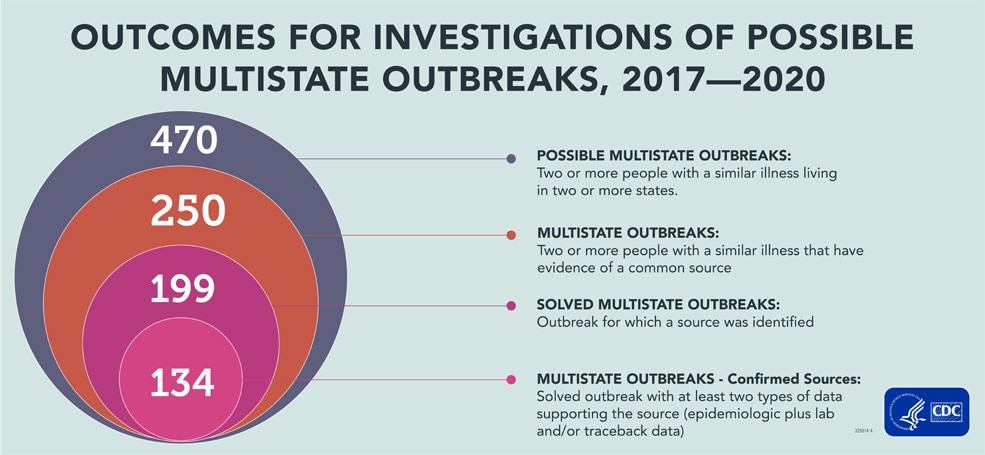
Research – USA – Summary of Possible Multistate Enteric (Intestinal) Disease Outbreaks in 2017–2020

CDC

This analysis includes 470 possible multistate outbreak investigations during 2017–2020.

Research – Examining Patterns of Persistent Listeria Contamination in Packinghouses using Agent-Based Models

Journal of Food Protection

Persistent Listeria monocytogenes contamination may occur in a packinghouse if the pathogen successfully infiltrates the facility and reaches a harborage site, from where it is difficult to remove and may contaminate produce within the facility. There is a need for simulation-based decision support tools that can predict which equipment sites are more likely to undergo persistent contamination and simulate potential corrective actions to prevent persistent contamination. Thus, we adapted for longer term simulation two existing applications of an agent-based model of Listeria spp. hourly contamination dynamics in produce packinghouses. Next, we developed a novel approach to identify and analyze persistent and transient Listeria contamination patterns on simulated agents representing equipment sites and employees. Testing of corrective actions showed that methods that involved targeted, facility-specific, risk-based sanitation were the most effective in both reducing the likelihood and duration of persistent contamination. This emphasizes that generic approaches to controlling Listeria (e.g., more concentrated sanitizers) are unlikely to be successful and suggests that usage of sanitation schedules produced through facility-specific root-cause analysis and hygienic design are key in reducing persistence. Hourly Listeria contamination patterns also suggest that transient contamination may be mistaken for persistent, depending on the frequency of environmental sampling. Likewise, as concentrations of Listeria on most contaminated agents were predicted to be very low, there is also a possibility to mistake persistence for transient contamination of sites, or even miss it outright due to false negative environmental Listeria monitoring results. These findings support that agent-based models may be valuable decision-support tools, aiding in the identification of contamination patterns within packinghouses and assessing the viability of specific corrective actions.

Research – Notes from the Field: Outbreak of Salmonella Enteritidis at a Correctional Facility Using Mechanically Separated Chicken — Nebraska, 2022

CDC

On January 14, 2022, the Lincoln-Lancaster County (Nebraska) Health Department (LLCHD) notified the Nebraska Department of Health and Human Services (NDHHS) of two cases of laboratory-confirmed Salmonella in inmates at a correctional facility (facility A). LLCHD initiated an investigation in collaboration with NDHHS to identify the source of the outbreak and develop recommendations. The investigation linked consumption of mechanically separated chicken to illness. Mechanically separated chicken, which is produced at chicken processing facilities by separating edible chicken from bone and cartilage under pressure, is frequently purchased for use in institutions, such as prisons, jails, and correctional facilities because of its affordability (1,2).

Staff members at facility A reported approximately 100 inmates experienced gastrointestinal symptoms during a period of a few days; no staff member reported illness. LLCHD conducted open-ended interviews with ill inmates. Because the facility was experiencing a concurrent outbreak of COVID-19, and access to inmates for interviews was limited, it is likely that additional cases existed among noninterviewed and untested inmates beyond the total cases identified in the investigation. Inmates who were designated food handlers were prioritized for interviews because of transmission risk to others; untested inmates were able to seek care through facility A medical staff. A probable case was defined as the onset of diarrhea, stomach cramps, or vomiting during January 9–11, 2022, but without a positive stool culture, in an inmate at facility A; a confirmed case was defined as isolation of Salmonella serotype Enteritidis highly related to the outbreak strain (within three alleles) by core genome multilocus sequence typing in a clinical specimen. LLCHD conducted an environmental assessment on January 15, 2022. A list of food handlers, food menus for January, and temperature logs were requested. During the environmental assessment, a sample of raw, unopened mechanically separated chicken from a 50-lb intact box from the same shipment used to prepare a meal on January 8, 2022, was collected for testing.

A total of 15 cases of S. Enteritidis infection were identifie

Research – Outbreak Investigation of E. coli O157:H7: Unknown Food (Fall 2020)

Food Poisoning News

The FDA and CDC, in collaboration with state and local partners, have completed the investigation on two of three multistate outbreak of E. coli O157:H7 infections in the U.S. this fall.

One of these investigations, Outbreak Unknown Source 3, identified 18 reported illnesses in nine states: California, Colorado, Illinois, Michigan, New York, Ohio, Pennsylvania, Virginia, Washington.

FDA completed a traceback investigation of several potential food vehicles identified in patient interviews and although no single farm was identified as a common source of the outbreak, FDA and state partners also conducted on-site investigations on farms of interest. However, information and samples collected in these inspections did not link these farms to the outbreak. The investigation of a farm does not mean that the farm is linked to an outbreak. The results of an investigation into a farm may well lead to that firm being ruled out of the investigation. On 12/18/2020, the CDC announced that this outbreak had ended.

The other completed outbreak investigation, Outbreak Unknown Source 1, identified 32 reported illnesses in 12 states: California, Illinois, Louisiana, Maryland, Michigan, Montana, New Jersey, Ohio, Utah, Virginia, Washington, Wisconsin. This strain of E. coli is genetically similar to a strain linked to a romaine outbreak that occurred in the spring of 2018, though a food was not linked to the current outbreak. FDA completed a traceback investigation and was unable to determine a common source of the outbreak. FDA and state partners also conducted on-site inspections on farms of interest, though information collected in these inspections did not link these farms to the outbreak. On 12/18/2020, the CDC announced that this outbreak had ended.

Investigations of a third E. coli outbreak of Unknown Source 2 continue.

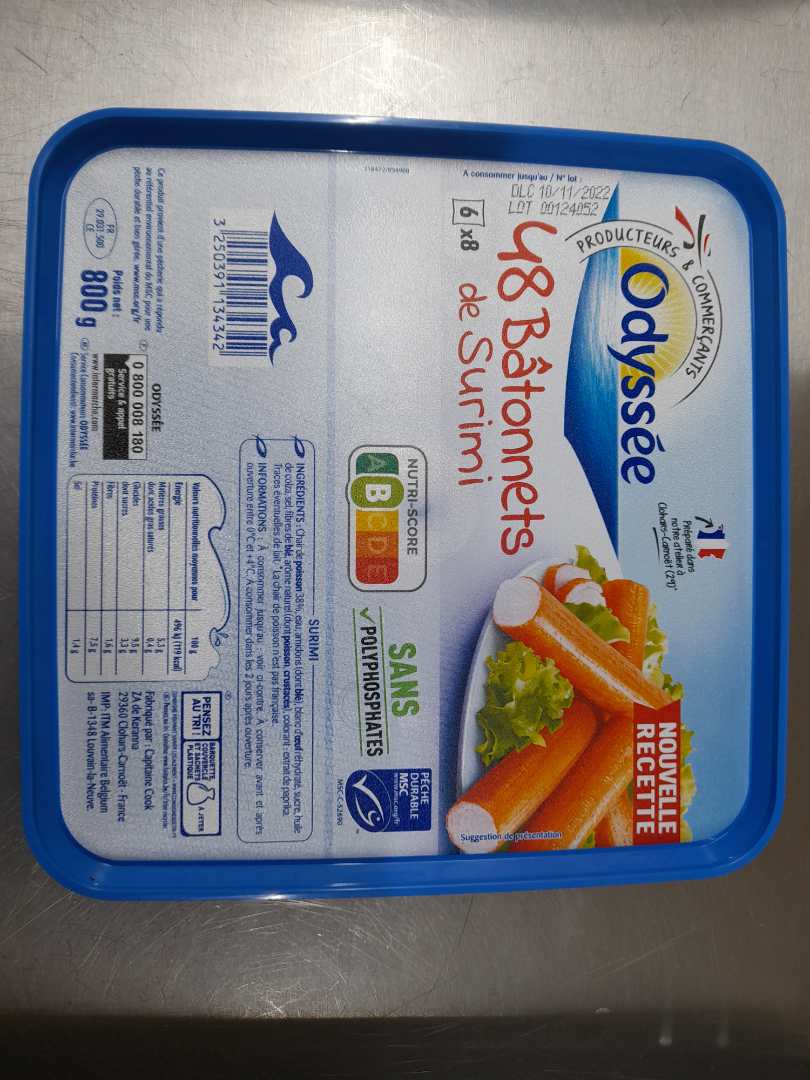
France – Surimi sticks – Microbial growth

Gov france

Identification information of the recalled product

  • Product category Feed
  • Product subcategory Prepared meals and snacks
  • Product brand name ODYSSEY
  • Model names or references30 Surimi sticks 48 Surimi sticks
  • Identification of products
    GTIN Batch Date
    3250390859963 00122366 Use-by date 09/22/2022
    3250391134342 00122368 Use-by date 09/22/2022
  • Packaging Plastic box of 500g and 800g
  • Marketing start/end date From 04/07/2022 to 02/09/2022
  • Storage temperature Product to be stored in the refrigerator
  • Health mark FR 29 031 500 EC
  • Geographic area of ​​sale Whole France
  • Distributors INTERMARCHE

Practical information regarding the recall

  • Reason for recall The products may present an organoleptic defect probably due to microbial growth
  • Risks incurred by the consumer Organoleptic changes

Austria – NÖM PRO protein drink cocoa – Microbiological Deviation

AGES

As part of the precautionary quality assurance, it was determined that a few bottles of the product NÖM PRO protein drink cocoa with the best before date 19.12.2022 had a microbiological deviation and a changed consistency.

NÖM PRO protein drink cocoa, 350 g, best before date 19.12.2022

Only some of the bottles with this best-before date are affected, which were delivered to individual BILLA, BILLA PLUS and ADEG branches in Vienna, Lower Austria and Burgenland. The trading partner has already been informed and all affected products were immediately removed from the shelves.

The changed consistency of the defective product is clear and recognizable at first sight, as the product is puncture-resistant and surrounded by a transparent whey liquid. It is not suitable for consumption in this form.

From the point of view of preventive consumer protection, NÖM AG asks you to return this product to the BILLA, BILLA PLUS or ADEG sales outlet in Vienna, Lower Austria and Burgenland if it is in a faulty condition. The returned goods will of course also be replaced without presenting a receipt.

NÖM PRO protein drinks cocoa with this best-before date, which shows the usual content, as well as other best-before dates of the NÖM PRO protein drink cocoa, all other products of the NÖM PRO and NÖM brands are not affected and can still be bought and consumed without hesitation.

NÖM AG thus fulfills its personal responsibility in accordance with the provisions of food law. If consumers have questions, the consumer service of NÖM AG is available at the following telephone number: 0800 800 500 .

original recall

Australian Food Safety Week 2022 will be held from 12 – 19 November 2022

Food Safety Council

The theme will be ‘Food safety – raw and risky’ covering the risk of food poisoning from raw or minimally cooked meat, poultry, fish, eggs and vegetables as well as possible  parasite infections. We will also be celebrating our 25th anniversary of educating the Australian community in food safety.

Our community package for AFSW2022 containing social media tiles, posters, sample media release, a quiz and event registration will be available in September subscribe to our newsletter to keep up to date.

Proudly sponsored by Fit for Food an initiative of our member ACCORD Australasia.

Thanks also to our member SA Health for sponsoring our consumer research

Promote your local event by using our sample media release

Share our Raw and Risky quiz

Reusable Food Containers and Food Safety

Food Safety Council

The Food Safety Information Council today issued advice about safely using reusable food containers, especially as they are gaining acceptance with food retailers.

Cathy Moir, Council Chair, said whether it is your coffee keep cup, refillable water bottle, or if you are taking your own container to the deli, take away or cafe we need to follow some safety tips to make sure we aren’t increasing cases of food poisoning.

‘We support the reduction of singe use plastics but not at the expense of increasing the number of cases of food poisoning. For example, we support the use of thin plastic bags to stop the contamination of ready to eat salad vegetables at the checkout or loose in supermarket trolleys.’ Ms Moir said.

‘But you need to follow these 6 simple tips to keep your food safe:

  1. Make sure the container is easy to keep clean and that you clean it thoroughly with hot water and detergent (or in the dishwasher) between uses. Some types of containers, such as plastic takeaway food containers are only meant for single use or are very difficult to clean so are not suitable to reuse as a food container.
  2. Your container must have a sealable lid that won’t leak and have removable seals for easy cleaning. This is especially important for raw meat that could drip onto other food.
  3. Stick to the rules of the retailer, for example, some retailers won’t accept glass or ceramic containers in case they are dropped and shatter.
  4. Where your retailer doesn’t offer plastic ‘barrier’ bags for fruit and vegetables, that won’t be cooked before eating, take your own washable bag and, as always, thoroughly rinse the fruit and veggies under running water before use. If you do use a plastic produce bag remember that soft plastics can be recycled at RED facilities in many major supermarkets.
  5. If you are purchasing hot food or taking a ‘doggy bag’ of leftovers home from a restaurant transport the food in an insulated bag and use or refrigerate within 2 hours. Make sure the container you use is suitable for reheating in the microwave or oven. Leftovers will last 2 to 3 days in the fridge and should be reheated to 75°C or using the microwave reheat auto function.
  6. Discard your plastic container once it shows signs of wear and tear as cracks, breaks, scores in the plastic can allow contaminants to enter or make the container difficult to clean. This may allow chemicals to migrate into the food or contaminate it with shards of plastic.

‘Finally, don’t forget to empty and wash your reusable water bottles daily after use to prevent bacteria, and even fungi, growing inside the bottle from it touching your mouth or even leaving a half-finished bottle lying about at room temperature. Use hot water and a bottle brush then allow the bottle to air dry thoroughly before refilling or put it in the dishwasher if the bottle is dishwasher safe. If you use a water bladder when jogging or cycling you can clean it with hot water and two tablespoons of baking soda or bleach, hold the bladder up and pinch the bite valve so the solutions runs into the tube, then leave for 30 minutes. Then rinse with clean water. Some brands also sell cleaning tablets to use,’ Ms Moir concluded.

Media contact: Lydia Buchtmann, Food Safety Information Council, 0407 626 688 or info@foodsafety.asn.au