Category Archives: Foodborne Illness Death

USA – Milk Shakes kill 3 sicken 3 others with Listeria

Food Poison Journal

The Washington Department of Health (DOH), the Tacoma-Pierce County Health Department, and Thurston County Public Health and Social Services investigated an outbreak of Listeria monocytogenes in July and August 2023. Six cases of listeriosis were reported by August 9, 2023. This cluster was given the outbreak code 2306WAGX6-1.

Cases ranged from 43 to 79 years (median 63.5). Sixty percent (60%) were male. Five of the six cases had serious underlying health conditions, which put them at high risk for Listeria infection. All six were hospitalized, and three out of these six cases have died. Illnesses ranged from February 27 to July 22, 2023. These cases were residents of Pierce (5) and Thurston (1) County.

Research- Three clusters of Salmonella Enteritidis ST11 infections linked to chicken meat and chicken meat products

EFSA

Abstract

From 1 January–24 October 2023, 335 laboratory-confirmed Salmonella Enteritidis ST11 cases belonging to three distinct microbiological clusters have been reported in 14 EU/EEA countries, the United Kingdom and the United States, affecting all age groups. Most interviewed cases reported consumption of chicken meat, including chicken kebabs. Nine cases in three countries were hospitalised and one case in Austria died, highlighting the potential for severe and fatal infections from this outbreak. Following the food exposure information and the national investigations in 2023, the food safety authorities in Austria, Denmark and Italy investigated 10 food products (six contaminated by Salmonella Enteritidis ST11 cluster 1 and/or cluster 2), seven final producers in Poland and one in Austria. Traceability information revealed that three Salmonella-contaminated kebabs shared a number of Polish food business operators. The trading link of the suspected kebab suggests one or more common source(s)/point(s) of contamination in Austria, Denmark, and Italy. Following the collection of genomic information, the cluster analysis revealed the presence of the outbreak strains in the food chain in multiple European countries. Most positive foods sampled in 2022–2023 with shared epidemiological data originated from Poland. Given the information collected, contaminated chicken kebab and chicken meat are the plausible vehicles of the human infections reported in these three clusters. In the absence of conclusive microbiological evidence and comprehensive traceability, the role of the identified final producers, their meat suppliers, and the possible involvement of other food business operators as sources of the infections could not be confirmed or excluded. Further investigations are needed to identify the root cause of the contamination and the source of infections, which is crucial for prompt implementation of targeted effective control and corrective measures. As the source(s) have not been identified, new cases are likely to occur in this prolonged multi-country outbreak.

Fatal Spanish Salmonella outbreak under investigation

Food Safety News

More information has come to light about a deadly outbreak of Salmonella in Spain in 2022.

The outbreak occurred at the Geriàtric Aragó care home in Barcelona. According to officials, it started in July 2022 and affected 39 residents, of which 15 were hospitalized and eight died.

Additional information was revealed in documents from the Parliament of Catalonia in response to a question on action taken by the Departament de Drets Socials (Department of Social Rights).

An investigation is ongoing by the Fiscalía Provincial de Barcelona, the local prosecutor’s office.

In March 2022, an inspection was carried out to collect information concerning a complaint submitted in February by a resident’s family. No irregularities were detected from the documentation and observations made during the visit. Another check was undertaken in May due to a separate complaint, but no related non-compliances were found.

South Africa – GP POLICE WARN AGAINST VIGILANTISM AFTER 4 KIDS DIE FROM ALLEGED FOOD POISONING

EWN

JOHANNESBURG – Police are urging Gauteng residents not to take the law into their own hands following the death of four children from alleged food poisoning this week.

Authorities are probing the mysterious deaths of two children aged between two and three in the West Rand.

Preliminary investigations suggest that the pair died after eating snacks bought from a nearby taxi rank.

The incident comes just a few days after the passing of two other children from Soweto – who became fatally ill after eating biscuits they allegedly bought from a spaza shop in Naledi.

England and Wales – Listeriosis in England and Wales: summary for 2020

Gov UK

Main points for 2020

This report summarises the number, demographics and clinical outcomes of confirmed cases of listeriosis in England and Wales in 2020:

A total 124 cases of listeriosis were reported in England and Wales.

Incidence rates of listeriosis were highest in people aged 80 years and over.

Overall, the crude incidence of listeriosis was lower in men than women, but reported cases among men aged 60 to 69 were 4 times higher than in women aged 60 to 69.

Pregnancy associated infections accounted for a fifth of all reported cases and, a 34.8% of pregnancy-associated cases resulted in stillbirth or miscarriage.

Among non-pregnancy associated cases of listeriosis, death was reported for 29 cases (29.3%), of whom 17 (17.2%) were known to have listeriosis recorded as a cause of death on the death certificate.

Incidence of listeriosis varied geographically, with the lowest incidence in the North West (0.15 per 100,000 population) and the highest in the East Midlands (0.27 per 100,0000 population).

There were 2 listeriosis outbreaks investigated in England, including a national outbreak associated with smoked salmon.

Listeriosis is a foodborne disease caused by the bacterium Listeria monocytogenes. These bacteria are widely distributed in the environment and infection usually occurs after consumption of contaminated raw, chilled, or ready-to-eat foods, and can cause sporadic infection and outbreaks of disease. People with listeriosis have been reported to develop symptoms between 1 to 70 days after consuming food contaminated with Listeria monocytogenes.

Compared to other foodborne pathogens, infections in humans are relatively rare, with 2,621 confirmed cases of listeriosis reported across 28 EU member states in 2019, and a median of 160 cases in England and Wales each year (2010 to 2019). However, listeriosis can cause severe clinical outcomes in vulnerable groups, including those aged over 60 years, pregnant women and their unborn or newborn babies, and people with impaired immunity. In these groups, listeriosis can present as infection of the bloodstream or brain. Due to the severity of infection and high case fatality rate, listeriosis is an important public health concern.

National surveillance of listeriosis in England and Wales has been undertaken since 1992. This report summarises the number, demographics and clinical outcomes of confirmed cases of listeriosis in England and Wales reported in 2020.

France – Emergency Serious food poisoning: 10 cases of botulism, including 8 hospitalized and 1 death, linked to visiting a restaurant in Bordeaux

Sante Publique

kswfoodworld

The health authorities, in conjunction with Public Health France and the National Reference Center for Botulism (Institut Pasteur) recommend that people who have visited the Bordeaux establishment Tchin Tchin Wine Bar (3 Rue Emile Duployé, 33000 Bordeaux) between Monday 4 and Sunday September 10, 2023 to consult a doctor urgently or to contact the 15th, mentioning cases of botulism, in the event of symptoms appearing after this attendance.

The people concerned all frequented the same restaurant-bar in Bordeaux, the Tchin Tchin Wine Bar, over the last week. The suspected foods are at this stage canned sardines in oil homemade by the restaurateur and served between September 4 and 10, 2023 in this Bordeaux restaurant. 

Botulism is a serious disease (fatal in 5 to 10% of cases) whose incubation time can range from a few hours to a few days. 
Symptoms include, to varying degrees: early digestive signs which may be fleeting (abdominal pain, nausea, vomiting and diarrhea), eye damage (failure to accommodate, blurred or double vision), dry mouth accompanied by a lack of swallowing or even speech, or neurological symptoms (wrong paths, more or less severe paralysis of the muscles). There is usually no fever.

If you have symptoms, consult a doctor urgently or contact 15, mentioning cases of botulism.

What are the possible sources of contamination?

Botulism is a serious neurological condition caused by a very potent toxin produced by the bacteria Clostridium botulinum. It develops particularly in poorly preserved foods. In France, the majority of cases of botulism correspond to food poisoning, by ingestion of the toxin produced by C. botulinum in preserved foods that have not undergone an extensive sterilization process: cured meats, cold meats or even family-made preserves. or artisanal.

It is the extremely powerful toxin that it synthesizes that is responsible for the disease.

Research – Preliminary Incidence and Trends of Infections Caused by Pathogens Transmitted Commonly Through Food

Medscape

Abstract and Introduction

Introduction

Each year, infections from major foodborne pathogens are responsible for an estimated 9.4 million illnesses, 56,000 hospitalizations, and 1,350 deaths in the United States.[1] To evaluate progress toward prevention of enteric infections in the United States, the Foodborne Diseases Active Surveillance Network (FoodNet) conducts surveillance for laboratory-diagnosed infections caused by eight pathogens transmitted commonly through food at 10 U.S. sites. During 2020–2021, FoodNet detected decreases in many infections that were due to behavioral modifications, public health interventions, and changes in health care–seeking and testing practices during the COVID-19 pandemic. This report presents preliminary estimates of pathogen-specific annual incidences during 2022, compared with average annual incidences during 2016–2018, the reference period for the U.S. Department of Health and Human Services’ Healthy People 2030 targets.[2] Many pandemic interventions ended by 2022, resulting in a resumption of outbreaks, international travel, and other factors leading to enteric infections. During 2022, annual incidences of illnesses caused by the pathogens CampylobacterSalmonellaShigella, and Listeria were similar to average annual incidences during 2016–2018; however, incidences of Shiga toxin-producing Escherichia coli (STEC), YersiniaVibrio, and Cyclospora illnesses were higher. Increasing culture-independent diagnostic test (CIDT) usage likely contributed to increased detection by identifying infections that would have remained undetected before widespread CIDT usage. Reducing pathogen contamination during poultry slaughter and processing of leafy greens requires collaboration among food growers and processors, retail stores, restaurants, and regulators.

Listeria (Sweden September 2022–) VP Cold Smoked Salmon

Fokhalsomyndigheten

Cases where people have contracted listeria infection are investigated by the Public Health Authority in collaboration with the regional infection control units and the Swedish Food Agency. The outbreak of listeria can be linked to salmon products from one producer.

2023-09-01

A total of 19 people have been reported sick in the outbreak with the same variant of listeria serotype IIa ST37 since autumn 2022, of which 15 cases since the end of May this year (see figure). The cases are aged 63-93, of which 13 are men and six are women. The cases have been reported from 10 different regions. Six of the disease cases have died in close connection with their listeria infection. However, it is often difficult to say what role the listeria infection has as a cause of death because most of the patients affected have severe underlying diseases.

Of the cases for which there is information about what they ate before becoming ill, 14 cases have eaten some type of vacuum-packed salmon (digging/cold-smoked/hot-smoked salmon) from one of two different brands. Both of these brands are produced by the same company and listeria has been detected in both products and environmental samples in the company’s facility. Comparisons of the bacteria’s genetic material in samples from food, plants and human cases show that it is the same variant of listeria, which points to the salmon products being the likely source of infection. The company has increased its sampling and is carrying out further clean-up measures at the facility.

The outbreak is being investigated together with the infection control units and the Swedish Food Agency.

USA – Summary of Possible Multistate Enteric (Intestinal) Disease Outbreaks in 2021

CDC

Outbreak Investigations At A Glance

Possible Multistate Outbreaks

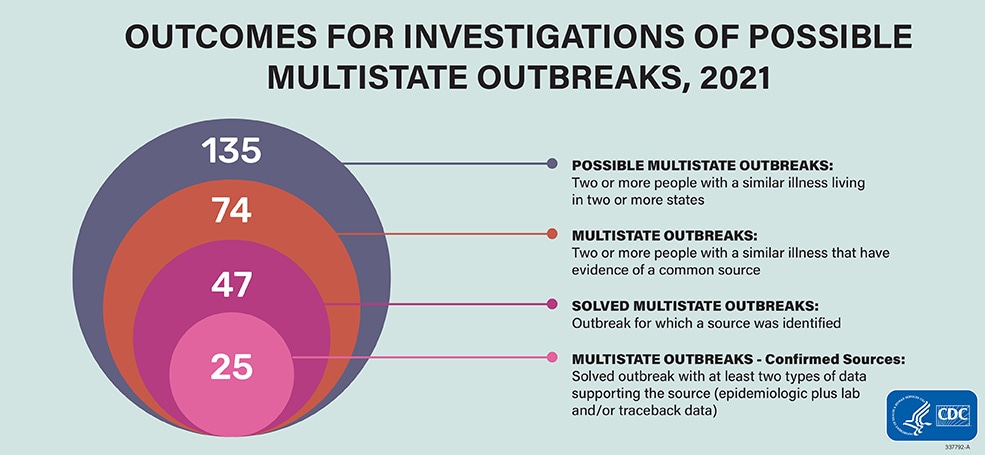
This analysis includes 135 possible multistate outbreak investigations during 2021.

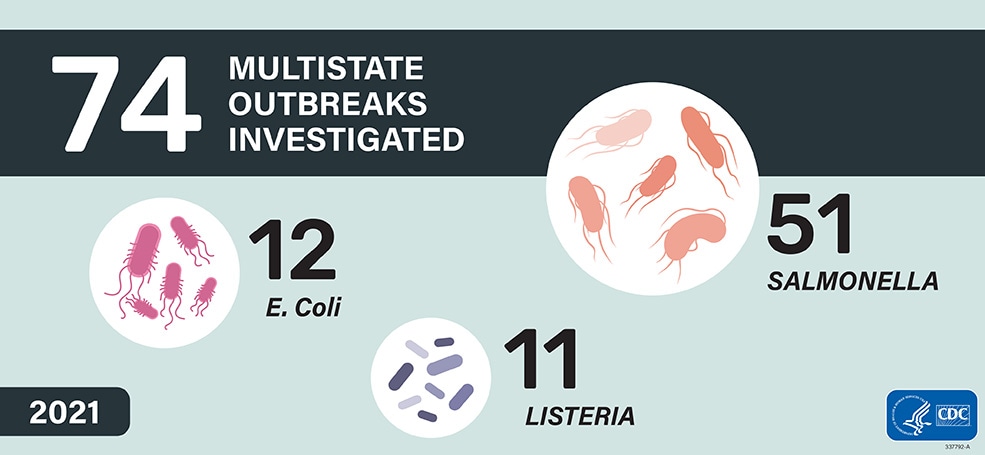
This analysis includes 135 investigations of possible multistate enteric (intestinal) outbreaks during 2021. Some possible outbreaks were excluded from this report because they were determined to be single state or because they were linked to international travel. After investigation, 74 (55%) of these were determined to be multistate outbreaks, and investigators solved 47 (64%) of these outbreaks.

Multistate Outbreaks

74 (55%) of the 135 investigations were determined to be multistate outbreaks.

The number of outbreaks increased from 2020 but was lower than the 82 investigated outbreaks in 2019. The number of outbreaks investigated in 2021 was likely lower than that in 2019 due in part to continued effects of the COVID-19 pandemic on enteric disease outbreak detection and investigation (e.g., decreased resources at local, state, and federal public health agencies, changes in healthcare-seeking behavior, and changed restaurant dining and grocery shopping patterns.) Additionally, changing diagnostic testing practices likely continued to affect enteric disease surveillance and the ability to identify possible outbreaks.

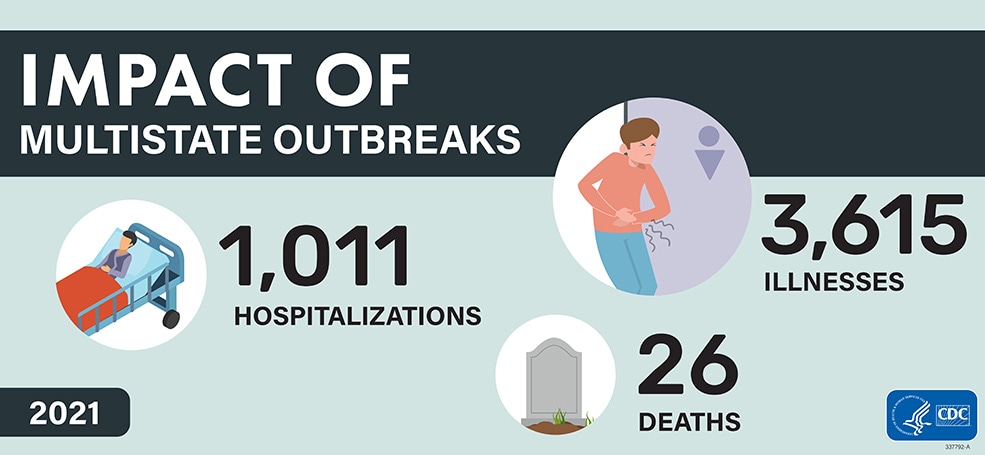
The 74 investigated multistate outbreaks resulted in 3,615 illnesses, 1,011 hospitalizations, and 26 deaths

Solved Multistate Outbreaks

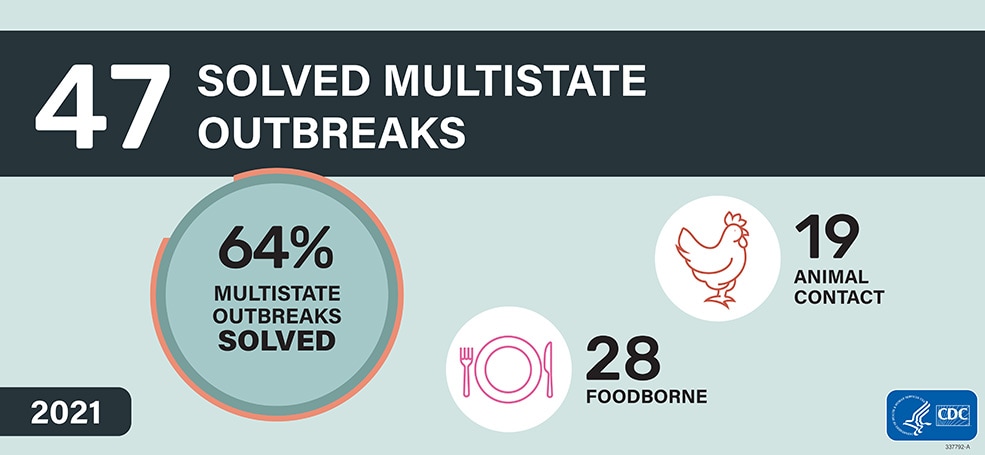
Among the 74 investigated multistate outbreaks, 47 (64%) were solved, including 25 outbreaks with confirmed sources and 22 with suspected sources.

Among the 74 multistate outbreaks, 47 (64%) were solved, meaning a confirmed or suspected source of the outbreak was identified, including 25 (53%) outbreaks with confirmed sources and 22 (47%) with suspected sources. Among the 47 solved outbreaks, 28 (60%) were linked to contaminated foods, and 19 (40%) were linked to animal contact.

Solved multistate outbreaks caused at least 2,047 illnesses. Solved multistate outbreaks linked to contaminated food caused 1,740 illnesses, 496 hospitalizations, and 15 deaths, while multistate outbreaks linked to animal contact caused 1,307 illnesses, 329 hospitalizations, and 3 deaths.

Norway has two sick in Spanish botulism outbreak

Food Safety News

kswfoodworld

Norway has reported two cases that are part of a botulism outbreak in Spain, bringing the number of people affected to 11.

There is a link between patients and different packaged brands of Spanish omelet (tortilla de patata), which is made with potatoes and eggs, purchased in various supermarkets in different regions.

The Norwegian cases stayed in Barcelona between July 10 and 23.