Category Archives: food recall

RASFF Alert – Listeria monocytogenes – Black Pudding Sausage

RASFF-Logo

RASFF – Listeria monocytogenes (10000; 2000; 10000; 1100; 1300 CFU/g) in black pudding sausage from Spain in Portugal

RASFF Alert – E.coli – Live Cockles

RASFF-Logo

RASFF – too high count of Escherichia coli (13000 MPN/100g) in live cockles from France in France


RASFF Alert – Moulds – Tomato Sauce

RASFF-Logo

RASFF – tomato sauce from Sweden infested with moulds in Denmark

RASFF Alert – Foodborne Outbreak -Salmonella enterica ser. Enteritidis – Eggs

RASFF-Logo

RASFF – foodborne outbreak suspected to be caused by Salmonella enterica ser. Enteritidis in eggs from Poland in Austria

Ireland -Outbreak in Ireland tied to Romanian pork; other countries report illnesses

Food Safety News

Eight people are part of a Salmonella outbreak in Ireland linked to pork from Romania. Five of them were admitted to hospitals. Infected people also have been identified in other countries.

One person was sickened by Salmonella Bredeney in August 2018. The other seven people fell ill between May 4 and June 3, this year. Those stricken are six adult males and two children who are siblings. There have not been any deaths.

Pork product recall

Andromi Toba de Casa was recalled last month

In mid-July, Andromi Toba de Casa 500-gram packages with a use-by date of Aug. 4 and with the lot number 17 from Romania were recalled because of the presence of Salmonella. The chilled cooked pork preparation is sold in Polonez stores throughout Ireland.

Ireland – Recall of Prymat White Mustard Seeds due to Presence of Salmonella Typhimurium

FSAI

Summary
Category 1: For Action
Alert Notification: 2019.35
Product: Prymat Gorczyca Biała cała (white mustard seeds); pack size: 30 g
Batch Code: 1298133, ‘best-before’ date: 31/05/2022
Country Of Origin: Poland

Message:

Salmonella Typhimurium has been detected in the above batch of white mustard seeds. The implicated batch may cause illness if consumed raw.  The affected batch has been removed from sale and a point-of-sale recall notice must be displayed where the batch has been sold.


Nature Of Danger:

People infected with Salmonella typically develop symptoms between 12 and 36 hours after infection, but this can range between 6 and 72 hours.  The most common symptom is diarrhoea, which can sometimes be bloody.  Other symptoms may include fever, headache and abdominal cramps.  The illness usually lasts 4 to 7 days. Diarrhoea can occasionally be severe enough to require hospital admission. The elderly, infants, and those with impaired immune systems are more likely to have a severe illness.

Action Required:

Manufacturers, wholesalers, distributors, caterers & retailers:

Food businesses who have sold the implicated batch are requested to remove it from sale and clearly display a point of sale notice informing customers not to eat it.

Consumers:

Consumers are advised not to eat the implicated batch. Consumers who may have already consumed the affected batch and are feeling unwell should seek medical advice.
Mustard_seeds

RASFF Alerts – Duck Carcases – Chicken Inner Fillet – Breaded Chicken Strips – Sesame Seeds – Black Pepper – Crocodile Burger – Chicken Breast Cordon Bleu – Chicken Legs

RASFF-Logo

RASFF – Salmonella (presence /25g) in ducks carcasses from the Czech Republic in Poland

RASFF – Salmonella enterica ser. Enteritidis (presence /25g) in frozen chicken inner fillet from Poland, via the United Kingdom in France

RASFF – Salmonella (presence /25g) in frozen breaded chicken strips from Poland in France

RASFF – Salmonella (in 2 out of 5 samples /25g) in black pepper from Brazil in the Netherlands

RASFF – Salmonella (presence /25g) in sesame seeds from Sudan in Greece

RASFF – Salmonella (presence /25g) in sesame seeds from Ethiopia in Greece

RASFF – Salmonella (presence /25g) in frozen crocodile burger from Belgium in Belgium

RASFF – Salmonella enterica ser. Infantis (in 5 out of 5 samples /25g) in frozen chicken breast cordon bleu from Germany in Finland

RASFF – Salmonella enterica ser. Derby (presence /25g) in chilled chicken legs from Poland in Lithuania

RASFF – Salmonella (presence /25g) in sesame seeds from Sudan in Poland

RASFF – Salmonella (presence /25g) in sesame seeds from Nigeria, via Singapore in the Netherlands

Denmark -WGS project helps Denmark uncover Campylobacter outbreak

Food Safety News

Fifty people are ill in Denmark from Campylobacter after eating chicken meat but authorities believe the actual number of patients may be much higher.

Statens Serum Institut (SSI), Danish Veterinary and Food Administration (Fødevarestyrelsen) and DTU Food – National Food Institute are investigating the Campylobacter jejuni outbreak.

Campylobacter is the main cause of bacterial intestinal infections in Denmark and more than 4,500 cases were registered in 2018.

The same type of Campylobacter, sequence type 122, identified in patients by whole genome sequencing has also been found in chicken meat from one slaughterhouse, named as HKScan in Vinderup, a town in Northwestern Jutland.

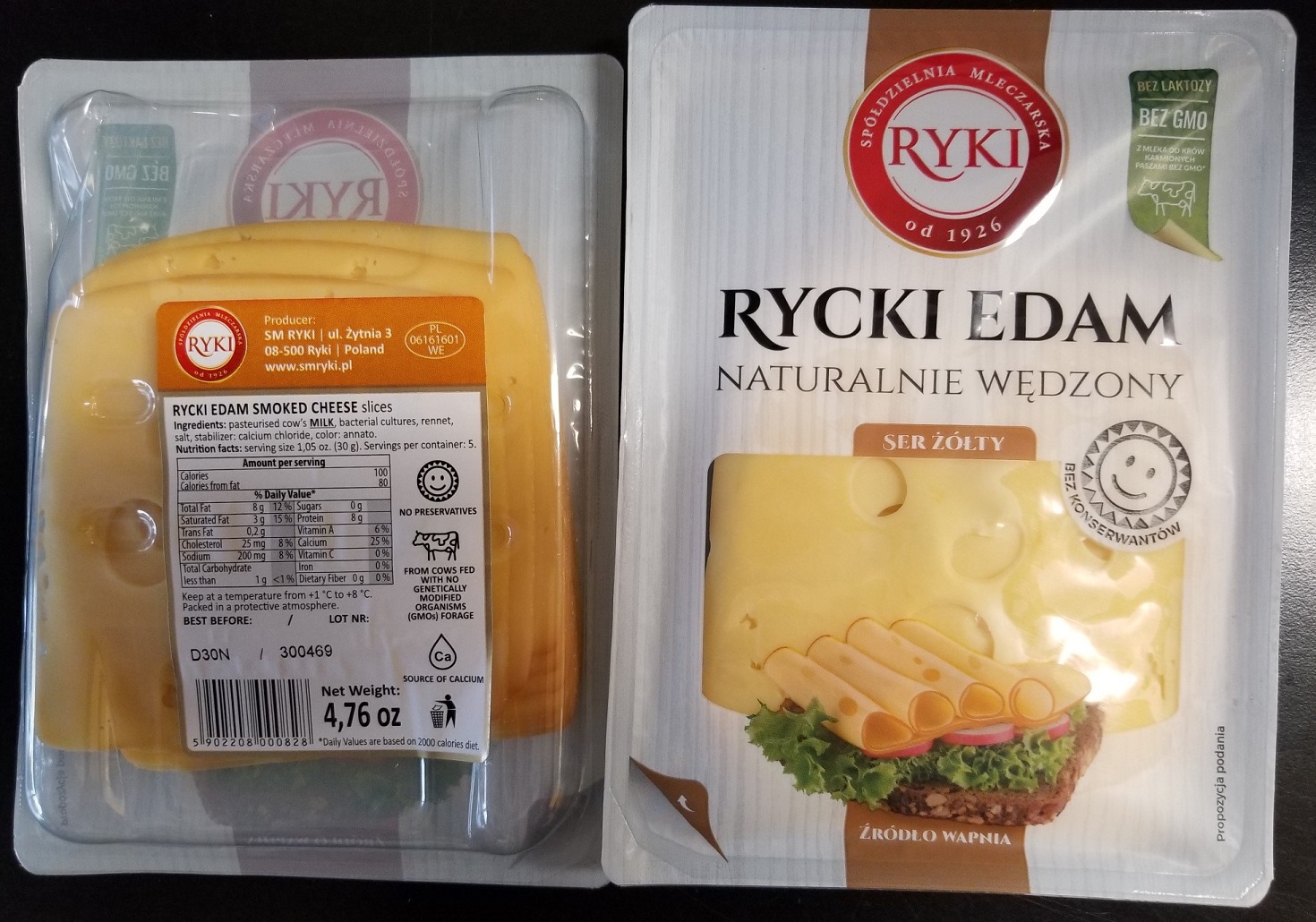
Canada – Updated Food Recall Warning – Ryki brand Rycki Edam Cheese Slices recalled due to Listeria monocytogenes

CFIA Rycki Edam Smoked Cheese Slices

Recall details

Ottawa, July 29, 2019 – The food recall issued on July 23, 2019 has been updated to include additional product information. This additional information was identified during the Canadian Food Inspection Agency’s (CFIA) food safety investigation.

Polish Trade Center Ltd. is recalling Ryki brand Rycki Edam Cheese Slices from the marketplace due to possible Listeria monocytogenes contamination. Consumers should not consume the recalled products described below.

Recalled products

Brand Name Common Name Size UPC Code(s) on Product
Ryki Rycki Edam Cheese Slices 4.76 oz 5 902208 000811 D30N / 300454
Ryki Rycki Edam Smoked Cheese Slices 4.76 oz 5 902208 000828 D30N / 300469

Australia – Gippsland Jersey — Gippsland Jersey Full Cream Milk 2L and Gippsland Jersey Light Milk 2L – Recall – Not Pasteurised

Product Safety Australia

Photograph of Gippsland Jersey milks

Identifying features

Use by date
29 July 2019
Other
APN/EAN 9351328000014 (full cream) and 9351328000007 (light)

What are the defects?

The recall is due to a processing error associated with pasteurisation.

What are the hazards?

Milk that is not pasteurised according to the standard may be associated with food-borne illness and decreased shelf life.