Category Archives: Food Pathogen

Research – Seasonality and the effects of weather on Campylobacter infections

BMC

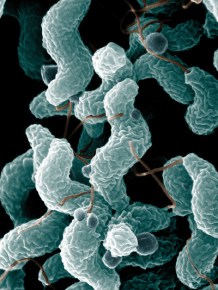
Campylobacter

Image CDC

The increase of Campylobacter infections in the late spring was significantly linked to temperature two weeks before, with an increase in conditional incidence of 0.175 cases per 100,000 per week for weeks 17 to 24; the relationship to temperature was not linear. Generalized structural time series model revealed that changes in temperature accounted for 33.3% of the expected cases of Campylobacteriosis, with an indication of the direction and relevant temperature range. Wavelet analysis showed a strong annual cycle with additional harmonics at four and six months. Cluster analysis showed three clusters of seasonality with geographic similarities representing metropolitan, rural, and other areas.

USA – Butterball Ground Turkey Salmonella Schwarzengrund Outbreak Sickens 6

Food Poisoning Bulletin

The Butterball ground turkey Salmonella Schwarzengrund outbreak first reported in a USDA recall notice has sickened 6 people in 3 states, according to the Centers for Disease Control and Prevention (CDC). One person has been hospitalized. No deaths have been reported.

Australia – Salmonella sweeps Karratha mining camp

Perth Now

Salmonellaa

Image CDC

Workers based at a Karratha mining camp were so sick, some “felt like they were dying” as a salmonella epidemic affected up to 50 FIFO workers, hospitalising at least 20 and leaving mattresses lining the porches of dongas.

Construction, Forestry, Maritime, Mining and Energy Union state secretary Mick Buchan believed poor camp conditions at Searipple Village had left subcontractors to a number of big mining companies seriously ill.

“It is a disgrace what is happening up there at the moment,” he said.

“This all goes down to the amenity providers and where their margins are being cut short.

Kenya – 18 Nyabururu Girls High School students treated for food poisoning

Daily Nation

At least 18 students from Nyabururu Girls High School have been in and out of the Nyangena Hospital in Kisii town over suspected food poisoning since Thursday.

On Saturday, the school circulated a message to all parents seeking to dispel fake news spread on social media that more than 100 students had been taken sick.

“Dear parent, kindly ignore malicious news circulating on social media that all girls are admitted in hospital. There are only seven girls who were admitted and discharged over various ailment, their parents were informed.”

But students who secretly informed their parents of their ill health after borrowing phones from other patients said they had been cautioned against informing anyone of their state.

UK – Drumsticks Products Co recalls Tahini products because they may contain salmonella

FSA

Drumsticks Products Co Ltd are recalling Tahini products because they may contain salmonella.

Product details

Achva Sesame Tahini

Pack size 500g
Lot number 18-132
Best before 12 May 2020
Achva Seasoned Tahini

Pack size 500g
Lot number 18-128
Best before 8 May 2020
Achva Whole Sesame Tahini

Pack size 500g
Lot number 18-134
Best before 8 May 2020

No other Drumsticks Products Co products are known to be affected.

Risk statement

The products listed above might be contaminated with salmonella. Symptoms caused by salmonella usually include fever, diarrhoea and abdominal cramps.

Action taken by the company

Drumstick Products Co is recalling the above products. Point of sale notices will be displayed in all retail stores that are selling these products. These notices explain to customers why the products are being recalled and tell them what to do if they have bought the product. Please see the attached notice.

Our advice to consumers

If you have bought any of the above products do not eat them. Instead, return it to the store from where it was bought for a full refund.

Research – Microbiological and chemical quality of ice used to preserve fish in Lisbon marketplaces

Wiley Online

Abstract

Ice is widely used to preserve fish on markets, playing a major role in the food industry. If manufactured, stored or distributed in inadequate sanitary conditions, it can represent a considerable health risk for both consumers and professionals. The present study characterizes ice used in marketplaces, on microbiological and chemical parameters. The aim was to assess potential risks on occupational exposure and consumer safety and therewith plan orientation guidelines. Sampling took place in 18 marketplaces in Lisbon, with ice samples collected at three different stages—production (n = 29), storage (n = 30), and product‐contact (n = 29). No significant contamination was found in production and storage stages, demonstrating that ice production and storage procedures are adequate regarding sanitary conditions. With exception for Salmonella, significantly higher concentrations of microbial parameters were identified in product‐contact stages, specifically Total Coliforms (548 MPN/100 mL), Escherichia coli (1 MPN/100 mL), Enterococci (29 MPN/100 mL), Staphylococcus aureus (271 CFU/100 mL), HPC at 5°, 22°, and 37° (>301 CFU/mL). Our study also shows that the majority of samples from ice production and storage comply with national regulations regarding drinking water quality. Yet, occupational health and consumer risks may still exist at the final product‐contact stage, as significant contamination was detected..

Practical applications

The present study can be used as a model for ice quality monitoring in fish preservation, serving as a tool for quality control and fast contamination detection during the several process stages.

This monitoring model is an important contribution for assuring the safety of the preserved products, as well as, occupational health improvement and consumer risk protection.

Research – Microbial composition changes on the surface of strawberries from the field and market by 16SrDNA sequencing

Wiley Online Library

Abstract

Fresh fruit is indispensable as a part of a daily diet; however, it commonly harbors large and diverse bacteria populations, including some important human pathogens. To determine the microbial composition on the surface of a strawberry, and structural changes of microbial composition from the field and market, 16SrDNA sequencing of 32 samples collected from production field (B) and market (M), which were divided into Groups I through III, was performed in this study. As a result, the 3,073 operational taxonomic units (OTUs) were clustered, and 5 phyla and 10 genera were dominant across all samples. When comparing I.B with I.M, Acinetobacter, Buchnera, and Bradyrhizobiumwere higher in I.B (p > 0.05), while Bacteroides, Pseudomonas, and Shewanella were higher in I.M (p > 0.05). Comparing II.B with II.M, Campylobacter was dominant in II.B, while most of the top10 genera decreased in II.M, except Acinetobacter, which presented an overwhelming richness, with an average relative abundance of 65.657 ± 1.071% (p = 0.002). Comparing III.B with III.M, Buchnera decreased in III.M, while Shewanella increased. Additionally, a certain number of opportunistic pathogens that included Acinetobacterwere present in some samples. Therefore, analysis of microbial composition changes on the surface of strawberries is important for ensuring the biological safety of strawberries.

Practical applications

This paper focused on determining the microbial composition on the surface of strawberry and comparing its structural changes of microbial composition from the field and market. The study results will be helpful for ensuring the biological safety of strawberries as well as a scientific basis for the traceability of microbial contamination of strawberries.

RASFF Alerts – Salmonella – Sesame Seeds – Chicken Filet Strips – Cumin Seeds -Milk Powder – Black Pepper – Ducks Leg -Chicken Breast

RASFF-Logo

RASFF – Salmonella (presence /25g) in sesame seeds from Sudan in Greece

RASFF – Salmonella enterica ser. Enteritidis (present /25g) in frozen chicken filet stripes from Denmark in the Netherlands

RASFF – Salmonella (presence /25g) in cumin seeds from Syria in Spain

RASFF – Salmonella (presence /25g) in sesame seeds from Sudan in Greece

RASFF – Salmonella (present /25g) in sesame seeds from Sudan in Greece

RASFF – Salmonella (presence /25g) in sesame seeds from Sudan in Greece

RASFF – Salmonella enterica ser. anatum (present /25g) in milk powder from Poland in Poland

RASFF – Salmonella enterica ser. Poona (in 1 out of 5 samples /25g) in black pepper from Brazil in Germany

RASFF – Salmonella enterica ser. Poona (in 1 out of 5 samples /25g) in black pepper from Brazil in Germany

RASFF – Salmonella (present /25g) in black pepper from Brazil in Spain

RASFF – Salmonella enterica ser. Rubislaw (presence /25g) in black pepper from Brazil in Austria

RASFF – Salmonella enterica ser. Enteritidis (presence /25g) in frozen duck legs from Poland in Estonia

RASFF – Salmonella enterica ser. Infantis (present /25g) in chilled chicken broiler from Poland in Lithuania

RASFF – Salmonella enterica ser. Infantis (in 1 out of 5 samples /25g) in chilled chicken breast fillets from Poland in the Czech Republic

RASFF Alerts – Listeria monocytogenes – Frozen Sweetcorn – Chilled Pate

RASFF-Logo

RASFF – Listeria monocytogenes (presence /25g) in frozen sweet corn from Turkey in the UK

RASFF – Listeria monocytogenes (present /25g) in chilled pâté from Belgium in Belgium

RASFF Alerts – Ochratoxin A – Raisins – Rye Flour – Pistachios

RASFF-Logo

RASFF – ochratoxin A (37.5 µg/kg – ppb) in raisins from Turkey in the UK

RASFF – ochratoxin A (7.25 µg/kg – ppb) in rye flour from Poland in Poland

RASFF – ochratoxin A (67 µg/kg – ppb) in pistachios from Germany in the Netherlands
