Brand : Sapori di cascina
Name : High quality cooked ham 150 g
Reason for reporting : Recall due to microbiological risk
Publication date : 18 October 2022


Brand : Sapori di cascina
Name : High quality cooked ham 150 g
Reason for reporting : Recall due to microbiological risk
Publication date : 18 October 2022
Posted in food contamination, food handler, Food Hazard, Food Hygiene, Food Inspections, Food Micro Blog, Food Microbiology, Food Microbiology Blog, Food Microbiology Testing, Food Pathogen, food recall, Food Safety, Food Safety Alert, Food Safety Management, Food Testing, Listeria, Listeria monocytogenes
As an extension of the information transmitted on September 30, 2022, the competent authority of Andalusia has informed that as a result of the follow-up activities of the alert for the presence of Listeria monocytogenes in liver sausage, it has become aware of the existence of Listeria monocytogenes in a batch of chorizo produced by the same company, which has marketed it in different presentations (rosary and horseshoe, in spicy and normal variety), under its own trademark and another brand.
The updated data for the products involved are:
Also, in application of the precautionary principle, the company is withdrawing the products made and put on the market after September 13, 2022, all with the identification mark 10.024902/CA.
These products were distributed by the company in the province of Cadiz, Seville (Los Palacios and Seville).
The product CABEZA LOMO MECHADA was distributed to one point of sale in Barcelona and two in Madrid.
With the available information there is no record of any notified case associated with this alert.
As a precautionary measure, people who have any of the products listed above at home are advised to refrain from consuming it and return it to the point of sale.
If you have consumed this product from the affected batch and have symptoms compatible with listeriosis (fever, headache, vomiting or diarrhoea), it is recommended to go to a health centre.
Posted in food contamination, food handler, Food Hazard, Food Hygiene, Food Inspections, Food Micro Blog, Food Microbiology, Food Microbiology Blog, Food Microbiology Testing, Food Pathogen, food recall, Food Safety, Food Safety Alert, Food Safety Management, food safety training, Food Testing, Listeria, Listeria monocytogenes

Protecting consumers from foodborne illness requires both rapid response when outbreaks occur, and focused attention on preventing outbreaks from happening.

Over the last decade, following enactment of the U.S. Food and Drug Administration’s Food Safety Modernization Act (FSMA), the FDA has investigated more outbreaks and conducted more research to advance our scientific understanding of the pathogens that contaminate our food — than any other time in history. We now know more than ever about the reoccurrence of contributing factors that can cause contamination of certain foods by specific disease-causing bacteria and how all parts of the food safety system – which includes the FDA and other government agencies, state and local health departments, the food industry, and others – can work together to keep such contamination from happening.
The FDA is compiling these learnings into a series of Prevention Strategies to Enhance Food Safety that identify and target specific patterns that have emerged with certain food-hazard pairings. The strategies contain recommendations to guide the work of preventing future foodborne illnesses.
As of September 28, 2022, six people infected with the outbreak strain of Listeria have been reported from six states (see map). Sick people’s samples were collected from August 6, 2017, to August 5, 2022 (see timeline).
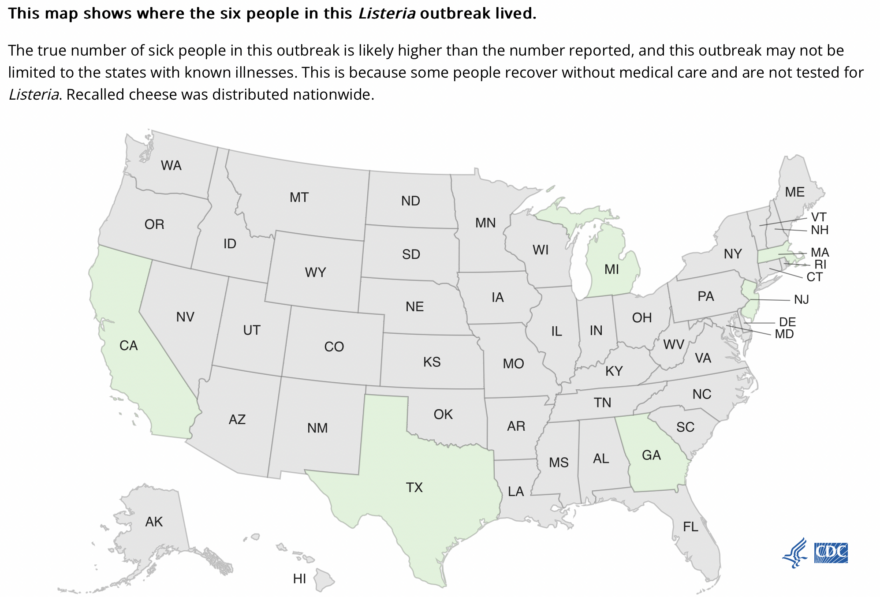
Sick people range in age from 56 to 83 years, with a median age of 78, and 67% are female. Five people have been hospitalized, and no deaths have been reported.
The true number of sick people in this outbreak is likely higher than the number reported, and the outbreak may not be limited to the states with known illnesses. This is because some people recover without medical care and are not tested for Listeria. In addition, recent illnesses may not yet be reported as it usually takes 3 to 4 weeks to determine if a sick person is part of an outbreak.
Posted in food bourne outbreak, food contamination, food handler, Food Hazard, Food Hygiene, Food Illness, Food Inspections, Food Micro Blog, Food Microbiology, Food Microbiology Blog, Food Microbiology Research, Food Microbiology Testing, Food Pathogen, food recall, Food Safety, Food Safety Alert, Food Safety Management, Food Testing, Foodborne Illness, foodborne outbreak, foodbourne outbreak, Illness, Listeria, Listeria monocytogenes, outbreak

The Michigan Department of Agriculture and Rural Development has recalled lemonade and gel products sold by Royalty Sea Moss.
After a complaint from the Maryland Department of Health, an investigation found that Royalty Sea Moss, based out of Mt. Pleasant, MI, produced products with inadequate processing controls that are needed to stop the growth of foodborne pathogens, according to the department.
Royalty Sea Moss also does not have a license to manufacture, hold or sell products, which is a violation against the Michigan Food Law of 2000, officials said.
Posted in Clostridium, Clostridium botulinum, food contamination, food handler, Food Hazard, Food Hygiene, Food Inspections, Food Micro Blog, Food Microbiology, Food Microbiology Blog, Food Microbiology Testing, Food Pathogen, Food Poisoning, food recall, Food Safety, Food Safety Alert, Food Safety Management, Food Testing, Food Toxin, Pathogen, pathogenic
Brand : Pascoli Italiani
Denomination : Fontina DOP
Reason for reporting : Recall due to microbiological risk
Publication date : 18 October 2022
Posted in food contamination, food handler, Food Hazard, Food Hygiene, Food Inspections, Food Micro Blog, Food Microbiology, Food Microbiology Blog, Food Microbiology Testing, Food Pathogen, Food Poisoning, food recall, Food Safety, Food Safety Alert, Food Safety Management, Food Testing, Food Toxin, STEC, STEC E.coli


Troll Salmon AS is recalling the following salmon and trout products: Smoked trout in slices 250g, 200g, 100g and smoked salmon in slices 250g, 120g and 100g. The products have expiry dates from 17.10. until 10.11.2022. The reason is the suspicion of Listeria Monocytogenes content in the products following the discovery of Listeria monocytogenes in the production environment.
Troll Salmon AS is recalling the following smoked salmon and trout products: Smoked trout in slices 250g, 200g, 100g and smoked salmon in slices 250g, 120g and 100g. The products have a use-by date from 17.10. until 10.11.2022. The reason is suspicion of indirect contamination in the products following the discovery of Listeria monocytogenes in the production environment.
19,872 packages of the goods in question have been sold in the following retail chains across the country: Rema 1000, Coop, and NorgesGruppen. In addition, the products are sold via oda.no. These items have now been withdrawn and are no longer for sale. Troll Salmon AS asks consumers who have bought these products to throw away or return the goods to the store.
Posted in food contamination, food handler, Food Hazard, Food Hygiene, Food Inspections, Food Micro Blog, Food Microbiology, Food Microbiology Blog, Food Microbiology Testing, Food Pathogen, food recall, Food Safety, Food Safety Alert, Food Safety Management, Food Testing, Listeria, Listeria monocytogenes, Matportalen
FASFC recall
Product: “Morbier” cheese made from raw milk.
Problem: Possible presence of Salmonella.
The FASFC is today recalling consumers of Morbier cheese made from raw milk (+ – 200g) in prepackaged pieces.
This recall follows a notification via the RASFF system (European Food and Feed Rapid Alert System) due to the possible presence of Salmonella.
The FASFC asks not to consume these products and to bring them back to the point of sale where they were purchased.
Product description :
– Product: Morbier raw milk cheese in prepackaged pieces
| Article number | EAN code | Expiry date – DDM |
| 170027 | 29549771 | 12/10/2022 and 26/10/2022 |
| 177062 | 29565347 | from 13/102022 to 27/10/2022 inclusive |
| 169084 | 29515011 | from 11/10/2022 to 27/10/2022 inclusive |
– Weight: + – 200 g

The product is sold via several points of sale in Belgium .
For any additional information , you can contact the FASFC contact point for consumers: 0800/13.550 or pointdecontact@afsca.be .
Small perforations in the cans means that there is a risk of microbiological contamination of the contents and fermentation in the cans.
Recalled Foods , Published: October 14, 2022
Which food:
REMA1000 Kidney Beans in brine, 420g
Lot no: LU052../ LU053../ LU054../ LU055..
Best-before date: 30.11.2025
EAN barcode: 5705830004307
REMA1000 Kidney Beans in Chilli Sauce, 420g
Lot no: LU080../ LU081..
Best-before date: 30.11.2025
EAN barcode: 5705830004321
REMA1000 White Beans in Tomato Sauce, 420g
Lot no: LU089…/ LU090…/ LU091…/ LU159….
Best-before date: 30.11.2025
EAN barcode: 5705830004314
Sold in:
REMA1000 stores throughout the country
Company that is recalling:
REMA Distribution A/S
Reason:
An error occurred during the packaging of the products, which means that the cans may be perforated and thus contaminated. The products are therefore unsuitable as food.
Risk:
The small perforations in the cans create a risk that fermentation may occur in the products and that the contents of the cans may be exposed to microbiological contamination with e.g. bacteria. The perforation can also mean that the products can develop a different smell.
Advice to consumers:
The Danish Food and Food Administration advises consumers to return the products to the store where they were bought, or to discard them.
Posted in bacterial contamination, cross contamination, Decontamination Microbial, food contamination, food handler, Food Hazard, Food Hygiene, Food Inspections, Food Micro Blog, Food Microbiology, Food Microbiology Blog, Food Microbiology Research, Food Microbiology Testing, food recall, Food Safety, Food Safety Alert, Food Safety Management, Food Spoilage, Food Testing, microbial contamination, Microbial growth, Microbiological Risk Assessment, Microbiology, Microbiology Investigations, Microbiology Risk
Qatar’s Ministry of Public Health has issued a warning against a certain volume of fresh and frozen shrimp imported from India and has decided to recall the affected quantity from the market, Gulf Times reported on 8 October.
Analyses at Qatar’s food laboratories have reportedly found that some volumes of Indian imported shrimp are microbially contaminated, according to a statement from the ministry.
The public health ministry is working with the Ministry of Municipal Affairs to recall all the …
Posted in bacterial contamination, cross contamination, Decontamination Microbial, food contamination, food handler, Food Hazard, Food Hygiene, Food Illness, Food Inspections, Food Micro Blog, Food Microbiology, Food Microbiology Blog, Food Microbiology Testing, food recall, Food Safety, Food Safety Alert, Food Safety Management, Food Testing, microbial contamination


